
Cole is “a quiet guy who enjoyed walking his dog” according to one of his neighbors.
Day: December 5, 2025
German lawmakers approve plan to attract more military recruits that stops short of conscription [deltaMinutes] mins ago Now
Hazardous and potentially life-threatening winter conditions are likely through the end of the week, according to the NWS.
The White House national security strategy lays out its conflict with Europe amid the Ukraine war—follow Newsweek’s live coverage.
Reddit users praised the rescue, as one commenter said: “However this turns out, please know that you’ve done a very good thing.”
REUTERS/Manuel Orbegozo
- Apple has lost over a dozen executives and researchers this year, with others announcing their retirement.
- Meta hired nine of these former Apple employees.
- Others left for AI startups, OpenAI, or simply retired.
They’re not called the AI talent wars for nothing.
With Big Tech firms scrambling to attract top talent, executives and artificial intelligence researchers have done a lot of job-hopping this year, and Apple employees were no exception.
The company has lost over a dozen employees who worked on its AI projects, from executives to scientists to engineers, and even its AI chief, John Giannandrea, who announced this week he was stepping down from the role.
One competing tech company has been the biggest beneficiary of the departures at Apple: Meta.
Nine of the former Apple employees listed below have landed at Meta, where CEO Mark Zuckerberg has been offering notoriously large pay packages and incentives to attract AI talent from across the industry.
Other ex-Applers jumped ship to join OpenAI.
To be sure, Apple has done some of its own recruiting too; its new vice president of AI is Amar Subramanya, who left Google in June to join Microsoft, only to join Apple several months later. Meta’s top lawyer, Jennifer Newstead, is departing to become Apple’s general counsel.
Here’s a running list of the AI talent Apple has lost this year and where they’ve ended up.
Executives:
John Giannandrea
Giannandrea was the senior vice president of machine learning and AI strategy at Apple and held the role for almost eight years. He will be retiring in the spring of 2026, but will serve as an advisor to Apple until then.
Alan Dye
Dye was the head of human interface design and was a pivotal figure in designing some of the company’s software. He will be joining Meta to run a new creative studio inside its Reality Labs division.
Kate Adams
Adams has served as Apple’s general counsel since 2017. She will transition her duties to Newstead and retire later in 2026.
Lisa Jackson
Jackson, Apple’s vice president for environment, policy, and social initiatives, is set to retire at the end of January 2026.
AI leaders and researchers:
Frank Chu
Chu was the head of engineering at Apple for nearly six years before he departed for Meta. He is now a software engineer at the Meta Superintelligence Labs.
Ruoming Pang
Pang was a senior distinguished engineer at Apple who led the company’s foundation models team. He joined Meta’s Superintelligence Labs as an AI research scientist in July.
Robby Walker
Walker was the senior director of answers, knowledge, and information at Apple. He announced his departure a month prior to leaving in October.
Tom Gunter
Gunter joined Meta in July as an AI research scientist after over seven years at Apple, where his title was distinguished engineer.
Ke Yang
Yang was the senior director of machine learning at Apple. He was at Apple for six years and described his departure as “bittersweet” in a LinkedIn post. He is now an AI research scientist at Meta.
Chong Wang
Wang was a distinguished scientist at Apple before joining Meta as an AI research scientist.
Shuang Ma
Ma was a senior research scientist at Apple. She joined Meta’s Superintelligence Labs as a research scientist in July.
Liutong Zhou
Zhou was a senior applied machine learning scientist at Apple until he left for Cohere, a Canadian AI startup, as a member of technical staff on foundation models.
Bowen Zhang
Zhang, formerly a staff machine learning researcher at Apple, joined Meta in July as an AI research scientist.
Mark Lee
Lee was a research engineer at Apple before joining Meta in July as an AI research scientist.
Brandon McKinzie
McKinzie was a senior research engineer of foundational models at Apple, before joining OpenAI as a member of its technical staff.
Dian Ang Yap
Yap was a machine learning researcher at Apple. He joined OpenAI in August as a member of its technical staff.
Read the original article on Business Insider

Weather watchers across the region snap pictures of the year’s last supermoon.
VU Talent Partners
- Alfredo Mercedes built an AI-enabled modular recruiting platform after starting his career in defense tech.
- He runs his platform, which lives inside a VC fund, remotely from Medellín, Colombia.
- He said he’s seeing AI companies struggle with overheated compensation and employee retention.
This as-told-to essay is based on a conversation with Alfredo Mercedes, the 27-year-old founder of VU Talent Partners based in Medellín, Colombia. It has been edited for length and clarity.
I’m the founder of VU Talent Partners, and I recently relocated from Orlando to Medellín, Colombia.
I started my career in the Marine Corps Reserve, where I trained as an infantry mortarman. I next worked as an executive recruiter at Daversa Partners, an executive retained search firm for VC portfolio companies, where I specialized in placing executives in cybersecurity and defense technology roles.
I left Daversa in August 2024 for a six-figure role at Defense Unicorns, a Series A defense technology company that delivers AI and open-source capabilities to national security and DoD systems.
Company pivots created uncertainty around my job. I could’ve moved into a leadership role, but it wasn’t aligned with my personal vision. I wanted to build something of my own where people and venture intersect, helping innovative tech founders scale teams that advance democracy and security for real-world problems.
I took a layoff with severance in December. After leaving Defense Unicorns, I was unsure of my next move. Now I run an AI-enabled modular recruiting platform inside a global VC firm.
A VC firm recruited me for my current role
In January, I was recruited by VU Venture Partners after the GP reached out to reconnect since we had crossed paths years before to launch VU Talent Partners, where I lead today. Our goal is to eliminate the chaos of scaling by building talent infrastructure that scales with startups.
I had built a reputation in defense and frontier tech recruiting. VU Venture Partners came with a unique proposition: Instead of building another search firm, what if we built a talent platform born inside the fund, powered by the same data and signals on which startups rely?
I jumped at the opportunity
It helped that VU Venture Partners was also a perfect fit, as I was a graduate of the Venture University Accelerator, and VU Venture Partners is an early-stage global venture capital fund.
I’m the founder and CEO, which comes with a 50/50 split of ownership and profit. I run the VU Talent Partners platform on a day-to-day basis, while the VC provides capital, infrastructure, and network leverage.
3 things made me feel confident to leave a high-paying career and take this risk
First, I had a personal runway. I received rental income from my house in Orlando, which I own, and I lowered my living costs by relocating to Medellín, Colombia, and giving myself some breathing room.
Living in Medellín, Colombia, is more affordable in almost every aspect of cost of living, including rent, transportation, food, and entertainment. I live in a two-story penthouse in the main district area for $1,200 a month. Groceries delivered to my house in 30 minutes cost $40. Ubering anywhere in the city costs $10.
Second, I felt the market demand. Startups are scaling leaner, and venture firms are struggling with refreshed talent sourcing. As AI became a capacity multiplier, I felt recruiting infrastructure and speed to outcomes were missing pieces, especially.
Third, I knew I would be a unique fit. With my military experience, executive recruiting expertise, and startup operator skill set, I knew I could deliver results confidently.
From my front-row seat to the AI talent wars, these are the biggest challenges I’m seeing
- Overheated compensation: I’ve seen AI roles with total potential compensation north of $1M, squeezing startups out of the competition.
- Signal vs. noise: Thousands of people rebrand as “AI experts,” but few have shipped real systems. Filtering that talent is critical.
- Dual-use talent gap: Defense and frontier companies, in particular, need employees who can operate at the intersection of AI, government, and enterprise.
- Retention: Landing talent is one thing, but keeping them engaged when they’re constantly approached with offers is another.
My story is about building a life centered on ownership, resilience, and alignment. The Corps taught me grit. Recruiting taught me leverage. Venture taught me scale. AI is teaching me code.
At 27, I’m focused and still learning, all while creating a people-first infrastructure that outlasts me by helping teams scale talent, not overhead.
Read the original article on Business Insider
Project will make the famously confusing London landmark easier to navigate and more accessible
“Everything leaks,” says Philippa Simpson, the director of buildings and renewal at the Barbican, who is standing outside the venue’s lakeside area and inspecting the tired-looking tiles beneath her feet.
Water seeps through the cracks into the building below and serves as a reminder of the job facing Simpson and the team who are overhauling the 43-year-old landmark.
Patrick T. Fallon/AFP via Getty Images
- The companies making money off the AI boom aren’t the ones you might expect.
- Caterpillar, Cummins, and others have made billions of dollars selling generators to data centers.
- Some analysts have raised concerns about investors overpaying, while the companies foresee years of demand.
For the last century, Caterpillar’s calling card has been its trademark macaroni-yellow backhoes and bulldozers. Increasingly, customers are interested in something else: the generators powering the artificial intelligence boom.
At hundreds of data center construction sites across the US, Caterpillar — alongside Cummins, Generac, and Rolls-Royce — supplies dozens of these machines. With some capable of powering more than 1,000 homes, generators ensure that AI models and cloud software can run without interruption.
These hulking devices, it turns out, are cash cows. While the surge in AI demand has fueled hundreds of billions of dollars in spending, much of that hasn’t yet flowed to the usual suspects in Big Tech. Instead, it has ended up in the hands of builders, blue-collar laborers, and companies like Caterpillar and Cummins, which manufacture unsexy but crucial equipment.
Both companies have beaten the S&P 500 over the past year — and their stock prices have spiked even more than that of many major data-center customers, including Amazon, Meta, and Microsoft. Like the California Gold Rush’s picks-and-shovels purveyors before them, industrial vendors are cashing in on the AI boom.
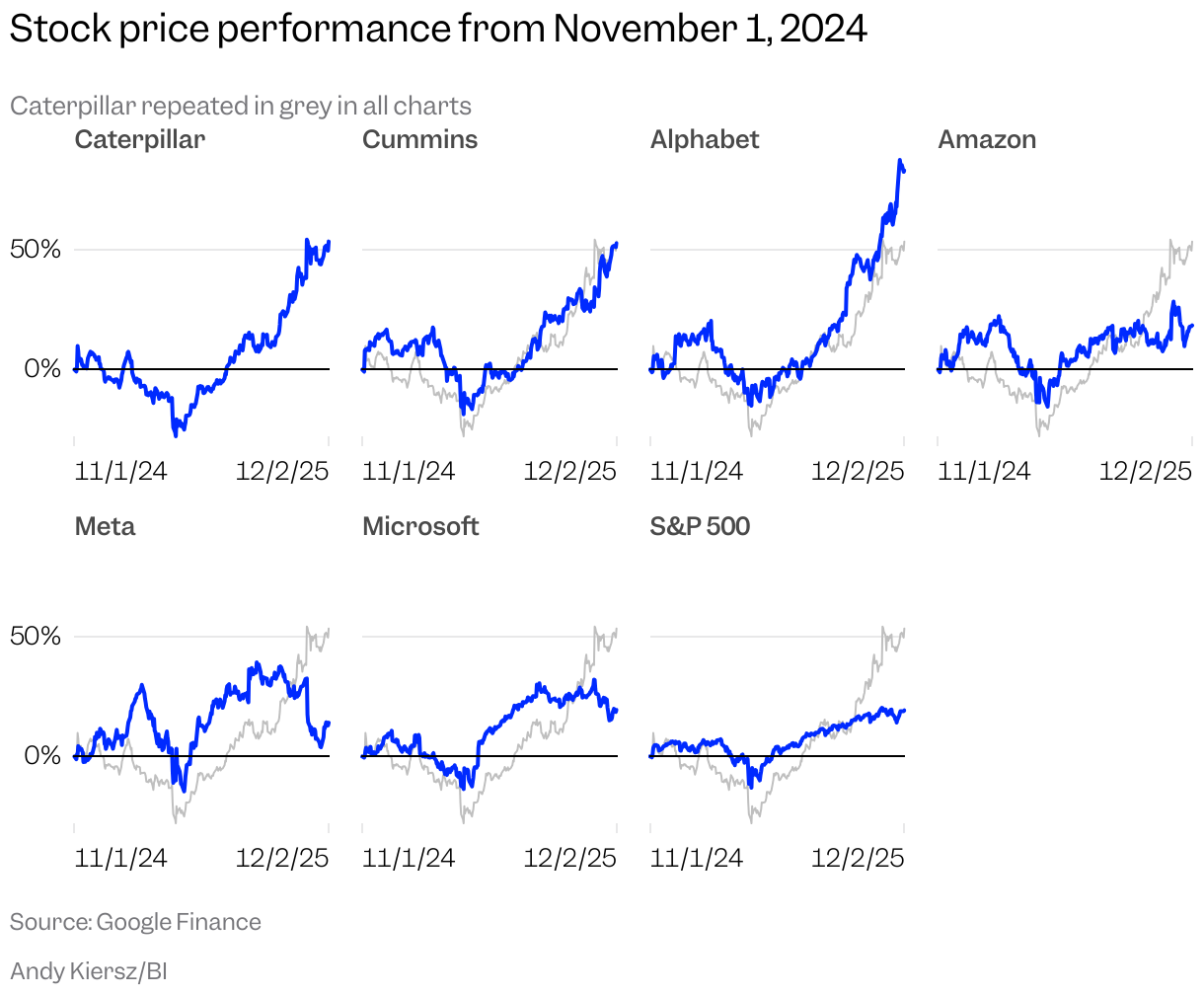
Plenty of non-tech companies have benefited from AI spending, including companies like Primoris and Dycom Industries that lay pipes and fiber that connect data centers to natural gas and the internet. Generator companies are particularly well-positioned: As hyperscalers race to build power-hungry data centers, the demand for backup and off-grid electricity has ballooned.
“Power generation is a business that has never seen this kind of scale, in any way, ever,” Tom Shepherd, a data center executive at Cummins, told Business Insider.
Data centers are a bright spot for industrial businesses
About a decade ago, Shepherd oversaw a $50 million-a-year regional power-generation business in Oklahoma that largely sold Cummins systems to customers like hospitals and wastewater plants. He recalled just one large data center in his territory, run by Google.
“There just wasn’t the scale,” he said.
Today, Google’s parent company, Alphabet, has more than two dozen data centers online or in development across the US. It has revised its planned capex spending for 2025 upwards every quarter, and now estimates that it will spend at least $91 billion by the end of the year. That’s a fraction of the $7 trillion that will be spent on data centers globally by 2030, per McKinsey.
For manufacturing-oriented industrial businesses that have faced threats from tariffs, rising expenses, and persistently high interest rates, data center demand is a welcome bright spot. Business Insider previously used diesel generator air permits to estimate data center growth and found that if all permitted data centers went online, their electricity use could be as much as the entire state of Florida.
Sales of Cummins’ signature truck engines have slipped over the past year, but the company sold $2.6 billion of power-generation equipment to the data-center industry last year and expects that number to grow by 30 to 35% this year, CEO Jennifer Rumsey said on a conference call last month.
The power-generation segment of Caterpillar — often shortened to Cat — grew from 8.4% of its total sales in 2021 to more than 14% of its sales in the first nine months of this year. And Rolls-Royce’s power-systems unit reported record revenue in February, driven partly by 46% annual growth in data-center sales.
Their stock prices have also soared. Both hit all-time highs this week; Cat closed above $590 a share on Wednesday, topping the previous high set after beating earnings in October, and Cummins shares crossed $507 on Wednesday.
Analysts are generally bullish. According to information tracked by the companies, over the past year, the percentage of analysts who think investors should buy Cat’s stock has grown from 41% to 54%; for Cummins, the share has gone from one-third to half.
Some analysts have sounded alarms, but the companies aren’t worried
Some indicators suggest the market took the picks-and-shovels trade too far. In October, Morgan Stanley estimated that Cat’s power-generation arm was valued by investors at 60-to-100 times its operating income. At Nvidia, the same multiple was 25 times; at GE Verova, another electrical-equipment business, the multiple was 28 times.
Melissa Busen, who runs the electrical power division at Cat, says she’s not worried. The company’s $39.8 billion order backlog is almost triple what it was five years ago, and Busen said the largest customers are making plans for years down the road.
Caterpillar
If one of them has hardships, she said, another will take its place. She noted that Cat has been supplying the data-center industry since the early 1990s and has “been able to build true partnerships” with the new crop of hyperscalers.
Cat broke ground last year on a $725 million expansion of its engine factory in Lafayette, Indiana, where it currently employs 1,900 people. The expansion will more than double the company’s output of the engines that data-center developers are demanding, and is set to come online in 2027. Expansions are also underway at Rolls-Royce plants that build data-center generator parts in South Carolina and Minnesota.
Data center construction in Asia and Europe is also a component of demand, and many generators are manufactured outside the US. Cummins said earlier this year that it planned to invest $200 million across its power-generation manufacturing sites in India, England, and the US. The company plans to double the production capacity of the giant, 95-liter engines that drive data-center generators.
The money isn’t just in backup generators that sit idle most of the time, either. In the race for power, utilities aren’t able to connect companies to the electric grid fast enough. Increasingly, Cat and Cummins have been called on by Microsoft, Amazon, hyperscalers like Coreweave, and regional players like Joule for natural gas-burning generators and turbines that can run 24/7 for months or even years.
Cat’s Busen said customers don’t just want to talk about engines and turbines — they want to talk about “a complete, integrated solution” to their electrical needs, including things like batteries, inverters, and control systems.
The biggest limiting factor for now, said Shepherd, is “the physical ability of our society to build this kind of infrastructure.”
Have a tip? Know more? Reach Jack Newsham via email (jnewsham@businessinsider.com) or via Signal (+1-314-971-1627). Use a personal email address, a nonwork device, and nonwork WiFi; here’s our guide to sharing information securely.
Read the original article on Business Insider