UPS delivery person with loaded hand truck on sidewalk in Manhattan, New York.
Lindsey Nicholson/UCG/Universal Images Group via Getty Images
Morgan Stanley predicts AI shopping agents will add $115 billion in US e-commerce by 2030.
Nearly half of US online shoppers are expected to use AI-powered agents by 2030.
Retailers like Amazon and Walmart have launched AI tools to boost online shopping growth.
AI-powered agents are poised to shake up online shopping. They could also meaningfully expand the US e-commerce market.
Morgan Stanley wrote in a note last week that AI shopping agents will transform the online retail landscape over the next few years, predicting that nearly half of all US e-commerce shoppers will use AI agents by 2030.
These “agentic commerce” tools that can make product recommendations, run price comparisons, and manage orders could add as much as $115 billionto US online spending, the firm wrote in the note.
“We believe agentic commerce — in effect the ability to have a personal digital interactive shopper — is set to be the best next substantial GenAI-enabled unlock,” the note stated. “With greater digitization of consumers’ wallets, agentic could add up to $115 billion to our ’30 e-comm forecast and shake up the e-comm funnel with implications across retailers and digital ad players.”
Morgan Stanley chart on agentic commerce
Morgan Stanley
That bullish outlook underscores why retailers have been scrambling to launch their own AI shopping assistants, including Amazon’s Rufus, Walmart’s Sparky, and Target’s ChatGPT-powered app.
OpenAI deepened ChatGPT’s agentic AI-powered shopping capabilities this week, adding a “shopping research” feature to help users find the best products for their needs. Google has also enhanced its AI shopping tools ahead of the holiday season, debuting an AI assistant that can call local stores on a user’s behalf.
Morgan Stanley wrote in the note that personalized grocery shopping could become a “key unlock” for agentic commerce growth. After groceries, Morgan Stanley predicts household products, personal care, and apparel categories to benefit from AI shopping agents.
Amazon has been an early mover in AI shopping assistants with its Rufus tool. Rufus is expected to indirectly contribute over $700 million in operating profit this year, Business Insider previously reported. Amazon CEO Andy Jassy said in October that Rufus was on pace to drive $10 billion in “incremental annualized sales,” although he pointed out that the customer experience still needs improvement.
“We’re very excited about the long-term prospect of agentic commerce,” Jassy said during an October call with analysts. “The promise is that AI and agentic commerce solutions are going to expand the amount of shopping that happens online.”
Defense tech founders who raised VC funding in 2025
Dirac, Pilgrim, Onebrief
Defense officials are signaling a shift away from traditional contracting and toward startups.
VC funding for the space has hit $19 billion, up from $10 billion last year, per PitchBook.
Business Insider has compiled its coverage of the top defense funding rounds of 2025.
Defense and aerospace startups have already raised more than $19 billion in 2025, according to data firm PitchBook.
This comes as the Pentagon, under Defense Secretary Pete Hegseth, calls for a total overhaul of the military’s acquisition system to “focus on speed and volume,” he said in a speech earlier this month. The military’s push towards faster and cheaper innovation is resonating in Silicon Valley, with investors pouring record amounts of cash into AI-powered weapons, drones, and other defense-focused startups.
The “objective is simple,” Hegseth continued. “Transform the entire acquisition system to operate on a wartime footing.”
Last year, global venture capital investments in defense and aerospace companies totaled over $10 billion. All signs point to this year nearly doubling last: As of late November, global defense and aerospace funding has surpassed $19 billion, per PitchBook.
As if Silicon Valley needed any more reassurance from the military’s top brass of its bet on defense tech, Army Secretary Dan Driscoll recently said the Army aims to work less with traditional defense businesses and procure more weapons from startups.
These proclamations highlight the Trump administration’s push to modernize the Defense Department and its armaments with Silicon Valley’s best and brightest.
The enthusiasm has spurred something of an arms race on the opposite coast. In El Segundo, Calif., where a handful of traditional defense contractors are headquartered, startups are setting up shop in warehouses adorned with American flags and squat racks and racing to build battlefield-ready tech. They’ve constructed FPV drones, used AI to automate factory floors, and sent capsules to space. Last week, an El Segundo-based nuclear startup said it split the atom.
It’s also led to mega rounds and soaring valuations. In February, Saronic, which makes autonomous ships, raised $600 million at a $4 billion valuation led by solo capitalist Elad Gil. Anduril Industries, Palmer Luckey’s autonomous weapons startup, raised $2.5 billion at a $30.5 billion valuation in June; Peter Thiel’s Founders Fund led the round with a $1 billion check. In mid November, Chaos Industries, a startup building radar tech to help militaries detect autonomous threats, raised $510 million led by Valor Equity Partners at a $4.5 billion valuation.
Business Insider has covered a handful of this year’s notable defense tech deals. Here are a few:
The Honolulu-based startup raised a $20 million Series C extension in June, led by Battery Ventures, bringing its total funding to over $120 million and pushing its valuation past $1 billion. That’s an over $400 million increase in valuation since January, when General Catalyst led a $50 million Series C round that valued Onebrief at $650 million.
Former Palantir employees Zachary Long, Eric Schwartz, and Ben Fichter founded Conductor AI in 2023. The startup uses artificial intelligence to help those in large organizations — like the US government — fill out paperwork and effectively resolve compliance issues, and has raised around $15 million for its Series A round led by Lux Capital.
Fil Aronshtein, Dirac’s cofounder and CEO, says BuildOS, the company’s main product, is a software tool that uses AI to generate assembly instructions for manufacturers. The startup raised nearly $11 million from Founders Fund and Coatue Management — and struck a new partnership with industrial manufacturing giant Siemens.
AndrenaM’s rapid fundraise signals just how eager investors are about the new wave of defense tech. The startup, cofounded by Matej Cernosek and Alex Chu, uses AI to analyze sonar data and deliver real-time insights, aiming to give this legacy defense tool a high-tech upgrade.
Jake Adler poured his actual blood into his startup. Adler, the founder of Pilgrim, a biotech and defense startup building medical devices for the battlefield, filmed himself testing his flagship product — a hemostatic dressing he calls Kingsfoil — by cutting open both of his thighs. Following the video, the Redwood, Calif.-based startup raised $4.3 million in seed funding.
JP Morgan and Goldman Sachs reveal plans for London and Birmingham, with sector spared tax rises
Two of Wall Street’s biggest banks have announced major expansions plans in the UK, hours after they were spared increased taxes in Rachel Reeves’s autumn budget.
JP Morgan on Thursday revealed plans to build a 3m sq ft tower in London’s Canary Wharf, which will serve as its new UK headquarters and house more than half of its 23,000 UK staff. It is understood the project will cost £3bn.
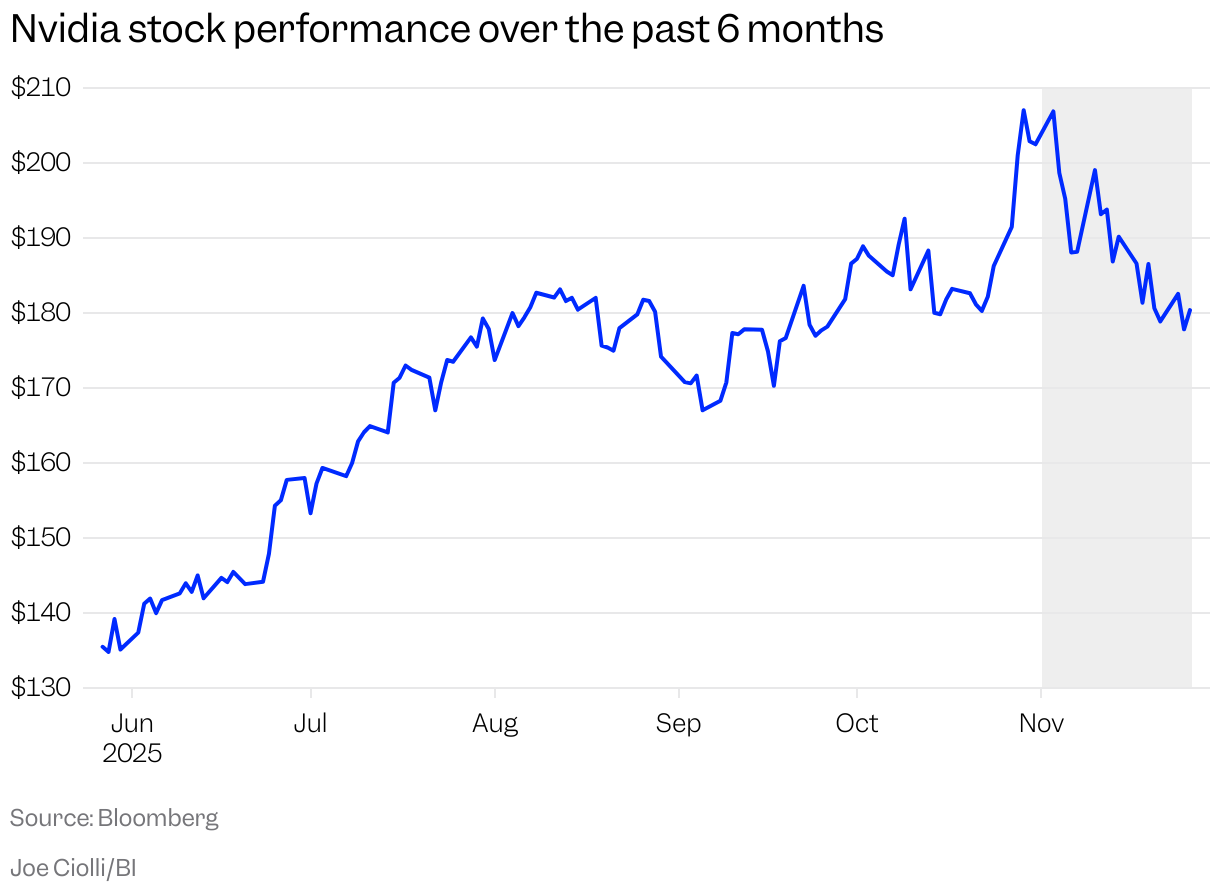
Nvidia looked poised to have a great month on the heels of hitting an all-time high and another blockbuster earnings.
Instead, the AI chipmaker has faced ongoing concerns about a possible AI bubble and increased competition from Google.
News of a potential big Google chip deal sent Nvidia shares tumbling further, though they’ve regained some of the losses.
Nvidia’s sterling armor was dented this month.
After years of meteoric success, the chipmaker and its CEO Jensen Huang have increasingly found themselves playing defense — an unusual position for the company.
Nvidia headed into the month with its stock price at an all-time high, bolstered by increasing AI spending from some of its major Big Tech customers like Meta, Microsoft, and Google.
Huang was hot off of Nvidia’s GTC conference in Washington, where he dismissed any concerns of an AI bubble and sounded jubilant.
But over the course of the month, which saw Nvidia shed 11% of its value, the chipmaker has gone from smashing earnings and alleviating Wall Street’s AI bubble fears to becoming the poster boy of what some analysts view as a company on an unsustainable path.
Nvidia has also had to fend off short-sellers and the growing threat of Google, picking up some bruises along the way.
Big names, including SoftBank and Peter Thiel, cashed out on the Wall Street darling that had became the world’s first $4 trillion market cap company mere months ago. SoftBank announced it fully exited its Nvidia position, selling $5.8 billion in shares to bet on OpenAI. And while its CFO stressed it had “nothing to do with Nvidia itself,” the move didn’t exactly dispel the ongoing AI bubble talk.
Nvidia defiantly pushed back on any investor skittishness when it released its third-quarter earnings on November 19, surpassing analysts’ already lofty expectations — no small feat — at a time when concerns about the AI bubble were once again creeping up.
“There’s been a lot of talk about an AI bubble,” Huang told analysts on a call following the results. “From our vantage point, we see something very different.”
But while shares rallied in after-hours trading following the results, markets did a U-turn the following day as hand-wringing over ballooning tech valuations and spending continued.
Behind closed doors, Huang privately told employees in remarks first reported by Business Insider that “the market did not appreciate” Nvidia’s “incredible” quarter.
Facing sky-high expectations and the position of being a bellwether for the AI industry, Huang described the chipmaker as being in a somewhat no-win situation.
“If we delivered a bad quarter, it is evidence there’s an AI bubble. If we delivered a great quarter, we are fueling the AI bubble,” Huang said during an all-hands meeting.
New pressure from Google
It didn’t take long for things to get a bit choppy for the chipmaker.
Shares of Nvidia fell after The Information reported that Google was engaged in talks with Meta to provide the social network billions worth of the tech giant’s own advanced chips.
While Nvidia’s chips have long been the gold standard in the AI race, a hot commodity used by tech giants and startups to train and run LLMs and chatbots, the news suggested that the chipmaker’s market share might be under threat. With Google now eyeing Nvidia’s lunch, the market digested a possible future where Nvidia may no longer be the star attraction.
Nvidia’s market losses following the news appeared to be Google’s gain, with its parent company Alphabet now positioned to join the $4 trillion club that Nvidia started.
The developments acted as fuel for Michael Burry of “The Big Short” fame, who has become increasingly vocal about voicing his doubts about Nvidia.
Burry, who has a particularly dour view of the AI industry, spent much of the month questioning the longevity of Nvidia’s chips, its stock dilution, and its circular, “give-and-take deals” in AI.
The investor recently leaned into online writing and labeled Nvidia as the Cisco of the AI bubble era in one of his first Substack posts.
“And once again there is a Cisco at the center of it all, with the picks and shovels for all and the expansive vision to go with it,” Burry wrote. “Its name is Nvidia.”
The chipmaker didn’t take the criticism lying down. In a note to Wall Street sell-side analysts, a copy of which was obtained by Business Insider, Nvidia took exception to Burry’s claims, stating that he appeared to have “incorrectly” made some of his calculations.
The memo also pushed back against views that Nvidia is too entangled in circular financial arrangements with some of its customers.
“First, Nvidia’s strategic investments represent a small share of Nvidia’s revenue and an even smaller share of approximately $1T raised each year across global private capital markets,” the memo said, adding, “The companies in Nvidia’s strategic investment portfolio predominantly generate revenue from third-party customers, not from Nvidia.”
Burry called Nvidia’s response “disappointing” and disclosed that he “continues to own puts” on Nvidia.
Nvidia isn’t going anywhere
While November undoubtedly turned up the heat on Nvidia, the chipmaker continues to be the world’s most valuable company by market cap and its shares have slightly rebounded in recent days, closing up 1.37% on Wednesday.
The world’s largest tech companies rely on Nvidia’s chips and have committed to spend billions and billions on the latest generation. CEO Jensen Huang has said sales of its latest Blackwell chips have been “off the charts.”
Nvidia’s CFO, Colette Kress, told analysts earlier this month that the company is on track to bring in “half a trillion” in AI chip orders during the combined 2025-2026 period — a number that she said “will grow” as more deals are struck.
While Nvidia’s bruising back half of the month is a reminder that even AI royalty can see its crown threatened, Huang had some words for the doubters during the company’s earnings call.
“As a reminder, Nvidia is unlike any other accelerator,” he said. “We excel at every phase of AI, from pre-training and post-training to inference.”