
People who have been recognized throughout The Dispatch’s reporting will be celebrated at the Dec. 3 Everyday Kindness Heroes award ceremony.
 Advertising and Donations - advertising-newsandtimes.com
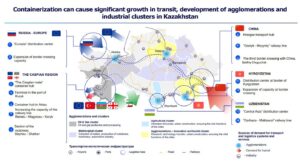
Containerization is rapidly becoming one of the most talked-about topics in Kazakhstan’s logistics sector. Amid surging transit traffic, the question is increasingly raised: why, despite clear potential, is the domestic market still underutilized? What’s holding Kazakhstan back from making containerization a cornerstone of its integration into global trade?
Currently, transport costs account for up to 30% of the final price of goods in Kazakhstan, nearly three times the global average of around 11%. Experts agree that a systemic transition to containerized transport could speed up delivery times, cut logistics costs, and boost the competitiveness of Kazakhstani products. Yet progress remains sluggish.
A Priority Still in Waiting
In September, President Kassym-Jomart Tokayev named the development of containerization as a strategic economic priority. Despite this, containers make up only 7% of domestic freight transport, less than half the global average of over 16%.
Meanwhile, transit volumes are surging. According to Kazakhstan Temir Zholy, the national rail company, container transit grew by 59% last year to 1.4 million twenty-foot equivalent units (TEU). The national target is 2 million TEU by 2030. Yet this growth is bypassing the domestic economy: Kazakhstan remains a transit bridge between China and Europe without yet unlocking containerization for its own industries.
Hidden Resources Still Untapped
Research by Russian consulting company Arthur Consulting suggests that Kazakhstan has the potential to containerize 50-55 million tons of domestic cargo, a volume capable of revitalizing the country’s entire logistics ecosystem.
So why hasn’t it happened? The reasons are well known.
First, infrastructure remains underdeveloped. Modern terminals capable of handling high volumes are lacking. Many transport routes lack essential repair facilities and service centers, meaning containers must often be returned without proper maintenance.
Second, there is a chronic shortage of containers and fitting platforms. This forces businesses to opt for cheaper, less efficient alternatives. Third, current tariffs make container transportation less attractive than road transport or covered railcars. Under such conditions, containerization appears more costly than beneficial. And lastly, there is a widespread lack of expertise. Some industrial players still don’t fully understand how to work with containers, optimize logistics, or implement modern transport solutions.
As a result, a significant portion of cargo is still transported the “old-fashioned way”, in covered railcars. This increases costs, extends delivery times, and limits access to multimodal transport routes.
Speaking at the New Silk Way transport and logistics forum, held in Almaty in September, Arthur Consulting partner Boris Poretsky described the sector as being “stifled” by systemic barriers. He emphasized the need for industrial companies to re-evaluate their logistics strategies. While nearly any cargo from bulk materials and liquids to heavy machinery can now be containerized, many exporters and consignees have yet to capitalize on the benefits.
Containers allow for door-to-door delivery without transshipment, reduce loading and unloading times, improve cargo safety, and offer maximum flexibility, whether by sea, rail, road, or even air.
@Dauren Moldakhmetov
A Global Shift
Worldwide, industries are rapidly adopting containerized logistics. The benefits are significant: 10-15% cost savings, reduced handling, greater cargo security, fewer supply chain disruptions, ESG compliance, and more efficient locomotive usage.
With urban growth, agglomeration, and the rise of e-commerce, demand for fast, reliable delivery is increasing. Containers are becoming the global standard.
Experts argue that containerization is no longer just a logistics tool. It is the infrastructural backbone of the modern economy.
Building a New Logistics Culture
Experts agree: Kazakhstan needs solutions from both the top down and the bottom up.
At the state level:
At the industry level:
At the business level:
If these steps are implemented in parallel, Kazakhstan could not only boost transit volumes but also establish a domestic containerized logistics economy that benefits shippers, exporters, and consumers alike.
Containerization isn’t just about packaging, it’s about speeding up trade. It makes Kazakhstani goods faster, cheaper, and more competitive in global markets.
In short, any serious discussion about economic modernization in Kazakhstan must include containers. They are a simple yet transformative tool capable of reshaping entire industries.
Late singer’s personal effects up for sale including a trunk gifted to her by Carrie Fisher, and artworks by Anita Pallenberg and Marlene Dumas
Diaries and a gift from actor Carrie Fisher are among the personal items from Marianne Faithfull that are going up for auction in London.
The musician died in January aged 78, leaving behind a cache of fascinating portraits, photographs and ephemera from a glamorous, sometimes troubled life. “Each piece tells a story and reflects her spirit and inimitable taste,” her son Nicholas Dunbar said. “It is time now for these belongings to find new homes and I hope that they will bring as much joy to their new owners as they did Marianne.”
Lord Dannatt and Lord Evans of Watford were filmed breaking rules in undercover footage recorded by Guardian
Two long-serving peers are to be suspended from the House of Lords after a parliamentary watchdog ruled that they had broken lobbying rules.
Richard Dannatt, the former head of the British army, and David Evans (Lord Evans of Watford), were filmed breaking the rules in undercover footage recorded by the Guardian.
PAU BARRENA/AFP via Getty Images
PwC wants to hire more tech talent. There’s just one problem — it can’t find them.
“Across the PwC network, we are looking for hundreds and hundreds of engineers. We just cannot find them,” Mohamed Kande, global chairman of PwC, told the BBC in an interview.
Traditionally, professional services firms have prioritized generalist, critical thinkers, and strong communicators. Now, technologists are in high demand, and top firms have been racing to bolster their ranks with tech talent through a mix of hiring and upskilling.
Accenture’s latest annual report shows it added nearly 40,000 AI and data professionals in the last two years. They now account for roughly 10% of its global head count. EY has made an even bigger push, adding 61,000 technologists since 2023.
The new demand for tech capabilities is tied to the changing nature of the work that top consulting firms offer their clients.
McKinsey recently told Business Insider that delivering straight strategy advice — the type of work typically associated with consultants — now only accounts for around 20% of the company’s work. Instead, McKinsey is offering more “deep implementation expertise” and multi-year transformation projects.
Kande told the BBC that advising clients on how to implement AI will be at the heart of PwC’s future business strategy.
PwC did not immediately respond to a request for comment from Business Insider.
Leon Neal/Getty Images
Kande said he didn’t know if PwC would continue hiring graduates at the same rate. “It will be a different set of people. But we are going to make sure we have the right skillset for the right jobs,” he told the BBC.
In August, Business Insider obtained part of an internal presentation showing that PwC US planned to cut graduate hiring by a third over the next three years.
A bullet point on the presentation slide said leadership’s decision to slow down associate-level hiring related to “transformation efforts, the impact of AI, and further AC integration” — with AC integration referring to PwC’s acceleration centers, its name for its offshoring hubs.
The firm told Business Insider at the time that the “rapid pace of technological change” was reshaping its operations, and that it was being “prudent” in response to “historically low levels of attrition.”
PwC UK has also reduced its entry-level recruitment in the UK this year, lowering the intake by 200 compared to last year. Marco Amitrano, the UK head, credited the decline in junior hiring to the impact of AI and a sluggish economy.
In 2021, then under the leadership of Bob Mortiz, PwC announced a plan to recruit 100,000 people by the middle of 2026. The firm is roughly 40,000 employees away from hitting that target, according to its latest head count released in October.
“The world looked very different” when those plans were made, Kande told the BBC, adding that meeting the goal was no longer possible
Have a tip? Contact this reporter via email at pthompson@businessinsider.com or Signal at Polly_Thompson.89. Use a personal email address, a nonwork WiFi network, and a nonwork device; here’s our guide to sharing information securely.