My trip to the Meta Lab pop-up included a Meta Ray-Ban Meta Display demo.
Henry Chandonnet/Business Insider
I visited the New York Meta Lab pop-up. It got me excited for the future of Meta’s in-person retail.
The pop-up was artfully designed and loaded with different use cases for the company’s AI glasses, which you can demo.
Meta staff dwarfed the number of customers, but it may have been a quiet period at 11:30 a.m. on a weekday.
For years, Meta has built its businesses online. Now, it’s also expanding to brick-and-mortar — including a new two-story location in NYC that I visited this week.
As it continues to launch new gadgets, including its popular Ray-Ban and Oakley AI glasses and VR headsets, Meta is accelerating its in-person pop-ups. In 2022, Meta opened its store in Burlingame, California, near the company’s Reality Labs campus. Pop-ups expanded to Los Angeles in 2024 and Las Vegas in October 2025. The recently opened pop-up in New York is smack in the middle of 5th Avenue’s shopping hub.
In-person retail could send new customers to Reality Labs products. Meta’s AI glasses and VR headsets have been available at major retailers for some time, but the Meta Labs pop-ups are the company’s first stand-alone glasses stores.
Are these pop-ups the future of Meta’s retail presence? I visited the New York location to find out.
Meta Lab was in the luxury shopping district on 5th Avenue.
Henry Chandonnet/Business Insider
Meta Lab is a small, blue building on Fifth Ave. The pop-up is around the corner from the St. Regis hotel, and two blocks from the Louis Vuitton flagship. Next door is the jewelry boutique Harry Winston.
The area is ripe for foot traffic.
The pop-up “highlights and fosters community.”
Henry Chandonnet/Business Insider
On the door, Meta Lab gives its mission statement. The four paragraphs were also at the base of the elevator bank inside.
“We endeavor to set the standard for conceptual retail in tech by celebrating customization and self-expression,” it read. “We hope the experiences will continue to delight and bring you back time and time again.”
The walls were lined with AI glasses from collaborations with both Oakley and Ray-Ban. These glasses were available for purchase, while the Meta Ray-Ban Displays required an appointment to buy.
One of Meta’s retail innovations: ping pong paddle mirrors.
Henry Chandonnet/Business Insider
There were mirrors all around the Meta Lab, and I caught more than one customer taking a mirror selfie. They were also used for glasses demos (say: “Hey Meta, take a picture”).
On the glasses counters, Meta replaced the traditional rubber on a ping pong paddle with a mirror for handheld use.
The pop-up’s design was skate-themed.
Henry Chandonnet/Business Insider
After exploring the wall of glasses, I turned to the other side, which was filled with skateboard-themed art. The collection was made in collaboration with Zoo York. It offered viewers an opportunity to “travel through the timeline of New York skate culture,” per a sign.
Around this time, I noticed how quiet the Meta Lab was. At 11:30 a.m. on a Wednesday, it likely wasn’t peak hours. However, on this base floor, there seemed to be twice as many staff members as customers.
A Meta representative wrote over email that “foot traffic numbers have exceeded expectations across all stores.”
Time for a demo!
Henry Chandonnet/Business Insider
The Meta Lab is built for AI glasses demos. There are signs scattered around the shop suggesting prompts to ask your glasses. Naturally, I signed up.
A trusty Meta Lab employee pulled me aside and started with my first demo: the second-generation Meta Ray-Bans.
“Hey Meta, take a picture.”
Henry Chandonnet/Business Insider
My Meta Lab guide walked me through all of the features. He showed me how to play music, how to ask Meta AI for information, or how to take a picture. Thus, this mirror selfie.
He also showed me how the Ray-Bans have transition lenses based on the time of day and brightness. Using a flashlight, he darkened one of the lenses. That, dear reader, is why it looks like I’m wearing an eyepatch.
My second demo: The higher-tech Meta Ray-Ban Display
Henry Chandonnet/Business Insider
Going upstairs, I asked to demo the Meta Ray-Ban Display, which, as their name suggests, includes an integrated screen in the glasses lens. (I was still jealous of my colleague, Peter Kafka, who got to try them out in September.) My Meta Lab guide sized a “neural band” for me and walked me through its features.
The glasses are controlled through a series of small hand motions. Users tap their index finger to select, or their middle finger to go back. To swipe, they move their thumb back and forth on their index finger, similar to a joystick.
It took some time to get used to. Eventually, I felt like a pro.
The Maps feature seemed helpful, as did the search function. The quality of the live transcription was more varied. But, above all, I was awed by the tech. The integrated screen was discreet, and I could see future use cases. Yes, I would love to watch Netflix on the subway without having to look down at my phone. Meta just needs to get there.
One fun moment: Walking me through the search functions, my Meta Lab guide asked me to pick a question of my own. I asked, “Who is the CEO of Meta?” The Displays brought up an older pick of Mark Zuckerberg, before he became the broccoli-haired Buff Zuck. I told my guide; he laughed.
Am I going to pay $799 for a pair of Displays? No. The tech is a bit too early for me, and I’m not sure the screen justifies itself just yet. (I’m more likely to buy the simpler AI Ray-Bans; I liked the music and photo options.) However, it was a promising sign of what’s to come in wearable technology.
Let’s tour the upstairs!
Henry Chandonnet/Business Insider
Having finished both of my demos, it was time to tour the upstairs of the pop-up.
First up: the custom engraving bar. With printers in the back, customers could request custom cases for their glasses or get the New York-only specialty case.
Next to it was a café area, where customers could request coffee from Buddies in Williamsburg or massive black-and-white cookies.
This is also when I started realizing how much money Meta likely spent. From multiple art collections to food and case engravings — let alone the prime New York real estate — Meta spared no expense.
Spotted: the Meta Quest headsets.
Henry Chandonnet/Business Insider
The Meta Lab was almost entirely devoted to AI glasses. They covered the walls, both upstairs and downstairs, and the art was designed for use with the glasses.
But, tucked into a nook near the register, customers could find another Meta hardware bet: Meta Quest VR headsets.
Some of the glasses were hooked up to demo tablets.
Henry Chandonnet/Business Insider
In many ways, the Meta Lab felt like a hybrid of an Apple Store and a Sunglass Hut. Some of the glasses were connected to tablets for a demonstration, which was helpful when human Meta workers weren’t available to assist.
Except, Meta employees were everywhere. With only a few customers browsing the pop-up, many staffers were chatting among themselves. There was even a Meta elevator attendant whose job was to press 1 or 2.
It’s possible the Meta Lab was more overstaffed than under-trafficked.
One Meta AI use: creating custom stickers.
Henry Chandonnet/Business Insider
Part of the Meta Lab’s goal is to show customers new and exciting use cases for the company’s AI, beyond generating recipes and email drafts.
Using Meta AI’s image generator, the “Sticker Slam” offers customers the chance to create their own AI-generated images. I asked for my dog, Charlotte, with angel wings and a tiara. The machine nailed it.
Evan Mock designed much of the top floor.
Henry Chandonnet/Business Insider
Keeping with the skate theme, actor and skateboarder Evan Mock designed much of the top floor. The colors were all neon, and there were name plates plastered around a map of New York with Mock’s memorable spots.
The display featured some print magazines in which Mock was featured on the cover. This wasn’t the Lab’s first reference to magazines. Downstairs, one of the Meta AI prompts asked the glasses where to buy skateboarding magazines.
I spotted a copy of V Magazine, one of my first jobs in journalism. Print media isn’t dead!
Leaving the Lab, I felt hopeful for Meta’s hardware effort.
Henry Chandonnet/Business Insider
I prepared to leave the Lab, but not before marveling at the subtle Meta logo carved into the pop-up’s high wooden arch.
It led me to wonder: Could part of the Lab’s relative slowness during my visit have to do with the pop-up’s “Meta Lab” branding? American shoppers could certainly recognize the company’s mega-popular products, such as the classic blue Facebook logo or the rainbow Instagram camera. But how many could point out the Meta logo?
Indeed, the name Meta itself is still relatively fresh, dating back to 2021. Maybe a “Facebook Lab” would drive more foot traffic.
Regardless, the Meta Lab left me excited. The demos were thrilling, and the design was inventive. Meta seems happy with it, too. The Meta representative told me that the pop-up will be open for the “next few months,” but that they are hoping to make it “a more permanent location.”
Long before guests found themselves abruptly kicked out of their “Sonder by Marriott” stays this month, Sonder, the Airbnb rival, was battling sloppy accounting, a litany of lawsuits, and a stock price so low it was nearly delisted from the Nasdaq.
Bankruptcy filings and SEC records show just how stark the signs were — and raise questions about why Marriott, the world’s biggest hotel chain, got into bed with the one-time unicorn.
The San Francisco startup, founded in 2014, leased apartments and hotel rooms in bulk, redesigned them with a minimalist aesthetic, and rented them to travelers. It’s the brainchild of Canadian Francis Davidson, who is the ideal of a 2010s founder: VC-backed, college dropout, Forbes 30 Under 30. He offered a “revolutionary” promise: Goodbye, poorly decorated Airbnbs with quirky hosts. Hello, streamlined rentals managed with modern technology.
In August 2024, he unveiled his pièce de résistance: a deal between Sonder and blue-chip Marriott, which was heralded as a way to bring that vision into the future.
“Making this deal happen — along with the multi-party, complex capital raise I orchestrated — was the hardest thing I’ve ever done,” former CEO Davidson wrote in June.
At the time, analysts lauded the deal, noting that it would add 9,000 rooms to Marriott’s portfolio — a key figure for the hotel giant’s valuation. Sonder said after the deal closed it would reduce costs by as much as $50 million.
Looking back, the Marriott deal was maybe less of a legitimization and more of a Hail Mary. Since going public at a $2 billion valuation in 2021, Sonder had faced layoffs, lawsuits, and a slew of executive departures, including Davidson.
“Marriott, no lie, they saved the company last year with their agreement,” Logan Ford, who worked in sales at Sonder before being laid off last week, told Business Insider.
The $76 billion hotel giant didn’t come to Sonder’s rescue again. In court filings for Sonder’s bankruptcy case, Marriott said that after it helped cover about $1.5 million in payroll, Sonder pressed the company for as much as $50 million to pay for shutdown operations. Marriott declined, and shortly afterward, signs appeared on the doors of Sonder properties telling guests to vacate.
Thousands of customers were suddenly left with no place to sleep.
Now, some in the industry are questioning how Marriott missed the warning signs. “I don’t know how anyone with any iota of business sense could have thought that this was a good idea,” said Alan Reay, president of Atlas Hospitality Group, a California brokerage firm that tracks hotel ownership and financing trends.
“The Marriott partnership is what essentially kept the company afloat for the next year,” Ford said — and when it ended, there was nothing left.
A unicorn that survived the pandemic
At the height of COVID-19, Sonder laid off a third of its staff and had been sued for allegedly bailing on leases, a claim that Sonder denied and for which litigation is ongoing.
In 2021, the company, which gained unicorn status two years earlier, announced it was going public via a SPAC at a $2.2 billion valuation. SPACs — or special purpose acquisition companies — offered what many startups saw as a quicker, less scrutinized path to going public than a traditional IPO.
Sonder had survived while competitors like Lyric folded, and was now on its way to becoming an “iconic 21st-century brand,” then-CEO Davidson told Business Insider at the time.
“This kind of financial discipline, with a really rapid response to the pandemic, has meant that we’ve been able to outperform a lot of the competition and be in a relatively strong position,” Davidson said.
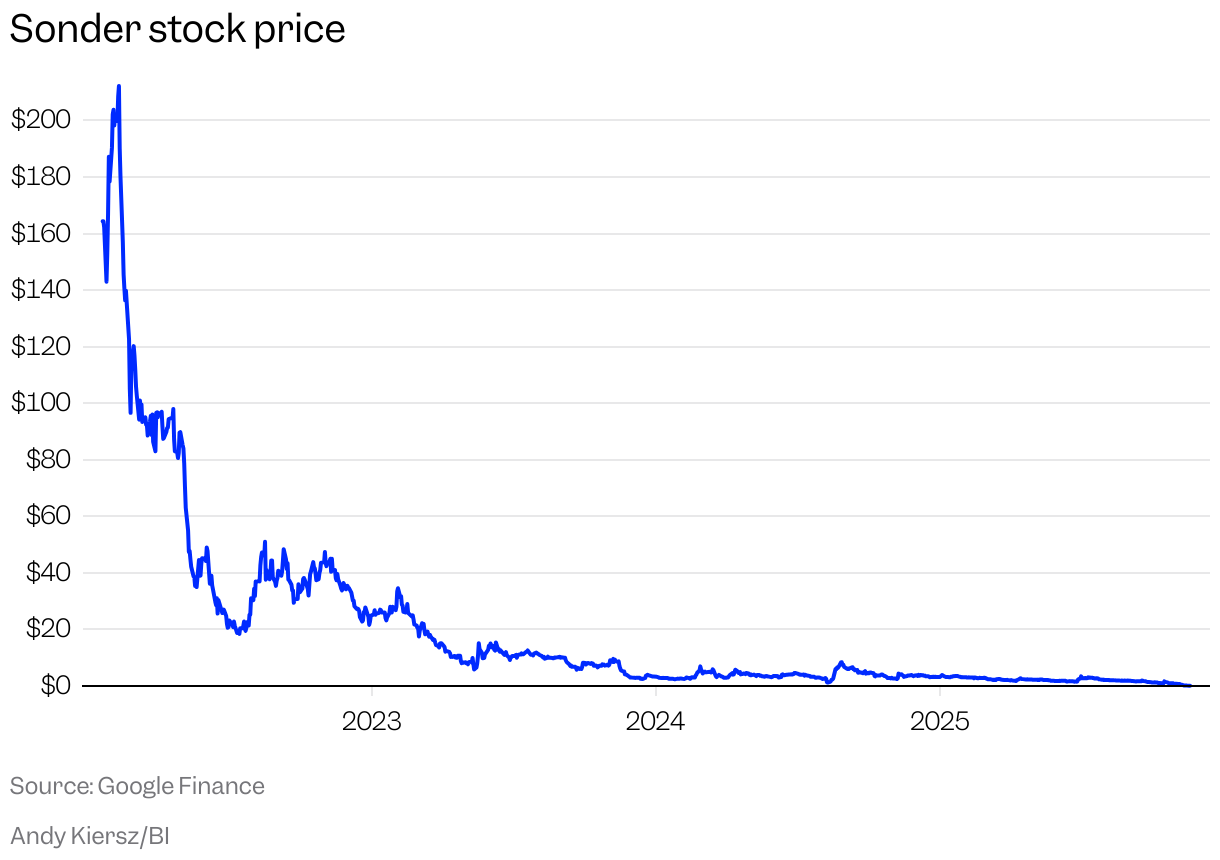
Its public market debut was lackluster. On its first day of trading, Sonder’s stock dipped 8%.
Its downward spiral continued. Shares traded under $1 for much of the following year, leading the Nasdaq to threaten a delisting.
There was another round of layoffs — this time 17% — in 2024, and Sonder was hit with lawsuits accusing it of not paying rent or properly managing its buildings.
One New Orleans hotel that Sonder managed, the 100-year-old Jung Hotel, alleged that the startup had tarnished its reputation. There wasn’t enough security, which led the hotel to become a “magnet for violent crime” and a “warzone,” the landlord said in the lawsuit. The hotel was also not properly cleaned, with toenails in the bed sheets and blood on the linens, the complaint said.
Sonder disputed the claims, and the lawsuit was settled, as was a 2022 lawsuit Sonder filed against the Jung Hotel’s owner at the time.
“SCAM- NOT AN OPERATING HOTEL,” one online review read, according to the Jung Hotel’s 2023 complaint. “Just another short term rental place poorly taken over by Sonder. You’ve been warned.”
A hotel in San Francisco sued, saying Sonder wasn’t paying its rent and owed more than $1.2 million as agreed upon in a lease termination agreement. Sonder denied the claims, and the lawsuit was settled.
The company’s accounting also had problems. In 2024, Sonder revealed in an SEC filing that its financial records since its debut as a publicly traded company could not be trusted after being reviewed by an auditor.
The stock fell 38%, and Sonder said in filings that it was asking lenders not to call in loans or otherwise punish the company for the errors.
Despite that, Marriott took a chance. Six months after its announcement of two years of unreliable financial reporting, Sonder announced its deal with Marriott. All of Sonder’s properties would now fall under the “Sonder by Marriott Bonvoy” branding.
“When we did the deal back in August 2024, everyone around the table was aligned that plugging into Marriott’s distribution should increase revenues for Sonder,” Davidson told Business Insider this week. “The fact that in the end there was seemingly a decline comes as a great surprise, I think, for all parties involved.”
Sonder declined to comment on the record.
Sonder’s rooms allowed Marriott to boost its “net unit growth,” or the number of rooms it can rent, a key metric followed closely by investors and Wall Street analysts. The Sonder deal allowed it to add 9,000 units to its portfolio, it said when it announced the deal.
For Sonder, it provided desperately needed cash. Marriott would pay Sonder $15 million in “key money” as part of the deal.
Some in the hotel industry said they were surprised at the deal. Reay of Atlas Hospitality Group said it “absolutely made no sense.”
“Whoever did the due diligence, whoever did the underwriting on this, if they’re still at Marriott, I’d be surprised,” he said, comparing Sonder to a WeWork-style implosion waiting to happen.
Robert Rauch, a hotel consultant and Marriott franchisee, said the company’s confidence in its own brand perhaps clouded its judgment. He called Marriott “a great company” that is “vertically integrated better than any company I’ve seen,” but said its deal with Sonder was “a bad risk.”
A Marriott spokesperson declined to comment.
Multiple people with familiar with Sonder’s said the Marriott deal sustained the company.
“The Marriott agreement a year ago is actually what kept us from bankruptcy,” Ford, the sales employee, said.
Even still, Sonder was in a precarious position.
“Management has concluded that there is substantial doubt, which is not alleviated, about the Company’s ability to continue as a going concern for at least one year,” it wrote in a November 2024 filing. One year after the filing, Sonder was out of business.
A sign announcing the closure of a Sonder property in New York City.
Steve Russolillo/Business Insider
Final days of Sonder
By this November, Sonder was drowning in debt, nearly out of cash, and out of options, according to legal filings.
Sonder had been negotiating for emergency financing and a potential buyer to take over its assets in bankruptcy, but the bidder abruptly pulled out on November 2, the filings said.
Three days later, Marriott agreed to provide Sonder with about $1.5 million in funding to cover one week of US payroll, the hotel chain said in filings in Sonder’s bankruptcy case, calling it a short-term move to help keep thousands of guests housed.
The “ink was barely dry” when Sonder, on November 6, sent Marriott a $50 million proposal for Marriott to cover the costs of winding down Sonder, according to bankruptcy filings. The hotel giant said it rejected that plan, along with two other revised proposals for $28 million and $14 million.
Marriott accused Sonder of trying to “leverage guest safety as a bargaining chip” in order to get money out of it.
Sonder threatened that “unless Marriott financed its wind-down, it would shut down hotel systems and leave thousands of guests locked out of their rooms mid-stay,” Marriott alleged in bankruptcy papers.
On November 7, Marriott terminated its 20-year license agreement after Sonder told Marriott it faced an “imminent free-fall liquidation.” Marriott said in court filings that this allowed it to take over guest support and begin rebooking travelers.
The move left guests scrambling, forcing many to leave their stays with little warning.
Marriott said Sonder notified customers that it would no longer honor their reservations and advised them to contact Marriott regardless of whether they had booked stays outside Marriott’s platforms. Sonder, which reported having over 1,400 employees at the end of 2024, also laid off all staff the same day without severance.
On November 10, Sonder announced its Chapter 7 bankruptcy plans.
In its press statement, Sonder blamed financial strain, technical problems integrating with Marriott’s booking systems, and a sharp drop in bookings from Marriott’s Bonvoy program. Marriott, in turn, said the collapse stemmed from Sonder’s own mismanagement.
“Sonder collected tens of millions of dollars in advance payments for reservations it now admits it will never honor, spent weeks on a failed restructuring without any contingency plan, and failed to reserve sufficient liquidity to support an orderly wind-down,” Marriott said in a bankruptcy filing.
The company, Marriott claimed, used guests’ advance payments and deposits to bankroll its own operating expenses.
“It’s important to understand, and I think it’s important for the public to understand, that there was a license agreement, and, quite frankly, nothing more between Marriott and Sonder,” an attorney for Marriott told a Delaware bankruptcy judge this week.
Sonder managed and operated its thousands of apartment-style and boutique hotel short-term rental units around the globe — not Marriott, the lawyer emphasized.
For Marriott, the end of the deal was a black eye as news stories and social media were flooded with stories of travellers left without options and being given conflicting advice.