Disney and YouTube are nearly a week into a dispute about how much the media giant’s networks are worth. The Mouse House says the Google-owned TV service isn’t properly valuing its channels, while YouTube blames Disney for pushing rates it warns will lead to further price hikes.
Though carriage fights like this usually get resolved quickly, since they’re costly for both sides and frustrating for customers, history shows they can last for weeks — and, in rare cases, even years.
The longest blackout in modern TV history was a war between HBO and Dish that kept the premium cable channel sidelined for nearly three years, from November 2018 until July 2021.
“If it’s a month long, certainly, that’s a bigger deal,” said Alan Wolk, the cofounder of media research firm TVREV. He thinks there’s a chance that this Disney-YouTube TV staring contest could last weeks.
This is the third consecutive year that Disney’s networks have been off the air for an extended period on a major provider. Previously, the company’s channels were blacked out for nearly two weeks, in a 11-day dispute with Charter in 2023 and a 13-day standoff with DirecTV in 2024. It also had a blackout with Dish Network in 2022 that lasted just a few days.
Google’s YouTube TV has also engaged in hard-fought negotiations with Fox and NBCUniversal in the last few months. Unlike with Disney, however, YouTube TV reached short-term deal extensions that prevented its subscribers from losing their channels during negotiations.
This is only the second time since YouTube TV’s launch in 2017 that it’s been without a major media company’s channels. In December 2021, Disney and YouTube TV had a short stalemate that lasted less than three days, which is half the time of their current squabble.
However, Google’s live TV service has gone years without including specialty channels like the MLB Network, or offering regional sports networks like YES and SNY in New York or Monumental Sports Network in the Washington, DC, TV market.
Although industry analysts generally expect the showdown between Disney and YouTube TV to be resolved soon, each side has some leverage during this blackout.
The Mouse House controls competing pay-TV services Hulu + Live TV and Fubo, which have seen an uptick in demand since the blackout. It also allows sports fans to subscribe to the ESPN app directly, sidestepping services like YouTube TV.
YouTube TV may lose subscribers during this dispute, but it’s backed by tech giant Google, whose business won’t be materially affected by what happens here.
The showdown is “indicative of YouTube TV wielding increased bargaining power,” said analyst Ric Prentiss of Raymond James in a note. At $3.4 trillion, Google parent Alphabet is roughly 17 times the size of Disney.
Sports fans have been furious about the standoff keeping them from college football games, “Monday Night Football,” and NBA matchups with teams like the New York Knicks and Los Angeles Lakers.
If the two sides can’t agree to terms by this weekend, when another slate of college football kicks off, it could provoke a fresh round of anger.
Anti-Trump activists are deploying an array of tactics to fight back against the policies of the President and his Administration — protests, marches, events, advocacy campaigns, social media videos. But success requires thinking broadly, and the history of the civil rights movement suggests that there is one uncommon realm for activism which could provide them with a boost: the kitchen.
[time-brightcove not-tgx=”true”]
In 1955, civil rights activist and cook Georgia Gilmore (1920-1990) took to her kitchen after Dr. Martin Luther King Jr. and the Montgomery Improvement Association (MIA) launched the Montgomery Bus Boycott. An active member of the local National Association for the Advancement of Colored People (NAACP) chapter and well-known for cooking and selling food to raise funds for her church, the boycott presented Gilmore with the opportunity to amplify her talents. For 381 days, she transformed her simple home kitchen on Dericote Street in the cradle of the Confederacy into a battle post for the boycott.
Her weapons: fried chicken, sweet potato pies, pound cakes, fried fish, stewed collard greens, and stuffed pork chops. On the surface, this sounds like a menu of soul food delicacies. But in the hands of Gilmore, and a covert network of Black women cooks she called the “Club from Nowhere,” these foods reconfigured the landscape of public transportation in America, opening up a pathway for all Americans to ride buses.
Gilmore was born in 1920 on a small farm in Montgomery County, Ala. She grew up raising hogs and slaughtering chickens for food. Like many Black women in the rural Jim Crow South, Gilmore watched her mother and other women in her community convert these provisions into fried chicken, pork chops, and other staples. Their kitchens served as a network of classrooms in which Gilmore received culinary training in southern cuisine.
By the 1950s, cooking offered Gilmore one of the few professional opportunities available to Black women in the South, and she had become the top cook at the popular, whites-only National Lunch Company in downtown Montgomery.
In December 1955, however, everything changed for Gilmore. Police arrested seamstress Rosa Parks after she refused to move to the back of a bus for a white passenger, sparking the formation of the MIA and its boycott. Parks’ arrest deeply resonated with Gilmore.
Three months earlier, a white bus driver had verbally harassed her. After taking her fare, the driver called her a racial slur, and forced her to enter the back of the bus — only to then speed off before she could get on. From that moment on, Gilmore boycotted the city’s buses. Parks’ arrest, however, compelled her to want to do more.
Inspired by King’s call for Black people to use their skills to support the boycott, Gilmore did what she knew best: cook.
But she didn’t cook alone. Gilmore organized other Black women cooks and enlisted them to join the Club from Nowhere to sell plates and help fund the protest. She coordinated the delivery of the plates to MIA meetings, beauty shops, doctors’ offices, and even cab stands, dispatching her team to secure purchases in support of what would become the longest protest in the history of the civil rights movement.
Stationed in her kitchen, using her stove as a platform, Gilmore practiced what I call emancipatory food power, which was a means for Black people to weaponize food at times of social unrest as a way to protect themselves from oppression. With each pot, cast iron skillet, and cooking utensil, Gilmore exemplified this longstanding tradition in Black life, negotiating her identity in America and resisting the ills of racial segregation that pervaded nearly every aspect of her community.
Gilmore decided to fight racism in the place where she felt most comfortable—and where she felt like she could make the most difference as a Black woman in America—her kitchen. The room became her command center, empowering Gilmore to carve out her own space to think, organize, and act. Others marched and protested in support of the boycott, engaging in high-risk forms of activism that could cost them their jobs. While Gilmore’s activism from her kitchen involved less risk, it still changed the course of the civil rights movement.
As national headlines rightfully celebrated Parks’ courage and the charismatic leadership of King in fomenting and sustaining the boycott, Gilmore continued to cook in quiet obscurity. That was until she testified in court in March 1956 in support of King, who was facing charges for unlawful conspiracy in relation to the boycott.
Gilmore’s testimony shifted the tone of the court hearing, placing a target on her back. Vividly describing her encounter with the bus driver in October 1955, Gilmore called city bus drivers the “meanest, nastiest” people in the world. “I decided then and there not to ever ride a bus again,” she concluded. The next day, a photo of Gilmore between King’s attorneys appeared in the Pittsburgh Courier with the caption: “Trial Figures—…One of their key witnesses, Mrs. Georgia Theresa Gilmore, who gave a vivid description of her ‘unpleasant’ experiences with a bus driver.”
Entering the public eye cost Gilmore her job. The National Lunch Company terminated her employment — which was a common practice used by the white power structure in the South to punish civil rights activists. Within a few days, however, she received financial backing from the King family to update her kitchen equipment and turn her dining room into a restaurant.
From that point on, her in-home restaurant functioned as a “situation room” for the boycott and beyond. Top secret conversations about movement strategies and tactics abounded over plates of Gilmore’s food.
On Dec. 20, 1956, the boycott finally ended after a year when the U.S. Supreme Court ruled that segregation on public buses was unconstitutional. With the victory, Gilmore disbanded the Club from Nowhere. Yet, that didn’t mark the end of her activism. Gilmore’s in-home restaurant took on a new life of its own. It now served as a meeting place for the movement as struggles for voting rights took center stage, becoming a cornerstone in the system of Black eateries in the South that served as safe havens for activists, including Peaches in Jackson, Miss., Dooky Chase’s in New Orleans, and Paschal’s in Atlanta.
King was a regular visitor, and even after he left Montgomery for Atlanta, he returned to Gilmore’s restaurant in 1965 to eat as he prepared to make his way to the Edmund Pettus Bridge to participate in the Selma March that catalyzed the Voting Rights Act.
Over the next decade, Gilmore’s list of patrons included prominent American figures such as President Lyndon B. Johnson and Senator Robert F. Kennedy. Dignitaries crossing the threshold of Gilmore’s home to eat and discuss the future of the nation’s democracy illustrated why she believed that food could be a tool in helping to redirect America’s trajectory toward an equitable future for all.
Though she never attained fame, without Gilmore’s thinking and sharp culinary skills, the Montgomery Bus Boycott may not have succeeded. The legacy of her kitchen activism offers a way forward as Americans scramble to fight back against an array of Trump administration policies. While some will march or protest, for those less comfortable with those forms of advocacy, they can look to follow in the footsteps of Gilmore — as the Ghetto Gastro, a Black-led Bronx-based chef collective that is fighting systemic racism through emancipatory food power rooted in community, is doing. In embracing food as a tool to fight injustice, activists would be amplifying a tradition that was at the heart of Gilmore’s kitchen.
Bobby Smith II is associate professor of African American studies at the University of Illinois—Urbana-Champaign, author of the James Beard Award-nominated book Food Power Politics, and Public Voices Fellow through The OpEd Project.
Made by History takes readers beyond the headlines with articles written and edited by professional historians. Learn more about Made by History at TIME here. Opinions expressed do not necessarily reflect the views of TIME editors.
Some shifts, such as construction work, are outside the usual 9-to-5 schedule.
pocketlight/Getty Images
Working late nights and early mornings is essential to some jobs.
Industries such as healthcare and food preparation often require employees to work late at night.
Night shifts can affect childcare access and work-life balance for these workers.
Clocking in during the wee hours of the night is the norm for some industries.
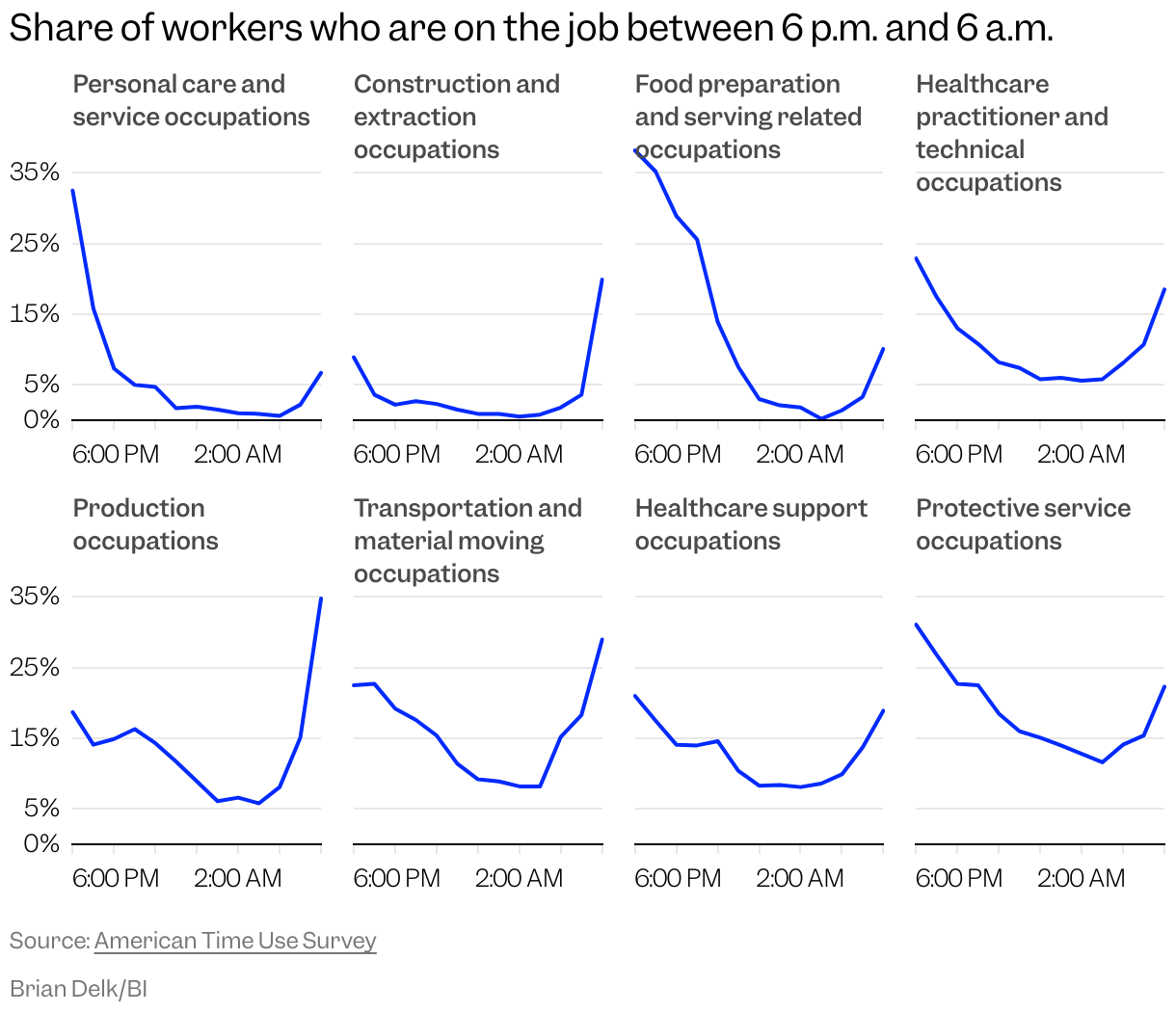
The Bureau of Labor Statistics’ American Time Use Survey asks thousands of Americans each year how they spend their days. That data includes showing when people are at work, and in particular, can tell us what kinds of jobs are most likely to involve working outside the traditional 9-to-5 hours.
Those working in protective services, healthcare, food preparation, and production all have personnel working around the clock. While construction workers and personal care workers may have less concentrated nighttime hours, plant workers, healthcare workers, and some restaurant workers have late-night shifts.
Those working the most after midnight and before 6 a.m. are protective service workers. This includes police officers, firefighters, and security guards. At 3 a.m., the lowest percentage of protective service workers are on shift, with 11.6% of personnel working.
Some workers in roles with atypical hours previously told Business Insider that it’s a part of their job, and changing their hours would impact their career. Rochelle Cooper, a pastry chef in Silver Springs, Maryland, said she works a nine-hour shift that bleeds into the evening.
“I could potentially try to rework my schedules, so I work more daytime hours and come in earlier, but then I’m missing out on part of the role I’m doing,” Cooper said. “So I’d have to maybe scale back my salary.”
Food preparation work peaks at 1 p.m., but people work well into the night, with 3% of workers still clocked in at midnight. Cooper explained that people preparing food for the next day and cleaning up from the previous day often have late-night shifts and come in later in the morning.
Healthcare occupations, like nurses, pharmacy aides, and home health aides, often work odd hours as well. Katie Wallace, a registered nurse at a hospital in Pennsylvania, said she starts her shift at 6:45 a.m.
She works a 12-hour shift that ends after 7 p.m. and may come in earlier to complete some administrative tasks. Healthcare workers like her are still busiest during the daytime, even if 6% of those workers are still on the job at 1 a.m.
While working at night can leave your day less busy, these workers said it limits their access to childcare. Many workers are clocked in before daycares and early drop-off for schools open, leaving them with few alternatives. It can also compromise some people’s work-life balance.
Do you have a job that works odd hours? Reach out to this reporter at bdelk@insider.com.