
“He is neutered, but his fur is all messed up, so I think he was abandoned,” the poster shared.
Month: October 2025
DHS said that Nuralys Jose Umanzor Molina was identified as a suspect during a HSI operation targeting child sex trafficking.
Connor Swofford and Pieter Louw
- Part-time real estate investors Connor Swofford and Pieter Louw own 24 rental units.
- They used the “BRRRR method” and hard money loans to scale quickly without much savings.
- Their strategy involves buying multi-family properties in Buffalo.
Connor Swofford and Pieter Louw closed their first property together in October 2024. Nearly a year later, they own 24 rental units across nine properties.
The childhood friends, who met in seventh grade, invest in Buffalo, where Louw lives and works as a real estate agent. He has a construction background, while Swofford, a startup consultant based in Charleston, contributes business experience.
“Early on, as we started things together, I kept questioning why he wanted to do this with me, when all I thought I brought to the table was my ability to split a down payment 50/50,” Swofford told Business Insider. “Pieter’s repeated response was, ‘There’s not much better than having fun, making money, and doing it all with your best friend.'”
Swofford and Louw, who both turn 32 in March, share the strategies they used to buy nine investment properties in 12 months without using much of their own savings.
Courtesy of Connor Swofford and Pieter Louw
From 0 to 9 properties: Scaling with the BRRRR method and financing with hard money
Their first deal was a three-unit property — a duplex with a carriage house — that needed a minor rehab.
“The front two units were pretty much ready to go, and one was already rented. The carriage house needed some work, but nothing crazy,” said Louw. “So, it was a good intro to doing a construction project that wasn’t a complete gut job, and where we could still cash flow from the beginning.”
It was also an intro to the BRRRR — short for buy, rehab, rent, refinance, repeat — method, which would allow them to scale quickly by recycling their initial capital, rather than coming up with new capital for each deal.
When buying an investment property, “you’re really looking at at least 20% down,” explained Louw. “Even with a $300,000 or $400,000 property, with closing costs, you have to come up with 60 to 80 grand, which is not very scalable.”
He and Swofford put about $40,000 worth of work into their first property and built about $90,000 in equity by the time they refinanced.
“We were pretty much able to pull out all the money that we invested into it and take that money for the next one,” said Louw. “That really kick-started us.”
As for financing, they’ve done each of their deals with hard money. They can secure money faster this way than going through a traditional lender, and, now that they have a solid track record to show their lenders, they said they’re also able to lock in better rates.
However, going through a hard money lender can be risky, Swofford noted: “It’s a big balloon payment, you have to personal guarantee the loan, and there’s a bit more paperwork and harder compliance hurdles to clear.”
Thanks to Louw’s construction background, they can confidently predict their rehab costs and timeline, which is critical.
“The two biggest things are making sure that your construction budget is reasonably accurate, because that would be one thing that could get you in trouble, and knowing your purchase price and what the value would be afterward — the ARV,” said Louw.
“Because if you buy a place for $200,000, put $100,000 into it, and then it’s only worth $300,000, once you refinance, you can only pull 75% of that out, so you’d still have a lot of money in it. At that point, you might as well have just bought a $300,000 place with the normal investment loan — 25% down — rather than go through those headaches.”
If you don’t build equity with the rehab, “you’re really just slowing yourself down for the future,” he said.
Another key to their success has been buying multi-families — they prefer three- to 10-unit properties — that don’t need a full rehab and have at least one livable unit.
“Almost every property of ours has had a tenant still living in it, and that tenant is basically able to pay the interest expense as we are rehabbing the property,” explained Swofford. “So, we basically get to semi-rehab it for free in a way.”
It also helps that their rental portfolio remains a side hustle. Any money they earn from it goes toward vacations, their nest egg, or their kids’ future educations, but they’re not relying on it to make ends meet.
“We’re at a point where we don’t need to make any emotional investments. We don’t need a property at any specific point,” said Louw. “And if it doesn’t work out, if we lose to another investor or anything, it’s like, ‘Okay, well, the numbers didn’t make sense for us. Let’s move on to the next one.'”
Read the original article on Business Insider
Data protection authority warns against using AI as a voting aid tool days before national elections in the Netherlands
AI chatbots are “unreliable and clearly biased” when offering voting advice, the Dutch data protection authority (AP) has said, warning of a threat to democracy eight days before national elections.
The four chatbots tested by the AP “often end up with the same two parties, regardless of the user’s question or command”, the authority said in a report ahead of the 29 October election.

The latest news in US politics, with coverage of Donald Trump’s second term.
Simone Gbagbo, Ivory Coast’s iron lady, eyes presidential palace in unlikely comeback bid [deltaMinutes] mins ago Now
A woman felt she had to act when she learned about a couple of puppies that had been abandoned in some woods.
Lukas Schulze/Sportsfile for Collision via Getty Images
- General Catalyst’s CEO said insurance should cover personal health and longevity investments.
- Current insurance covers limited preventative care, excluding aging therapies and supplements.
- Longevity has become an obsession for the Silicon Valley’s tech elite.
The CEO of General Catalyst thinks that health insurance needs to cover more.
Hemant Taneja, CEO and managing director of the global venture capitalist firm, told the “TPBN” podcast on Friday that he thinks investments in personal health and longevity should be reimbursable and covered by insurance.
“There’s a ton more that needs to be done so that the system moves toward incentives that keep us healthy and out of the hospital, versus a high-performance but really expensive, unaffordable care if we go into the hospital,” Taneja told show host John Coogan and Jordi Hays.
“There’s no model that’ll show what’s the ROI on this where insurance companies pay for it,” Taneja added of longevity care. “The insurers don’t know if they make an investment in longevity, they’re going to be able to capture the value on the other side.”
General Catalyst has made many moves in the healthcare space. In 2017, the VC cofounded healthcare startup Commure and has raised over $1 billion since then. The startup has cycled through four different CEOs as of 2024. In October, General Catalyst, through its Health Assurance Transformation business, closed a deal to acquire the Summa Health system for $485 million, which will convert the Ohio-based nonprofit hospital system into a for-profit entity.
At the moment, only some preventative care measures are covered by health insurance, mostly limited to the screening of diseases like cancer and HIV. Supplement medications or therapies that target aging cells are not included in health insurance plans.
Longevity has become one of Silicon Valley’s most alluring obsessions. America’s tech elite are already treating death as a problem that could be solved with enough money, data, and willpower.
OpenAI CEO Sam Altman founded Retro Biosciences, which aims to extend human life by a decade, while Google cofounders Larry Page and Sergey Brin have funneled billions into Calico Labs and Verily Life Sciences, which seek pharmaceutical and genetic solutions to aging and diseases. Other like Bryan Johnson are subjecting themselves to biohacking experiments with extreme regimens of supplements, fitness training, and data tracking.
Read the original article on Business Insider
Courtesy of Andrew Clark
- Andrew Clark balances his family and career with a flexible work schedule at Call Tracking Metrics.
- Clark negotiated later start times to manage day care drop-offs when he accepted his offer.
- If he were to be called into the office five days a week, he says he would ask for a raise.
This as-told-to essay is based on a conversation with Andrew Clark, a 38-year-old SEO and content specialist and father based in Baltimore. The following has been edited for length and clarity.
Ever since my daughter was born in 2020, I’ve worked remotely and set my own business hours at various companies as an SEO and content specialist. Even with the flexibility of setting my own schedule, it was always a balancing act — trying to prioritize quality time with my family while still advancing my career and staying engaged professionally.
Now I work at Call Tracking Metrics, which has a three-day-a-week in-office schedule. When I was interviewing with them in February, I told my wife, “If this feels like too much of a tradeoff, I’ll keep looking.” She said, “It’ll be a challenge, but we can make it work.”
I started work later that month.
As part of my counteroffer, I asked for later start times on office days
I wanted to be able to handle day care drop-offs, so that was non-negotiable for me. Thankfully, they said, “No problem.”
For the rest of that school year, I did drop-offs, and my wife, who works fully remotely, handled pickups and then watched our daughter until I got home and could help out.
My wife has been told that her company might soon require her to come in a few days a week. If this happens, we’re unsure how we’d make it work. If our in-office days overlap, how would we handle it? How do we explain that to a boss who may not be understanding?
At my company, if you do good work, you’re trusted
There have been times when I’m scheduled to be in the office, and I’ve had to say to my employer, “I can’t come in today,” because my daughter is sick or there’s a school event I wanted to attend. I feel very fortunate that my company is flexible and understanding.
Everybody is afforded this same level of flexibility. The cofounders of my company are a husband-and-wife team with school-aged kids, so those early years are still fresh in their memory.
They usually just want to ensure my deadlines are met, versus trying to micromanage. I’ve tried to keep these impromptu requests to a minimum, which has been easier since my daughter is now in kindergarten.
For me, the hardest part of returning to the office is the commute
My drive is an hour each way, and often worse. Since the Baltimore Bridge collapse, traffic has been a nightmare. One recent evening, it took me three hours to get home due to rain, a ballgame, and multiple accidents. Even as someone who doesn’t mind driving, it’s wearing on me.
I still enjoy the three days a week in the office. My team makes the commute worth it. The in-person collaboration and the casual hallway conversations that spark real ideas are refreshing.
There are no technical difficulties or distractions like at home, so I get deep focus time. Plus, seeing colleagues face-to-face brings a level of connection and communication that just doesn’t come through a screen.
RTO is a topic of discussion among employees continuously
There’s a real dialogue around RTO — leadership asks for feedback, listens, and treats us like whole people. My coworkers vary in their perspectives, usually based on where they’re commuting from, if they have kids or someone else to care for at home, and how they think collaboration is best achieved.
Just recently, we were in a team meeting, and we asked each other, “What’s our gut feeling on this RTO? Is it really still working for everybody?” Even people without kids were saying, “I don’t like having to be told I have to be in the office three days a week.” Once you experience the flexibility of being a fully remote employee, you can’t put that genie back in the bottle.
There are no current plans for five days a week in the office, as I think the company has found its happy medium, and the majority of employees seem to enjoy it.
If that were to change, I’d likely choose to stay but ask for compensation to offset the drawbacks, such as commuter benefits or a higher salary to lessen the need for my wife to work full-time. Time away from my family doesn’t come for free.
Read the original article on Business Insider

Around 2015, Kazakhstan saw the rise of Q-pop, led by the boy band Ninety One. A decade on, the cultural tension remains: while youth artists enjoy greater visibility, many observers argue that freedom of expression is still shaped by a silent boundary — ‘you can make music, but not stir too much controversy.
A little over a decade ago, five young men in earrings and pastel clothes released “Aıyptama!” (“Don’t blame me”) – a slick, catchy track in Kazakh, with a video that looked like it came straight out of Seoul. The group, Ninety One, was born out of a reality TV show modeled on the K-pop system.
At the time, Kazakh-language pop had little presence on mainstream radio or TV, where Russian-language and Western hits dominated. Much of the Kazakh-language music most people heard came from weddings and folk performances rather than commercial pop charts. Occidental pop, rock and Russian-language hip hop ruled the charts. So, when Azamat Zenkaev (AZ), Dulat Mukhamedkaliev (Zaq), Daniyar Kulumshin (Bala), Batyrkhan Malikov (Alem), and Azamat Ashmakyn (Ace) debuted as a group, they looked and sounded like nothing the local music scene had ever seen.
Their appearance sparked outrage. In Karaganda, a 2016 concert was canceled after protests. “We are against them because they dye their hair and wear earrings!” a demonstrator shouted, captured in the 2021 documentary Men Sen Emes (Sing Your Own Songs) by Katerina Suvorova. “No parent would want their son to look like a woman,” a conservative activist added. Even their producer, Yerbolat Bedelkhan, noted, “They shook up Kazakh show business with their unusual looks.”
And yet, their rise was unstoppable. Despite boycotts and online abuse, Ninety One topped national charts. Each video release became an event. Over time, their success helped make gender-fluid aesthetics more visible in Kazakhstan’s pop scene — and made singing in Kazakh fashionable again among young audiences.
But their aesthetics stood in sharp contrast to the state-promoted model of Kazakh masculinity.
Ninety One; image: JUZ Entertainment
Revival and Restriction: The State’s Masculine Ideal
In 2017, then-President Nursultan Nazarbayev launched Rukhani Zhangyru – a sweeping state program for “spiritual renewal.” Its goal was to forge a unified Kazakh national identity after decades of Soviet domination, largely by reigniting traditional values. Streets were renamed after historical khans, a National Dombra Day was established, and the country began shifting from Cyrillic to the Latin alphabet.
But the cultural revival came with a gender script. School textbooks were rewritten, according to a 2021 Rutgers University study, to cast masculinity as a blend of strength, rationality, and emotional restraint. The ideal Kazakh man – the Batyr – was reimagined as a stoic warrior of the steppes.
In this context, Ninety One’s aesthetics didn’t fit in. “Many thought Q-pop artists didn’t act like ‘real Kazakhs’,” Merey Otan, a musician and PhD candidate at Nazarbayev University told The Times of Central Asia. “Wearing makeup, earrings, or bright clothes, expressing emotions or sexuality – these all clashed with a rigid model of masculinity.”
Some other pop groups, however, had already challenged this model.
According to Nargiz Shukenova, director of the Batyrkhan Shukenov Foundation and producer of the encyclopedic, 91–23: The popular music of independent Kazakhstan, the Kazakh pop scene had been experimenting for decades. “To say pop started with Ninety One is inaccurate. Even during the Soviet era, it drew inspiration from Western bands such as The Beatles, Depeche Mode, and Earth, Wind & Fire.”
Orda, the pop group led by the producer Bedelkhan, was an early pioneer. “Because they wore earrings and had a style deemed too feminine, they were called ‘freaks’,” Shukenova recalls.
What changed with Ninety One was timing and resonance.
A Generation Looking for Air
“The youth wanted something that connected their roots to the modern world they live in,” Shukenova told TCA, and Ninety One struck that nerve. Urban, digital-native fans wanted to reclaim the Kazakh language and rediscover local folklore – without denying the parts of their identity shaped by the internet and globalization.
The band gave them all that. Fans named themselves “Eaglez”, after the Kazakh national emblem. They even coined the term “Q-pop” (short for Qazaqstan pop) in the Latin alphabet. Rapidly, each one of their clips went viral.
Their popularity grew so strong that even former haters came around. “Ex-anti-fans started listening,” notes Otan. “The fact that they sang almost exclusively in Kazakh helped promote the language and tied music to the national identity.”
For N.B., a member of Q-pop group ALPHA formed in 2019, Ninety One was a revelation. “My first impression was freedom,” he told TCA. “Q-pop isn’t traditional and that’s what I liked. In 2015, teens needed air. Q-pop gave us that.”
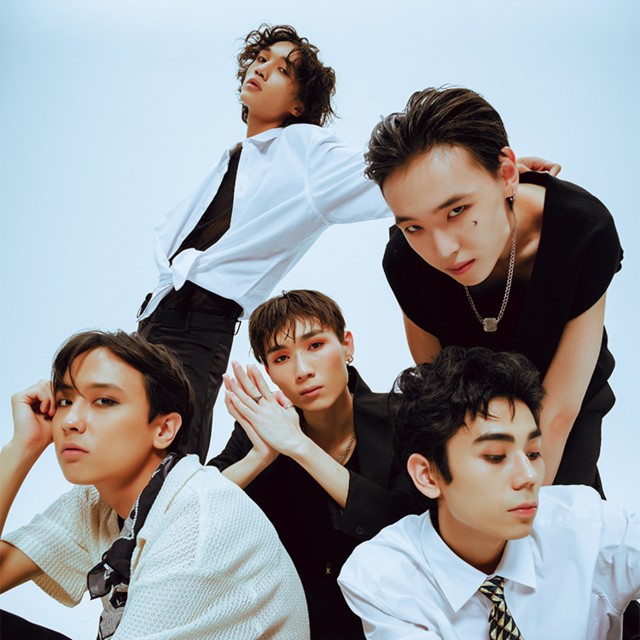
ALPHA; image: recentmusic.com
From Love Songs to Protest Anthems
At first, Ninety One mostly sang about love, self-confidence, and resilience. But in 2019, their tone shifted. The single, “Bari Biled,” tackled corruption, environmental degradation, and social injustice, striking a chord with young listeners disillusioned by broken systems. A year later came “Taboo,” a collaboration with rap collective Irina Kairatovna, whose sharp social commentary and gritty blend of Russian and Kazakh pushed underground energy into the mainstream.
“Young people love songs that address real issues,” observes Otan. And it’s not just in pop or rap. After the COVID-19 pandemic, new scenes flourished online.
“For artists, it used to be either patriotic or commercial music,” says Shukenova. “Social media created a third way.”
One example is Qazaq Indie, a label born on the platform VK in 2017. Its first breakout star was Samrattama, a long-haired singer-poet embodying the identity struggle shaping Kazakhstan’s music scene. His latest project, Barsakelmes – a collective hybrid performance mixing traditional and electronic music with the group Steppe Sons – quietly ventures into delicate territory. By exploring decolonization through Kazakh legends and the Aral Sea tragedy, he touches on a subject few artists have dared to explore. “I’m ‘decolonial’ in the sense that I’m changing my own paradigms, my ways of seeing,” he says.
Social criticism has become even more direct in tracks like “Obal oilar-ai” (“These Guilty Thoughts”), a collaboration among indie musicians such as Dudeontheguitar and Jeltoksan, addressing poverty, corruption, and everyday despair. Even punk has joined the wave. “We’re seeing all-female fem-punk bands like Krasniye Chulki (Red Stockings),” notes Otan. “Their raw energy challenges gender norms in a rock scene long dominated by men.”
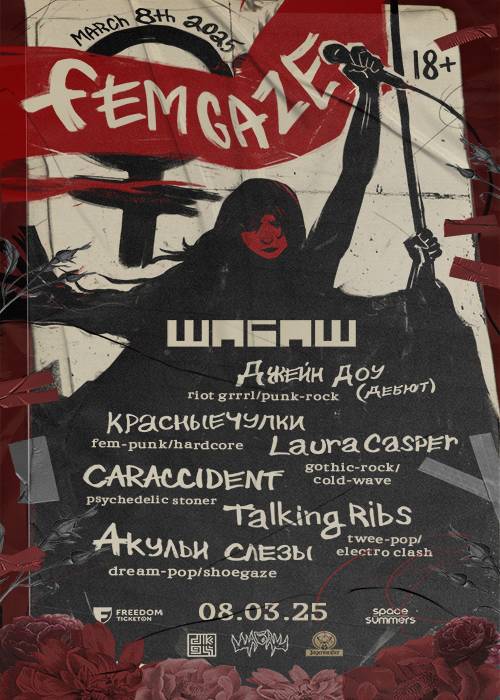
FEMGAZE 2025 featuring Krasniye Chulki; image: @kair_fltt
Free to Sing, but Not Everything
But artistic freedom remains limited; criticism may be less virulent than in 2015, but it persists. “It’s less violent now, yet mindsets don’t change overnight,” say A.Boo, I and N.B. from ALPHA. Otan agrees: “If someone like Samrattama reached Ninety One’s level of fame, there would still be resistance, though weaker than ten years ago.”
As for freedom of expression, censorship is often indirect. “There’s no official censorship, but a lot of self-censorship,” Otan notes. She recalls seeing a band at the OYU Festival – an annual celebration of Kazakh art held since 2022 – perform a political song without lyrics, only as an instrumental. “It says a lot about the fear of speaking out,” she adds.
ALPHA deliberately stays away from politics. “It’s not our role,” they say.
The subject remains fraught. In December 2024, rapper Karim Asylbekov was charged with “hooliganism” after performing a song about social injustice. That same year, a comedian was briefly detained for “obscenity” after joking about President Tokayev’s “Zhana Kazakhstan” slogan.
Kazakhstan may have moved past the open outrage of 2015, but a quiet message still lingers in the cultural airwaves: Kazakhstani artists can make music – as long as they don’t make too much noise.