
Mindy Davis, 40, told Newsweek about her unexpected experience at the cat breeders that went viral on TikTok.
Month: October 2025
Zeena gave herself away pretty quickly. “She hands herself in whenever I get home,” her owner commented in the viral post.
WWE reportedly changes plans for big Survivor Series match ahead of the November event, according to a new Dave Meltzer report.
Science Photo Library/Reuters
- A version of this story originally appeared in the BI Tech Memo newsletter.
- Sign up for the weekly BI Tech Memo newsletter here.
A few years ago, FAANG engineers were famously “locked in” by massive equity windfalls. Today, the same dynamic is playing out with AI chipmakers.
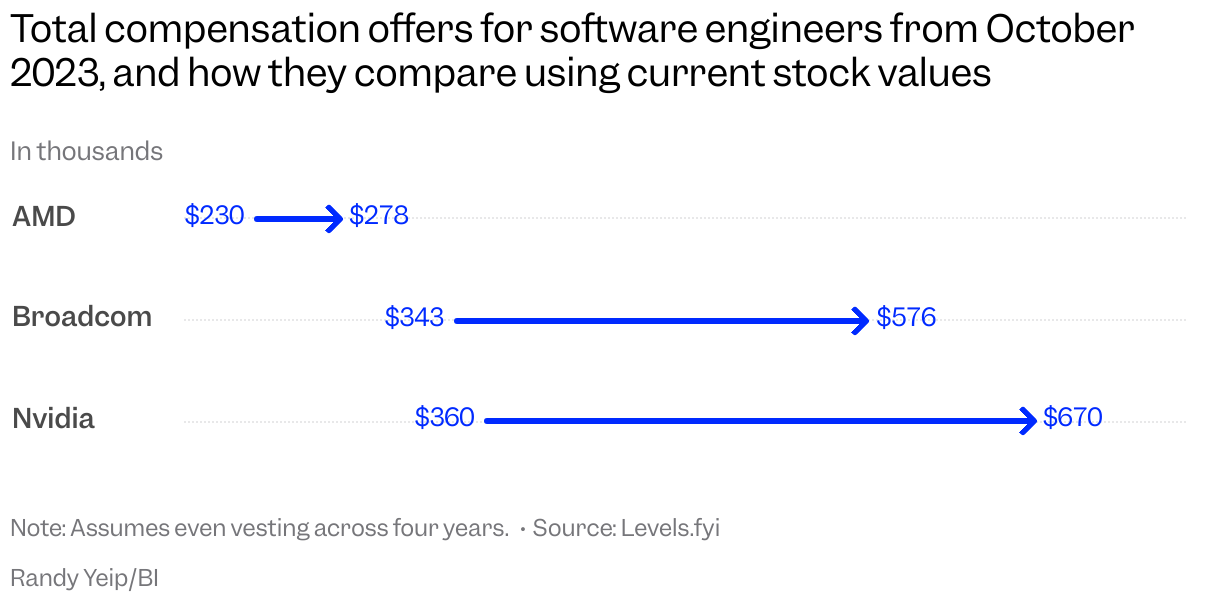
According to Levels.fyi data, engineers at AMD, Broadcom, and Nvidia are sitting on life-changing stock gains.
Heavy equity-based offers made in late 2023 have ballooned as these stocks have soared. Some Nvidia mid-level engineers, for instance, have seen total compensation swell from roughly $360,000 to $670,000.
Broadcom and AMD engineers are experiencing similar locked-up wealth increases, according to Levels.fyi estimates.
This is the new cost of leaving. Imagine getting 10,000 restricted stock units at $100 a share, which would be worth $1 million over four years. That’s the typical vesting period for equity awards like this.
At a normal company, the stock might go up a bit, or it might fall. So your year 3 and 4 vests would probably be worth about $500,000 in total, or maybe $750,000 if you’re lucky and the stock goes up a bit.
What if you’re at a fancy AI company, and the stock triples? That total 4-year award would balloon to $3 million. Walking away after year 2 could mean forfeiting about $1.5 million. So people often stay.
The “golden handcuffs” haven’t disappeared; they’ve just migrated from Big Tech software giants to the silicon stars powering the AI boom.
Levels.fyi calls these “silicon handcuffs.”
Sign up for BI’s Tech Memo newsletter here. Reach out to me via email at abarr@businessinsider.com.
Read the original article on Business Insider
The NBA hoped to begin its season on a strong note. Now it faces a gambling scandal [deltaMinutes] mins ago Now
Two hikers struck by lightning on Arizona’s Humphreys Peak were rescued and hospitalized.
Lucia Wamala
- I shop at Costco at least once a week for myself and my teenage daughter.
- Frozen pineapples are a key ingredient in my daughter’s post-track-practice smoothies.
- Costco’s rotisserie chicken is another staple that we use in a variety of meals throughout the week.
As a mom and business owner, I’ve learned that fueling a young athlete requires more than just smart nutrition. It also requires curiosity for trying new things and finding ways to enjoy the process together.
So, although the only thing that gets my teenage daughter excited about a Costco run in our home city of Toronto is the chance to hunt down a viral snack she’s seen on TikTok, I welcome it.
Here’s a look at one of our weekly hauls, complete with my daughter’s track bag must-haves and practical staples that keep our household energized and feeling good.
Lucia Wamala
Lucia Wamala
Lucia Wamala
Lucia Wamala
Lucia Wamala
Lucia Wamala
Lucia Wamala
Lucia Wamala
Lucia Wamala
Lucia Wamala
Read the original article on Business Insider
Athena may have been free, but she certainly hasn’t been cheap, as one TikTok user joked that “free dogs are the most expensive.”
The Post begins a five-part series going in depth about the cases for the key figures for the Mets’ and Yankees’ offseason. First up, Pete Alonso.
Carlos Barria/REUTERS
- A version of this story originally appeared in the BI Tech Memo newsletter.
- Sign up for the weekly BI Tech Memo newsletter here.
Meta chopped 600 employees from its Meta Superintelligence Labs group this week. Google is removing managers again. Broadcom cut staff recently, too.
These 3 companies have one thing in common: They are growing quickly and minting money from the AI boom. So why are they still shedding employees?
I asked Brad Gastwirth, global head of research and market intelligence at Circular Technology. He’s been analyzing the tech industry for decades.
“The Meta cuts are a perfect example of AI working too well not failing. These aren’t demand-driven layoffs; they’re the result of a massive internal restructuring as AI changes the cost structure of tech itself.”
This is perfectly illustrated by another scoop this week from Business Insider’s Jyoti Mann. She reported that Meta executive Michel Port recently told some employees that their jobs were being replaced by new automated processes.
Here’s the rest of Brad’s take, edited for clarity and length:
“In Meta’s case, it looks like a consolidation and reprioritization issue. Meta has hundreds of separate AI initiatives spanning Llama, infrastructure, content moderation, recommendation systems, and ad optimization. The 600 jobs being cut are largely from overlapping research or support teams as Meta shifts from “AI research mode” to “AI productization mode.” Once the models are trained and deployed, you simply don’t need the same headcount to maintain that velocity, especially when internal tools are now automating much of the work engineers used to do manually.
Think of it like the moment after an airplane reaches cruising altitude: you need fewer hands in the cockpit. The heavy lift training, data labeling, model architecture is done. Now the focus is on efficiency, inference, and monetization.
More broadly, all the major AI players — Meta, Google, Microsoft, Broadcom — are demonstrating the same pattern. They’re investing billions in infrastructure while trimming the human layers that are being displaced by those very systems. It’s not layoffs because business is bad; it’s because AI is doing exactly what it promised: automating middle-tier technical and operational roles.
If the industrial revolution replaced muscle, AI is replacing repetition and coordination. It’s not that Meta or Google suddenly need fewer ideas; they just need fewer people to execute them.”
Sign up for BI’s Tech Memo newsletter here. Reach out to me via email at abarr@businessinsider.com.
Read the original article on Business Insider