Authors will come to rely on artificial intelligence to help them beat writer’s block, the boss of the book publisher Bloomsbury has said.
Nigel Newton, the founder and chief executive of the publisher behind the Harry Potter series, said the technology could support almost all creative arts, although it would not fully replace prominent writers.
Imagine this: Just as a new generation enters the job market, a crisis rocks the world and permanently alters the economic landscape, forcing the young people starting out on their career journeys to learn the new rules of a different era. For both millennials and members of Gen Z, that description may hit close to home. Both generations were smacked with global turmoil right as they were launching their careers.
For millennials like myself, there was the financial system’s implosion in 2008. Our parents lost houses, we lost our college funds, and graduated into the worst job market in at least half a century.
For Gen Zers, it was a pandemic. COVID wrecked many of your college years, and sky-high inflation ate into your meager student budgets. Now, you’re out in the real world, right as the pool of entry-level jobs starts to dry up, thanks to technological change, high interest rates, and chaotic tariff policy.
Every generation has its war stories from its formative years. Gen Xers had to process 9/11 and the bursting of the tech bubble. Baby boomers dealt with their own bout of inflation and painfully high interest rates in the 1970s. But the past two upheavals felt particularly burdensome for the young generations trying to stand on their own two feet for the first time.
Today, the burden is on Gen Z after a brutal handful of years for our wallets, and society in general. Forty-eight percent of Gen Zs don’t feel financially secure, according to a Deloitte survey released in June 2025, and more than 80% said their financial futures and day-to-day finances add to their anxiety and stress.
Gen Z, I hear you. I’ve been you. And I know there’s a way through.
In these uncertain times, I’m not here to pile on the “brainrot young people” tropes or to deliver half-baked advice on how to write an effective résumé using ChatGPT. Instead, I want to provide perspective based on what we’ve learned time and time again over history. The US economy has gone through its fair share of triumphs and challenges, and it can feel like the deck is stacked against those of you trying to strike out on your own. But with the right conditions and careful planning, there’s no doubt that all you Gen Zers out there will eventually have your moment.
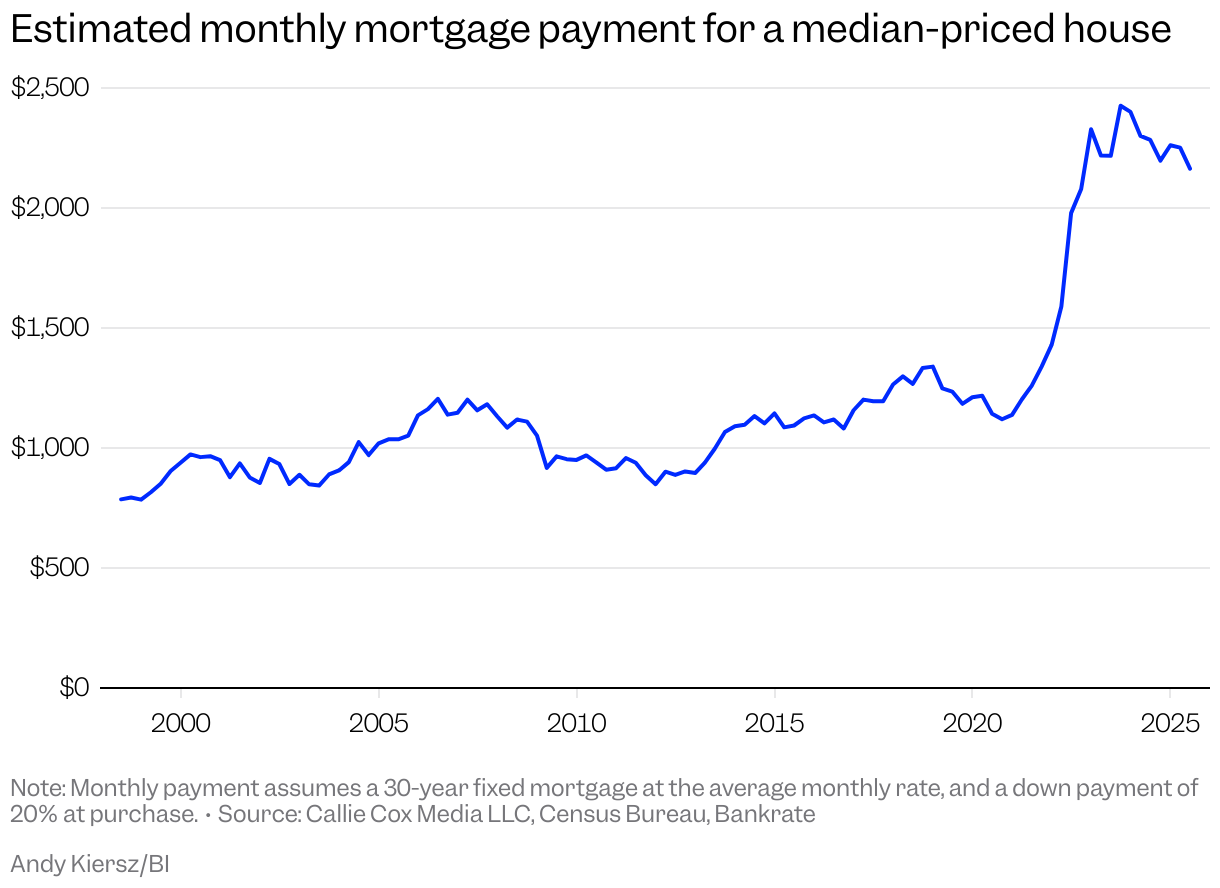
Amid all of this, we’ve endured an economy constantly out of balance thanks to an inflation jump not seen in four decades and the slow-motion contraction of the job market. That affordability crisis? It’s absolutely a thing. There was a 17-month period between 2021 and 2023 in which paycheck growth didn’t keep pace with the surge in prices. Those are just averages, too. We all know the pain of higher prices was felt more acutely depending on where you’ve worked and what you’ve purchased. Essentials like housing have become a much greater burden: Rent prices have grown faster than paychecks for much of the past 15 years, and the typical mortgage payment is almost double what it was before the pandemic.
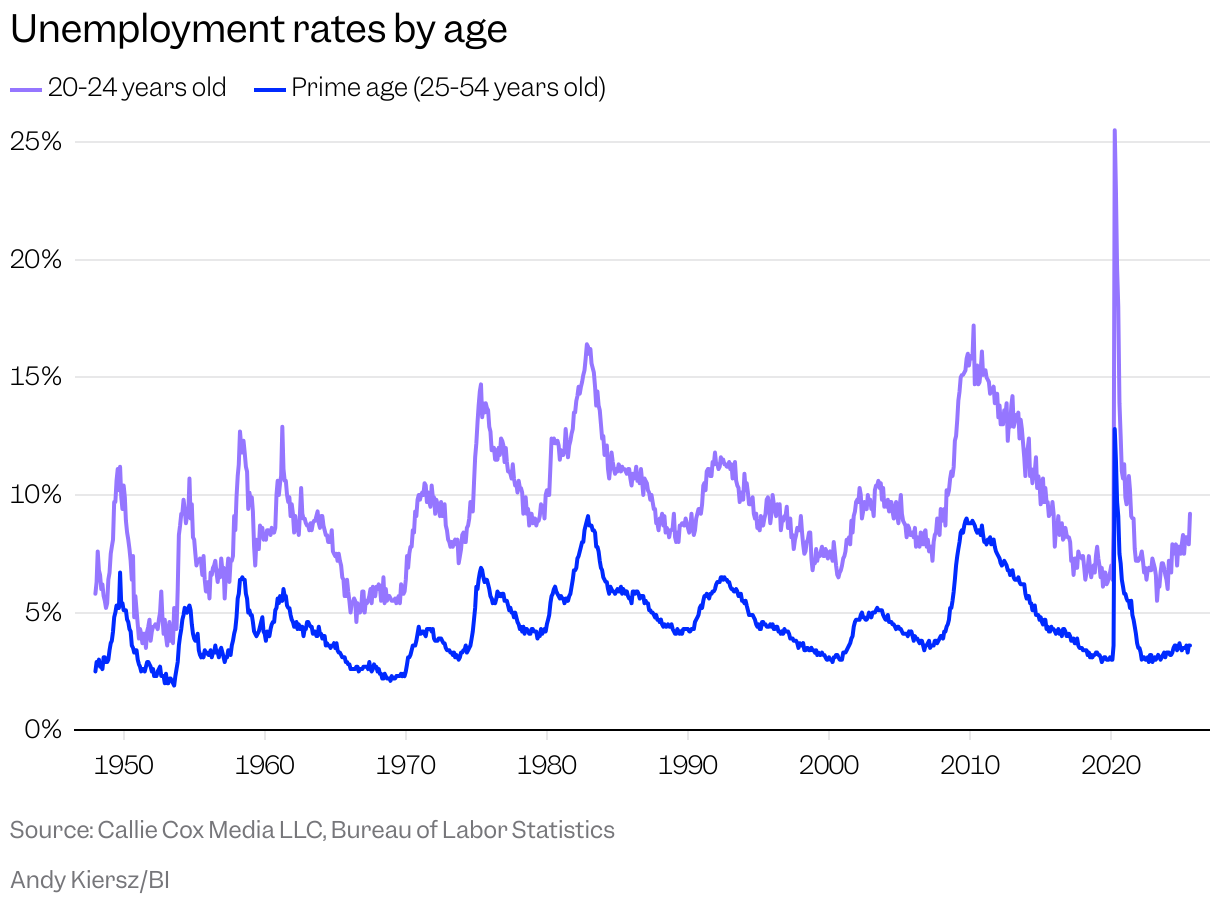
These days, paychecks are outpacing inflation again — an environment in which American households and businesses tend to thrive. But now unemployment is nipping at our heels. Especially yours, Zoomers. If you’re in your early 20s, your job market prospects have soured much more quickly than for older Americans. The unemployment rate for 20 to 24 year olds is 5.6 percentage points higher than for 25 to 54 year olds (often referred to as the prime age unemployment rate because it covers a large portion of workers) — a gap so wide it’s rarely seen outside economic crises.
People have been quick to point fingers at AI taking your entry-level jobs, too. Perhaps the most dispiriting part, your prospective employers are heralding this new technology not as an economic catastrophe but as a long-term structural change in how the world works and a long-term barrier to gaining on-the-job experience. And then there’s Wall Street’s gaslighting. Sure, society feels like it’s ripping at the seams, but the stock market is trading at record highs. The dissonance between markets and large chunks of the economy is striking. Put it all together, and a bunch of you are probably feeling like you can’t get off the mat. Psychologically and financially.
I didn’t go through the exact same experiences you did. My senior prom wasn’t canceled over a deadly virus. I didn’t graduate over Zoom, and my biggest worry on social media was trying to make a new friend’s top 10 ranking on MySpace. But as a millennial who graduated from high school in the depths of the financial crisis, I’ve felt some of the same feelings you have — even if the circumstances were drastically different.
I wasn’t in the unluckiest cohort of millennials, though I wouldn’t say I had it easy. I graduated from college in May 2013, when the unemployment rate for 20- to 24-year-olds was 13% — down from a then-record high of 17% for the class of 2010, but well above the current young adult unemployment rate of around 9%. I was also too young to open a brokerage account in the depths of the crisis, so I wasn’t scarred forever by the pain of losing huge sums of money. Many millennials were, though. My generation is notorious for missing out on some of the best years for the stock market in recent history, simply because we couldn’t — or wouldn’t — invest. Our cash holdings in early adulthood were significantly higher than our Gen X predecessors, and we’re the generation that brought you a thick distrust of Wall Street.
Yet I was still burned by the nasty side of risk before I was even able to start investing. My mom lost her part-time accounting job at a homebuilder after it was revealed that her company had been swindling money from customers and subcontractors. My dad was an electrician, and his business suffered under the strain of the housing market meltdown. Back then, I swore I’d never start a business. A few years later, I was tossing my résumé to anyone who would listen because I knew I needed a job ASAP. I lucked out with a great first job in one of the world’s best newsrooms — an opportunity that materialized from an internship. Many of my peers weren’t as fortunate, but they eventually found jobs over time.
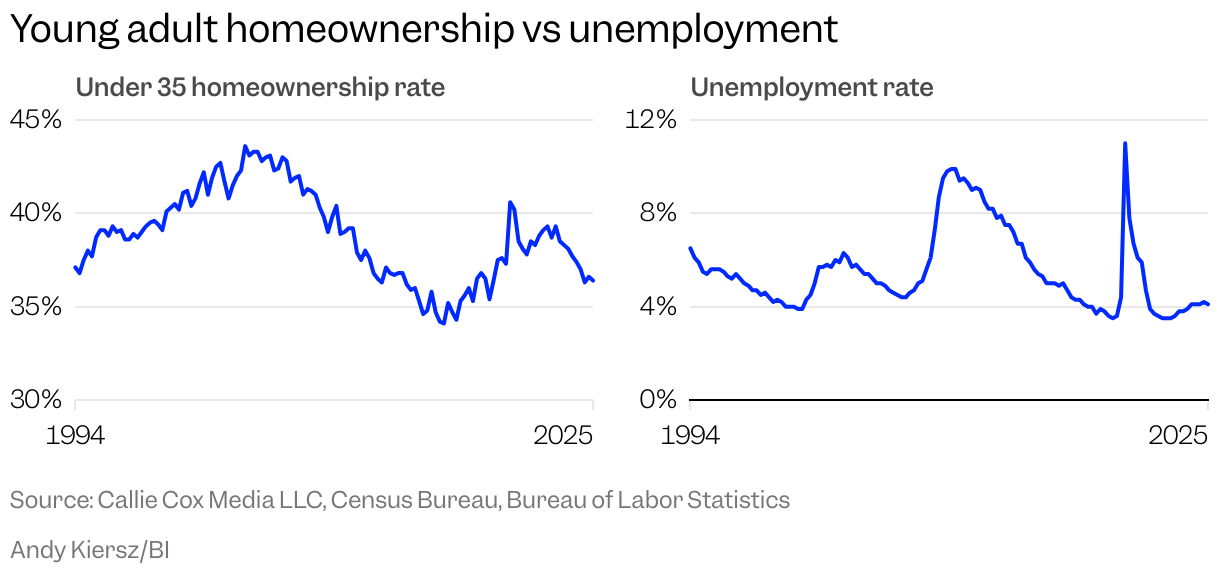
This is where I start to turn toward the sunnier news — and offer a bit of advice. Sometimes, time is all you need to heal an economic wound. You could certainly say that was true in the 2010s. Markets stopped falling, and the government stepped in to stem the economic bleeding. The unemployment rate for all ages slowly decreased over the decade, eventually reaching a 55-year low in 2019. Millennials finally felt confident enough to start investing in their 30s, catching the middle of one of the stock market’s longest rallies in history — the S&P 500 nearly quadrupled from 2009 to 2020. Interest rates stayed near zero for most of the 2010s, opening the door for millennials to buy their first homes toward the end of the decade. Homeownership rates for Americans under 35 turned around in the summer of 2016, just as unemployment fell to 4% and 30-year mortgage rates reached 3.3%. And in the hot job-market days of 2022, paycheck growth for 16-24 year olds compared to all prime-age workers hit a 25-year high.
The comeback hasn’t been perfect, though. Economic growth was sluggish and wages were anemic in the 2010s, which undoubtedly limited the pace of millennials’ progress. Companies stopped investing in their businesses in favor of stock-boosting initiatives such as buybacks, which benefited investors more than workers. The 2010s were marked by rampant distrust of institutions, ultimately sowing the seeds for the instability we’re witnessing. Millennials are still far behind Gen X and Baby Boomers in homeownership when calibrating for age, according to ApartmentList calculations of Census Bureau data.
It’s easy for us older folk to step back and tell you to suck it up. Mountains of data tell us the economy ebbs and flows over time, and cycles of joy and pain are the heartbeat of the stock market. We all know words ring hollow when you’re out of a job and financial stability feels unattainable.
But remember how cyclical the economy — and your fortune — can be. AI, like other technologies, may prove to be a boon for society rather than a downfall. Its cannibalization of entry-level jobs may be overstated. Sure, you could find some evidence of companies automating roles, but the slowdown in hiring looks to be more than in AI-concentrated fields. This looks more like your run-of-the-mill job market slump, something we’ve encountered plenty of times in history.
Economists are split on what’s happening — and what comes next. Stanford researchers claim AI is already gobbling up entry-level jobs at a noticeable rate, while Yale Budget Lab analysts argue there’s no evidence of this in employment and unemployment data. MIT researchers have found that a vast majority of AI implementations in businesses fail to generate profits, and a Harvard Business Review study found that AI output is actually harming worker productivity.
Everybody seems to be grasping for narratives, which appears to be a natural human response during a time of drastic change. Add in a revolutionary technology, and the noise is deafening. Right now — as it was in the late 1990s — it’s hard to put a finger on what forces will prevail over the next decades. But if AI proves to be like every other technological breakthrough, it’ll help us become better at our jobs and lead to lower unemployment. Yes, even if it takes years.
You can’t just wait for the economic tide to pick you up, though. If we really are coming under AI’s technological grip, you’ll want to focus on skills that humanize you. Become a commodity in an increasingly homogenous world. Focus on empathy, communication, and strategy to set yourself apart. On the financial side, learn to be an owner, not an employee. While you initially need to make money to have money, the days of climbing the corporate ladder are long gone.
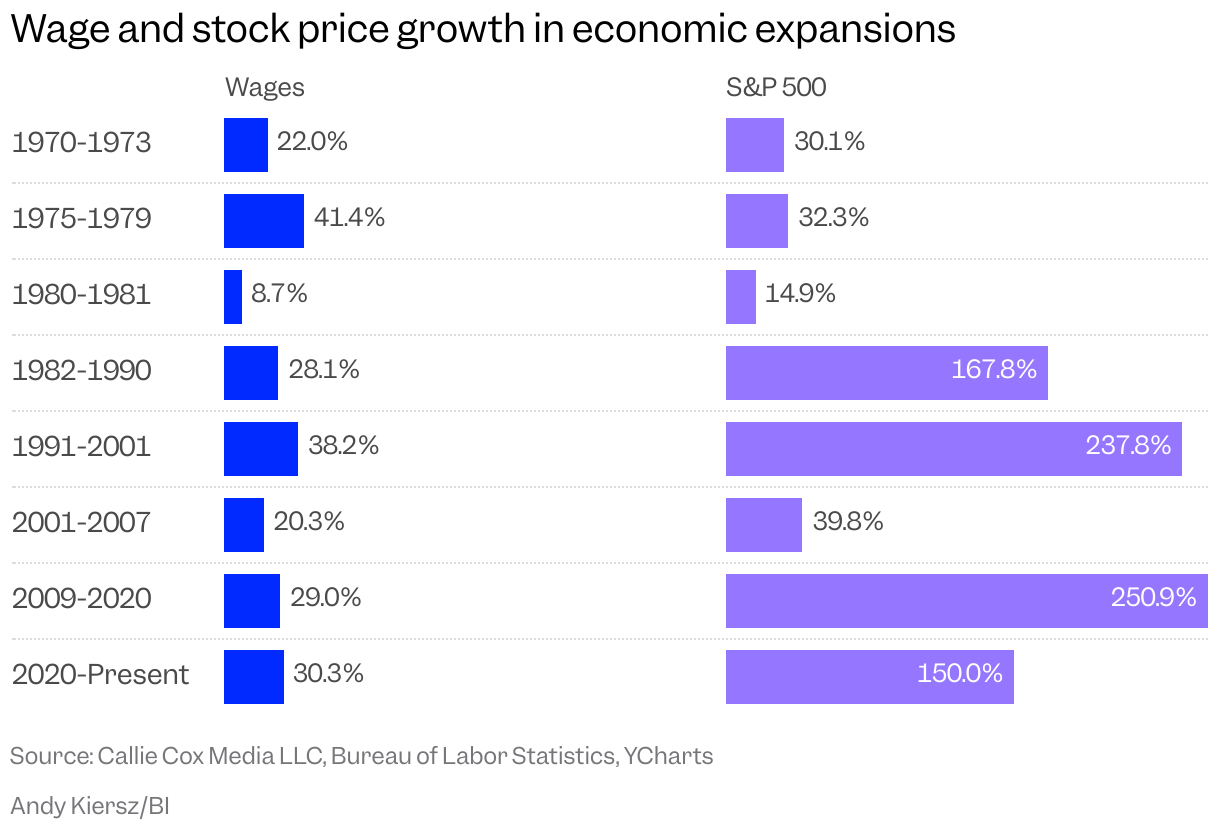
Take the last five years. The average worker’s paycheck grew by 5% each year, slightly faster than the 4% growth in prices. But if you invested in a hypothetical, no-fee S&P 500 fund, you would’ve made 15% annual returns on your money.
This isn’t a call to quit your job and become a day trader. But it is a sign of how much owners have been rewarded by technology’s boon to profits and corporate America’s changing incentives.
In this age of AI and rampant automation, wage growth could keep losing ground to capital appreciation, and ownership becomes even more important for your path to wealth. Especially if you think a robot could take your job.
Humans are incredibly resilient, and so far, Americans have always dug themselves out of challenging times.
New ‘national interest’ provision revealed as extracts of legislation circulated to stakeholders before bill introduced to parliament later this week
The environment minister would be able to approve projects at odds with nature laws if it was deemed in the “national interest” under the Albanese government’s planned overhaul of the environmental protection regime.
The proposed new provision was revealed in extracts of the legislation that were circulated to stakeholders on Monday, ahead of its introduction to federal parliament later this week.
66 objects spotted on radars overnight leading to closure of Vilnius airport as senior official calls it part of a ‘hybrid psychological operation’ to disrupt everyday life
Lithuania closed its Vilnius Airport for the fourth time in a week last night after several objects, believed to be helium balloons, entered its airspace.
The balloons were primarily believed to be used by smugglers transporting contraband cigarettes from Belarus, but authorities blamed Russia and Belarus for putting more pressure on Vilnius and testing the country’s readiness.
the German foreign minister Joseph Wadephul’s visit to Brussels where he is due to meet Nato’s Mark Rutte and senior EU representatives,
Hungary’s Viktor Orbán’s trip to see Pope Leo at the Vatican and the Italian prime minister Giorgia Meloni in Rome,
and the final days of the Dutch election campaign ahead of the polling day on Wednesday.
Alex Honnold says he’s constantly juggling three things: work, family, and climbing.
Planet Visionaries
This is an as-told-to essay based on a conversation with Alex Honnold, professional rock climber and founder of the Honnold Foundation. Honnold’s rope-free ascent of the 3,000-foot rock wall El Capitan in Yosemite National Park was featured in the Oscar-winning 2018 documentary “Free Solo.”
Honnold is an executive producer and host of the podcast “Planet Visionaries,” which spotlights pioneering conservationists addressing the impacts of climate change. The podcast, produced in partnership with the Rolex Perpetual Planet Initiative, returns for its fifth season on October 28.
Honnold, 40, lives in Las Vegas with his wife and two daughters.
This story has been edited for length and clarity.
I drop my daughter off at school, then I climb
I wake up and I have my green juice from Athletic Greens, which is a powder you mix with water. I live in the desert, so it’s a nice morning routine because you just drink a bunch of water in the morning.
I’ve never been into coffee. I think it tastes disgusting. I try to get enough sleep. I eat relatively well. I try to exercise enough. So it all works pretty well without caffeine. I normally wake up feeling rested and fired up.
After my juice, I eat some breakfast, which is usually either muesli and fruit or eggs, toast, and avocado.
Then, I go outside and go climbing. I probably climb more than most climbers, around 30 to 40 hours a week. It doesn’t feel like working a full-time job, though, because it’s so freaking fun.
Now, living at home with my family, I often take my older daughter to school, drop her off, and then head to a nearby cliff, where I climb until pick-up time. I then pick her up on the way home.
Every day is either a climbing day or a rest day for me. Traditionally, I follow a two-day-on, one-day-off routine. Rest days are different every day, and they don’t mean bed rest. It just means resting your skin and physically resting your muscles. It’s nice to do mentally engaging work on rest days, such as hosting podcasts, working with my foundation, public speaking, and all the other activities that accompany being a professional climber.
My routine always changes, but I have one non-negotiable
The irony of being a professional climber is that you’re sponsored because you’re good at the sport, but then the reality is that you’re getting paid to show up at events and do public appearances, so I travel all the time for work.
Alex Honnold, right, approaching a climb in Red Rock Canyon National Conservation Area near Las Vegas.
Brian van der Brug/Los Angeles Times via Getty Images
In some ways, I’m very routine, as I eat and drink the same things all the time. But in the bigger picture, I travel so much that sometimes I wake up in a different bed five days a week, so every day looks different. When I’m doing a lot of events, I start to feel like a piece of meat that’s just being shipped around from place to place to perform.
A non-negotiable for me is some form of exercise, including climbing in a gym. I love walking to events or using bike shares or scooters — anything that gives me control over my own travel and allows me to be independent, rather than just being transported around.
Occasionally, on climbing days, I can host a podcast in the morning and then still do a garage training session for four hours and feel like, “Oh, it’s the best of both worlds. I did some work. I got worked. It’s perfect.”
I typically don’t eat lunch and just snack during the day. If I’m going up on the wall, I take bars. I shop online at TheFeed.com and buy bars in bulk. Every handful of months I spend 500 bucks on bulk sugar products — we have a drawer in our kitchen that’s just a tremendous number of different types of bars, and then a drawer full of technical sugar products, like the energy gels and goos that are popular with runners.
After school, it’s playtime before hangouts with my wife
My older daughter comes home from school around 3:30, and bedtime is around 7:30, so there’s about four hours to hang out once we’re all home. We have a little swing set in the back with a pretty view. We play on the patio, run around outside, or go on hikes. There’s a little carpeted playroom in one corner of the house where the girls go crazy and spin until they fall down.
Dinner is often pasta and veggies, as well as Asian noodles and tofu. At home, we’ll do more salads. When I’m traveling in my van, it’s mac and cheese or tuna.
If both babies are asleep by 8:30 p.m., that’s a great success, and then my wife and I have an hour and a half to deal with normal life, which might mean responding to emails and other work. Often, we just chill or watch an episode of something together. We recently watched the first season of “Wednesday.” We joke that we have sleepovers where basically we just chit-chat for an hour and catch up.
Alex Honnold speaking at a Disney event in 2022.
Image Group LA/The Walt Disney Company/Getty Images
Occasionally, we both read something for a bit, and I read a lot on planes and when traveling. I almost always read nonfiction. I just read “On the Edge: The Art of Risking Everything,” Nate Silver‘s new book. I recently read “Intermezzo” by Sally Rooney and was like, “Wow, fiction goes so fast compared to nonfiction.”
Ideally, we try to get to bed early because the kids wake up early, and you have to be ready. That means trying to be asleep from 10 to 6 every day.
Juggling work, family, and climbing
Part of the beauty of being a professional climber is that you can set your own hours. I also have a pretty nice home gym, so I can train at home. We’ve kind of built our lifestyle around convenience, and we live in a place with a lot of climbing access.
I think of work, family, and climbing as the three things that I’m juggling at all times, and you just can’t have all three at the same time, really. Over the course of a week, though, I can juggle it all.
A friend and I were just in Yosemite National Park for a short dad’s trip, and even though I was on the wall for two days, I FaceTimed my family, so my 3-year-old got to see El Cap at night from the ledge. It was freaking cool.
After spending a couple of days together, my friend said, “God, you just optimize everything. You’re just so efficient.” And I was like, “Yeah, otherwise you can’t keep all the balls in the air. If you’re not tight on everything, the whole empire crumbles.”
I do everything very quickly and just turn it up to 11. By being super efficient about all the things, you get to do way more things.
Literally, our only thing is time, and then we die. So I just don’t want to waste time. I unpack from one thing, I’m already packing for my next thing.