
HOUSTON — Cam Thomas is known for his prolific scoring. But it was something beyond the banged-up guard’s bucket-getting that coach Jordi Fernández praised Monday. Cam Thomas of the Nets shoots a floater against the defense of Steven Adams of the Rockets in the second quarter of the game at Toyota Center on Monday night…
Month: October 2025
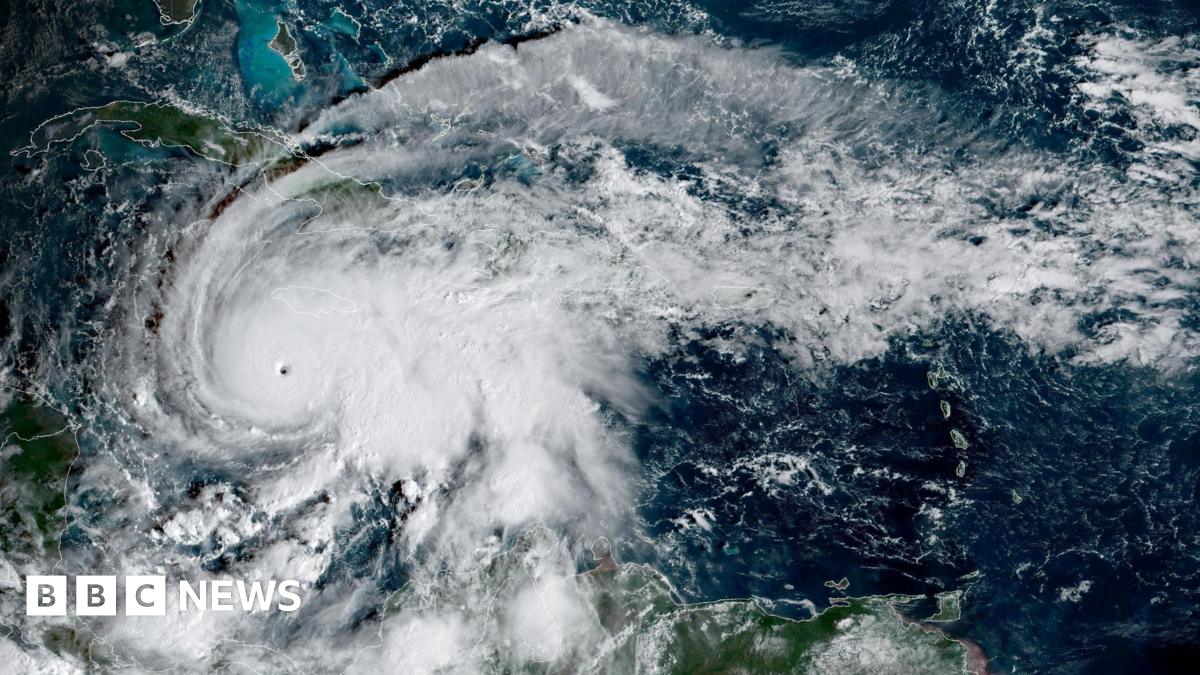
Powerful winds of 175 mph (280 km/h) have battered the coast and up to 101cm of rain is possible.
HOUSTON — Early days, the Nets tank appears safe. But losing is the easy part. The hard part is walking the tightrope of losing without becoming losers. Day’Ron Sharpe of the Nets drives to the basket during the game against the Rockets on Monday night in Houston. In the most star-driven league in sports, the…
US Air Force provides views from inside Hurricane Melissa
Bader — a Miami-based social media star who gave lifestyle and financial advice to more than 200,000 followers across Instagram, TikTok, and X — died on Oct. 23, his girlfriend Reem shared in a heartbreaking TikTok post.
Gleb Garanich/REUTERS
- China’s military showcased a live-fire exercise of its long-range delta-wing drone on Sunday.
- State media aired footage of an ASN-301 fired by the PLA’s Eastern Theater Command.
- The drone, closely resembling the Israeli Harpy, is meant to hunt and destroy air defense systems.
The People’s Liberation Army has released brief footage of an ASN-301 drone being fired from a truck-based multiple launch system, offering a rare glimpse of the Chinese munition in action.
State media outlet CCTV aired the video on Sunday, describing the live-fire exercise as training for newly recruited drone operators.
The clips, seen by Business Insider, show two 6×6 trucks in desert terrain. Each is mounted with launchers that appear to feature six canisters for firing drones.
The ASN-301, a delta-wing drone, is seen rocketing forth from a launcher and climbing sharply in a straight flight pattern.
After showing several seconds of the drone in flight, CCTV cuts to a shot of the loitering munition diving into its target — seemingly a mock airfield with a nearby shelter — and detonating.
The clips have since circulated on international social media.
A striking resemblance to an Israeli drone
The ASN-301’s shape and design resemble the Iranian Shahed-136, but it shares more similarities with Israel’s Harpy loitering munition.
China’s drone is widely believed to be modeled after the Harpy. Unlike the Shahed, which was built as a general one-way attack drone, the ASN-301 and Harpy are both meant to detect radio frequencies that can help them target enemy air defenses.
Beijing purchased 100 Harpy drones from Israel Aerospace Industries in the 1990s. The US, concerned that shared sensitive technology might end up in Chinese hands, later pressured Israel to stop upgrading that batch of drones.
Eventually, the ASN-301 began appearing at defense exhibitions around 2017. It was marketed by China National Aero-Technology Import & Export Corporation, or CATIC, which said the eight-foot-long drone can be remotely piloted or operate fully autonomously.
CATIC said at the time that the ASN-301, known within China as the JSW-01 or the Flying Dragon 300A, can fly for four hours and scan for radio frequencies up to 15.5 miles away.
The drone itself is supposed to fly at up to 136 mph, weigh 440 pounds, and travel up to 170 miles.
The Taiwan Strait is roughly 110 miles wide, while Taiwan’s main island spans nearly 90 miles at its widest point. Thus, if launched from mainland China, the ASN-301 can likely reach the greater Taipei area.
CCTV’s Sunday report on the ASN-301 did not mention Taiwan. However, it said the live-fire exercise was carried out by a brigade of the Eastern Theater Command, which is China’s primary Taiwan-facing military force.
The China North Industries Corporation, a state conglomerate that builds launchers and armored vehicles, previously showed a partially animated promotional clip of the ASN-301 being fired from a similar launcher mounted on a 6×6 chassis.
The video, published in November 2024, shows that the ASN-301 is propeller-driven and sports a bulbous nose.
Shahed-like drones are gaining attention
Delta-wing drones have especially entered the spotlight in recent years with Russia’s increased use of the Shahed, which is originally of Iranian design but is now produced locally by the Kremlin.
Dubbed the Geran-2, the Russian version of the loitering munition has been a core part of the Kremlin’s regular bombardments of Ukraine. Moscow’s favored tactic is to launch hundreds of these cheap one-way attack drones and decoys in a single night to overwhelm air defenses.
If produced en masse, the Geran-3, Russia’s version of the jet-powered Shahed-236, stands to be a greater threat. A Russian general once boasted that it can fly 500 mph, compared to the Geran-2’s 115 mph.
Ukraine, meanwhile, has adopted an improvised air defense system that combines small arms fire, anti-air quadcopters, and expensive missile interceptors to counter the Shahed threat.
The drone war there has reshaped how the world’s militaries are now thinking about air defense and battlefield tactics. Taiwan, for example, said this summer that it plans to buy nearly 100,000 military drones, including tens of thousands of small quadcopters like the ones used in Ukraine.
Read the original article on Business Insider
Shelby Tauber/REUTERS
- OpenAI’s $500 million Stargate project needs more workers and electricity.
- The AI company recommends that the US add 100 gigawatts in energy capacity every year.
- The spike in energy demand could have consequences for public health and electricity prices.
OpenAI’s project to build more data centers is hungry for more workers and electricity.
In a letter sent by CEO Sam Altman to the White House’s Office of Science and Technology Policy on Monday, OpenAI called its $500 billion Stargate project, which is a chain of AI data centers now under construction in Texas, New Mexico, Ohio, and Wisconsin, a “once-in-a-century opportunity” to reindustrialize the US economy.
The company also projects that a $1 trillion investment in AI infrastructure could result in more than 5% in additional GDP growth over three years.
To make the ongoing data center buildout a success, it might take one-fifth of the nation’s existing skilled trade workforce, as well as for the US to add 100 gigawatts of energy production capacity a year.
“The country will need many more electricians, mechanics, metal and ironworkers, carpenters, plumbers, and other construction trade workers than we currently have,” the letter said, adding that OpenAI plans to create new training pipelines through a “Certifications and Jobs Platform” starting in 2026.
In the letter, OpenAI also warned of an “electron gap” between the US and China and wrote that limited domestic electricity generation threatens both America’s AI competitiveness and national security. According to figures cited by OpenAI, while China added 429 gigawatts of new power capacity in 2024, the US only added 51 gigawatts.
The energy bottleneck is becoming an issue for AI companies seeking to build data centers, and so is the pushback. This summer, new AI centers popping up across the country have drawn the ire of local residents for driving up household electricity bills in at least 13 states. As major utilities companies plan multibillion-dollar infrastructure projects to build more energy-generating capacity, there is little regulation to prevent companies from recovering those costs from a utility’s entire customer base.
A Business Insider investigation earlier this year also found that annual public health costs from electricity generation for data centers could reach between $5.7 billion and $9.2 billion. This is mainly because the US relies on highly polluting fossil-fuel-fired sources for at least 60% of its electricity, which has health implications for residents in the region.
OpenAI did not immediately respond to a request for comments.
Read the original article on Business Insider
Ford’s enormous F-150 becomes unlikely part of Japan’s efforts to woo Trump 2 MIN READ
Guillermo Rauch
- Vercel CEO Guillermo Rauch says the internet will be full of AI agents, and they must be hosted somewhere.
- He said Vercel is building what he calls an “AI cloud” to do just that.
- Software now runs and thinks for hours, and Vercel wants to power that shift, Rauch said.
The internet is starting to fill up with AI agents, and they’ll need to be hosted somewhere, says CEO Guillermo Rauch.
The CEO of the cloud-based platform said in an interview published on TBPN Monday that “the world is going from pages to agents.”
To prepare for that shift, Rauch said Vercel is building what he calls “the AI cloud.” That refers to infrastructure designed to host autonomous agents that can plan, reason, and act independently.
“Every type of software will become AI native software, and the new primitive of the cloud will be the agent,” he said.
Vercel is building new frameworks and developer tools to support this next wave of AI software, Rauch said. The company, which powers millions of web apps, raised $300 million at a $9.3 billion valuation in September to fuel that push.
Many companies will bypass the digital transformation playbook and move directly to AI agents, Rauch said. He added that these agents are already changing how online infrastructure works.
“Software is running for a lot longer, which is fascinating from a compute standpoint,” he said.
“We’re seeing all of these new types of software that are just running, like thinking and producing, obviously demanding tokens, but running for minutes, hours, days.”
Vercel’s chief operating officer, Jeanne DeWitt Grosser, told Business Insider in a report on Monday that the company is training AI agents on the work of its top performers.
Grosser said Vercel’s “lead agent” handles the work that used to require multiple sales development reps, allowing the company to cut a 10-person team to just one person and a bot.
Rauch did not respond to a request for comment from Business Insider.
The era of the agentic internet
AI agents are poised to reshape the internet, automating everything from bookings to payments.
The foundations for this new agentic web are being built as tech companies race to claim and establish the early infrastructure.
OpenAI launched its ChatGPT-powered browser, Atlas, last week. The browser merges internet navigation with the capabilities of agentic AI, and can do basic tasks for users like booking appointments and filling grocery carts.
In April, Google launched Agent2Agent, a protocol designed to let AI agents talk to one another, share data securely, and coordinate actions across different business systems.
Anthropic, the maker of Claude, rolled out its Model Context Protocol, or MCP, last November. It links agents to backend systems like databases, pricing engines, and workflows, and replaces the patchwork of APIs and integrations that power most commerce online.
Last month, Cloudflare said it plans to introduce NET Dollar, a US dollar-backed stablecoin meant to support secure transactions for the emerging agentic web.
Read the original article on Business Insider
The Dallas Mavericks got some concerning news regarding their No. 1 overall draft pick Cooper Flagg on Monday night.