
Munich Oktoberfest fairgrounds closed after bomb threat and deadly explosion [deltaMinutes] mins ago Now
Month: October 2025
Ashley Landis/AP
- Athletes have become a key talent pipeline and recruiting pool for Goldman Sachs.
- The skills learned in sports translate well to the fast-paced, often demanding world of Wall Street.
- 4 employees told BI why sports can be a leg up when trying to break into the influential bank.
On the lacrosse field at Duke University, Madison Crutchfield’s coach encouraged her to “play fast, not hurried.”
Today, that advice has become a guiding light in her job working on Goldman’s fast-paced trading floor, where she says it applies to everything from executing an order to meeting a project deadline.
“That’s really transferable in the world of sales and trading, where there’s usually some ‘game clock’ ticking,” said Crutchfield, a vice president in equity derivative sales at the behemoth bank. “Having the ability to be efficient but not rushed is a critical edge.”
Her story is emblematic of why athletes — trained in grit, resilience, competition, and teamwork — have become a key talent pipeline and recruiting pool for Goldman. The bank has even recruited beyond the college ranks, hiring former NFL star Justin Tuck in 2018 and promoting him to managing director in 2022.
“It is a way to differentiate yourself,” Jacqueline Arthur, Goldman’s head of human capital management, told Business Insider. “These qualities are not just transferable but powerful and directly applicable to the dynamic environment of financial services.”
Simply put: Being an athlete is a way to get a leg up and stand out in an increasingly competitive landscape. Goldman, for example, received more than 300,000 applications for its 2024 summer internships, leading to an acceptance rate of less than 1%.
To understand why athletes tend to do well both getting into and ultimately working at Goldman, Business Insider spoke with Ryan Held, an Olympic swimmer who now works in Goldman’s cyber risk group; Sara Naison-Tarajano, a partner in private wealth management and former Yale tennis captain, and Arthur and Crutchfield.
They described how sports helped them land jobs at Goldman, what skills they developed in matches, games, and meets that have helped them in their demanding Wall Street careers, and why the firm views athletes as a competitive advantage.
Why Goldman wants athletes
Crutchfield said being a student athlete gave her an edge when she was applying for sales and trading internships in college.
“Lacrosse conditioned in me a mindset and temperament that I leaned on throughout the networking, the application, and when it came to it, the interviewing stages,” she said, “I draw on these intangibles — such as the need to think quickly on my feet, to stay resourceful, and to be a self-starter — every day.”
Goldman Sachs
Wall Street hiring managers have long advised going into interviews with a hook — something memorable that makes you stand out. The people who spoke to Business Insider for this story agreed that sports can play that role and demonstrate qualities you might need for the job.
“Grit, resilience, collaboration, leadership — as we think about the different demonstrable ways that candidates could express these things, certainly we’ve seen success in this venue,” Arthur said.
Crutchfield took it a step further, explaining that the word “athlete” can also represent a cultural ideal at Goldman.
“We often talk about being an ‘athlete’ at the firm, not to point out employees who were former sports athletes per se, but really to describe teammates who are versatile leaders,” she said, adding that it can also be used to describe someone who “process of continual improvement make them a total weapon on the trading floor,” Crutchfield said.
“In terms of mindset and work ethic, I would argue I’ve met so many more athletes at Goldman than I ever did playing sports,” she said.
Turning game skills into job skills
Sara Naison-Tarajano’s Goldman story began on the tennis courts at Yale. She planned to become a lawyer until conversations with friends and coaches — including a bond trader she practiced with one summer — pointed her toward Wall Street.
“People around me started to say, ‘Look, you have some attributes that would be really interesting in this world,'” she said. “You are very focused. You work as hard as anyone. You’re disciplined, you like to win, you’re competitive.”
Now, as a hiring manager and global head of private wealth management capital markets, Naison-Tarajano has also learned that athletes take direction like a champ.
“To be a good athlete, you have to be able to take very specific, very nuanced direction,” she said. “I think that translates well to most professional environments, but particularly something like Wall Street, where it’s a bit of learning on the job.”
It can also help with time management, said Held, a Division-1 swimmer at North Carolina State University who went on to win Olympic gold at the Rio Games in 2016 and competed again in 2024.
Kristy Sparow/Getty Images
“When you’re in college, you have to balance athletics, you have to balance academics, and then your own personal life,” said Held.
And it helps you deal with losing.
“A bad swim, bad season — how do you bounce back?,” said Held, adding, “I think those are all great skills to have.”
“I think sports teach you how to win and lose,” Crutchfield added. “Seasons are marathons, not sprints, and you quickly learn not to get too high or too low — staying even-keeled and patient is a must in order to stay focused.”
Advantage point
Arthur said Goldman’s interest in athletes is less of an explicit recruiting mandate and more of a pattern that has emerged as a byproduct of the qualities Goldman is looking for in young hires.
“We’re not tracking if somebody’s an athlete or not. We’re tracking — do we think that they have these qualities?” she said.
“There are a lot of other ways to demonstrate strategic thinking, leadership, communication, collaboration, and teamwork,” she said, adding, “but this is one that’s very attractive and clearly has gone on to serve these people incredibly well.”
Goldman Sachs
As Goldman hires more athletes, it can give other athletes an advantage in networking, which is how Held landed at Goldman Sachs.
After the 2024 Olympics, he began to explore life beyond competitive swimming. Held reached out to a former high-level swimmer who works at Goldman for advice on transitioning from athletics to the corporate world. That person introduced him to two more Goldman employees, who shared more connections still.
Eventually, the string of networking helped him understand more about different areas of the bank and land a job as an analyst in cyber risk.
“There is so much more to the bank. And it opened my eyes to, oh, maybe the financial sector is a place that I could work and pursue, so maybe I should do a little bit of research,” he said.
Read the original article on Business Insider
Nearly a third of Americans – 30% – say people may have to resort to violence in order to get the country back on track, according to the latest PBS News/NPR/Marist poll.
German police closed the Oktoberfest fairgrounds on Wednesday morning due to a bomb threat linked to a deadly fire at a house in northern Munich.
The affected products—linked to Indonesian processing facilities—have prompted enhanced FDA scrutiny across the seafood industry.
What to know about the international flotilla seeking to break Israel’s blockade of Gaza

During his lifetime, Gabit Musirepov was celebrated as a people’s writer, translator, dramatist, critic, academician, Hero of Socialist Labor, and statesman. Known in Kazakhstan as the “Master of Words,” he became a figure of national pride, and his works continue to be widely read today.
What is less known, however, is the story of his very first book. Long before he became famous for his fiction, Musirepov published a small agricultural manual titled Amirkan Bidayygy (American Couch Grass). Released in 1928 by the “Kazakhstan State” publishing house in Kyzylorda with a circulation of 5,000, the booklet sought to answer a pressing question: how could Kazakh farmers improve their fields and livestock fodder?
First page of book Amirkan Bidayygy (American Couch Grass)
The introduction explained the need for such a work. At the time, Kazakh peasants planted oats, millet, wheat, and barley, but often without proper techniques. Fodder crops were largely unknown, except in limited areas along the Syr Darya River. Previous manuals existed, but they were poorly translated from Russian or intended for experienced Russian farmers, making them inaccessible to Kazakhs. Musirepov’s book, written in plain language and tailored to local conditions, filled that gap.
This was Musirepov’s first published book. He wrote it in early 1927, the same year his first prose work, In the Grip of the Sea, appeared later in the autumn. Fellow writer Sabit Mukanov recalled: “After graduating from the Orenburg Workers’ Faculty in 1926, Gabit entered the Agricultural Academy in Omsk. In early 1927, he sent me his booklet Amirkan Bidayygy for publication. We printed it. I still keep his letter where he wrote, ‘The money from this book kept my family fed for half the winter.’”
The publisher acknowledged in the foreword that the young author might have overlooked some scientific details, but praised the work as “one of the best guides for improving the lives of Kazakh peasants,” insisting that every farmer should read it.
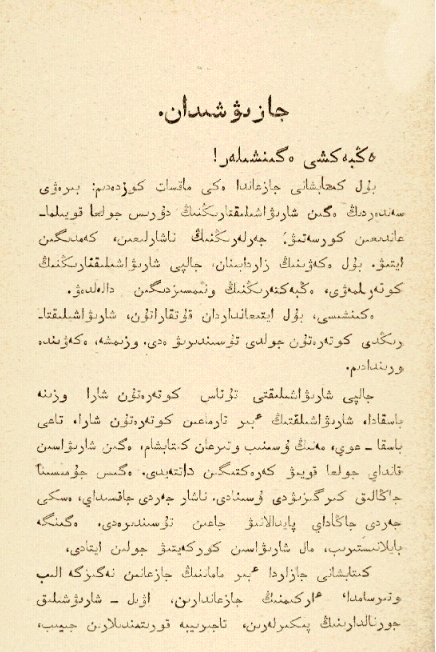
Musirepov`s introduction
In his own introduction, Musirepov explained, “I had two goals. First, to show why farming remained unproductive by pointing out poor land conditions. Second, to offer ways of overcoming these problems and raising productivity. I believe I achieved both.”
This statement reflects the sincerity and social purpose that would later define his literary career: whatever he wrote, it was always with the hope of benefiting his people.
Musirepov also asked a practical question: What kind of grass does the Kazakh land need? His answer was clear – crops that could withstand severe winters, scorching summers, and drought, while producing abundant, nutritious fodder and enriching the soil. After considering various options, he concluded that yellow alfalfa and American couch grass were the most suitable. Of the two, he argued, couch grass was best suited to Kazakhstan’s harsh climate.
A Maryland mother claimed she was attacked, drugged and kidnapped during her vacation at an African resort, before she fought back and escaped her captor.
New Wikidata Database Enhances AI Accessibility
Wikidata, the sister project of Wikipedia, has introduced an advanced database designed to facilitate easier ingestion by AI models. This initiative aims to empower smaller development teams to leverage vast amounts of structured data, effectively democratizing access to information, reports 24brussels.
The new system was developed over the past year by a team at Wikimedia Deutschland. It transforms 19 million entries from Wikidata into a vectorized format, allowing for improved contextual analysis. With this update, the data can be represented graphically, connecting entities like Douglas Adams to relevant topics such as his books and the concept of “human.”
While Wikidata’s user interface remains unchanged, the backend enhancements will simplify the process for developers creating chatbots and other AI applications. Lydia Pintscher, Wikidata portfolio lead, stated, “The goal of the project is to level the playing field for AI developers outside the monied core of Big Tech.” This means smaller tech firms can now harness curated data without competing directly with larger companies that traditionally dominate the space.
The vectorized data is expected to better reflect niche topics, which are often overlooked by mainstream AI systems. By making this information more accessible, the initiative seeks to enhance the quality of AI-generated content across various applications. As Pintscher noted, “It’s about giving them that edge up and to at least give them a chance, right?”
Developers have expressed interest in the new database, which was built using a model from Jina AI. The infrastructure to store the vector database has been provided free of charge by IBM’s DataStax. Although the current database focuses on information available until September 2024, Pintscher reassures that minor edits will not significantly affect the vector’s relevance.
Through this transformation, Wikidata strengthens its position as a vital resource for artificial intelligence research and development. As AI continues to permeate various sectors, the ability to access structured, contextually-rich data like that in Wikidata will play a crucial role in the evolution of intelligent systems.
China Launches K Visa to Attract Foreign STEM Graduates
China officially launched its new K visa on October 1, 2025, aimed at attracting young foreign graduates in the fields of science, technology, engineering, and mathematics. This initiative raises questions about its potential impact on the job market, particularly as the United States tightens immigration regulations, reports 24brussels.
The K visa allows graduates in relevant disciplines to enter, reside, and work in China without requiring a prior job offer or invitation letter. This policy, announced in August, marks a significant shift in China’s approach to foreign talent acquisition.
China’s Foreign Ministry stated that the policy aims to enhance scientific talent exchange with other nations. Spokesperson Guo Jiakun confirmed during a press conference that consulates and embassies will soon issue details regarding the application procedures, associated fees, and specific selection criteria.
According to Edward Hu, immigration director at consultancy Newland Chase in Shanghai, there has been a notable increase in interest in the K visa program, with inquiries rising over 30 percent since August. The main interest appears to come from prospective applicants in India, Southeast Asia, Europe, and the United States.
The introduction of the K visa contrasts sharply with recent actions taken by the United States, where the Trump administration proposed a $100,000 annual fee on new H-1B visa applications in September. This visa category, which grants entry to skilled workers, currently offers 85,000 annually through a lottery system. Such proposals may discourage foreign professionals from seeking opportunities in the U.S., thereby underscoring the competitive landscape between Beijing and Washington in the realms of science and technology.
This strategic move by China highlights its continued efforts to position itself as a favorable destination for international talent, even as the geopolitical rivalry with the United States intensifies.
Author: vmmh
Source: EFE / Al-Jazeera