
It does not look like the Blue Jays are going anywhere anytime soon, and that’s bad news for the Yankees.
Day: October 31, 2025

US refugee groups say move ‘lowers our moral standing.’ Plus, unionized Starbucks workers to vote on strikes over pay and conditions

The president wants the GOP to use the “nuclear option” as government shutdown drags on.
JOSH EDELSON/AFP via Getty Images
- Meta’s CTO shared advice on how to manage your “emotional economy.”
- Andrew Bosworth said in a blog post to think of your relationships like investments.
- “Manage your emotional economy like any other portfolio,” he said.
Manage your relationships like you manage your stock portfolio.
That’s the advice that Andrew “Boz” Bosworth, the CTO of Meta, gave in a blog post this week about what he described as managing your “emotional economy.”
“Imagine each person in your life as a publicly traded security,” Bosworth, who has been at Meta since 2006, wrote. “You’re heavily invested in a few — your parents, your partner, your manager. You hold small positions in many others, like coworkers or acquaintances. And then there are people you have no stake in at all — strangers on the street, commenters online, passing critics.”
Bosworth said how much influence someone has over our sense of self-worth should be proportionate to how much we’ve emotionally invested in them.
“When a guy on the street insults your shirt, it shouldn’t register any more than a stock you don’t own crashing,” he said. “But most of us don’t run our emotional portfolios so rationally.”
Bosworth said most of us grant others “emotional equity” in our lives that they haven’t earned. Instead, he said, we should be putting emotional investments into relationships that actually deliver returns.
He wrote: “Manage your emotional economy like any other portfolio: diversify wisely, invest intentionally, and don’t panic when the market dips.”
Bosworth, who regularly shares advice on his personal blog, said his goal is to share what he’s learned over his career, and that most of the lessons he learned “the hard way.”
Bosworth did not immediately respond to a request for comment.
Meta reported Q3 earnings on Wednesday, with its stock declining 9% in after-hours trading following the call.
Read the original article on Business Insider
After more than a century of keeping time, this Tribeca clocktower at 108 Leonard has a new job: keeping house.
Diplomats raise alarm over homeland security adviser assuming control through interagency phone meetings
The historic shifts in US immigration under Donald Trump have been dictated by a relentless voice over a telephone line: Stephen Miller, the president’s immigration czar, who in recent months has turned the state department’s visa and refugee operations into what some current and former diplomats have described as a personal fiefdom.
Each morning, usually at 10am, a small circle of conservative diplomats allied with Miller, including those who have assumed control of the state department’s consular and refugee operations, dial in for what some have termed the “Stephen Miller call”, an interagency discussion of immigration measures led by Miller, the White House’s homeland security adviser.
Hospital officials in Gaza say Israel has handed over the bodies of 30 Palestinians [deltaMinutes] mins ago Now
Andy Kiersz/Business Insider
- On earnings calls this week, Big Tech companies reported significant AI spending.
- Each said the spending spree will continue into 2026 and be even bigger than previously reported.
- Some investors are concerned about the risks of an AI bubble.
Big Tech’s AI gold rush isn’t slowing down— it’s getting more expensive.
Amazon, Google, Meta, and Microsoft all opened their wallets wider than ever this quarter, logging record-breaking capital expenditures on AI chips, servers, and data centers.
Microsoft was the top spender at nearly $35 billion, narrowly beating Amazon. Meta CEO Mark Zuckerberg said the company could increase its long-term asset spending, or capital expenditure (capex), by as much as 24% next year. Each company said it planned to spend even more on capex going forward.
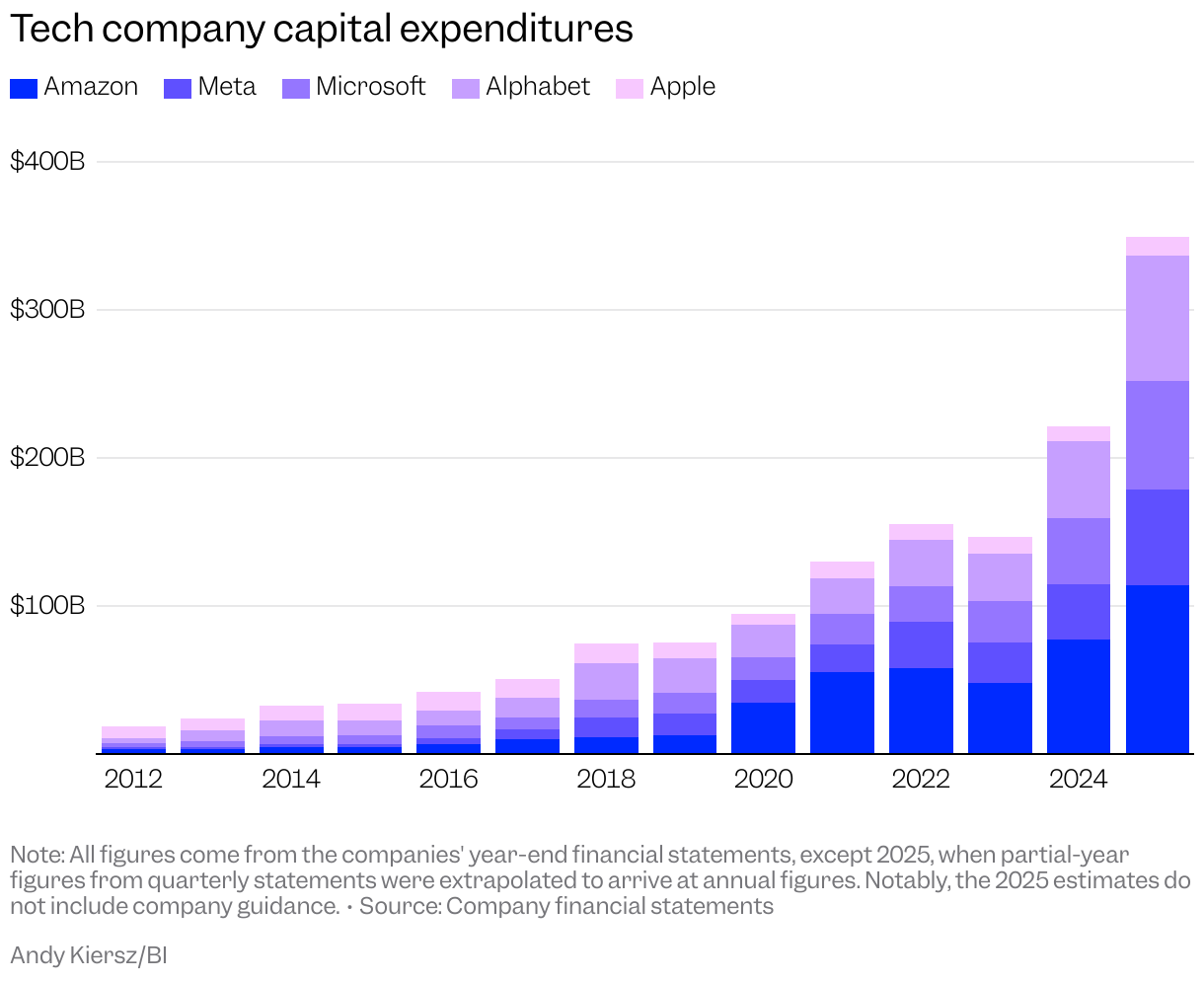
A few recent deals exemplify this trend. Amazon this week opened an $11 billion data center in Indiana, part of its massive AI supercluster called Project Rainier, and said it would spend $5 billion on data centers in South Korea. Microsoft recently joined a consortium of investors, including BlackRock, Nvidia, and Abu Dhabi’s MGX, to buy 50 data centers in the US and Latin America Aligned Data Centers for $40 billion. Aligned operates 50 data centers in the US and Latin America.
Even Apple, a notoriously restrained spender compared to the other hyperscalers, told investors that it expects capital expenditure (capex) spending to increase in the next fiscal year.
Investors are watching closely: companies showing early AI payoffs, like Google, are being rewarded, while others — like Meta — are running out of time to prove the spending spree is worth it.
“After all the expensive hires and the capex ramp, Meta’s grace period for showing investors something on the non-core AI side is nearly up,” Bernstein senior analyst Mark Shmulik said Wednesday in a research note.
The question for investors: which of these giants can turn that spending into actual AI returns — and which are just building costlier foundations for the future?
Matthias Balk/picture alliance via Getty Images
Reuters
Chris Jung/NurPhoto via Getty Images
Jonathan Raa/NurPhoto via Getty Images
Read the original article on Business Insider
Christine had a feeling her son Michael, 7, would have done “something crazy” for his drawing. That prediction proved correct.