
The main takeaways from the Netherlands’ nail-biter elections, with the result still in the balance [deltaMinutes] mins ago Now
Day: October 30, 2025
China says it will work with US to resolve issues related to TikTok [deltaMinutes] mins ago Now

Reeves has been renting out her south London home without the specific £945 licence required by the local council
The Conservative have said Keir Starmer should sack Rachel Reeves. A Tory spokesperson said:
Rachel Reeves has broken the law and broken the ministerial code, but Keir Starmer is too weak to sack her.
While the chancellor is planning tax hikes for millions of families across the country at the budget, it’s one rule for the chancellor and another for everyone else.
“I think he needs a service dog,” added one user.
France’s new submarine-launched ballistic missile provides enhanced range, accuracy and the ability to penetrate defenses.
Her husband, Andrew Bradshaw, confirmed she died on Monday in a heartbreaking social media post.
Getty Images; Tyler Le/BI
You’ve heard soulful power ballads about love, or loss, or yearning. But have you heard someone croon about… property taxes?
“In a world full of noise, hear the love choir sing/Together in unity, we’re reclaiming our wings,” the singer croons. “So sign a petition/come join the fight/let’s axe the taxes/bring wrongs to the right.”
The song, “Uplift the Dream,” is one of 20 tracks on an AI-generated album specifically designed to rally support for eliminating Ohio’s property taxes. (That’s also not including 10 bonus tracks released later.) While a full album devoted to rolling back property taxes may seem extreme, it’s rooted in a very real movement: Right now, large swaths of America are gripped by a property tax revolt.
Beyond Ohio’s musical pushback, there’s breakdancing at New Jersey town meetings in protest of property tax increases, and even rallies in Washington state where attendees can win a raffle to have their property tax paid for. On the federal level, lawmakers like Republican Rep. Marjorie Taylor Greene are advocating for the nationwide abolition of property taxes. Even Elon Musk has weighed in, stating that the taxes mean “your house is a de facto lease from the government.” On the whole, the pressure seems to be coming from baby boomers, who are both the largest share of home buyers and help make up the largest share of homeowners across the generations.
There’s a good reason, on the surface, for some Americans to be taken aback at their taxes. Property values have exploded over the last few years, causing some homeowners’ tax bills to grow by hundreds or even thousands of dollars annually. That has led to pushback, from people like Brian Massie, a retired Ohioan whose group generated the anti-property levy album and is leading the effort to axe the tax in his home state.
“When my friend and I were talking about this, we were saying, ‘No one cares.’ Representatives aren’t even willing to talk to us about the problem,” Massie says. “Then we’re going to have to starve the beast, and that’s the expression we use — starving the beast. We said, ‘We’re going to get a citizens-led initiative to abolish all Ohio property taxes’.”
The revolt also comes at a particularly tense moment between generations. On one side are the boomers, who are sitting on properties whose values have skyrocketed but are entering their retirement years, when cash flow starts to become squeezed. On the other hand are millennials and other younger residents, many of whom are priced out of homeownership, but rely on the local services, from schools to fire departments, that property taxes fund. Both have legitimate concerns — but the decision to take aim at one of the simpler tax bills we’re stuck with could pop many structures of American daily life in the process.
The role of a property tax
Property taxes are just one part of the life cycle of American taxation. Younger taxpayers pay Social Security taxes out of their incomes, funding the benefits they won’t receive for decades. On the other hand, older taxpayers help fund schools and other municipal services they may not use in their daily lives by paying property taxes on their larger and generally more valuable properties. Property taxes are a huge funding source: As of fiscal year 2022, 27.4% of local and state tax collections came from property taxes, per an analysis by the Tax Foundation, making it the largest single source of tax revenue.
“Replacing the property tax is virtually impossible in most states, at least without avoiding substantial economic harm,” Jared Walczak, the vice president of state projects at the Tax Foundation, says. “Property taxes generate about 70% of all local tax revenue nationwide. In many states, it’s 80% or 90%, or even higher.”
Property taxes are also, unlike a lot of other aspects of the American tax system, pretty simple. Kyle Pomerleau, a senior fellow studying federal tax policy at the American Enterprise Institute, tells me that property taxes are relatively high on the list of simple and efficient taxes. Rather than rely on some wild calculation or complicated brackets, property taxes are assessed as a percentage of the value of the land and the buildings on it, so there are a lot fewer ways to dodge the tax.
Of course, property taxes can have their flaws — something many aggrieved homeowners are experiencing firsthand. Owners have constrained direct control over the value of their property. Sure, you could make a major renovation or build an entirely new building on the lot, but the price of real estate in a given area is subject to larger factors like zoning laws, migration trends, and interest rates. When home values skyrocket, as they have over the last few years, property taxes soar with them. Home values have increased by an inflation-adjusted nearly 27% since 2020, according to a Tax Foundation analysis, and that’s dragging property taxes up with them.
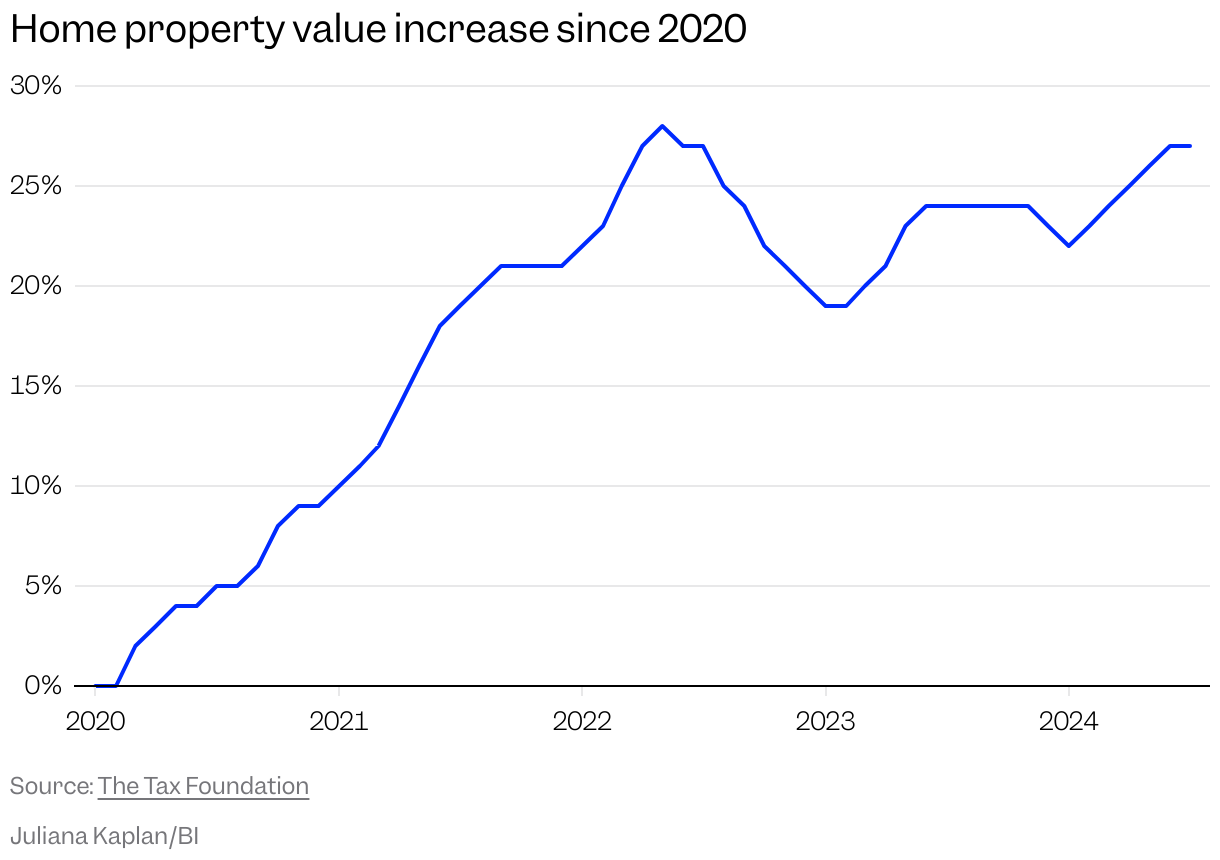
“If your property value has gone up by 50% and your rate hasn’t changed, you’re paying 50% more in nominal terms,” Walczak says. In inflation-adjusted terms, that’s over 25% more in taxes. “You’re probably upset, and you’re probably calling your legislators, and they are clamoring for solutions. And that doesn’t always yield good policy, but there are valid reasons for the current consternation.”
There are, of course, benefits to having the value of your property go up. Your net worth is higher, and you have more borrowing power. If and when you sell your property, you’ll make a good profit. But that net worth is pretty illiquid. You may have that home equity and wealth, but you can’t redeem that at the supermarket.
As Pomerleau tells me, part of the pushback might just be because of how visible these taxes are: Income taxes are withheld from your paycheck, and other taxes might only make their appearances when you wrangle all your documents in April. But with property taxes, you’re paying it through your mortgage or actually sending a check to your local government.
“You internalize the tax burden,” Pomerleau says. “And that internalization, I think, can cause people to be like, wow, it really costs this much.”
A sudden increase in the size of the check that you’re writing to the government can feel especially disconcerting when the home around you isn’t materially changing. Structures themselves tend to decrease in value over time — it’s the land that’s appreciating in value. So, homeowners are sitting in their same homes, with their creaky floors and occasional leaky faucets, and being told that they have to pay up because it’s 20% more valuable. Those changes can feel abstract, Rita Jefferson, a local analyst at the Institute on Taxation and Economic Policy, tells me.
“We really do have to deal with the affordability problem of housing in this country at a very basic level in order to get a handle on property taxes. But the way to do that is not to cut property taxes,” Jefferson says.
A generational divide
Motivated Americans have previously gone to war over property taxes, but this iteration of the battle has a distinct generational flavor — and more extreme demands. In the 1970s, Walczak said, a combination of skyrocketing home values and localities pocketing extra cash led to some tweaks around the country. In California, for instance, Proposition 13 froze property tax collections at 1% and capped assessments, which are the government’s estimates of property value for tax purposes, at 2% annually until a property is sold. The rules helped freeze some homeowners in place — the assessed value of many long-held homes is well below the actual market value of the property, so those who bought in that era are paying a lot less in tax than their more recently moved-in neighbors.
That tweak may also have contributed to some of the circumstances fueling today’s revolt. While it’s not entirely the intention, Jefferson says that property taxes often act as a built-in incentive or gentle nudge for folks sitting on properties increasing in value. If you’re an older person in a four-bedroom house, paying property taxes on that larger property, you might take that moment to realize it’s time to downsize. When you downsize, that opens another housing option for a cash-strapped millennial. In California, research suggests younger workers have had to put off the transition from being renters to homeowners, as older people are unwilling to give up their preferential rates. It’s not just California: Across the country, older homeowners are staying put, with 40% of them remaining in their homes for 20 years or more. This has helped push up the median age of a first-time homebuyer to a record 38 years old. That leads to generational resentment, as younger would-be homebuyers feel boxed out by intransigent boomers, while the older generation feels like millennials and Gen Xers are the beneficiaries of those tax checks they’re mailing into town hall.
“When you have predominantly older people paying the vast majority of your home property taxes, what ends up happening is that they become increasingly resentful of the fact that they’re paying for school districts. They’re paying for all these things that they say they don’t use,” Jefferson says.
She adds that eliminating the property tax outright is “shortsighted.” It’s, in essence, addressing the symptoms rather than the root. After all, one of the reasons that home values have skyrocketed is that there isn’t enough affordable, available housing for everyone.
Massie, the retired Ohioan trying to wholesale abolish property taxes, says he feels bad for younger generations as they contend with both higher home prices and ballooning college loans. But he doesn’t understand why he’s on the hook to pay for someone else’s education. He also chafes at the idea that older people should move out of their homes if they can’t afford their property taxes.
“I’ve been in this house 20 years, and I’ve paid over a hundred thousand dollars for local education,” Massie says. “I’ve never sent a child. I’ve never benefited from the services at all. Do I have to go bankrupt? Is that what everybody wants, or is that enough?”
Some areas have already started to offer some relief to homeowners. In Indiana, for instance, a newly passed bill lets homeowners take a 10% property tax credit off what they owe. But this comes with its own problems: Lawmakers in the state have argued that the reductions will force the state to rely more heavily on income taxes and shrink the available revenue for public services.
“My area, Fort Wayne Community Schools, is looking at, I believe, around a $10 million hit for their budget coming up in 2026,” Indiana House Minority Leader Phil GiaQuinta, a Democrat representing Fort Wayne, tells me. “And so they’re going to have to figure out ways to probably have to borrow, but who knows what, but they’re going to have to figure out ways to fund the school system. But we’re talking about basic needs, like a new roof.”
A wholesale cut would cause even more problems, Jefferson says, since it also lets people who can afford to pay property taxes off the hook. It will also lead to what Pomerleau says is a reduced cycle of wealth transfers — older taxpayers will no longer fund the resources that younger households rely on. As he puts it, “you and I work and earn wages today to pay for current benefits for the same seniors that don’t like paying property taxes.”
That’s an argument that resonates with Cameron Mulvey, a 27-year-old entrepreneur in Massachusetts. If you’d asked him five or six years ago, he might have been more open to a property tax repeal. But in the current economy — and with perhaps a less naive worldview, he says — it’s a much harder sell.
“If you look across the broader scope of the economy, there are so many advantages to boomers and so many headwinds working against people in their 20s,” Mulvey says.
As Mulvey notes he’s not receiving Social Security benefits, but his taxes are still paying for it. Ideally, he said, entitlement pools like that of Social Security grow, so that you can take out more than you paid in. But, if he died at the age of 60, he might not ever see a penny of his payments — even though he paid into it.
“Just because you’re not using the benefits that your tax pays for — in this case, schools — that’s how taxes work. That’s how taxes are supposed to work,” Mulvey says. “So I think it’s just a little bit of a frankly delusional argument that just because they’re not using the benefits, they shouldn’t have to pay the tax.”.
Massie, the anti-property tax Ohioan who draws from Social Security, counters that Social Security funds are drawn from a federal tax, and the monthly benefits are “not making anybody rich.” He says that some public pensioners likely receive more than he does from his Social Security.
“Why would I have to pay more or less than my neighbor for police and fire and roads based on the valuation of my property? What does the valuation of my property have to do with how much I should be paying for my police and roads?” Massie said.
Regardless of the resentment, all the tax aficionados agreed that a wholesale elimination of property taxes is just not fiscally sustainable for the larger infrastructure ecosystem. That doesn’t mean that the situation has to fester, though — there are ways to reform it, but none that are likely as simple or as appealing as just nixing the tax entirely.
Walczak says that one potential solution is imposing levy limits, which limit the amount of revenue that a locality can generate from existing properties. The important distinction is that it’s a limit on overall collections, rather than a parcel-by-parcel cap — that type of tweak leads to situations like the one in California, where property tax burdens both hinder housing availability and place a greater property tax burden on new homebuyers. Other options, according to Jefferson, could be what’s called property tax circuit breakers — circuits that get “tripped” when property tax bills consist of a certain percentage of workers’ incomes, or when homeowners are below certain income thresholds. It may increase the complexity of the system, but it would also alleviate some of the concerns about tax burdens on older people who no longer have paychecks coming in.
“They sound complicated. They’re not straightforward. They’re not merely as straightforward as cutting property taxes,” Jefferson says. “But these are the kinds of things that will actually make sure that the people who genuinely cannot afford paying property taxes are the ones who are being supported.”
It’s unclear how successful these pushes will be. The argument, however, comes at a time when Americans’ distrust of one another is on the rise, especially among younger people. If boomers successfully argue away a tax that will only impact them for a few years, it may be because it appeals to Americans who already feel like their social contract has broken.
“I think it’s incredibly shortsighted because we all benefit from living in a society in which there’s a basic level of provision of goods for everybody regardless,” Seth Coltar, an Oregon-based historian, tells me. “It feels like it’s part of this generalized sense of a radically individualistic and antisocial attitude towards other people.”
And the pushback — and any tweaks that come with it — could create unpleasant, subtle cracks that only surface years later.
“For an entire class of people who already own their homes to stand up and say no is, to me, just totally unreasonable,” Jefferson says. “It is, to me, a total dereliction of civic duty to your fellow taxpayers, to the people who live in your community, to the people who use all these other public services that are not just for the benefit of you, the homeowner, who can stand up and say, no.”
Read the original article on Business Insider

After their two countries teetered for months on the edge of an all-out trade war, U.S. President Donald Trump and Chinese President Xi Jinping said they’ve reached a trade deal after meeting face-to-face in South Korea.
Trump and Xi spoke Thursday morning in Busan in a highly-anticipated meeting that lasted close to two hours. Trump was accompanied by Secretary of State Marco Rubio, Trade Representative Jamieson Greer, Treasury Secretary Scott Bessent, Commerce Secretary Howard Lutnick, Chief of Staff Susie Wiles, and U.S. Ambassador to China David Perdue. Chief of Staff Cai Qi, Foreign Minister Wang Yi, Vice Foreign Minister Ma Zhaoxu, Vice Premier He Lifeng, Commerce Minister Wang Wentao, and Chairman of the National Development and Reform Commission Zheng Shanjie accompanied Xi.
[time-brightcove not-tgx=”true”]
The deal formalizes a framework agreement between American and Chinese negotiators reached earlier this week.
“I guess, on the scale from zero to 10, with 10 being the best, I would say the meeting was a 12,” Trump told reporters aboard Air Force One after the meeting. “You know, just the whole relationship is very, very important. I think it was very good.”
He added that the U.S. and China “have a deal” that can likely be signed “pretty soon” and that can be renegotiated every year.
“We have not too many stumbling blocks,” Trump said.
Xi also announced that the U.S. and China reached a consensus, according to Chinese state media.
It is not yet clear whether the deal is a comprehensive agreement, but its news comes as a relief to businesses, consumers, and investors after the world’s two biggest economies ramped up levies and export controls in recent weeks. The deal scraps Trump’s threat of a 100% tariff increase, immediately reduces the total tariff rate on Chinese goods, and resolves, at least for now, several of the more contentious trade issues between the U.S. and China.
Thursday was the first meeting between Trump and Xi in six years. Busan rounded off Trump’s three-country tour of Asia, which included the ASEAN summit in Malaysia, Trump’s first meeting with Japan’s new Prime Minister Sakae Takaichi in Tokyo, and the APEC summit as well as a meeting with South Korea’s new President Lee Jae-myung in Gyeongju.
Trump also said he would travel to China in April and Xi would visit the U.S. later next year.
“We do not always see eye-to-eye with each other, and it is normal for the two leading economies of the world to have frictions now and then,” Xi said to Trump in preliminary remarks. “And in the face of winds, waves and challenges, you and I, at the helm of relations, should stay the right course and ensure the steady sailing forward of the giant ship of China-U.S. relations.”
“He’s a very tough negotiator, that’s not good,” Trump said with a laugh in preliminary remarks.
The details of the agreement have yet to be released, but here’s what we know so far about the deal.
Rare earths
China will suspend its rare earths licensing measures for at least a year, according to the Chinese Ministry of Commerce’s statement about the framework agreement. Earlier this month, China announced new licensing requirements for rare earths exports to all countries. The move prompted further hostile measures from the U.S., which had also introduced its own restrictions on China in the weeks before. Experts had speculated that rare earths would be a key piece of leverage for China in trade negotiations with the U.S., as China accounts for around 70% of the world’s supply of critical minerals, which are crucial to the U.S.’s military, semiconductor and auto sectors.
“That road block is gone now,” Trump said, adding that the rare earth issue “has been settled, and that’s for the world. … This was a worldwide situation and not just a U.S. situation.”
He added that the pause could be renewed after a year. “That will hopefully disappear from our vocabulary for a little while,” he said.
Soybean purchases, increased investments
China will also resume its purchases of American soybeans, Trump said. China, which was once the biggest buyer of U.S. soybeans, had effectively frozen new orders of the crop after Trump unveiled his tariffs earlier this year, battering farms across the country. Shortly before the meeting between Trump and Xi, China reportedly bought cargoes of U.S. soybeans in its first known purchase of this season.
Trump also said the Chinese “feel very strongly” about increasing investments in the U.S. and that they had congratulated him on thus far attracting huge sums of foreign investment.
Semiconductor chips
China may also be allowed to buy advanced computer chips from the U.S., which has been another sore point between the two countries. Trump said Beijing will speak with Nvidia’s CEO Jensen Huang with the U.S. acting as a “sort of arbitrator or the referee” but that discussions would not involve the most advanced Blackwell chip.
Lower tariffs on China
China’s Commerce Ministry said in its statement about the framework agreement that the U.S. agreed to suspend Trump’s 24% reciprocal tariff on China for another year. The reciprocal tariff was suspended for 90 days in May following a truce between the U.S. and China, and the suspension was subsequently extended again in multiple 90-day periods. The latest extension was set to expire on Nov. 10.
Greer told reporters on Air Force One that the U.S. will also postpone its Section 301 probe into Chinese shipbuilding which would have involved higher port fees on Chinese ships and prompted retaliatory port fees from China on American ships. China’s Commerce Ministry said the U.S. agreed to suspend the investigation for one year, and that China will also suspend its countermeasures for one year. The Trump Administration has sought investments and partnerships with Asian allies during this trip in line with their goal to “Make American Shipbuilding Great Again.”
And Trump said the U.S.’s 20% fentanyl-linked tariff on Chinese goods would be halved, effective immediately, bringing the total tariff on most Chinese goods down from 57% to 47%. Trump said he and Xi agreed China would take “very strong measures” to reduce the flow into the U.S. of precursor chemicals used to make fentanyl.
“I believe he’s going to work very hard to stop the death that’s coming in,” Trump said.
Security issues, peace talks
Trump said Xi also agreed to work together with the U.S. to end the war in Ukraine.
“We’re both going to work together,” Trump said. “We agree that the sides are locked in fighting and sometimes you have to let them fight I guess. Crazy. But he’s going to help us and we’re going to work together on Ukraine.”
In a pivot from his earlier friendly relationship with Russian President Vladimir Putin and rocky relationship with Ukrainian President Volodymyr Zelensky, Trump has pushed countries to end ties with Russia over its continued bombardment of Ukraine, including threatening tariffs on countries that continue to purchase Russian oil. Trump said talks with Xi, however, did not center on Russian oil, but focused on cooperation to end the war. (China was the biggest buyer of Russian crude oil last year.)
In their preliminary remarks before the meeting, Xi said, “China and the United States can jointly shoulder our responsibility as major countries, and work together to accomplish more great and concrete things for the good of our two countries and the whole world.”
The security of Taiwan, which some had worried would be used as a concession by the U.S. in order to secure better trade terms, was not discussed, Trump said.
China’s foreign ministry said in a readout after the meeting that China “will further deepen reforms comprehensively and expand opening up.” The country has opened itself up to an unprecedented level this year to tourists and immigrants, while it has sought to diversify its trade relationships and position itself as a potential global mediator.
“Economic and trade relations should continue to be the ballast and engine of China-U.S. relations, not a stumbling block or point of conflict,” the readout said, adding that the two sides should finalize the deal soon. “Both sides should consider the bigger picture and focus on the long-term benefits of cooperation, rather than falling into a vicious cycle of mutual retaliation.”
U.S. leaders did not say whether a deal for the purchase of TikTok’s U.S. operations, which was part of the framework agreement, was part of the deal reached Thursday.
Jakub Porzycki/NurPhoto via Getty Images
- Boot Barn beat Wall Street expectations with an 18.7% sales increase to $505.4 million.
- Western wear has had a resurgence in recent years.
- Boot Barn’s CEO said the company is also selling more denim, especially bootcut jeans.
Boasting the rodeo-ready title of the largest Western retailer in the United States, Boot Barn beat Wall Street expectations in its quarterly earnings report on Wednesday.
The company reported a net sales of $505.4 million, a 18.7% increase from a year prior. Boot Barn’s share price has increased by more than 50% over the past 12 months, and is up over 27% year-to-date.
Boot Barn, which operates nearly 500 stores, said it conducted a market analysis that determined its total addressable market is bigger than previously believed, at an estimated $58 billion. Its TAM was previously thought to be $40 billion.
“We now also believe we can operate 1,200 stores across the United States, an increase from our prior estimate of 900, which is more than double our current footprint,” CEO John Hazen said. “We are confident in our ability to capitalize on this expanded market opportunity while continuing to deliver strong returns for our stockholders.”
Hazen said during the call that while the company had seen strength across its main categories of western apparel and boots for men and women, the company’s denim segment has become a draw in and of itself.
“We really have become more of a denim destination,” Hazen said.
Western wear has experienced a resurgence in recent years, driven in part by the popularity of the show “Yellowstone” and major pop culture events, like Beyoncé’s “Cowboy Carter” album and tour.
While some American retailers experienced a slowdown this year, driven in part by tariffs, Boot Barn said it’s seen sales growth both online and in-store.
“As I look at the top 10 styles in women’s denim or men’s denim, it is almost exclusively bootcut jeans,” Hazen added, noting that its customers are seeking out the “traditional silhouette.”
Christopher Nardone, an analyst with Bank of America who was on the call, asked if Boot Barn was seeing emerging competition in the Western category, given its popularity.
CFO Jim Watkins said that when Western boots, especially women’s, are more in style, some of the mainstream brands will sell them, at least temporarily, but that they “haven’t really seen any significant, sizable entrants into the market.”
Have a tip? Contact this reporter via email at kvlamis@businessinsider.com or Signal at @kelseyv.21. Use a personal email address, a nonwork WiFi network, and a nonwork device; here’s our guide to sharing information securely.
Read the original article on Business Insider