
The European Union separately unveiled a fresh sanctions package against Moscow on Thursday.
Day: October 23, 2025

Save up to $220 on high-end items from Dyson, Hunter, and more. These are the best new Costco luxury brands that just hit shelves.
Speculation grows around whether the Louvre’s stolen jewels could end up on the market [deltaMinutes] mins ago Now
Terence Crosbie (38) from Dublin is accused of raping an American woman in Boston after St Patrick’s Day celebrations in 2024
A Texas mom admitted to running over and killing her husband with her SUV — but claimed she was drunk and only meant to “hit” him.
AaronP/Bauer-Griffin/GC Images
- An American Airlines flight returned to Omaha 20 minutes after taking off.
- The pilots declared an emergency after mistaking an intercom issue for a security threat.
- Passengers ultimately reached Los Angeles more than four hours later than expected.
American Airlines passengers endured a flight to nowhere after the pilots mistakenly thought somebody was trying to breach the cockpit.
Flight 6469 departed Omaha, Nebraska, at 6:40 p.m. on Monday, headed for Los Angeles. The Embraer 175 was operated by the regional carrier SkyWest Airlines as an American Eagle flight.
However, less than 10 minutes after takeoff, it was circling back to Eppley Airfield in Omaha.
The plane landed at 7 p.m., having only reached a maximum altitude of about 10,000 feet, per data from Flightradar24.
In a statement, the Federal Aviation Administration said the flight declared an emergency “when the pilot could not contact the cabin crew.”
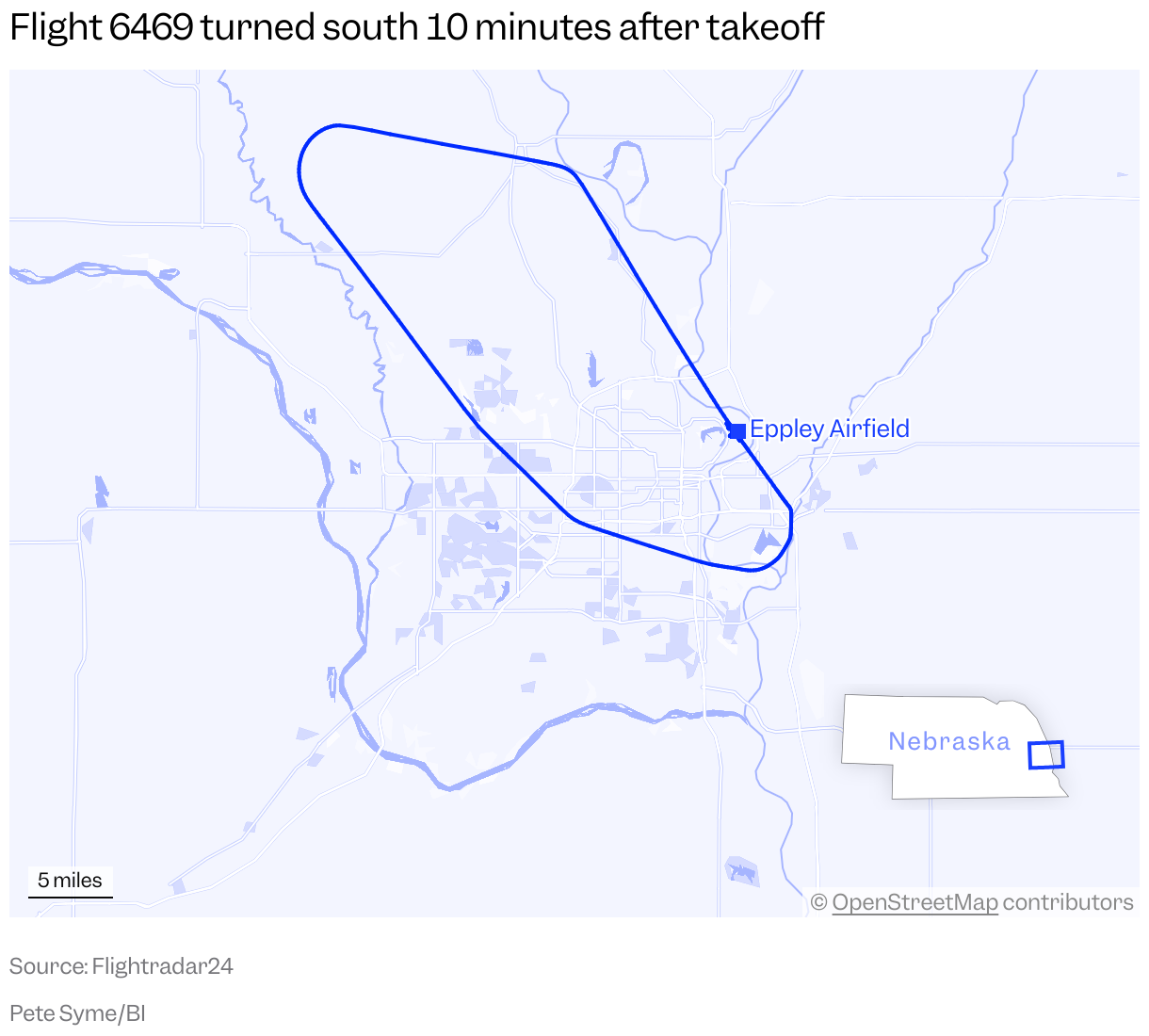
“After landing, it was determined there was a problem with the inter-phone system and the flight crew was knocking on the cockpit door,” it added.
An American Airlines spokesperson told the Associated Press that the intercom system, which pilots and flight attendants use to talk to each other, had been left on by accident.
They added that the pilots heard some static sound over the intercom and thought this meant somebody was trying to break in.
A SkyWest spokesperson told Business Insider the flight had “returned to Omaha out of abundance of caution after experiencing communication issues with a flight crew mic.”
Data from Flightradar24 shows that the same Embraer 175 again departed Omaha at 11:18 p.m. local time.
It landed in Los Angeles just after midnight Pacific Time — over four hours later than it was initially scheduled to touch down.
American Airlines did not immediately respond to a request for comment sent by Business Insider.
Read the original article on Business Insider
Joanna Kulesza for BI
When one of my relatives asked for a $1,000 loan, I felt two emotions immediately: guilt and dread.
Guilt because I had more financial resources than they did — I’m a millionaire who has worked in finance for decades. Dread because I’ve seen, both professionally and personally, how quickly money can complicate even the best of relationships.
As a financial planner professional turned financial therapist, I specialize in wealth alignment — helping ultra-high-net-worth individuals and couples transform money from a source of stress into one of connection, impact, and lasting fulfillment.
Still, this situation brought me face-to-face with the very thing I help others navigate: the emotional land mines of lending money to family.
I approached the ask like a financial planner — and a therapist
In reality, a $1,000 loan wasn’t going to break me, and it was something that could help my family member significantly when they asked for it in 2018. If I were going to help them, I knew that I wanted to protect our relationship.
First, we formalized the loan. We agreed to monthly interest-only payments of $100, with the principal due three months after the initial payment. Although it may seem overly formal to some, I asked my relative to sign the paperwork outlining the repayment terms we had agreed upon. I’ve seen too many family rifts erupt when expectations aren’t clearly spelled out.
Joanna Kulesza for BI
Second, I made a private mental shift: I decided to treat the loan as a gift. I didn’t tell my family member this; it was something I did for myself. That way, if they never paid me back, I wouldn’t hold any resentment.
What I didn’t do was address another uncomfortable feeling: the fear that I might be enabling unhealthy behavior. I was afraid that giving them money — even as a loan — might be more harmful than helpful. But at the time, I was too caught up in guilt about our financial disparity to be honest about that, even with myself.
Things went well until they didn’t
The first month, my relative made the monthly interest payment as agreed. Then, there was silence. The payments just stopped. I followed up a couple of times via text, but there was no reply.
Because I’d framed it as a gift in my head, I stopped pushing. Months passed. I wasn’t particularly worried because it followed the typical cadence of our relationship; occasional texts with weeks, if not months, of silence in between. We didn’t have the type of relationship where we often spent time together.
Joanna Kulesza for BI
A year later, I reached out again. That’s when I finally heard back.
They apologized and said they had been going through some personal issues. Then, they told me when they’d repay me, and followed through this time. Later, they explained why they didn’t reply, saying they had felt so much shame.
In my work today, I often see clients experiencing feelings of shame around money. Having it, not having it, needing it, wanting it, resenting it — all of these stir up complex emotions.
I realized I’d sent mixed signals
Looking back, I realized something powerful: I’d said it was a gift in my mind, but I acted like it was a loan. That contradiction created confusion. If I had been clearer and more emotionally honest from the beginning, we could’ve avoided months of silence and perhaps reduced their emotional strain.
I now guide my clients, many of whom are 8- to 12-figure wealth holders, to get clear about why they want to lend money, not just whether it’s within their capacity.
Joanna Kulesza for Businses Insider
There’s always the stated reason: “I want to help.” But beneath that, there are often unexamined emotions such as guilt, fear, or unresolved family dynamics. When we don’t name those, our actions often send mixed messages — and create unnecessary harm.
The key takeaway is that if you’re lending money to someone you love, deal with your own emotions first. Unspoken guilt or shame doesn’t go away; it just hides in the fine print. And in relationships, that’s where real damage happens.
My relative and I have moved on
For years, when recalling our exchange, I remembered the number incorrectly and thought it was $10,000, rather than $1,000 that I had loaned. It wasn’t about the amount of money to me, it was the principle of everything the money stirred up.
This was seven years ago; today, my relative and I are in a good place. We text and talk occasionally and know we can reach out to each other for help or support when needed. After they repaid in full, we haven’t discussed making any other loans between us.
Read the original article on Business Insider

As the walls come down on the part of the White House that’s been synonymous with American first ladies for decades, Melania Trump has remained silent.
Ascend Photography
- Nicole Shirvani is a full-time doctor and part-time real estate investor.
- She added short-term rentals to her portfolio for diversification and tax benefits.
- Before buying a short-term rental, she asks a few questions about the location and Airbnb rules.
Nicole Shirvani owns a combination of long- and short-term rentals, and is currently renovating a triplex that she plans to turn into a mid-term rental.
There are pros and cons that come with each type of rental.
Short-term rentals typically cash flow more, “but you do have more involvement,” Shirvani, a full-time psychologist who invests in real estate on the side, told Business Insider. “There are guests coming in and out, so there are just so many different logistics.”
With mid- and long-term rentals, “once you find an appropriate tenant and the place is doing well and the maintenance is all done, you don’t really get involved as much, but the rental income is generally going to be lower,” she added.
Shirvani, who manages three vacation rentals — one in Florida, where she resides, and two in the Shenandoah Valley in Virginia — added short-term rentals to her portfolio for various reasons: diversification, tax benefits, and her own personal interest in design.
“There are some very legitimate tax benefits that you could take, and so I wanted to be able to take advantage of that,” she said, referring to the short-term rental tax “loophole” that allows investors to use property-related losses to offset their taxable income. “And, I just enjoy design and being a little more hands-on. I like to create those nice spaces for people and families to stay at.”
The vacation rentals have also provided an additional income stream, allowing her to boost her nest egg and save for her daughter’s future. Since January 2024, Shirvani’s short-term rentals have brought in six figures, according to her Guesty dashboard.
She asks herself various questions before investing in any short-term rental property.
Courtesy of Nicole Shirvani
1. What’s nearby?
First and foremost, Shirvani follows the age-old real estate rule of “location, location, location.”
“I’m looking at what’s near there that people are attracted to,” she said. “Is there a National Park that a lot of people love to go hiking in? Is it near major cities where you can get in the car, be at my place in two or three hours, and get out of the busy city for a quick weekend trip?”
For example, her two properties in the Shenandoah Valley are less than three hours by car from DC. One is located on the river, while the other is nestled in the woods in a ski resort area, making them excellent getaway spots for city dwellers.
2. Would I enjoy staying here?
Next, she asks if the location appeals to her. If not, she’ll likely pass.
With her Virginia properties, “I thought of areas that I would also enjoy staying at, and what appeals to me,” she said.
Ascend Photography
Investing out of state isn’t necessarily complicated, she added: “A lot of people find it nerve-racking — the uncertainty, not having potentially seen the property yourself and not being familiar with the area. And what I say to that is, the more research you do, the more you familiarize yourself with the area, the more comfort you will feel.”
3. What are the short-term rental rules?
This one may seem obvious, but it’s necessary to ask, “Is the area open to short-term rentals? Are there any rules against them?” she said, noting that short-term rental rules can vary significantly by region.
To succeed on Airbnb, “you definitely have to know your market,” said Shirvani. “You have to know what demands are there and what people need; you want a place that’s beautifully designed; and you want to have a strong team on the ground in case there are any issues or concerns, so you are able to address them right away, because with a short-term rental, you’re really in hospitality. You have to have that mindset and be willing to go the extra mile.”
Read the original article on Business Insider