Categories
Selected Articles

How a Kazakh Writer`s Book About American Couch Grass Was Written

During his lifetime, Gabit Musirepov was celebrated as a people’s writer, translator, dramatist, critic, academician, Hero of Socialist Labor, and statesman. Known in Kazakhstan as the “Master of Words,” he became a figure of national pride, and his works continue to be widely read today.

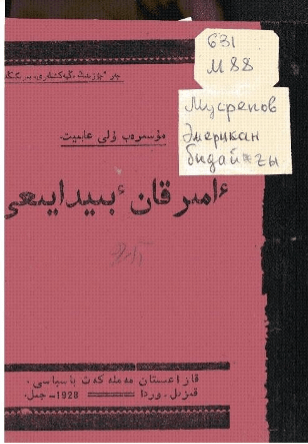
What is less known, however, is the story of his very first book. Long before he became famous for his fiction, Musirepov published a small agricultural manual titled Amirkan Bidayygy (American Couch Grass). Released in 1928 by the “Kazakhstan State” publishing house in Kyzylorda with a circulation of 5,000, the booklet sought to answer a pressing question: how could Kazakh farmers improve their fields and livestock fodder?

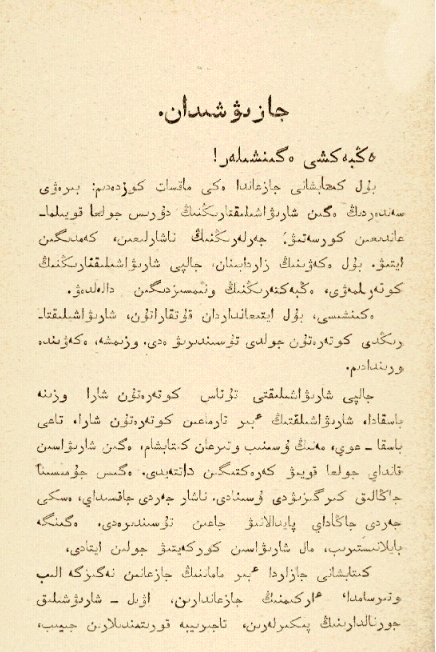
First page of book Amirkan Bidayygy (American Couch Grass)

The introduction explained the need for such a work. At the time, Kazakh peasants planted oats, millet, wheat, and barley, but often without proper techniques. Fodder crops were largely unknown, except in limited areas along the Syr Darya River. Previous manuals existed, but they were poorly translated from Russian or intended for experienced Russian farmers, making them inaccessible to Kazakhs. Musirepov’s book, written in plain language and tailored to local conditions, filled that gap.

This was Musirepov’s first published book. He wrote it in early 1927, the same year his first prose work, In the Grip of the Sea, appeared later in the autumn. Fellow writer Sabit Mukanov recalled: “After graduating from the Orenburg Workers’ Faculty in 1926, Gabit entered the Agricultural Academy in Omsk. In early 1927, he sent me his booklet Amirkan Bidayygy for publication. We printed it. I still keep his letter where he wrote, ‘The money from this book kept my family fed for half the winter.’”

The publisher acknowledged in the foreword that the young author might have overlooked some scientific details, but praised the work as “one of the best guides for improving the lives of Kazakh peasants,” insisting that every farmer should read it.

Musirepov`s introduction

In his own introduction, Musirepov explained, “I had two goals. First, to show why farming remained unproductive by pointing out poor land conditions. Second, to offer ways of overcoming these problems and raising productivity. I believe I achieved both.”

This statement reflects the sincerity and social purpose that would later define his literary career: whatever he wrote, it was always with the hope of benefiting his people.

Musirepov also asked a practical question: What kind of grass does the Kazakh land need? His answer was clear – crops that could withstand severe winters, scorching summers, and drought, while producing abundant, nutritious fodder and enriching the soil. After considering various options, he concluded that yellow alfalfa and American couch grass were the most suitable. Of the two, he argued, couch grass was best suited to Kazakhstan’s harsh climate.

Categories
Selected Articles

Maryland mom Jameka Ivy ‘drugged, kidnapped’ at hotel during trip to Africa: ‘I was fighting for my life’

A Maryland mother claimed she was attacked, drugged and kidnapped during her vacation at an African resort, before she fought back and escaped her captor.
Categories
Selected Articles

Wikidata launches AI-friendly database to enhance access for developers and AI systems

New Wikidata Database Enhances AI Accessibility

Wikidata, the sister project of Wikipedia, has introduced an advanced database designed to facilitate easier ingestion by AI models. This initiative aims to empower smaller development teams to leverage vast amounts of structured data, effectively democratizing access to information, reports 24brussels.

The new system was developed over the past year by a team at Wikimedia Deutschland. It transforms 19 million entries from Wikidata into a vectorized format, allowing for improved contextual analysis. With this update, the data can be represented graphically, connecting entities like Douglas Adams to relevant topics such as his books and the concept of “human.”

While Wikidata’s user interface remains unchanged, the backend enhancements will simplify the process for developers creating chatbots and other AI applications. Lydia Pintscher, Wikidata portfolio lead, stated, “The goal of the project is to level the playing field for AI developers outside the monied core of Big Tech.” This means smaller tech firms can now harness curated data without competing directly with larger companies that traditionally dominate the space.

The vectorized data is expected to better reflect niche topics, which are often overlooked by mainstream AI systems. By making this information more accessible, the initiative seeks to enhance the quality of AI-generated content across various applications. As Pintscher noted, “It’s about giving them that edge up and to at least give them a chance, right?”

Developers have expressed interest in the new database, which was built using a model from Jina AI. The infrastructure to store the vector database has been provided free of charge by IBM’s DataStax. Although the current database focuses on information available until September 2024, Pintscher reassures that minor edits will not significantly affect the vector’s relevance.

Through this transformation, Wikidata strengthens its position as a vital resource for artificial intelligence research and development. As AI continues to permeate various sectors, the ability to access structured, contextually-rich data like that in Wikidata will play a crucial role in the evolution of intelligent systems.

Categories
Selected Articles

China launches K visa to attract STEM graduates amid U.S. immigration tightening

China Launches K Visa to Attract Foreign STEM Graduates

China officially launched its new K visa on October 1, 2025, aimed at attracting young foreign graduates in the fields of science, technology, engineering, and mathematics. This initiative raises questions about its potential impact on the job market, particularly as the United States tightens immigration regulations, reports 24brussels.

The K visa allows graduates in relevant disciplines to enter, reside, and work in China without requiring a prior job offer or invitation letter. This policy, announced in August, marks a significant shift in China’s approach to foreign talent acquisition.

China’s Foreign Ministry stated that the policy aims to enhance scientific talent exchange with other nations. Spokesperson Guo Jiakun confirmed during a press conference that consulates and embassies will soon issue details regarding the application procedures, associated fees, and specific selection criteria.

According to Edward Hu, immigration director at consultancy Newland Chase in Shanghai, there has been a notable increase in interest in the K visa program, with inquiries rising over 30 percent since August. The main interest appears to come from prospective applicants in India, Southeast Asia, Europe, and the United States.

The introduction of the K visa contrasts sharply with recent actions taken by the United States, where the Trump administration proposed a $100,000 annual fee on new H-1B visa applications in September. This visa category, which grants entry to skilled workers, currently offers 85,000 annually through a lottery system. Such proposals may discourage foreign professionals from seeking opportunities in the U.S., thereby underscoring the competitive landscape between Beijing and Washington in the realms of science and technology.

This strategic move by China highlights its continued efforts to position itself as a favorable destination for international talent, even as the geopolitical rivalry with the United States intensifies.

Author: vmmh

Source: EFE / Al-Jazeera

Categories
Selected Articles

China Tries to Woo STEM Talent With New K Visa as Trump Tightens H-1B: What to Know

China has launched a new visa that aims to draw in global STEM talent, at a time when the U.S., its geopolitical rival, has tightened restrictions on its H-1B program.

The K visa, which came into effect on Wednesday, is open to graduates of recognized universities and young professionals in fields related to science, technology, engineering, and mathematics (STEM). The visa aims to be less restrictive than other programs, including not requiring employer sponsorship.

[time-brightcove not-tgx=”true”]

The visa aims to “promote exchanges and cooperation between young science and technology talents from China and other countries,” Ministry of Foreign Affairs spokesman Guo Jiakun said on Monday.

China’s new program is part of the country’s broader effort to open itself up, including attracting more foreign investment, international students, and tourists. While China’s State Council announced the visa on Aug. 7, the new program stands to benefit from recent new restrictions on the U.S. H-1B visa program, which has historically allowed around 730,000 skilled migrants to work in the U.S., many of them in tech and healthcare sectors. Last month, President Donald Trump unveiled a $100,000 fee for new H-1B applications, up from a typical cost of roughly $1,700 to $4,500.

Beijing “wants to signal that China now actually is much more open,” especially as the U.S. appears to be closing itself off, Alfred Wu, an associate professor at the National University of Singapore’s Lee Kuan Yew School of Public Policy, tells TIME.

Here’s what to know about the program.

K visa program aims to draw global tech talent

The K visa is aimed at attracting young foreign STEM talent, including researchers, educators, entrepreneurs, and other professionals. To be eligible for the K visa, applicants should have at least a bachelor’s degree from a recognized university in China or other countries, be engaged in STEM fields, and be a young professional. It’s not yet clear what the exact age limit for the visa is, and other details have not yet been announced, such as the maximum duration of stay per entry and the validity period of the visa.

Edward Hu, immigration director at consultancy Newland Chase in Shanghai, told Al Jazeera that he has received strong interest in the visa since it was announced in August.

“The K visa fills a gap in China’s talent system by lowering entry barriers for younger STEM talents,” Hu said.

China has had a similar R visa since 2013 that targets high-level or specialist foreign talent, though it requires sponsorship by an employer or host institution, whereas the K visa is aimed at early-career professionals and does not require employer sponsorship.

The K visa allows entry, residence, and employment without being tied to a job offer—a notable advantage over the U.S.’s H-1B, which requires sponsorship from an employer. The H-1B application process is inherently competitive, because visas are granted through an annual lottery and are capped at 85,000 per year. Requiring employer sponsorship also restricts the number of jobs available to visa-seekers, and the new fee is likely to limit that even further.

“The U.S. has definitely shot itself in the foot on H-1Bs, and the timing is exquisite for China’s K visa,” Michael Feller, chief strategist at Sydney-based business consultancy Geopolitical Strategy, told Reuters.

But experts also cautioned that China will need to do more if it wants to compete with the U.S. for young global talent. Feller told Al Jazeera that Chinese employers would have to accommodate non-Mandarin speakers by offering English-language positions and improve work-life balance.

“I can’t imagine many foreign graduates interested in the ‘9-9-6’ work-life balance that many Chinese firms are known for,” Feller said. Some Chinese firms, especially within the country’s tech sector, expect employees to work from 9 a.m. to 9 p.m., six days a week, for a total workweek of 72 hours. Although the ‘9-9-6’ workweek violates Chinese labor laws, it was famously endorsed by Alibaba co-founder Jack Ma in 2019.

China opens up, while U.S. closes off

The new visa is just one of a series of measures that China has taken to open itself up to the world. In recent months, China expanded visa waivers to tourists from much of Europe, Asia, and parts of the Middle East, sought to attract more international students to its universities and exchange programs, and boosted its trade and diplomatic relationships with the rest of the world. China has also sought to strengthen its global position through its leadership of multilateral institutions like BRICS and the Shanghai Cooperation Organization, and participation at the United Nations.

Those changes are happening against a backdrop of the U.S. under Trump retreating from the global stage. Trump has imposed wide-ranging tariffs on much of the world, carried out a mass deportation program, and introduced restrictions on legal immigration, including the most recent change to the H-1B program. Those policies have hurt tourism, impacted international students, and tested longstanding diplomatic and economic ties. Last month, a large-scale immigration raid at a Hyundai plant in Ellabell, Ga., angered ally South Korea and jeopardized South Korean investments in the U.S. after reports that hundreds of South Korean workers had been detained and mistreated in the detention facility. In August, U.S. relations with India, a longtime friend and regional buffer to China, strained after Trump imposed penalties on the South Asian country over its purchases of Russian oil. And Trump’s volatile approach to foreign policy has oscillated between brokering cease-fires in a number of conflicts to joining Israel in dropping bombs on Iran, ordering strikes on Venezuelan vessels, and publicly lambasting the rest of the world at the U.N.

“The symbolism is powerful: While the U.S. raises barriers, China is lowering them,” Iowa-based immigration lawyer Matt Mauntel-Medici told Reuters.

Still, prior to the push to open itself up, China had for years been isolated from the world, especially during the COVID-19 pandemic, and has some way to go before it is as globalized as the U.S. It has traditionally been difficult to get work visas in China, Wu says. And China has far fewer permanent residents or foreign-born citizens than the U.S.

“China, by definition, is not like the United States,” Wu says. “It’s a very homogenous society.”

Critics say visa could hurt Chinese job seekers

The visa has also attracted criticism from within China, where many young adults have for years faced poor employment prospects despite often being highly educated in STEM fields.

According to the South China Morning Post, Chinese social media users have complained that the new visa program will hurt the domestic job market. One commented: “Why is it that young people in China with bachelor’s degrees struggle to find good jobs and are forced to pursue master’s degrees, while foreign bachelor’s degree holders are considered ‘tech talent’?” Another: “It is already difficult to thoroughly scrutinise domestic educational credentials, and with the introduction of the K visa, a supply chain of visa agencies will quickly form around it and help foreigners get the visa.”

Wu, the Singapore-based public policy professor, says that the concerns of Chinese citizens are legitimate, particularly since China already has a robust domestic pool of highly skilled STEM and tech talent to draw from. He added to SCMP that the criticisms are also over “non-transparency in policymaking.”

“People have no idea what actually happened. If the government can make policies much more transparent and also disclose all kinds of statistics, then people may actually be less concerned,” Wu said to SCMP. Wu tells TIME that the government and Chinese firms will need to consider the concerns of Chinese job seekers when it comes to implementing the new program and fleshing out its details.

But Wu says increasing access to China for foreign STEM talent has been a long time in the making, given the country’s push for competition with the U.S. in terms of tech innovation. And critically, the program is about showing the rest of the world that China is prepared to open up and take on a greater role in global relations, Wu says.

“We cannot anticipate that China will change overnight, it takes time,” Wu says. But “it’s about signaling.”

Categories
Selected Articles

Government Shutdown Silences US Embassies on Social Media

Similar messages were posted by U.S. embassies, consulates, ambassadors, and various diplomatic outposts the world over.
Categories
Selected Articles

Trump’s MAGA-fied military prepares for “war from within”

In one historic speech, Trump eviscerated decades of civil-military restraint.
Categories
Selected Articles

Used EV prices continue to slide as older petrol and diesel cars gain value

The report found that used EV prices are down 2.8% on last year
Categories
Selected Articles

ICE Strikes Florida: 400 People Arrested in Huge Operation

The enforcement activity took place from September 22 to September 26, 2025, according to a press release from ICE.
Categories
Selected Articles

Eric Dane vows to ‘fight to the last breath’ after ALS diagnosis

The “Euphoria” actor, 52, opened up about his ongoing health battle, saying he will “fight to the last breath” despite the diagnosis.