
More than 1,500 police on hand for final stage of Spanish Vuelta amid pro-Palestinian protests [deltaMinutes] mins ago Now
Month: September 2025
#FBI – FBI #Kirk
The Mossad’s Hybrid War against the Freedom of Speech and Media!
Trump makes next step on the road to dictatorship!
There is no Photo Evidence of Charlie Kirk’s assassination wound in public domain – Google Search … The Assassination of Charlie Kirk – Links – 9.14.25 thenewsandtimes.blogspot.com…— Michael Novakhov (@mikenov) Sep 14, 2025
Michael M. Santiago/Getty Images
- Chipotle this week announced plans to expand to Singapore and South Korea.
- New Chipotle restaurants will open in the countries in 2026, featuring the chain’s core menu.
- Chipotle’s arrival in Asia heats up the international “slop bowl” battle.
The “slop bowl” battles are heating up in the international market, with Chipotle announcing this week that it will expand into Singapore and South Korea.
New Chipotle restaurants will open in the countries in 2026, the company’s first foray into Asian markets, as part of a partnership with SPC Group, a leading South Korean-based food company.
“Both markets have large, fast-growing out-of-home dining cultures that prioritize real food, and consumers are highly familiar with American brands like Chipotle through education, travel, and social media conversations among relevant celebrities,” a Chipotle spokesperson told Business Insider about the expansion. “Operationally, the dense urban footprints of major Korean cities and Singapore also make them very manageable markets to enter.”
The South Korean and Singaporean restaurants will closely mirror the look and feel of Chipotle’s restaurants in the US, with an open kitchen format and the same full core menu offerings that American consumers are accustomed to, the spokesperson said.
Chipotle operates 3,800 restaurants in the US, Canada, the United Kingdom, France, and Germany. It plans to open as many as 345 new restaurants this year, with a long-term target of operating 7,000 locations in the US and Canada, according to a press release about the expansion.
The new Chipotle locations will compete directly with the Australian-owned fast-casual Mexican chain, Guzman y Gomez, which went public last year. Guzman y Gomez has a prominent presence in Singapore and has plans to expand to 1,000 outlets in Australia over the next 20 years, Business Insider previously reported.
Chipotle isn’t the only fast-casual Mexican chain expanding into Asia. In July, GoTo Foods announced it would open new Moe’s Casa Mexicana restaurants in India, a reimagining of its Moe’s Southwest Grill concept.
Read the original article on Business Insider
Italian women’s boxer Angela Carini quit her fight against Algeria’s Imane Khelif after just 46 seconds.
For fantasy baseball owners, there is nothing more frustrating than your best players struggle when you need them most.
Pope Leo XIV turns 70 and thanks God, his parents and all those who prayed for him [deltaMinutes] mins ago Now
richiesd/Getty Images
- This post originally appeared in the BI Today newsletter.
- You can sign up for Business Insider’s daily newsletter here.
Welcome back to our Sunday edition, where we round up some of our top stories and take you inside our newsroom.
On the agenda today:
- Costco’s new shopping hours are the latest example of America’s consumer caste system.
- She bought an apartment in NYC at 28 years old. The wildest part? It was easy.
- Microsoft employees are officially heading back to the office.
- Wall Street is flocking to Texas. Here’s what financial giants are building in the state.
But first: Quitting? In this economy?
If this was forwarded to you, sign up here. Download Business Insider’s app here.
This week’s dispatch
It’s time to go
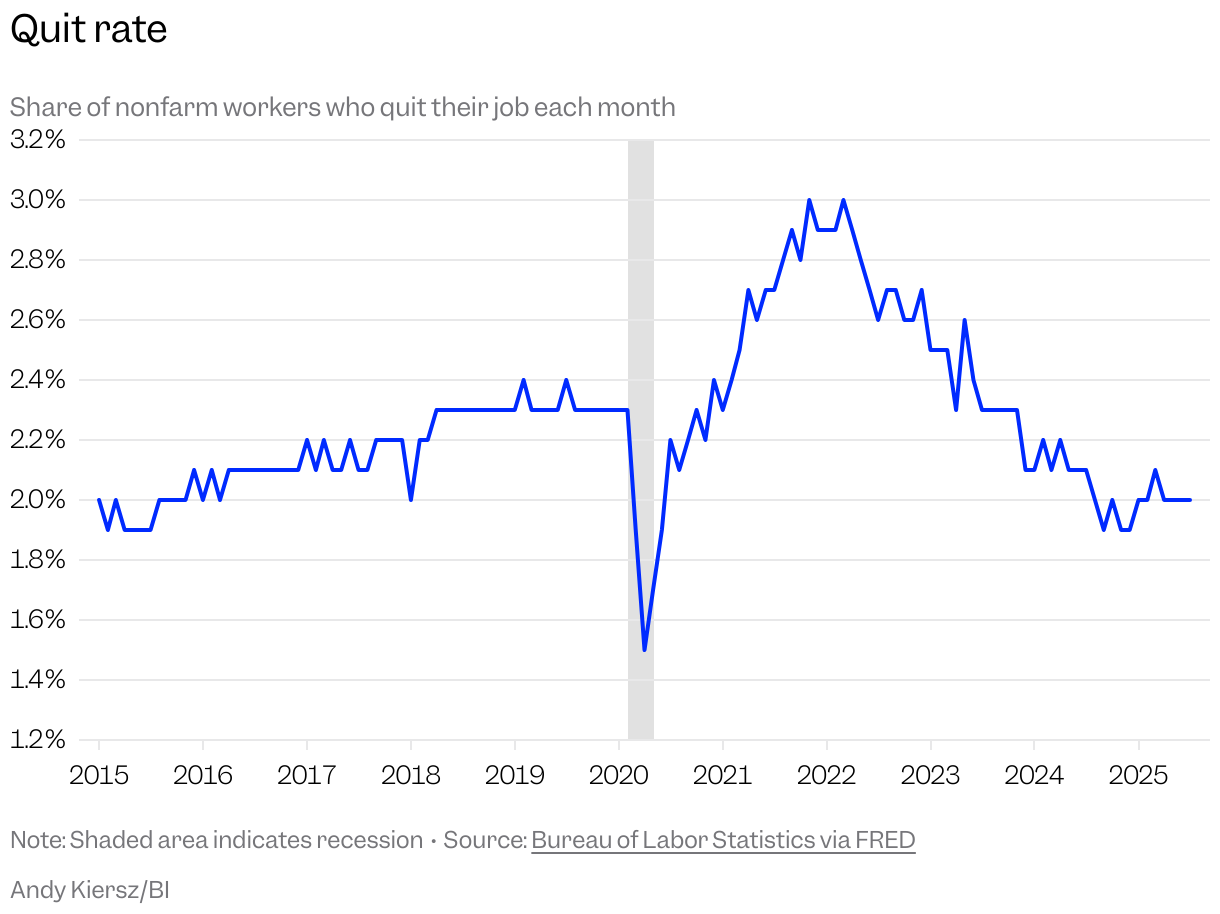
Quitting a job can be a tantalizing idea — especially when so few people are actually doing it.
The worker quit rate across the country has been around 2% for much of the year. Excluding the beginning of the pandemic, that’s near the lowest it’s been since 2018, according to the Labor Department.
More people appear to be “job-hugging” than “job-hopping” these days.
That’s what makes the stories of people actually quitting even more fascinating.
Some just want a change; others yearn to move overseas. Many are career switchers looking for a fresh start. There are those who regret quitting, while others say it’s the best decision of their lives.
Business Insider has spoken with workers who decided it was time for a change. Here are their stories, in their own words.
Jessica Yen: “I worked long hours in data analytics, but the difference now is that I’m willing to put in far more hours because it’s my own company; it’s part of my identity,” said Yen, who is now an entrepreneur.
Evelyn Ramli: “I decided to take a pay cut and switch to a corporate marketing job,” said Ramli, who previously quit being a content creator because it made her insecure and anxious. “I’m still not sure if it was the right decision.”
Blair Lonergan: “Success for me isn’t about the money — it’s about the lifestyle I have,” said Lonergan, who stopped working as an attorney when her website about family life took off. “I would happily do this job for less because of the time it gives me with my family. The money is an added bonus.”
Sofia Javier: “My advice to others is to do what makes you happy and fulfills you. If it’s not the Big Four, you can leave whenever you want and take control of your life,” said Javier, who left PwC to join Comcast as a senior financial analyst.
Cindy Sheahan: “My quality of life has improved in Italy,” said Sheahan, who quit her job, divorced her husband, and moved overseas to retire. “I walk almost everywhere, so my blood pressure, weight, and cholesterol are in better condition. I eat better, I’ve made new friends, I’ve cut down on expenses, and most importantly, I’m happy.”
Have you quit your job or are you thinking about doing it? We’d love to hear from you. Please email me at srussolillo@insider.com.
You’ll need to pay extra for that
Getty Images; Alyssa Powell/BI
For $130 a year, instead of the annual $65 base tier, Costco’s executive members have access to fancy discounts — and more recently — special store hours.
The move is part of a trend happening across the economy where businesses increase customer stratification to boost revenue and identify exactly how much they can get out of each consumer. Particularly in sectors like entertainment, travel, and retail, consumers have more choices than ever — but it’ll cost you, BI’s Emily Stewart writes.
In her homeowner era
Amy Lombard for Business Insider
BI’s Juliana Kaplan recently achieved a milestone in New York City that most of her generation merely dreams of: homeownership. At 28, she bought an apartment and was stunned at how easy it actually was.
Juliana secured her dream house thanks to a mix of thrift and luck. As part of the oldest cohort of Gen Zers, she entered the job market at the perfect time, right before the pandemic. She’s also part of a small but growing trend of young, single homebuyers.
The American dream (Juliana’s Version).
Microsoft employees are going back to the office
Max Cherney/REUTERS
One of Big Tech’s remaining RTO holdouts is now calling its employees back to the office at least three days a week, according to an internal email Microsoft sent to staff.
The mandate will occur in three phases, starting at the end of February 2026 with Seattle-area employees living within 50 miles of a Microsoft office. It will then expand to other US offices and eventually internationally, per an email from Microsoft’s HR chief.
Also read:
- Microsoft is setting an even stricter RTO policy for its AI org, internal document shows
- Microsoft execs make the case for RTO in leaked meeting: In-person staff are ‘thriving’
Dallas Bankers Club
Goldman Sachs
Wall Street is out, Y’all Street is in. Big banks and institutions, from JPMorgan and Goldman Sachs to Nasdaq and the New York Stock Exchange, are investing heavily in their Texas presence.
The Lone Star state, which promises a tax-friendly environment, is inviting plenty of new development from these firms. From new office buildings to HQ relocations, see what some of the big names are up to.
This week’s quote:
“The worse the old chapter was, the more you need the fresh start.“
— Katy Milkman, a professor at the University of Pennsylvania’s Wharton School, on the Great Lock In trend being an example of the “fresh start effect.”
More of this week’s top reads:
- Exclusive: Leadership changes hit the xAI team training Grok, and some employees have been asked to explain their work.
- The Department of Defense is betting on a startup that wants to control prosthetic limbs with muscle memory.
- Exclusive: Here’s NBCU’s severance offer for employees who don’t want to return to the office.
- US data center construction spending reaches record-breaking high.
- From 6 figures to minimum wage: America’s oldest workers are taking pay cuts.
- How a $1 billion TikTok challenger unraveled.
- Microsoft to spend heavily to build its own AI chip cluster and become “self-sufficient,” AI CEO says in leaked meeting.
-
20-year-old fintech Klarna finally went public. Here’s who’s getting rich.
The BI Today team: Steve Russolillo, chief news editor, in New York. Lisa Ryan, executive editor, in New York. Dan DeFrancesco, deputy editor and anchor, in New York. Akin Oyedele, deputy editor, in New York. Grace Lett, editor, in New York. Amanda Yen, associate editor, in New York.
Read the original article on Business Insider
Venezuela Conducts Nationwide Militia Drills Amid Rising U.S. Tensions
Venezuela organized extensive training exercises for the Bolivarian Militia over the weekend, citing escalating threats from the United States as the primary catalyst for the drills, reports 24brussels.
During the exercises, held across all 312 military garrisons, militia members engaged in live-fire operations under the watchful eyes of the Bolivarian National Armed Forces. The event was overseen by President Nicolás Maduro, alongside senior military commanders, who emphasized the drills as a crucial response to perceived U.S. aggression.
Defense Minister Vladimir Padrino López stated that the U.S. intends to “turn the Caribbean Sea into a war zone,” articulating the Venezuelan government’s concerns over American military posturing in the region. Official reports indicate that training concentrated on rifle proficiency and shooting techniques, reinforcing the militia’s preparedness for potential confrontations.
As part of its broader military strategy, the Venezuelan government framed the exercises as a necessary step to confront ongoing U.S. provocations. Officials reiterated their commitment to maintaining military readiness in light of what they characterize as a new phase of confrontation with the United States.
Robert Daly/Getty Images
- There are fewer buyers in the market, and home sellers are getting desperate.
- That’s good news for motivated buyers, who are seeing a rise in sellers offering concessions.
- Here are four deals buyers can negotiate, from price cuts to seller-covered repairs.
After years of being at sellers’ mercy, homebuyers can finally breathe.
In markets where inventory is outpacing demand and contracts are falling through, sellers are getting desperate.
This is an opening for motivated buyers: homebuilders and homeowners are cutting asking prices and, in some cases, offering incentives or concessions.
“There are more homes to fill than there are buyers out there,” Daryl Fairweather, chief economist at Redfin, told Business Insider. “Those are going to vary by geography, but especially in places where there’s a lot of new construction, it is a buyer’s market.”
While Fairweather says homebuilders are generally more willing to negotiate than existing homeowners — many of whom are locked into pandemic-era low mortgage rates — there’s still room to bargain in today’s real estate market.
Here are four deals worth negotiating as a homebuyer, along with their benefits and risks.
A lower purchase price
A lower purchase price has many benefits. Because the down payment is a percentage of the price, a reduction cuts your upfront costs. It also pays off over time: If you have a mortgage, you’ll borrow less, so your principal-and-interest payment decreases, reducing the total interest paid over the life of the loan.
Fairweather says builders are more likely than existing homeowners to agree to a price cut.
“Existing homeowners can just continue to live in the home if they don’t get a high enough offer,” Fairweather said. “Builders, on the other hand, are more motivated because every day that a home doesn’t sell is a day that they’re paying interest or that they don’t have that money on their books.”
A mortgage rate buydown
In a mortgage rate buydown, a home seller or builder pays to temporarily reduce a buyer’s interest rate for the early years. When that period ends, the rate reverts to its original note.
An alternative option for buyers seeking a permanent cut is to purchase discount points at closing. Typically, one point equates to 1% of the loan and cuts the rate by 0.25%.
It’s important to remember a mortgage rate buydown is temporary. That means your interest rate will eventually increase, which can be challenging if you’re not prepared for the higher costs. A buydown may also not pay off if you’re planning to sell your home in the short term or if rates drop below your current rate.
“It might be better to ask for something that’s more permanent — like upgraded kitchen countertops — so your home has more long-term value,” Fairweather said. “But I think a lot of buyers are thinking more about their monthly budgets, especially in the near term, which is why so many like the idea of a mortgage buydown.”
Asking the seller or builder to cover closing costs
Closing costs are fees required to finalize a home purchase that aren’t included in the sale price. They cover things like loan origination, appraisal, title services, and attorney fees. Typically, you pay 2%-5% of the loan amount in closing costs, which can add up to thousands of dollars.
If a seller or builder covers some or all of your closing costs, you could put more money toward repairs, renovations, furniture, or other expenses.
Asking the seller to cover repairs
If you’re buying a home that’s less than perfect, say, the HVAC needs updating or you want better landscaping, you can negotiate several things: ask the seller to pay for the service or repair, provide a credit at closing, or lower the overall purchase price.
Fairweather said that homebuyers often do this with newly built homes.
“Usually they’re little customizations that you can do to the home that you can negotiate on to get complimentary, or to have a lower price on,” she said.
It won’t always be a buyer’s market
While there are plenty of deals to be had now, that might not always be the case.
“It depends on where rates are headed,” Fairweather said. “I think that rates are going to continue to drop, and that if that happens, by spring, there’ll be more buyers in the market.”
Read the original article on Business Insider
ALLISON ROBBERT/AFP via Getty Images
- Elon Musk has warned for years that collapsing birth rates could threaten economies and society.
- Europe and the US have stepped up this year with tax breaks, childcare, and expanded parental leave.
- Experts caution these measures may not reverse fertility declines, citing Scandinavia and Hungary.
For years, Elon Musk has consistently argued that one of the greatest threats to civilization is collapsing birth rates.
The billionaire CEO believes that declining fertility could hollow out economies, weaken workforces, and leave the West unable to sustain itself.
In an X post last week, he wrote: “Low birth rate is the number one threat to the West. There will be no West if this continues.”
In August, Musk amplified a warning from political commentator Tim Pool, who wrote: “The population isn’t ‘collapsing’ — it has collapsed. The shoreline is receding and no one understands the tsunami about to hit us.” Musk reposted it, adding: “I’ve been warning about this since the turn of the century.”
Now, governments in Europe and the US are taking steps to combat falling birth rates, and introducing policies to encourage people to have more children — from tax breaks and family allowances to longer parental leave and subsidized childcare.
While Musk has been a vocal advocate for increasing birth rates, demographers told Business Insider that he is not directly responsible for governments taking action.
A wave of pro-natal policies
In France, President Emmanuel Macron has called for a “demographic rearmament.”
In July, his government pledged to replace the current low-paid parental leave with a new, better-paid “birth leave. ” This would offer parents several months of leave at around half their salary, capped at €1,900, or around $2,200 a month.
That same month, Spain passed a new family law extending paid maternity and paternity leave to 17 weeks, while some regions, including the capital Madrid, expanded their “baby check” programs.
Italy is leaning on financial incentives: since January, mothers of two or more children have qualified for lifetime payroll tax breaks, and families can access zero-interest “First Home” loans, alongside child allowances.
Hungary extended its own policy in January, granting lifetime personal-income-tax exemptions to mothers of two or more children.
Even the UK, typically cautious about family subsidies, launched one of its most ambitious early-years reforms in decades: starting in September, parents of children as young as nine months will be eligible for 30 hours of free childcare a week.
Meanwhile, the US passed a federal package in July expanding family tax credits and creating new savings accounts under the banner of the “Working Families Tax Cut.”
Associated Press
‘Musk and some other commentators have only made the issue more visible’
As governments step up pro-natalist measures, demographic experts told Business Insider it would be a mistake to see Musk and other tech leaders as the drivers of these policy shifts.
“Concern with low birth rates is nothing new and certainly nothing that anyone in the tech world, and certainly not Musk, should get any credit for originating or leading on,” said Ronald Lee, founding director of the Center for the Economics and Demography of Aging at UC Berkeley.
He noted that pronatalist policies were already widespread in Europe and East Asia decades ago, while the US Social Security system was overhauled in the early 1980s with aging in mind.
Tomas Sobotka, deputy director at the Vienna Institute of Demography, made a similar point.
“This is not a new topic among researchers and many policymakers,” he said, citing France’s family benefits dating back to the 1930s and Japan’s interventions in the 1990s.
“Musk and some other commentators have only made the issue more visible — and, regretfully, also more politically polarized.”
Wolfgang Lutz, founding director of the Wittgenstein Centre for Demography and Global Human Capital, was even more blunt: “Tech leaders like Elon Musk may be experts in their fields, but they are not experts in demography. Their views on fertility are based on gut feelings and vague conjectures rather than scientific reasoning.”
The chorus grows
Other tech leaders have echoed Musk’s concerns.
Telegram CEO Pavel Durov has gone as far as to fund free IVF treatments at a Moscow clinic for women using his sperm.
In a July 2024 Telegram post, he called declining fertility “an increasingly serious issue worldwide” and urged his followers to “Defy convention — redefine the norm!”
Sam Altman, CEO of OpenAI, has invested in reproductive-tech startups, including Conception, which is developing ways to extend fertility and even enable two men to have biological children.
Andrew Harnik/Getty Images
An uncertain fix
Whether the flurry of new incentives will actually reverse the trend is far from clear. Fertility rates across the developed world have been below replacement level for decades, driven by high costs, delayed parenthood, and cultural shifts.
Experts note that lavish programs in South Korea, Japan, and Hungary have failed to reverse declining birth rates.
Lee said even Scandinavia’s generous parental leave and childcare systems have not prevented fertility from falling. “Financial incentives are mostly absurdly small relative to the cost of a child,” he said, adding that Hungary spends about 5% of GDP annually on pro-birth measures with little result.
Sobotka said governments can’t fully offset the costs and personal trade-offs of childbearing, though well-designed policies can still help parents realize their desired family size and lift fertility modestly.
“Altogether, these packages of family policies can boost fertility rates in the order of up to 0.2, maximum 0.3 children per woman,” he said.
Lutz was skeptical. He argued that while family support programs are valuable for child well-being, their impact on fertility is marginal at best and could even backfire if they push women out of the workforce.
Anna Rotkirch, research director at the Population Research Institute in Helsinki, pointed to Estonia as an example where expanded family policies in the 2000s initially boosted second and third births but ultimately could not stem a collapse in first births over the past decade.
“We need new and bolder solutions,” she said, “which also have to come from employers, city planners, and society at large — not just politicians.”
In the US, Karen Benjamin Guzzo, director of the Carolina Population Center, argued that the modest measures being discussed will likely not “budge” birth rates because they don’t tackle the main barriers American parents say they face: expensive housing, unaffordable childcare, and the absence of paid leave.
Read the original article on Business Insider