
Bonhomie, kind words – but what did Trump’s meeting with Starmer add up to? AP explains
Month: September 2025
The autopsy’s conclusion is being called “pretty shocking” — raising more questions than it answered.
Reuters
- This post originally appeared in the BI Tech Memo newsletter.
- Sign up for the weekly BI Tech Memo newsletter here.
OpenAI and Anthropic released comprehensive studies this week on how people use AI. The findings reveal diverging patterns: ChatGPT is more about augmentation, while Claude skews toward automation.
OpenAI’s study found that ChatGPT is most popular for writing, editing, summarization, and brainstorming. Students, marketers, and knowledge workers use it to draft essays, prep reports, or spin up campaign ideas. Educators tap ChatGPT for quizzes, tutoring, and simplifying complex topics.
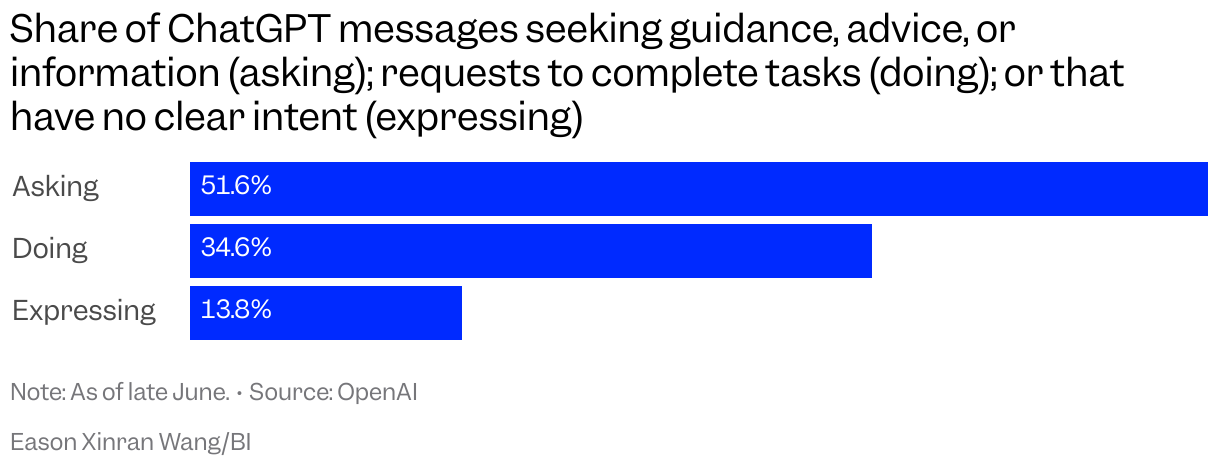
OpenAI sliced the data into three buckets. “Doing” conversations focus on delivering output that can be plugged into a production process. “Asking” chats support decision-making but do not produce output directly. “Expressing” mostly covers other use cases. As of late June, there was a lot more Asking, according to OpenAI’s study.
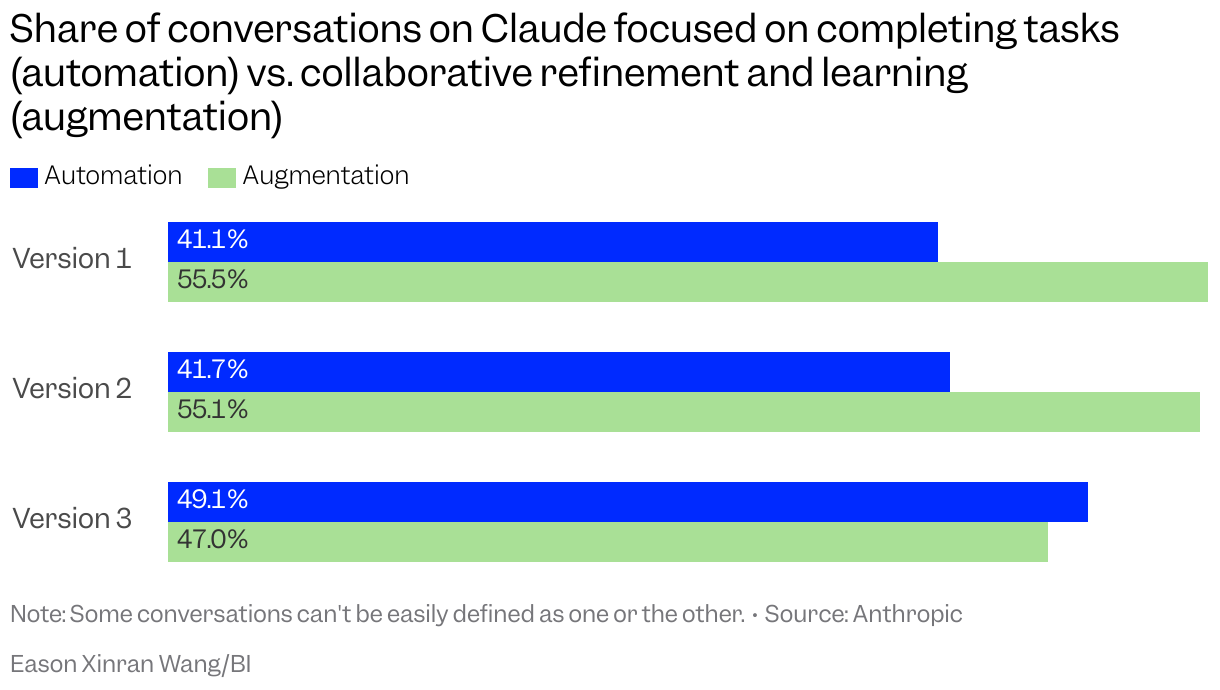
Anthropic’s study found Claude leans more heavily into software development and enterprise automation. Coding and other math-based tasks make up more than a third of usage. Companies embed Claude in workflows for document processing, report generation, and bulk coding. This was the third of these studies released by Anthropic, and this latest version was the first where automation usage exceeded augmentation.
For now, ChatGPT thrives in consumer productivity, where users iterate alongside it. Claude is more about workplace efficiency, as some enterprises increasingly delegate entire tasks. Companies may run both in the future: ChatGPT for communication and creativity, Claude for structured enterprise-scale execution.
Sign up for BI’s Tech Memo newsletter here. Reach out to me via email at abarr@businessinsider.com.
Read the original article on Business Insider
A Democratic internal poll showed Collins trailing one of her challengers ahead of the midterms.
Democratic leaders rejected the bill, insisting the GOP must negotiate on health care and other priorities, setting up a Senate clash.
Sydney Sweeney is dominating the digital releases this weekend.
In a country divided on nearly everything, one of the few places where people from different backgrounds still sit side by side is the local chain restaurant.
Dalinna’s son Mateo had been quiet for some time, so she assumed he was fast asleep. Nothing prepared her for what she saw.
Eswatini activists protest US deportation deal at embassy in South Africa [deltaMinutes] mins ago Now
Trump Threatens to Revoke Broadcast Licenses Amid Criticism of Media
On September 19, 2025, U.S. President Donald Trump threatened to revoke the broadcast licenses of television networks that criticize him, asserting that outlets with licenses should not oppose him. His comments came after ABC temporarily suspended Jimmy Kimmel’s show following the host’s remarks about the killing of far-right activist Kirk, reports 24brussels.
During a flight aboard Air Force One from the United Kingdom, Trump expressed disdain for what he called the media’s overwhelming bias against him. “I read somewhere that the networks were 97% against me. Ninety-seven percent negative. And yet, I easily won in the seven key states (in the presidential election),” he stated. “If they’re 97% against me, they only give me bad publicity and still have a license, I would say maybe their license should be taken away.”
The president intensified his critique of media networks, alleging they lack conservative representation. “If you look back, you see they haven’t had a conservative on for years. I think someone said, ‘Take a look, all they do is hit Trump.’ They have a license. They’re not allowed to do that. They’re an arm of the Democratic Party,” he added.
Earlier on the same day, Trump dismissed the notion that Kimmel’s show suspension was an act of censorship, framing it instead as a response to low viewership. “He should have been fired a long time ago,” Trump remarked.
ABC announced on September 18 that “Jimmy Kimmel Live!” would be suspended indefinitely due to the controversy surrounding Kimmel’s comments about the fatal shooting of Charlie Kirk, who was killed the previous week. Nexstar Media Group, which owns numerous local TV stations in the U.S., indicated that it would replace Kimmel’s show with alternate programming, criticizing the remarks as “offensive and insensitive.”
Andrew Alford, president of Nexstar’s broadcasting division, stated, “Mr. Kimmel’s comments about the death of Mr. Kirk are offensive and insensitive at a critical time in our national political discourse, and we do not believe they reflect the spectrum of opinions, views, or values of the local communities in which we are located.”
In his monologue on Monday night, Kimmel suggested the suspect in Kirk’s murder could have been a supporter of Trump, stating, “The MAGA Gang is desperately trying to characterize this kid who murdered Charlie Kirk as anything other than one of them and doing everything they can to score political points from it.”
In response to escalating tensions following Kirk’s death, Trump and various administration officials pinned blame on the “radical left.” The president rejected the Democrats’ assertion that political violence has emerged from both sides of the aisle.
Federal Communications Commission (FCC) Chair Brendan Carr threatened regulatory action against Disney and ABC due to Kimmel’s remarks, indicating the music network’s licenses could be at risk. This drew criticism from FCC Commissioner Anna Gomez, a Democrat, who cautioned against using extreme violence to justify censorship, stating, “An inexcusable act of political violence by one disturbed individual must never be exploited as justification for broader censorship and control.”
The ongoing conflict between Trump and media outlets highlights a significant moment in American broadcasting and political rhetoric, raising questions about freedom of speech and the responsibilities of media organizations. As events unfold, the ramifications of these tensions will likely continue influencing the national conversation.