
Thousands evacuated in Hong Kong after discovery of large WWII-era bomb [deltaMinutes] mins ago Now
Month: September 2025
It was the bouncer that got through his legs in the sixth inning Friday night that will stick with him the most.
VioletaStoimenova/Getty Images
- Men with degrees aren’t seeing their earnings go up as much as they historically have.
- Male-dominated fields like tech are at a standstill, while female-dominated fields are growing.
- That trend might show how the labor market is changing, and how male workers need to adapt.
For men, a bachelor’s degree isn’t worth what it once was.
The labor market is in flux, as job growth slows and AI eats up entry-level jobs. But, under the hood, the differences in how earnings are evolving by gender are stark, and men might offer a warning signal for how the economy is changing.
Business Insider analyzed the Census Bureau’s historical earnings figures by educational attainment and gender. For men with a bachelor’s degree and up, cumulative wage growth since 1991 has fallen and stalled; for women, it’s the opposite.
Men are still outearning women, but we’re seeing stagnation in male-dominated fields like tech and professional and business services, while female-dominated professions like education and healthcare have taken off. As the labor market tips toward those traditionally female professions, Gen Z men might be some of the first test subjects of the economy’s new shape.
“The fact that the labor market was gendered was more to the disadvantage of women,” Richard Reeves, the president of the American Institute for Boys and Men, said. “I think we’re entering an era where it’s going to be more to the disadvantage of men.”
The state of men in the labor market
Fewer young men are working, and their labor force participation — a measure that tracks whether they’re working or actively seeking work — has stagnated.
At the same time, the unemployment gap between young men with a degree and similar young women has widened, with men increasingly likely to be unemployed.
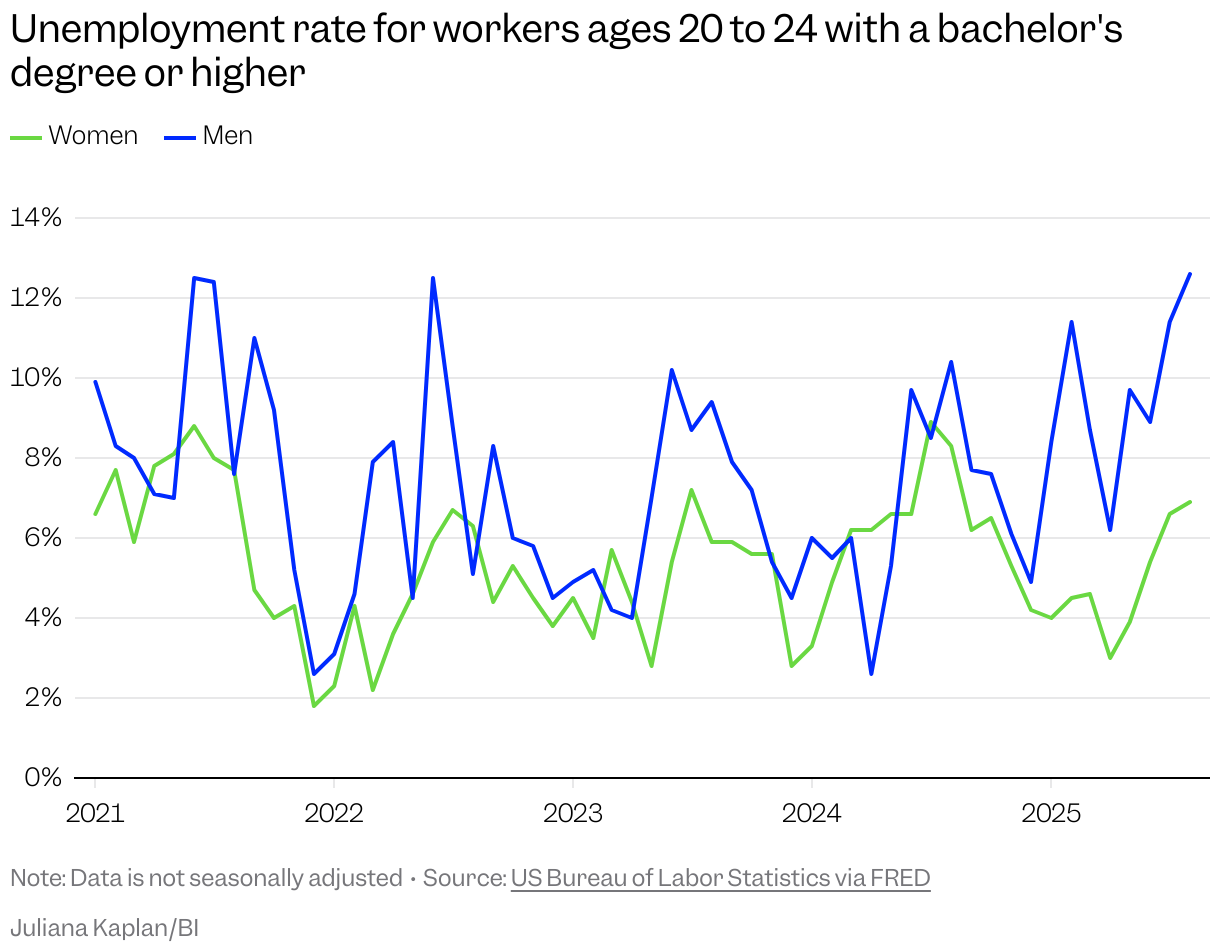
“Part of what we have going on as a macro story is, obviously, a softening labor market,” Ben Glasner, an economist at the Economic Innovation Group, said. Job-hopping is down, and wage gains from job-switching are falling. Along gendered lines, Glasner said that industries that are predominantly exposed to men with higher education are softening faster than industries that were more exposed to women with higher education. And so, Glasner said, men might now be the first exposed to a weakening labor market.
“This might be kind of a leading indicator of a weakening job market, but it’s not totally clear how much that’ll spill out into other industries and lower degree holder fields,” he said.
At the same time, fields traditionally dominated by women are rare bright spots in a more dreary labor outlook; in August, payroll additions in healthcare helped offset losses in other industries, with private education and health services adding 46,000 jobs. Continued growth in the labor market right now is essentially all about nurses and teachers.
“Those are basically the only jobs that we’ve been adding for at least this year,” Alex Jacquez, chief of policy and advocacy at the Groundwork Collaborative, said.
A role reversal in the job market
It all shows a role reversal in the labor market, and underscores that it might be time for both the labor market and men to adapt to a new reality. After all, roles in healthcare are projected to boom over the next decade.
“There’s also a real change in how our economy works, what our economy is focused on, and that is really favoring women in this labor market,” Emerson Sprick, the director of retirement and labor policy at the Bipartisan Policy Center, said.
One barrier that could be preventing men from going into these more robust fields might be pay. As Glasner said, the industries that are female-dominated, like education and healthcare, are seeing wages increase — but still paying less than more male-exposed ones; beyond the gender divide, as those sectors grow, it might also be time to figure out how to bolster salaries there accordingly.
Another aspect, Reeves said, is that we’ve made huge progress in increasing the share of women in professions that were previously inaccessible to them, but we’ve gone the other way in fields that are traditionally seen as female. The share of male public school teachers has dropped from 30% in 1987 to 23% as of 2022, per an analysis from Reeves’ American Institute for Boys and Men. In elementary schools, per Pew Research Center, 89% of teachers are women.
“My read of it is that actually there’s a lot of jobs there that are pretty good that a lot of men could get, but because they’re seen as women’s jobs, they’re not going for them,” Reeves said.
There are some signs of progress, or at least a way forward. As Reeves noted, a growing number of states are working on initiatives to get men into teaching. And some younger men are also potentially adapting by seeking out vocational training, setting themselves up to go into fields that aren’t as touched by a softening white-collar labor market. At the same time, labor market demand might finally boost wages in these growing fields to the point that they could draw more men in.
“I think there will be a wage level at which the opportunity cost, even for controlling for all the cultural and social hesitation that young men have to enter these jobs, is likely to be overcome,” Jacquez said. “As we continue to have a shortage of these jobs being picked up, the wage picking up even more is likely the way that employers are going to entice more people in.”
Read the original article on Business Insider
Lindsay Bloom told Newsweek she hoped the wedding would bring a sense of clarity, but it left her feeling “more lost than ever.”
Speaking to Newsweek, Truss is back, with a radical new message for a British right which could be on the cusp of transforming Britain.
Russia launches large-scale attack on Ukraine, killing 3 and injuring dozens [deltaMinutes] mins ago Now
Photos of an orthopedic center in Congo that helps amputees regain mobility [deltaMinutes] mins ago Now
On September 18, the European Union adopted its 19th sanctions package against Russia, intensifying restrictions on the country’s banking system and oil exports. The package, which includes more than 2,500 individuals and entities, specifically targets the so-called shadow fleet of tankers used to transport Russian crude. Energy giant Lukoil and its trading subsidiary Litasco are among the companies placed under new restrictions. The initiative to expand sanctions was strongly supported by Berlin and Paris, which urged the European Commission to include offshore companies involved in Russian oil exports.
Sikorski warns of shadow fleet’s ecological threat
In an interview with Frankfurter Allgemeine, Polish Foreign Minister Radosław Sikorski stressed that revenue from Russian oil transported by poorly insured and aging tankers continues to finance Moscow’s war effort. He proposed that Germany and NATO establish a maritime control zone in the North Sea to monitor the passage of obsolete vessels entering the Baltic Sea. Sikorski warned that Russia’s reliance on outdated tankers could trigger an unprecedented ecological disaster.
As evidence, he recalled the December 2024 accident in the Azov-Black Sea basin, where two shadow fleet tankers, Volgoneft-212 and Volgoneft-239, sank near the Kerch Strait, spilling more than 8,000 tons of fuel oil into the Black Sea. UN experts later confirmed that both vessels were river-class tankers not designed for open sea operations and operating under the supervision of Russian classification bodies.
Aging fleet and mounting risks
Russia continues to operate around 80 Volgoneft tankers, many built in the 1970s and never modernized. These vessels sail in the Mediterranean, Baltic, and Black Sea regions, posing severe risks to navigation and marine ecosystems. Environmental groups have linked more than 8,000 documented cases of environmental damage to Russian maritime activity since the invasion of Ukraine, with total estimated losses exceeding €85 billion. Of that, €14 billion in damages was attributed to the December oil spill in the Black Sea.
The UN Economic Commission for Europe in February 2025 emphasized the seriousness of the Volgoneft disaster and urged stronger international oversight of Russia’s shadow fleet. The International Maritime Organization (IMO) also highlighted the environmental threat in its January 2025 resolution, warning of elevated risks from obsolete Russian vessels.
Global response and new sanctions
The shadow fleet’s role in sanctions evasion has drawn increasing international criticism. In January 2025, New Zealand’s Ministry of Foreign Affairs and Trade condemned Russia’s use of shadow tankers to finance military aggression, citing the significant environmental risks involved. Canada followed in June with sanctions against Volgoneft-212 and Volgoneft-239, marking the first time ecological damage was formally linked to sanctions enforcement.
In September, the United Kingdom introduced fresh restrictions against Russia’s maritime network, blacklisting 70 vessels and 30 companies. London pledged to push for broader G7 and EU alignment, aiming to further curtail the shadow fleet’s operations and reduce Moscow’s oil revenues.
Britain’s Katarina Johnson-Thompson holds a 50-point advantage over O’Connor after the morning session’s long jump
The republican party has so far refused to clarify whether it will run a candidate.