
Why Texas A&M’s Midnight Yell is one of the ultimate college football traditions [deltaMinutes] mins ago Now
Month: September 2025
Eufy Introduces Innovative Outdoor Security Camera System
Eufy, Anker’s smart home brand, has introduced a new outdoor security solution that boasts a stationary 4K wide-angle camera capable of identifying intruders, complemented by two 2K cameras designed to pan, tilt, and zoom for detailed facial recognition up to 164 feet away, reports 24brussels.
Launching at a price point of $299, the new Eufycam S4 includes a 5.5W solar panel, allowing for full charging within an hour of direct sunlight. However, certain features such as 24/7 continuous recording require a constant power source. The S4 utilizes a combination of radar and a passive infrared sensor for motion detection, while integrated LED spotlights enhance color night vision capabilities. The device comes with 32GB of built-in storage, which can be upgraded to 256GB using a microSD card, or expanded to an impressive 16TB with the addition of Anker’s HomeBase S380 accessory.
Alongside the camera, Eufy announced an advanced accessory expected to launch in November known as the AI Core. This device leverages an on-device AI model to identify and classify over 100 distinct behaviors and events from multiple camera feeds, aiming to predict actions and reduce response times to potential threats by processing alerts more swiftly than cloud-based systems could.
The integration of these technologies highlights Eufy’s commitment to enhancing home security solutions, making it imperative for consumers to consider innovative products like the Eufycam S4 in their security strategy.
Stephane Cardinale – Corbis/Corbis via Getty Images
- Tiny tattoos are gaining popularity as a form of smaller conspicuous consumption.
- They’re a small status symbol — maybe reflecting disposable income and identity at the same time.
- The trend aligns with rising consumerism and changing perceptions of tattoos in society.
The other day, my sister and I found ourselves waiting for tattoos in a New York City basement.
No, this was not a sketchy setup; instead, a popular tattoo studio was offering a special flash tattoo treatment: For $20 to $40, you could pick an already-sketched tiny design and have it permanently inked onto your body. The deal was so popular that we waited for over an hour, and eventually had to depart for our next destination tattoo-less.
Indeed, over the last few years, tiny tattoos and fine-line tattoos have exploded in popularity. These designs are often black, minimal, delicate, and not as cost- or time-intensive as larger pieces.
“The floodgates have opened in the world of smaller tattoos,” said Sam Kelly, the cofounder of Tiny Zaps, a studio in New York City that offers a library of small designs by tattoo artists across the world. “For the consumer, it’s no longer this big body modification.”
Courtesy of Tiny Zaps
A tiny tattoo has become a status symbol that can signal the epitome of small luxury: They’re just pricey enough to show a person has enough disposable income to drop on a freckle-sized permanent alteration. (Despite the big New York City flash sale, most cost around at minimum around $50 to $70 and often tip into the three-figures.) And they telegraph — quietly — that you’re young or in-the-know enough to exhibit a nihilism that says: Why not get a silly doodle permanently inked into my skin?
Anjl Nath, 26, a musician and actor in Los Angeles, went from having zero tattoos to two within a matter of months.
“I never thought I’d actually get one until I learned about fine line tattoos and the daintier smaller ones,” Nath said. The rise in popularity of small tattoos influenced her to finally bite the bullet. She loved her first one so much that she ended up getting in another in a matter of months.
“I kind of just went into it thinking life is short,” she said, adding: “In this generation, people just have that mindset of going after what they want, which I think is really cool. Of course, tattoos are such a permanent thing, but I think this generation sees maybe small tattoos as more of just a whimsical, fun thing.”
Tattoos as a form of conspicuous consumption
The popularity of the tiny tattoo makes sense in an America that’s becoming more inked and increasingly expressing identity through the things we choose to consume.
A 2023 Pew Research survey of 8,480 adults found that around a third of American adults have a tattoo, and younger Americans — those who fall loosely into the millennial and Gen Z buckets — were the most likely across age groups to have a tattoo. For instance, 41% of respondents under 30 said they had at least one tattoo vs. 25% of those ages 50 to 64.
Another way to gauge the popularity of the tattoo: the rise in the number of people giving them. The number of workers in the “other personal care services” industry, which includes tattoo parlors, ear piercing services, and tanning salons, has seen employment jump from 150,000 at the start of 2020 to a little over 180,000 at the start of 2024. At the same time, a rise in consumerism, coupled with Americans’ desires to reward themselves with little treats, might mean a tiny tattoo falls into the category of a small, fun luxury.
“It’s something that I’m willing to spend money on and maybe not spend as much money eating out or on clothes,” Nath said. “I do feel like it is a small luxury, definitely.”
Courtesy of Angl Nath
It’s also a fun way to emulate celebrity it-girls like Zoë Kravitz, who have increasingly sported tiny tattoos of their own. And online search interest in “fine-line tattoos,” a common type of tiny tattoo, has surged. There are nearly 469,000 posts with #finelinetattoo on TikTok, and search interest in the term has spiked.
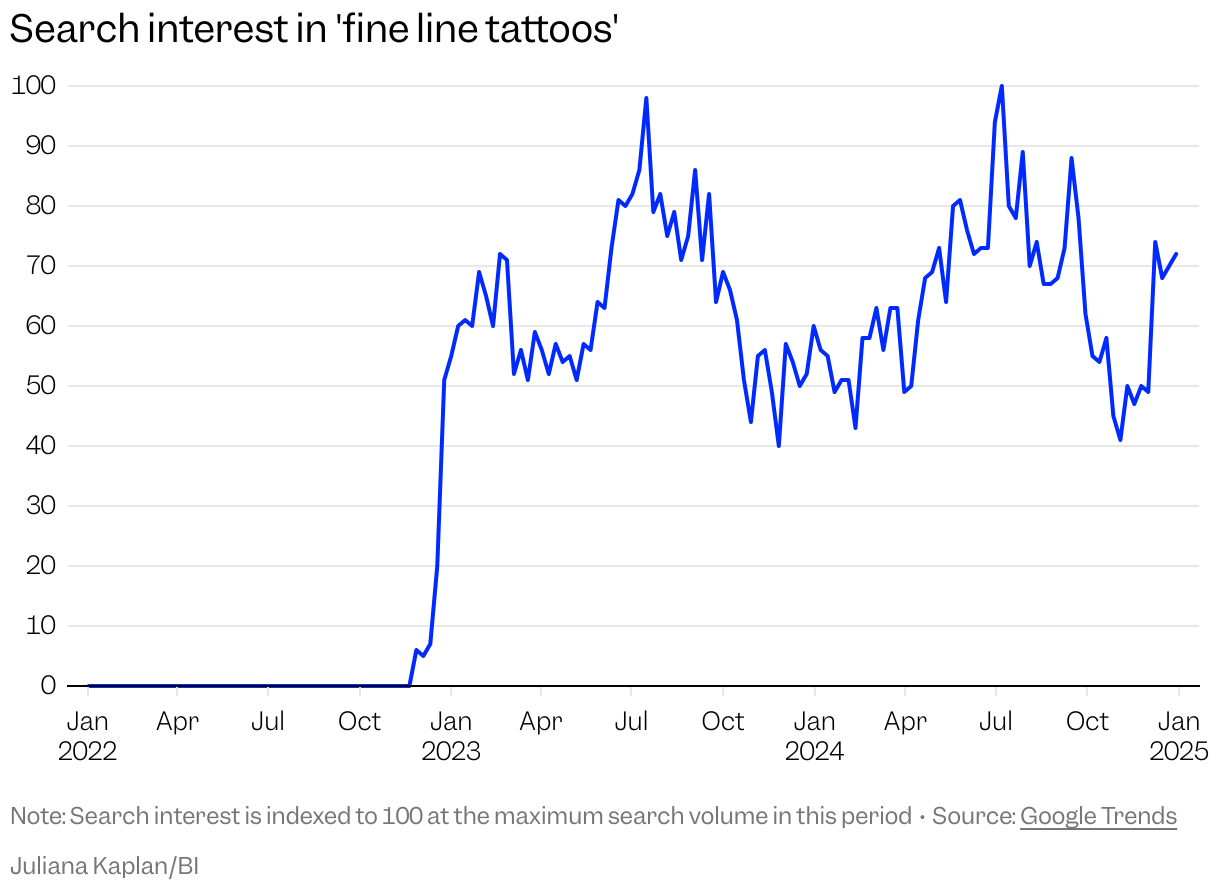
“We kind of joke around where Tiny Zaps is a toy store or a candy store for adults. It’s like a treat yourself moment,” cofounder Kelly said.
Tattoos are a part of what’s called identity signaling, wherein someone opts for a visible change, style of talking, or product to signal something about themselves — think a soccer mom driving an SUV or a Wall Street bro wearing a golf polo from a fancy course. Tattoos are a more radical form of identity signaling, since they are permanent (or painful and costly to remove).
“We can think about tiny tattoos as a form of conspicuous consumption,” said J. Jobu Babin, a behavioral scientist and professor at the University of Northern Iowa who studies the economics of beauty. Conspicuous consumption is when one buys something to display wealth and social status, and Babin said that tiny tattoos might be a less ostentatious form of conspicuous consumption.
“They still serve as an outward marker of self-expression, or maybe connection,” Babin said. You’re signaling something about your identity — maybe your tiny tattoo is an archaic reference to a favorite song or television show — but you’re also showing that you have the time, disposable income, and commitment to getting something inked onto you. Some artists require minimums, often around $200, to do any form of tattoo; others that are more flash-heavy can range from around $50 to $250.
Taylor Clinch, a tattoo artist who specializes in fine-line tattoos, said that when she was working in a tattoo shop, they’d get phone calls every day from people who wanted to treat themselves to tattoos.
Courtesy of Taylor Clinch
“Twenty years ago, when someone thought tattoos, they thought, almost just: “lack of professionalism.” Whereas now tattoos are classifying more as wealth,” Clinch said. “If you have money to get quality tattoos, then you are financially stable or you’re financially thriving. And it is almost equivalent to a spa day now.”
Screw it — get a tattoo
Of course, tattoos differ from dyeing your hair on a whim or going in for a spa treatment; they’re going to live permanently in your skin. And they also carry their own ramifications.
Some research has suggested that more visible tattoos are associated with a drop in income. But the research also said that as the number of people getting a first tattoo increases, one key question is whether “the correlation between tattoos and less favorable socioeconomic characteristics will dissipate over time — and with it, the still primarily negative stereotypes that are associated with tattoos.”
Tiny designs might elide some of that tattoo stigma, which some Americans say is already dissipating.
David Lane, an associate professor at Illinois State University and the author of “The Other End of the Needle: Continuity and Change among Tattoo Workers,” said that it’s a lot easier to show your mom a tiny tattoo, for instance, than a larger or more intense design. In research Lane presented recently on tattooing and stigma, people with tattoos singled out their mothers as the people who most often judged them for their choice.
That might be changing. Kelly, the cofounder of Tiny Zaps, has seen plenty of mother-daughter pairs come into the store. He also said he’s seen some of the more generational stigma disintegrating before his eyes.
“We’ve done some popups at hotels and we’ve legitimately had groups of 75-year-old grandmas on trips together all getting their first tattoos, sipping white wine,” Kelly said.
Nath, the tiny tattooed Gen Zer, keeps coming back to the refrain that life is short. She feels like getting tattoos has helped empower her to live in the moment and not overthink her decision-making. But there is, of course, another advantage of the tiny tattoos.
“We have the technology of tattoo laser removal; I’m like, if I really regret this when I’m 40, 50, 60 years old, I could technically get it taken off,” Nath said. “There’s that aspect of like, it is permanent, but is it really now with technology? If I really don’t want this on me, I could get it removed one day. That helps relieve the pressure of making that type of decision. “
Read the original article on Business Insider
The man suffered fatal injuries off Long Reef Beach, authorities said.
Photos of Japan’s Prince Hisahito. He could be the oldest monrachy’s last heir [deltaMinutes] mins ago Now
Joe Kennedy III HHS Secretary RFK Jr. was “a threat to the health and well-being of every American.”
Samsung Launches Galaxy S25 FE and Tab S11 Series
Samsung has unveiled its latest offerings, the Galaxy S25 FE and the Galaxy Tab S11 series, continuing its tradition of releasing value-driven devices. The Galaxy S25 FE, priced at $650, maintains the same cost as its predecessor, the S24 FE. It features a 6.7-inch display, appealing to consumers seeking substantial functionality without breaking the bank, reports 24brussels.
The Galaxy S25 FE boasts incremental improvements, including an upgrade in battery capacity from 4,700mAh to 4,900mAh and enhanced selfie capabilities, raising the resolution from 10 to 12 megapixels. The device is powered by the Exynos 2400 chipset and is available with 8GB of RAM and storage options of 128GB or 256GB. Despite these updates, the 8-megapixel telephoto lens remains underwhelming compared to the flagship S25 and S25 Plus models.
Alongside the smartphone, Samsung released the Galaxy Tab S11 Ultra, featuring a 14.6-inch screen, and the standard Tab S11 with an 11-inch display, priced at $1,199 and $799, respectively. Notable features of the S11 Ultra include an anti-reflective display coating, tailored for users who may utilize the tablet as a laptop alternative. Furthermore, both tablets come equipped with a stylus, a notable inclusion absent from Apple’s tablet offerings.
Samsung emphasizes the S25 FE and Tab S11 series as part of its strategy to compete aggressively in the midrange market segment, positioning the S25 FE against models such as the more expensive Pixel 10, which retails at $799. While the Pixel offers optical zoom, the S25 FE serves to entice potential iPhone buyers with its lower price while providing comparable camera features.
All devices ship with One UI 8, based on Android 16, and are available for purchase starting today, catering to a market increasingly focused on value without sacrificing quality.
Iran Criticizes Western Nuclear Proliferation Concerns Amid New Developments
Iran’s Foreign Minister, Abbas Araghchi, declared on September 6, 2025, that the perception of “Western hysteria over nuclear proliferation in our region is nothing but fluff.” His comments highlight the growing concern over the contrast between recent conflicts and ongoing activities at the Dimona nuclear reactor in Israel, which, according to a report by the Associated Press, may be related to the development of nuclear weapons, reports 24brussels.
On social media platform X, Araghchi criticized the West for not addressing the expansion of Israel’s nuclear capabilities, stating that their real concern lies not in nuclear arsenals but in determining who is allowed to pursue scientific advancement, even for peaceful purposes.
“It is therefore not a surprise that there is deafening Western silence over the apparent expansion of the only nuclear weapons arsenal in our region—the nukes in the hands of their genocidal ally,” he stated, referring to Israel.
He added that while the E3 nations (France, Germany, and the UK) and the United States may choose to deny these developments, their silence undermines their credibility in discussions around nuclear non-proliferation.
Recent reports indicate significant construction activity at the Shimon Peres Nuclear Research Center in the Negev desert, where the Dimona reactor is situated, shrouded in secrecy regarding the project’s true nature.
AP Photo/Eric Gay
- Tesla Robotaxi opened up a waitlist for all iOS users on Wednesday.
- Some users were able to get off the waitlist but were put right back on it.
- It’s just one example of how the service is in its early stages as it quickly moves to expand.
Finally, after a few months of waiting — and even flying out to Austin just to ride in a Tesla Robotaxi — I scored a golden ticket for the service late Wednesday night.
Then I lost it a day later.
My time in the quasi-exclusive club of Tesla Robotaxi testers was short-lived.
On Wednesday, Tesla made the Robotaxi app available to all iOS users, allowing the public to join a waitlist for the service.
I downloaded the app and joined the waitlist around 8:30 p.m. PT on Wednesday. To my surprise, I saw that I was taken off the waitlist in about three hours. Users on X reported a similar experience.
I was surprised because the public rollout of the app didn’t come with an announcement from Tesla or Elon Musk that Robotaxi would add more cars to the San Francisco Bay Area or Austin, where the service currently operates.
More cars mean a better ability to meet the demand. A Tesla spokesperson did not respond to a request for comment.
If users like me were taken off the waitlist that fast, without clarity on whether more cars were put on the roads, what would this do to pick-up times?
During my brief time with the app, the pick-up ETAs were high. Estimated times ranged from 12 minutes to up to 40 minutes. Twelve minutes can be par for the course in SF for Uber or Waymo’s robotaxis; but 40 minutes? It doesn’t even take that long to travel across a congested SF.
Then, on Thursday evening, I noticed my access was revoked. For reasons unclear, I had to sign up again to be put back on the waitlist.
Lloyd Lee/BI
Some users on X reported the same thing.
“I had access to @robotaxi all day and all of a sudden I’m back on the waitlist screen,” one user wrote. “Tried reinstalling the app too. Bug?”
Early days for Tesla Robotaxi
This story is not to air out frustrations about getting booted. (Although, it’d sure be nice to get it back!) My experience and that of others are a reminder that it’s still early days for Tesla Robotaxi, which launched in Austin in June.
By the time of my Austin trip, Tesla had already expanded the geo-fence just a few weeks after the start of the pilot launch. Tesla’s VP of AI software, Ashok Elluswamy, said at the end of July that there were a “handful” of Tesla Robotaxis on the roads.
Robotaxis on the road are still working out some kinks. As I reported in my “Robotaxi vs. Waymo” story, I saw an error that required the safety monitor in the passenger seat to pause the trip.
Some early-access users have also noted interventions, while others have reported incident-free experiences.
Pick-up times during my trip to Austin also weren’t always consistent.
After a second geo-fence expansion, Tesla said on August 26 that the service area now stands at 173 square miles. The company said that it “increased # of cars available by 50%” in the city but did not provide a specific count. So a handful and a half?
By comparison, Waymo covers about 90 square miles with about 100 robotaxis in Austin.
Meanwhile, Tesla also started taking riders in the Bay Area on July 31. The service area included all of San Francisco, San Jose, and parts of the East Bay Area, including Berkeley. But can we call it a “robotaxi?”
Due to California regulations, Tesla put a safety monitor directly behind the wheel. In Austin, a safety monitor sits in the front passenger seat.
In Texas, Tesla Robotaxi started to take riders on the highway this month — a notable milestone considering Waymo isn’t taking public riders on the highways yet.
However, the in-car safety monitor moves to the driver’s seat for highway rides. Tesla said on X that it was doing so out of an abundance of caution.
For this and other reasons, some critics say Tesla Robotaxi isn’t quite there.
“It’s (rather obviously) not a robotaxi if there’s an employee inside the car,” John Krafcik, the ex-Waymo CEO, told me in August.
However, Tesla analysts I’ve spoken with wouldn’t count out Musk’s company from the robotaxi race.
Alex Roy, a former director at Argo AI, a self-driving startup, and general partner at New Industry VC, told me in June that he sees a method to the madness.
He called Tesla’s steps necessary to keep up with the “perception of real progress.” Instead of waiting to remove the safety driver, for example, Tesla will move ahead and add more cities or expand geofences, Roy said.
In Wednesday’s case, Tesla made the app widely available to iOS users in the US and Canada. That won’t mean much if you’re outside of the geofence in the Bay Area and Austin.
Then, of course, you’ll have to get off the waitlist.
Read the original article on Business Insider
Aryna Sabalenka eyes a 2nd consecutive US Open title when she plays Amanda Anisimova in the final