
After a deadly Grand Blanc church attack, children handed out flowers and raised $170, while community groups and businesses offered food and resources.
 Advertising and Donations - advertising-newsandtimes.com
Getty images
Over the last 12 months, at least 10 executives have exited Tesla, including some of CEO Elon Musk’s most loyal lieutenants — from “Musk whisperer” Omead Afshar to longtime sales chief Troy Jones.
To track who remains at the top of the electric-car company, Business Insider reviewed the upper ranks of the company’s internal organizational chart.
As of August, Musk — who is listed on the org chart as “CEO and Technoking” — had 19 direct reports, compared with 35 before a round of layoffs in 2024 and 30 in late 2021. He has maintained nine of the same direct reports over the past three years, including design chief Franz von Holzhausen, who has been with the company since 2008; vice president of AI software Ashok Elluswamy; vice president of vehicle engineering Lars Moravy; and senior vice president of manufacturing in China, Tom Zhu.
An internal Tesla pay sheet obtained by Business Insider in 2024 showed how turbulent Tesla’s upper ranks have been. The company has swapped out at least three HR chiefs and several top legal officers since 2021, and about two-thirds of Musk’s direct reports have left the company between December 2021 and now.
Take a look at Musk’s direct reports, as well as their titles, locations, and tenure at Tesla, below:
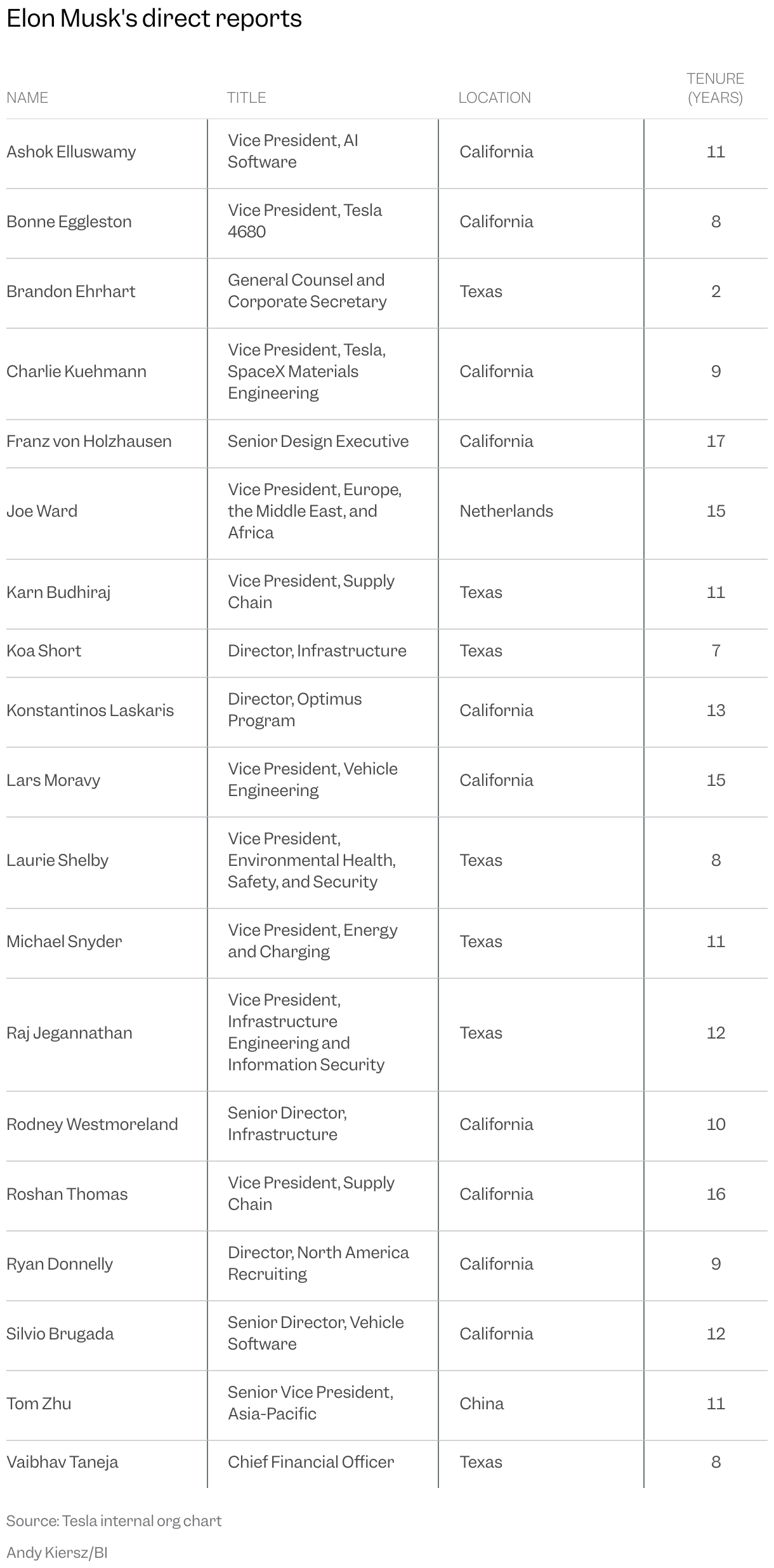
Most of Musk’s reports have between three and 30 of their own direct reports.
Konstantinos Laskaris began reporting to Musk this summer. He was previously listed as a director of engineering and has since assumed the same title as Milan Kovac, who led the team building Tesla’s humanoid robot and left in June. Laskaris’ LinkedIn profile says he is working on the robot’s actuators, which convert energy to allow it to move.
Jegannathan began reporting to Musk in July after taking over for Jones and leads US sales and service, according to Reuters. His X profile identifies him as working in “vehicle service,” and he has been responding to customers having delivery issues.
Elluswamy helps oversee the teams responsible for some of the company’s biggest bets, including the Autopilot team and the Optimus team. Elluswamy also took over leadership of some of the engineers that were part of the Dojo team after Pete Bannon left the company in August, two people familiar with the move said.
Most of the direct reports are based in San Francisco, a review of LinkedIn data shows.
Musk does not have any direct reports in the human resources department following director Jenna Ferrua’s departure in June, per the org chart.
The bulk of the recent executive departures came in two waves: between April and August 2025 and then in October 2024, in the days leading up to the company’s Robotaxi event.
Notable exits included Jones, who had led the sales team in North America for more than 15 years; Kovac; and Afshar, who became one of Musk’s top leaders while the Tesla CEO was working at the Department of Government Efficiency.
Over the past year, the company also lost its chief information officer, Nagesh Saldi, and the director of vehicle programs and new product introduction, Daniel Ho, who left to join the self-driving car company Waymo.
The departures came at a tumultuous time for Tesla. The carmaker has faced headwinds over the past year as delivery numbers continued to fall, and the Trump administration has made cuts to electric vehicle incentives.
The company’s corporate succession plan also attracted attention amid a proposed pay package for Musk. To receive the full compensation plan, Musk must name a successor, in addition to hitting a market capitalization of $8.5 trillion and putting 1 million autonomous vehicles on the road.
Do you work for Tesla or have a tip? Contact this reporter via email at gkay@businessinsider.com or Signal at 248-894-6012. Use a personal email address, a nonwork device, and nonwork WiFi; here’s our guide to sharing information securely.
TheStewartofNY/WireImage
Despite building a $111 million VC fund, backing 16 unicorn companies, and being married to a successful cofounder and investor, Serena Williams wishes she had more guidance when she launched her VC firm, Serena Ventures, over a decade ago.
“In hindsight, I feel like I should have had more mentors,” Williams, 44, told Business Insider.
While the tennis superstar said the mistakes she made were important for her to grow, she still asked herself: “Why learn them when you can learn them from someone else?”
It’s a good question from Williams, who, over the summer, became an “entrepreneur-in-residence” at Reckitt Catalyst.
Reckitt, a British hygiene company known for its health and cleaning products, including Lysol, has a social impact investment program aimed at delivering “health and hygiene solutions to 5 million people worldwide by 2030,” according to the company’s press release.
Catalyst recently expanded to the US, with Williams now mentoring US-based founders, including Erik Cárdenas, a founding member of Amazon Care (previously ranked on Business Insider’s 30-under-40 list in 2020), who started Zócalo Health to help Medicaid families in underserved communities.
“I feel like you learn something new every single day,” Williams said of joining the initiative. “I loved school, and I feel like I’m in school all day.”
Putting Williams in the professor role, Business Insider asked Williams to share the advice she learned from her investing experience, from refining an idea to dealing with setbacks.
Like most investors, when deciding whether to invest in a company, Williams first asks herself if there’s a true marketplace for the idea. “The founder can be amazing and smart and super likable, but if it’s not needed in the market, then it doesn’t fit,” she said.
If there is a market for the product or idea, she looks for the story the founder is telling. She cited some Catalyst-supported companies, such as the Tayaba Organisation and Nazava, both of which are led by female founders and address issues like water scarcity and water purification.
YouTube
“These women, they’re literally saving the lives of women and children, which truly will give you chills to hear some of these stories,” Williams said.
The key, Williams said, is for entrepreneurs to be passionate about their products, rather than just looking to fill a gap. “If they have a true connection to it, the businesses tend to do better,” she added, “as opposed to ‘Oh, there’s a white space, so we’re going to do it.'”
If there’s one lesson Williams learned over the years, it’s that so much depends on the face of the company.
“You’re only as good as your founder,” she said. “If someone is not a salesperson, they can have a great product, but they can’t sell it.”
Founders should be able to meaningfully connect with potential investors, Williams advised, rather than just relying on the idea being strong enough on its own.
“Access is key in VC,” she said. “When you’re doing business as an entrepreneur, it’s basically relationships.”
Kevin Mazur/Getty Images for SKIMS
She said connections you’ve met forever ago might be a perfect fit as investors or collaborators later on. Even a boring event to some can be very interesting to entrepreneurs who are truly open to meeting new people.
“When I think about what mentorship means and what I’ve learned, it’s really just about connections and unlocking how to get people to know about your product,” she said.
Drawing from her successful tennis career, where she won 23 Grand Slam titles and is widely considered the best female tennis player of all time, Williams said resilience is crucial — especially in early-stage VC, when many companies don’t work out in the long run.
“Sport really provides you with this mental fortitude that makes you understand that nothing happens overnight,” she said, whether you’re an athlete or a CEO.
It’s a great cheat code to understand when you’re launching businesses like Williams. In addition to Serena Ventures, which has backed brands like Esusu and Calico, she’s also launched Wyn Beauty, the topical pain-relief brand Will Perform, her clothing line S by Serena, Serena Williams Jewelry, and her production company Nine Two Six.
Joe Buglewicz/Getty Images for International Tennis Hall of Fame
Sometimes, resilience looks like finding the opportunity in obstacles.
Over half of the founders backed by Williams’ firm are women, historically a vastly underrepresented group in the VC world. According to data from the Founders Forum Group, in 2024, only 2.3% of venture capital funding globally went to all-female leadership teams, while mixed-gender teams accounted for 14.1% of spending.
“As a woman, when you start a business, you have to succeed because you have to work so much harder,” she said. In her experience of being a founder herself and working with female founders, “when we get an opportunity, we go out — we don’t know when our next opportunity to be.”
Often, she said, that drive helps the company succeed in the long run. “Whenever we are able to get a check, it tends to do well,” she said.