
Auburn travels to Kyle Field to take on Texas A&M in a pivotal SEC showdown Saturday.
Day: September 27, 2025
I can’t say that House of Guinness is firing on all cylinders.
Rookie Trey Yesavage will help lead the host Blue Jays past the Rays on Saturday afternoon, Stitches predicts.
BetMGM bonus code NYPDM1500 is allowing customers to get their first bet back in bonus bets if their first bet doesn’t win, up to $1,500.
Trump says he’ll send troops to Portland, Oregon, to handle ‘domestic terrorists’ [deltaMinutes] mins ago Now
Trump “welcomed” the request from President Lee Jae Myung and “he expressed his willingness to be engaged with North Korea again,” Foreign Minister Cho Hyun said.
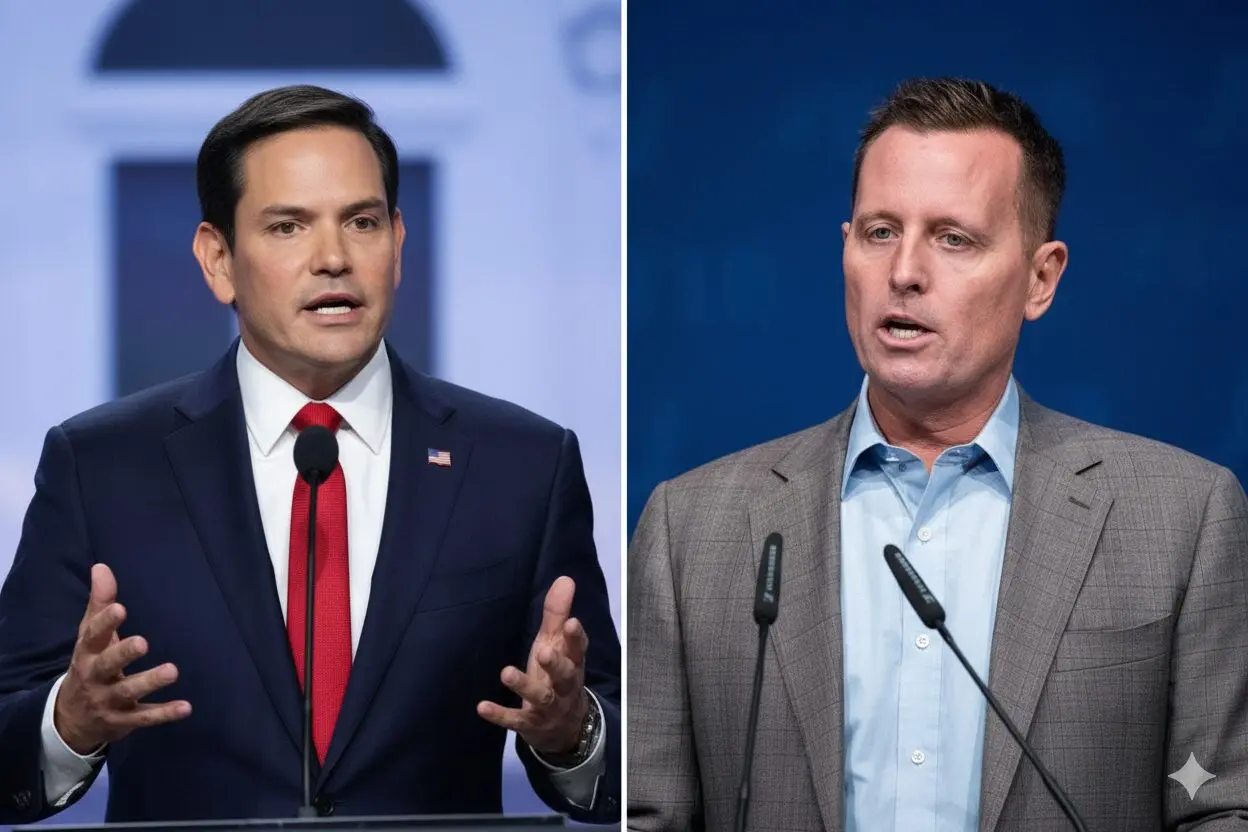
A Diplomatic Turn to Avoid War
In a significant shift from the Trump administration’s previous rhetoric, U.S. special envoy to Venezuela, Richard Grenell, has advocated for diplomacy over military action in the ongoing crisis with Caracas. Speaking at the Conservative Political Action Conference (CPAC) in Paraguay and during an interview with CBS, Grenell revealed he met with Venezuelan President Nicolás Maduro in January 2025, asserting that the primary objective of U.S. policy should be to “avoid war,” reports 24brussels.
This statement marks a profound departure from Secretary of State Marco Rubio’s more aggressive stance, which has included naval deployments and public threats against the Venezuelan government. Grenell’s comments have reignited debate over the legitimacy and effectiveness of U.S. actions in the Caribbean, with critics questioning military measures as necessary for addressing drug trafficking and the regime’s stability.
Grenell asserts that military escalation is counterproductive, potentially destabilizing the region further and provoking domestic backlash against President Trump. He emphasizes that direct negotiations could lead to peaceful outcomes without escalating to full-scale conflict. His strategy relies on backchannel diplomacy and leveraging limited concessions, such as the operations of Chevron in Venezuela, as means to reduce tensions.
Richard Grenell Venezuela Policy: A Strategic Alternative to Military Escalation
The Richard Grenell Venezuela policy underscores a critical insight: military force alone cannot remove Nicolás Maduro from power, and such attempts may inadvertently bolster his support domestically while increasing anti-American sentiment across Latin America. Recent U.S. military actions, which included targeting vessels linked to the Tren de Aragua gang, have resulted in significant casualties without clear evidence linking the deceased to drug trafficking, raising concerns about potential extrajudicial killings.
Some Pentagon officials have expressed unease, suggesting these operations could resemble “targeted assassinations” carried out without proper oversight. In contrast, Grenell’s diplomatic outreach fosters ongoing communication with Maduro’s inner circle, facilitating prisoner exchanges and contributing to agreements for the return of detained U.S. citizens.
Grenell’s efforts have also been integral in promoting the deportation flights agreement between the U.S. and Venezuela, signaling a rare moment of cooperation amid hostility. Recently, Maduro sent a letter to Trump denying involvement in drug trafficking and expressing a willingness to engage in talks through Grenell. Though the White House dismissed it as a collection of “lies,” the lack of outright rejection hints at a possible opening in relations.
“This channel has functioned impeccably,” Maduro noted of his correspondence with Grenell, “and we seek direct dialogue to resolve issues.” This indicates that even within tense relations, covert diplomatic channels can remain functional, an avenue Grenell aims to formalize rather than eliminate.
Geopolitical Context: Regional Realignments and the Limits of U.S. Power
The Richard Grenell Venezuela policy reflects evolving geopolitical dynamics within Latin America. The militarized strategies employed by the U.S. have provoked a unified response among regional actors including the strengthening of ties between Brazil, Colombia, and Venezuela. In a notable shift, the Community of Latin American and Caribbean States (CELAC) has emerged as a consolidated bloc opposing U.S. interventions, condemning strikes in the region as violations of sovereignty and reiterating longstanding criticisms of U.S. imperialism.
According to a regional analyst in São Paulo, this situation reflects not merely resistance to U.S. policy but indicates the emergence of a new regional order that emphasizes autonomy and multilateralism. China’s increasing involvement complicates these dynamics, as it reinforces partnerships with nations like Venezuela, further distancing the U.S. influence in its own backyard. Grenell’s strategy hints at recognizing the necessity of diplomacy to counterbalance China’s rising presence.
Despite increased military operations—including the deployment of F-35 aircraft and naval patrols near Venezuela—Rubio’s aggressive methods have not curtailed drug trafficking or led to any notable destabilization of Maduro’s government. In fact, Caracas has responded with military exercises, militia mobilizations, and the demonstration of Russian-made fighter jets, showcasing its resilience.
These developments highlight the inadequacy of a unilateral military approach, while Grenell’s negotiation-focused model presents a potential path forward that could safeguard U.S. interests without leading to extensive conflict.
Internal Divisions and the Battle for Influence in the Trump Administration
The conflict between Grenell and Rubio represents broader divisions within the Trump administration regarding how best to exert American power. Rubio epitomizes the hardline, ideologically motivated faction that views Venezuela as central to a larger ideological battle against socialism, whereas Grenell advocates for a pragmatic focus on achievable outcomes.
Reports suggest that Grenell’s influence is diminishing within formal policy discussions, with Rubio taking the lead amid internal disagreements. A senior official remarked that Grenell’s views are “out of step with the president,” indicating that Trump and Rubio remain the primary decision-makers on this issue.
Nonetheless, Grenell maintains direct access to the president and continues to assert his stance on restraint. Support from allies, including far-right figure Laura Loomer, underscores the challenge Grenell faces in navigating this political landscape, especially given the tight connection between any potential negotiations and Trump’s authorization due to existing sanctions.
The situation poses a significant dilemma for Trump, as he seeks to project strength while avoiding entrapment in protracted foreign conflicts—a pitfall that has historically hindered previous administrations. Grenell’s diplomatic framework allows for symbolic actions while keeping negotiation channels open, enabling Trump to present a posture of toughness while evading the fallout of outright military engagement—an intricate balancing act, particularly in an election year.
Conclusion: A Fragile Opening for Peace in the Americas
The emergence of the Richard Grenell Venezuela policy provides a glimmer of hope for diplomatic resolution, fostering an environment where alternatives to conflict can be explored. By advocating for dialogue and rejecting blanket calls for regime change, Grenell introduces a pragmatic approach to a volatile situation.
His framework recognizes a fundamental reality: Venezuela is not Libya, Iraq, or Afghanistan. Instead, it represents a sovereign state with established alliances and a populace opposed to foreign intervention. Although challenges persist, the reintroduction of negotiation as an option reflects a noteworthy shift in sentiment. In a region weary of external meddling, Grenell’s call to “avoid war” may resonate widely and serve as a plea for rationality amidst escalating tensions.
The response of the Trump administration will significantly influence not only U.S.-Venezuela relations but also the broader landscape of peace and sovereignty in Latin America.
Aalst – Mayor Christoph D’Haese has reinstated a ban on gatherings at Stationsplein until October 31, 2025, implementing systematic identity checks and planning a permanent police post in response to ongoing unrest, reports 24brussels.
Following concerns regarding potential violence in the area, the city has taken decisive action after police identified calls from some young individuals of immigrant origin on social media encouraging gatherings at the square. The mayor issued an urgent order to enforce the ban, which aims to mitigate unrest and maintain public safety.
What measures is Aalst taking to prevent unrest at Stationsplein?
The mayor emphasized that public safety remains the city’s top priority.
“Young people from other cities and municipalities come to Aalst with bad intentions,”
said Christoph D’Haese, mayor (N-VA) of Aalst.
In conjunction with the ban, Aalst police are authorized to carry out systematic identity checks in the station district. D’Haese emphasized the importance of maintaining close cooperation with the public prosecutor’s office and mayors from neighboring municipalities. He stated that it is crucial to prevent individuals from disturbing public order and to keep troublemakers out of the area.
The city is also planning to establish a permanent police presence at the square. This step follows previous measures, as a similar ban was enforced in 2023 and was only lifted at the end of last year. City officials assert that these measures are essential to maintain order, prevent disorder, and protect one of Aalst’s busiest public spaces.
Over the past year, the Stationsplein has been a target of multiple security interventions. In addition to the gathering ban, the city implemented an alcohol prohibition in the station district on September 5, 2025, due to separate public nuisance concerns.
The suburb may surprise some pundits.
The neo-imperialist post-Soviet Russian Mafia State under the cover of Putinism is one and the latest of the historical waves of the Mongol-Tatar system of governing and its patterns of the social, political, and economic relations
–
GS – AI Overview
The idea that modern Russian politics, particularly “Putinism,” is a continuation of the Mongol-Tatar system of governing is a highly debated historical and political thesis. While some scholars and political commentators draw comparisons between specific patterns of centralized power, corruption, and the use of violence, others reject this theory as a problematic oversimplification of history. [1, 2]
Arguments supporting the comparison • Centralized, autocratic rule: Some historians, like Nikolai Karamzin, have argued that Mongol rule helped unify the fragmented Russian principalities under a single, autocratic Moscow-based authority. This historical trajectory established a precedent for a powerful, centralized state, a pattern seen today in the concentration of power around Vladimir Putin.
• A historical view of the state: The Eurasian school of thought, which gained traction among some Russian emigres, argues that the Russian state is the heir and successor of the Mongol Empire. This view frames Russia as a unique Eurasian civilization, distinct from the West, and sees its autocratic traditions as a continuation of its imperial, Eastern heritage.
• Political culture: Proponents of the theory point to similarities in political practices, such as the use of fear and intimidation to maintain control. The Mongols demanded absolute submission from Russian princes, who in turn learned to use similar tactics to enforce compliance and collect tribute.
• Economic extraction: The Mongol system of extracting tribute through local intermediaries who were rewarded for their loyalty created a dynamic of corrupt, personalized relationships rather than a rules-based system. Critics of Putinism argue that it reflects a modern version of this system, with a ruling elite enriching itself through the state’s resources.
• Historical rhetoric: The narrative has been deployed politically within Russia as well. In a 2023 speech, Putin himself controversially framed submission to the Golden Horde as a choice that preserved the Russian people from Western invasion, a message with clear contemporary political overtones. [1, 2, 3, 4, 5, 6, 7, 8]Counterarguments and criticisms • Remote vs. direct rule: The Golden Horde did not directly occupy the Russian lands, but instead ruled from a distance, relying on Russian princes to collect taxes. This differed significantly from the Mongol approach in other regions, such as Persia and China. The Putinist “mafia state” involves a more direct, systemic integration of criminal and state interests, which is not an equivalent model.
• Overlooking other historical influences: The Mongol-Tatar yoke was just one of many formative periods in Russian history. Russian political traditions also draw heavily from Byzantine statecraft, Orthodox Christianity, and later, Western European imperial models. Focusing solely on the Mongol influence is a simplification that ignores these other complex historical sources.
• Anachronistic comparisons: Critics warn against drawing direct lines from medieval Mongol-Tatar rule to modern-day politics, pointing out that such comparisons are often used for political rhetoric rather than historical accuracy. Comparing Putin to a medieval ruler like Genghis Khan, for example, is seen by some as a crude analogy rather than a serious historical analysis.
• Exaggerated impact of the “yoke”: Some historians, particularly Soviet-era and post-Soviet Russian scholars, argued that the Mongol impact was minimal or even beneficial, emphasizing Russian heroism and self-preservation during the period. This view is contrasted with the “Westernizer” school of thought, which blames the Mongol period for Russia’s divergence from European modernity. [1, 2, 9, 10, 11]A complex historical legacy Ultimately, the thesis is not a straightforward factual claim but a framework for historical interpretation. The comparison is a controversial way of understanding the origins and characteristics of Russian authoritarianism. It highlights certain aspects of centralized power and political culture while downplaying the multitude of other factors that have shaped the Russian state over the centuries. [1]
AI responses may include mistakes.
[1] ijors.net/issue5_2_2016/arti…
[2] scholarworks.iu.edu/journals…
[3] egrove.olemiss.edu/hon_thesi…
[4] encyclopedia.com/history/enc…
[5] en.wikipedia.org/wiki/Putini…
[6] study.com/academy/lesson/how…
[7] ijors.net/issue5_2_2016/pdf/…
[8] fiveable.me/key-terms/ap-wor…
[9] lowyinstitute.org/the-interp…
[10] dergipark.org.tr/en/download…
[11] fiveable.me/early-world-civi…
–Gemini
g.co/gemini/share/2d5702eb91…
The assertion that the “neo-imperialist post-Soviet Russian Mafia State under the cover of Putinism is one and the latest of the historical waves of the Mongol-Tatar system of governing” is a complex thesis that draws parallels between contemporary Russia and the historical period of Mongol rule over the Rus’ principalities. While not a direct continuation, scholars and analysts have noted certain structural and political similarities that suggest a lasting influence of the Mongol-Tatar yoke on Russian political culture and statecraft.1At the heart of this argument lie several key perceived parallels: the centralization of power, the nature of the state’s relationship with society and the economy, and an expansionist foreign policy.
The Specter of the Golden Horde: Centralization and Autocracy
The Mongol Empire, and its successor, the Golden Horde, governed the Rus’ principalities through a system of tribute and vassalage.2 Russian princes were required to obtain a yarlyk, or charter, from the Khan to legitimize their rule. This fostered a political environment where power was concentrated in the hands of a single, autocratic ruler who acted as an intermediary.
Similarly, “Putinism” is characterized by a “power vertical,” a highly centralized political structure where regional leaders and institutions are beholden to the Kremlin.3 This system, much like the Mongol model, prioritizes the stability and authority of the central state above all else. The selective application of law and the suppression of dissent to maintain this order are also cited as echoes of the Horde’s methods of control.
Economic Relations: From Tribute to State Capitalism
The economic model of the Golden Horde was largely extractive.4 The primary goal was the collection of tribute from the subject principalities.5 This created a system where economic activity was heavily influenced and often controlled by the ruling power for its own enrichment.
Critics of the modern Russian state describe it as a “mafia state” or a kleptocracy, where a small elite of government officials, oligarchs, and security service members (the siloviki) are bound together to control and exploit the nation’s wealth.6 In this view, economic power is not independent but rather fused with political power, and state resources are used for personal enrichment and to maintain the loyalty of key figures, a dynamic that bears resemblance to a system of tribute and patronage.
A Neo-Imperial Foreign Policy?
The Mongol Empire was built on conquest and the subjugation of neighboring territories. The Golden Horde maintained its dominance through military might and by playing rival principalities against each other.
Contemporary Russian foreign policy under Putin has been described as “neo-imperialist,” characterized by a desire to reassert influence in the “near abroad”—the former republics of the Soviet Union.7 Actions in Chechnya, Georgia, and Ukraine are often cited as evidence of a willingness to use military force to achieve geopolitical objectives and maintain a sphere of influence, a strategy that some analysts connect to a long-standing Russian imperial tradition that was arguably shaped during the Mongol period.
Divergences and Historical Debate
It is crucial to note that this thesis is a matter of historical and political interpretation and not without its critics. Many historians argue that the influence of the Mongol-Tatar yoke is overstated and that Russian political development was also heavily influenced by Byzantine traditions, Orthodox Christianity, and its interactions with European powers.
Furthermore, the modern Russian state operates within a globalized and technologically advanced world that is vastly different from the medieval period of Mongol rule. The ideologies and justifications for power have also evolved significantly.
In conclusion, while contemporary Russia under Putin is not a direct replica of the Mongol-Tatar system, the argument that it exhibits certain enduring patterns of governance—such as a strong, centralized autocracy, the fusion of political and economic power, and an assertive foreign policy—is a compelling one. These parallels suggest that the historical experience of the Mongol yoke may have left a lasting imprint on Russia’s political DNA, an imprint that some see re-emerging in the 21st century.
–— Michael Novakhov (@mikenov) Sep 27, 2025