
Categories
Selected Articles

Why your favorite brand is trying to make the next “Friends”

A Director's chair labeled

This summer, a new series on TikTok caught my eye. “Roomies” appeared to be a group of sketch comics turning out a once-weekly, highly-produced (by TikTok standards) mockumentary-style sitcom about a young woman named Ellie who moves from the Midwest to New York and encounters all the horrors the city has to offer: long lines for restaurants that have gone viral, bad roommates, and broken air conditioning. But when I peeped the show’s bio, I found that it’s not the work of a Gen Z iteration of the Upright Citizens Brigade or “SNL” hopefuls — it’s written, directed, and produced in-house by the rent loyalty rewards company Bilt.

In the first dozen or so two-minute-long episodes, there’s not one mention of Bilt. The show focuses on the issues central to Bilt’s existence — housing affordability and scarcity in New York — and the “Roomies” account has garnered nearly 90,000 followers and its videos have racked up some 8 million views without pushing a single Bilt product placement. Perhaps the most shocking thing about this barely-branded content: It’s actually funny and relatable.

“Roomies” isn’t the first brand to take a shot at the stealth sitcom. Jewelry brand Alexis Bittar began uploading short videos of its own mockumentary series “The Bittarverse” on social media platforms two years ago, in which “Pose” actress and stylist Patricia Black pokes fun at the fashion industry while sporting items from Bittar’s collection. (The series has won a Webby award.) InStyle magazine has run three seasons of its short-form series “The Intern” satirizing obnoxious young workers with no concept of workplace boundaries. This is the latest evolution of sponsored content, which has subtly been making its way to us since Procter & Gamble sponsored radio and TV shows a century ago, launching the soap opera. Some of the comedic groups I follow have taken to posting not hauls or out-right endorsements of brands, but writing and filming sketches in their own style around the brand (think: a group of chaotic girl friends in Brooklyn hastily getting ready for a wedding, explicitly sponsored by clothing rental brand Nuuly).

It’s a departure from buttoned up, traditional influencer marketing, where someone blatantly endorses or explains a product or shows the way it fits into a made-for-the-Gram lifestyle. Instead, the videos take a form that conveys a feeling, more subtle show than tell. In an online world where everything feels like an ad, the latest trend is making ads that feel like the organic social content people actually bother scrolling to see.

Ironically, advertisers are parroting authenticity as social media at large seems to lose it.

Our social internet is increasingly defined by rage clickbait and generative AI slop, with ads mixed between. Brands have raced to capitalize on social trends, like Taylor Swift album drops, Barbenheimer summer, or the latest memes on social media for the past decade, from Denny’s acting out of pocket on Twitter to brands jumping on Threads, ultimately turning it into their playground and killing the juice. Many of those attempts fall flat. “Relevance without storytelling is just random and scattered,” says Andrew Roth, founder and CEO of the Gen Z-focused research firm DCDX. In today’s brain-rot filled social world,this entertainment-forward content “feels so good and nice to see,” Roth says. “It’s like a relief.”

That relief comes because the content is more about laughs and storytelling than it is the intricacies of Bilt’s loyalty programs. “We’re trying to show all the things that Bilt enables you to do,” Zoe Oz, Bilt’s chief marketing officer, tells me. “There’s a bigger emotional element to this type of content that isn’t just, what is Bilt’s product? It is also, what does Bilt make me feel and what do I feel as a Bilt member?” Oz says measuring the success of “Roomies” is more about seeing how many people followed its account or engaged with it, and less, for now, about how many of those people became users of its product after watching the show. “We wanted to build content for content’s sake and really build visibility.” Advertisers want your eyeballs; if they can keep you there for a full two minutes by getting you to laugh, that’s a huge win, even if they don’t see a tagline at the end.

Advertisers are parroting authenticity as social media at large seems to lose it.

The short sitcom snippets also are just the right length to cater to our ever-shrinking attention span. These brands are solving a problem that has long plagued Hollywood: how to master short-form video for mobile. Quibi failed spectacularly at this, despite $1.75 billion in funding and promotion from some A-list actors. DramaBox has captured interest with short-form soap operas, and is now looking to take on other genres. There’s a clear appetite for storytelling on TikTok, and anonymous accounts regularly cut and post, without permission, scenes from TV and movies like serialized dramas like “Chicago Med” or classics like “Sex and the City.” TikTok and YouTube are the most popular video platforms for people ages 18 to 35, outpacing more traditional streaming services, according to research firm Omdia.

And for actors, making it big on the little screen might be the new way to break into the industry. Maddie Land, who plays Ellie in “Roomies,” comes from a theater background. Originally from Cincinnati herself, Land has a lot in common with the character, and tells me she felt authentic playing her — something that is hard to come by when making ads. “They are writing the most relatable content,” Land says. “So many different people I’ve seen in the comments are like, ‘oh my God, is this about me?'” Land also tells me she was looking for exposure and experience, and taking on Ellie “has absolutely been the best way to get that, because so many different people are seeing ‘Roomies.'”

Gen Z is more likely than other age groups to be influenced into buying a product by social media, according to McKinsey research. But what they want to see is changing. Young people preferred influencers who were “quirky, humorous, and vulnerable” than those showcasing products used in their picture perfect lives, according to a 2023 report from the consulting firm about the fashion industry.

These mockumentaries are “pushing the boundaries of what marketing has done in the past, in terms of the topics that they’re covering or the less polished version that they’re showcasing,” says Olivia McNaughten, vice president of marketing at Grin, an influence marketing software company. That doesn’t mean aspirational influencer content is going away, but for brands that don’t need to sell a picture perfect lifestyle, it can work. “Humor is just inherently stickier, people remember it,” says McNaughten, “When it’s done really well, it can cross over the skepticism that people have typically when they’re engaging with a brand.”

For the “Bittarverse,” founder Alexis Bittar tells me the satirical content is a way to make “the brand to resemble my values.” Bittar, who writes and directs the series, focuses on critiquing the elite class so often shown as aspirational in fashion advertising. He also hired two trans women to act in the short-form series, and takes risks with humor that pushes boundaries of political correctness — something bigger brands are unlikely to do. “Generally, brands want to sell to everybody,” Bittar tells me. “I’m not looking to get the tennis club customer.”

The thing about the “Bittarverse,” “The Intern,” and “Roomies,” is that they’re actually good. People might be more willing to be entertained by ads when they set the bar for humor high. These companies are cracking a way to entertain people and break through social feeds filled with obnoxious, addictive videos in favor of micro-versions of “The Office.” Brands eying the success stories are likely trying to think up their own series. Some might be good, many will probably fail to land on many FYPs. There’s an uncanny aspect of having ads stealthily served like this not as a side dish but with equal weight to the main content you want to see. And yet, I have to wonder if Ellie, our doe-eyed Midwestern protagonist, makes it as a city girl or gets driven back to the safety of her Ohio hometown, so I’ll keep watching.


Amanda Hoover is a senior correspondent at Business Insider covering the tech industry. She writes about the biggest tech companies and trends.
Read the original article on Business Insider
Categories
Selected Articles

Poland scrambles aircraft as Russia attacks Ukraine with hundreds of drones and missiles

Poland said it had scrambled aircraft to protect its airspace as Ukraine reported a Russian attack featuring more than 600 drones and missiles

Polish and allied aircraft were deployed early on Saturday to ensure the safety of Polish airspace after Russia launched airstrikes targeting western Ukraine near the border with Poland, armed forces of the NATO-member country said.

“Polish and allied aircraft are operating in our airspace, while ground-based air defence and radar reconnaissance systems have been brought to the highest state of readiness,” the operational command said in a post on X.

Three Russian MiG-31 fighters violated Estonian airspace over the Gulf of Finland on Friday, Estonia said, triggering complaints of a dangerous new provocation from the EU and NATO. Italian F-35 fighters attached to Nato’s air defence support mission in the Baltic states were scrambled to intercept the Russian jets and warn them off, Estonian and Italian officials said, with alliance chief Mark Rutte praising the “quick and decisive response”.

Russia’s defence ministry on Friday denied that three of its MiG-31 fighter jets had illegally entered Estonian airspace. The ministry said the jets were on a “scheduled flight… in strict compliance with international airspace regulations and did not violate the borders of other states, as confirmed by objective monitoring”.

Zelenskyy on Friday condemned the move, calling the 12-minute incursion “outrageous” and accusing Moscow of deliberately expanding its “destabilising activity” three and a half years after its full-scale invasion of Ukraine. “These are not accidents. This is a systematic Russian campaign directed against Europe, against Nato, against the West. And it requires a systemic response,” Zelensky posted on X.

President Donald Trump said on Friday he would soon be briefed on reports that Russia had violated Estonia’s airspace and made clear he was not pleased with the situation. “I don’t love it. I don’t like when that happens. Could be big trouble,” Trump told reporters.

One or more large fires erupted early on Saturday at Russia’s Saratov oil refinery as it was hit heavily by Ukrainian drones that attacked the target deep inside Russian territory for at least the second time in a week. Videos vetted and posted by online analysts showed incoming UAVs followed by big explosions and flames rising from the site while air raid sirens blared. The major refinery is nearly 600km (370 miles) east of the frontline in Ukraine. The Russian governor in the area, Roman Busargin, confirmed an attack by UAVs.

The EU proposed on Friday to bring forward by a year to January 2027 a total ban on Russian natural gas imports as part of its 19th package of sanctions targeting Moscow. The European Commission chief, Ursula von der Leyen, said “it is time to turn off the tap” of fossil fuel revenue to the Kremlin. Zelenskyy welcomed the measures, saying they would have a significant effect on the Russian economy.

Ukrainian troops pressed on with a frontline counteroffensive around two eastern cities on Friday with Zelenskyy saying heavy losses were being inflicted on Russian forces. The counteroffensive had disrupted Russian plans in their longstanding objective of seizing the logistics centre of Pokrovsk, said Ukraine’s president. Russia said its forces captured two new villages – Muravka outside Pokrovsk and Novoivanivka further in the Zaporizhzhia region – but its defence ministry made no reference to the Ukrainian drive near the towns of Pokrovsk and Dobropillia.

The general staff of Ukraine’s military listed Muravka among settlements where its forces had halted 87 attacks near Pokrovsk. Zelenskyy also said Ukrainian forces were holding their positions around Kupiansk – an area of Ukraine’s north-eastern Kharkiv region that has been subject to Russian assaults for months.

Zelenskyy said on Friday that Kyiv plans to begin exporting certain types of weapons, such as naval drones, to finance its domestic military production. “We already have certain types of weapons in much larger quantities than we actually need today in Ukraine,” Zelensky said in his daily address.

Russia has filed an appeal with the International Court of Justice over a decision deeming Moscow responsible for the downing of a Malaysian jetliner over Ukraine in 2014, killing 298 people, the court said on Friday. Australia and the Netherlands, the countries with the most fatalities in the disaster, had launched the case, calling for Russia to assume responsibility for the downing and pay damages.

Continue reading…

Categories
Selected Articles

Thousands evacuated in Hong Kong after discovery of large WWII-era bomb

Thousands evacuated in Hong Kong after discovery of large WWII-era bomb [deltaMinutes] mins ago Now
Categories
Selected Articles

Will Warren’s solid start undone by ‘embarrassing’ error: ‘Worst play’

It was the bouncer that got through his legs in the sixth inning Friday night that will stick with him the most.
Categories
Selected Articles

The plight of college-educated men shows where the job market is going

man on laptop looking stressed
Men are dealing with some big labor market changes.

  • Men with degrees aren’t seeing their earnings go up as much as they historically have.
  • Male-dominated fields like tech are at a standstill, while female-dominated fields are growing.
  • That trend might show how the labor market is changing, and how male workers need to adapt.

For men, a bachelor’s degree isn’t worth what it once was.

The labor market is in flux, as job growth slows and AI eats up entry-level jobs. But, under the hood, the differences in how earnings are evolving by gender are stark, and men might offer a warning signal for how the economy is changing.

Business Insider analyzed the Census Bureau’s historical earnings figures by educational attainment and gender. For men with a bachelor’s degree and up, cumulative wage growth since 1991 has fallen and stalled; for women, it’s the opposite.

Men are still outearning women, but we’re seeing stagnation in male-dominated fields like tech and professional and business services, while female-dominated professions like education and healthcare have taken off. As the labor market tips toward those traditionally female professions, Gen Z men might be some of the first test subjects of the economy’s new shape.

“The fact that the labor market was gendered was more to the disadvantage of women,” Richard Reeves, the president of the American Institute for Boys and Men, said. “I think we’re entering an era where it’s going to be more to the disadvantage of men.”

The state of men in the labor market

Fewer young men are working, and their labor force participation — a measure that tracks whether they’re working or actively seeking work — has stagnated.

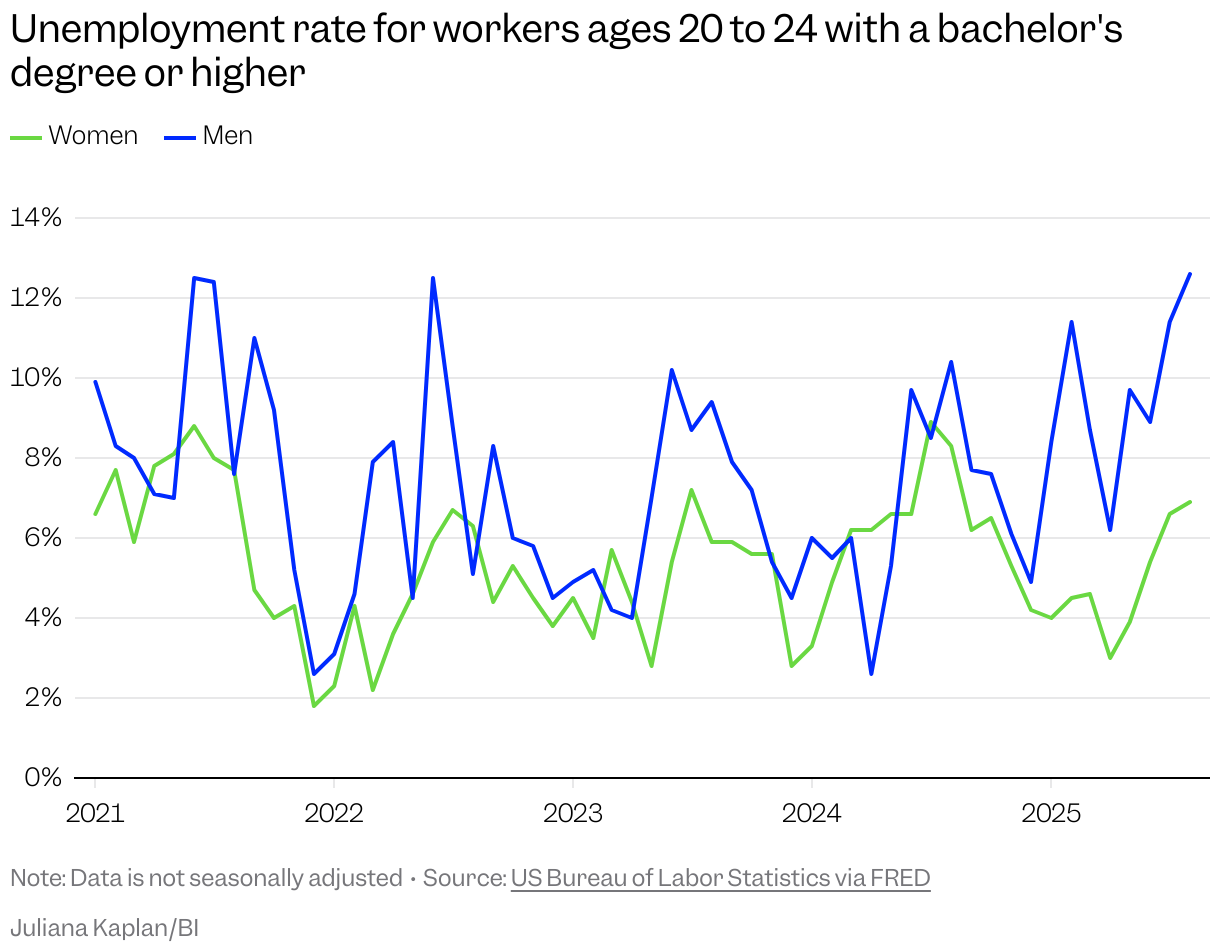
At the same time, the unemployment gap between young men with a degree and similar young women has widened, with men increasingly likely to be unemployed.

“Part of what we have going on as a macro story is, obviously, a softening labor market,” Ben Glasner, an economist at the Economic Innovation Group, said. Job-hopping is down, and wage gains from job-switching are falling. Along gendered lines, Glasner said that industries that are predominantly exposed to men with higher education are softening faster than industries that were more exposed to women with higher education. And so, Glasner said, men might now be the first exposed to a weakening labor market.

“This might be kind of a leading indicator of a weakening job market, but it’s not totally clear how much that’ll spill out into other industries and lower degree holder fields,” he said.

At the same time, fields traditionally dominated by women are rare bright spots in a more dreary labor outlook; in August, payroll additions in healthcare helped offset losses in other industries, with private education and health services adding 46,000 jobs. Continued growth in the labor market right now is essentially all about nurses and teachers.

“Those are basically the only jobs that we’ve been adding for at least this year,” Alex Jacquez, chief of policy and advocacy at the Groundwork Collaborative, said.

A role reversal in the job market

It all shows a role reversal in the labor market, and underscores that it might be time for both the labor market and men to adapt to a new reality. After all, roles in healthcare are projected to boom over the next decade.

“There’s also a real change in how our economy works, what our economy is focused on, and that is really favoring women in this labor market,” Emerson Sprick, the director of retirement and labor policy at the Bipartisan Policy Center, said.

One barrier that could be preventing men from going into these more robust fields might be pay. As Glasner said, the industries that are female-dominated, like education and healthcare, are seeing wages increase — but still paying less than more male-exposed ones; beyond the gender divide, as those sectors grow, it might also be time to figure out how to bolster salaries there accordingly.

Another aspect, Reeves said, is that we’ve made huge progress in increasing the share of women in professions that were previously inaccessible to them, but we’ve gone the other way in fields that are traditionally seen as female. The share of male public school teachers has dropped from 30% in 1987 to 23% as of 2022, per an analysis from Reeves’ American Institute for Boys and Men. In elementary schools, per Pew Research Center, 89% of teachers are women.

“My read of it is that actually there’s a lot of jobs there that are pretty good that a lot of men could get, but because they’re seen as women’s jobs, they’re not going for them,” Reeves said.

There are some signs of progress, or at least a way forward. As Reeves noted, a growing number of states are working on initiatives to get men into teaching. And some younger men are also potentially adapting by seeking out vocational training, setting themselves up to go into fields that aren’t as touched by a softening white-collar labor market. At the same time, labor market demand might finally boost wages in these growing fields to the point that they could draw more men in.

“I think there will be a wage level at which the opportunity cost, even for controlling for all the cultural and social hesitation that young men have to enter these jobs, is likely to be overcome,” Jacquez said. “As we continue to have a shortage of these jobs being picked up, the wage picking up even more is likely the way that employers are going to entice more people in.”

Read the original article on Business Insider
Categories
Selected Articles

After Decade Dating Woman Marries Boyfriend—8 Months Later They’re Divorced

Lindsay Bloom told Newsweek she hoped the wedding would bring a sense of clarity, but it left her feeling “more lost than ever.”
Categories
Selected Articles

Liz Truss: Britain Faces Its MAGA Moment

Speaking to Newsweek, Truss is back, with a radical new message for a British right which could be on the cusp of transforming Britain.
Categories
Selected Articles

Russia launches large-scale attack on Ukraine, killing 3 and injuring dozens

Russia launches large-scale attack on Ukraine, killing 3 and injuring dozens [deltaMinutes] mins ago Now
Categories
Selected Articles

Photos of an orthopedic center in Congo that helps amputees regain mobility

Photos of an orthopedic center in Congo that helps amputees regain mobility [deltaMinutes] mins ago Now
Categories
Selected Articles

EU unveils new sanctions targeting Russia’s shadow fleet and oil trade

On September 18, the European Union adopted its 19th sanctions package against Russia, intensifying restrictions on the country’s banking system and oil exports. The package, which includes more than 2,500 individuals and entities, specifically targets the so-called shadow fleet of tankers used to transport Russian crude. Energy giant Lukoil and its trading subsidiary Litasco are among the companies placed under new restrictions. The initiative to expand sanctions was strongly supported by Berlin and Paris, which urged the European Commission to include offshore companies involved in Russian oil exports.

Sikorski warns of shadow fleet’s ecological threat

In an interview with Frankfurter Allgemeine, Polish Foreign Minister Radosław Sikorski stressed that revenue from Russian oil transported by poorly insured and aging tankers continues to finance Moscow’s war effort. He proposed that Germany and NATO establish a maritime control zone in the North Sea to monitor the passage of obsolete vessels entering the Baltic Sea. Sikorski warned that Russia’s reliance on outdated tankers could trigger an unprecedented ecological disaster.

As evidence, he recalled the December 2024 accident in the Azov-Black Sea basin, where two shadow fleet tankers, Volgoneft-212 and Volgoneft-239, sank near the Kerch Strait, spilling more than 8,000 tons of fuel oil into the Black Sea. UN experts later confirmed that both vessels were river-class tankers not designed for open sea operations and operating under the supervision of Russian classification bodies.

Aging fleet and mounting risks

Russia continues to operate around 80 Volgoneft tankers, many built in the 1970s and never modernized. These vessels sail in the Mediterranean, Baltic, and Black Sea regions, posing severe risks to navigation and marine ecosystems. Environmental groups have linked more than 8,000 documented cases of environmental damage to Russian maritime activity since the invasion of Ukraine, with total estimated losses exceeding €85 billion. Of that, €14 billion in damages was attributed to the December oil spill in the Black Sea.

The UN Economic Commission for Europe in February 2025 emphasized the seriousness of the Volgoneft disaster and urged stronger international oversight of Russia’s shadow fleet. The International Maritime Organization (IMO) also highlighted the environmental threat in its January 2025 resolution, warning of elevated risks from obsolete Russian vessels.

Global response and new sanctions

The shadow fleet’s role in sanctions evasion has drawn increasing international criticism. In January 2025, New Zealand’s Ministry of Foreign Affairs and Trade condemned Russia’s use of shadow tankers to finance military aggression, citing the significant environmental risks involved. Canada followed in June with sanctions against Volgoneft-212 and Volgoneft-239, marking the first time ecological damage was formally linked to sanctions enforcement.

In September, the United Kingdom introduced fresh restrictions against Russia’s maritime network, blacklisting 70 vessels and 30 companies. London pledged to push for broader G7 and EU alignment, aiming to further curtail the shadow fleet’s operations and reduce Moscow’s oil revenues.