
Tears of joy as Egyptian immigrant and Cincinnati chaplain is released from detention [deltaMinutes] mins ago Now
Day: September 19, 2025
Purdy missed last Sunday’s 26-21 49ers win over the Saints in New Orleans.
The Iowa Hawkeyes will take on the Rutgers Scarlet Knights on Friday at SHI Stadium in what should be an exciting college football matchup.
Let’s hear it for The Great British Baking Show always showing us how different is cool and beautiful.
160-mile march for democracy arrives in Washington from Philadelphia [deltaMinutes] mins ago Now
Pennsylvania detectives killed in an ambush are remembered for saving lives and helping others [deltaMinutes] mins ago Now
New York could ditch multiple young players prior to the start of the 2025-26 NBA season, according to an insider.
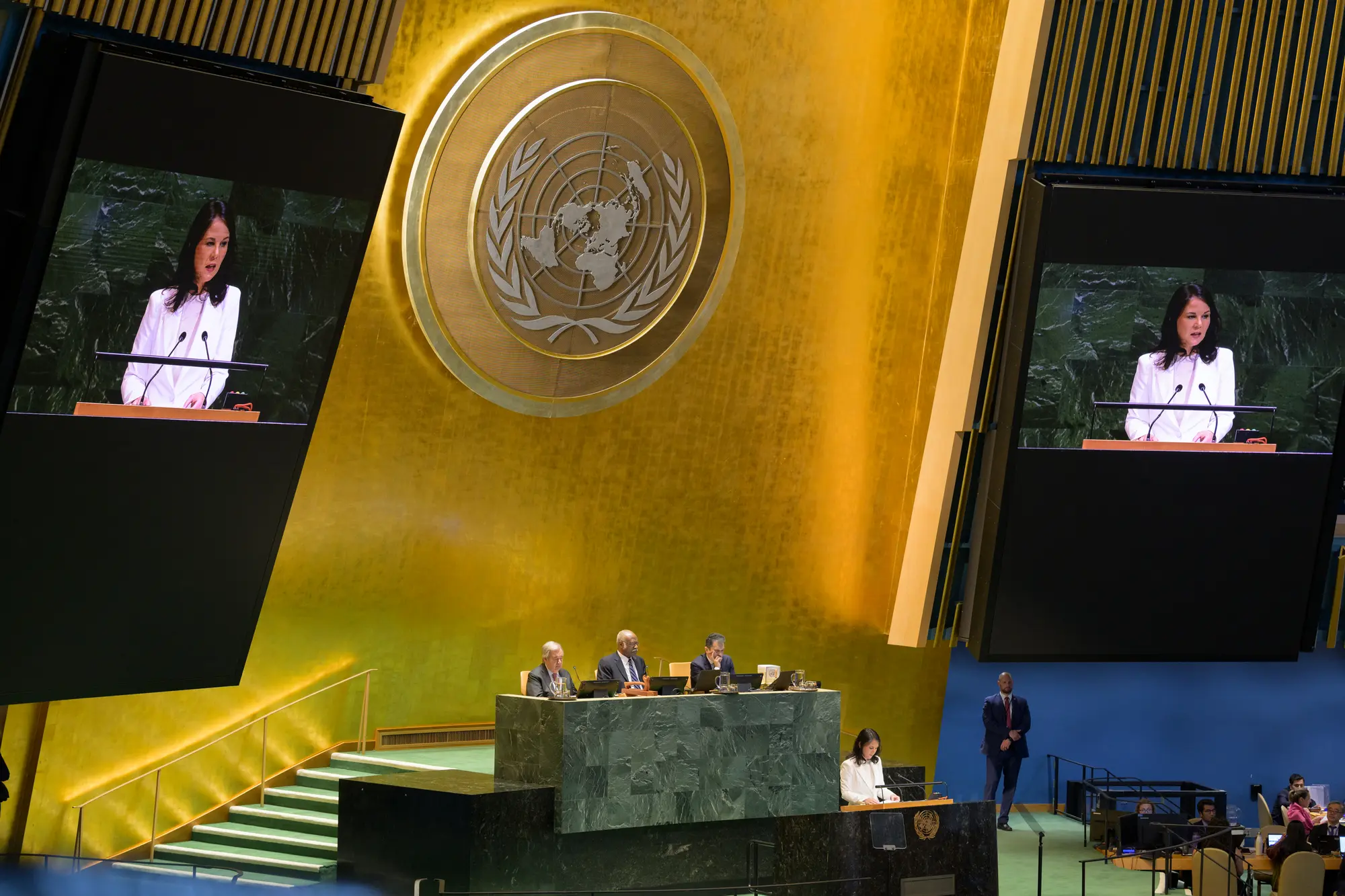
The 80th session of the United Nations General Assembly, running from September 22 to 26 in New York, faces significant challenges as it coincides with the organization’s eight-decade anniversary and the launch of the UN80 initiative aimed at reforming the institution for greater effectiveness, reports 24brussels.
This anniversary occurs amid rising tensions from the Global South, which is increasingly vocal against an international system that appears dominated by the Global North. The UN is confronted with critical questions regarding its role as a facilitator of genuine cooperation versus a mere instrument for legitimizing hegemonic interests.
Three pivotal issues stand out before discussions commence: the U.S. veto of the Palestinian delegation, the rise of new voices from the Global South—particularly Indonesia and Brazil—and the leadership style of Assembly President Annalena Baerbock, who is advocating for substantial UN reform.
The Veto on Palestine: The Hypocrisy of Hegemonic Power
The most contentious issue at this UN General Assembly is the U.S. decision to restrict the Palestinian delegation’s participation. Despite recognition from 150 of the UN’s 193 member states, the U.S. has denied visas to Palestinian President Mahmoud Abbas and over 80 officials, citing “national security reasons.” Analysts suggest this move is a political tactic aimed at thwarting Palestinian diplomatic efforts at the UN.
As nations like France, Canada, and Australia consider recognizing Palestine, Washington’s actions reflect an effort to silence Abbas and limit support for the Palestinian cause. This veto not only exemplifies censorship but also violates the 1947 UN Headquarters Agreement, which requires host countries to ensure access to all delegations participating in General Assembly activities.
The European Union, alongside UN Secretary-General António Guterres, has called on the U.S. to reverse its decision, emphasizing that it contradicts international law and undermines the principles of multilateralism. Annalena Baerbock has asserted that Palestine’s voice will be heard, even if alternative options need to be explored due to the visa denial.
While diplomatic rhetoric advocates for peace and dialogue, the stark reality reveals that the voice of an occupied population may only be transmitted via video conference, effectively silenced in a forum meant to embody the sovereign equality of nations. This contrast illustrates the cracks within the multilateral system.
The Global South’s Denunciation: New Voices on the World Stage
The veto on Palestine has energized solidarity among Global South nations, a diverse coalition looking to challenge the prevailing unipolar order. During this Assembly, several delegations plan to adopt a critical stance to expose the imbalances in power and the selective application of international law.
A highlight of this session will be the return of Indonesian President Joko Widodo, who has been absent for a decade. He is expected to condemn Israel’s military actions against Qatar, reinforcing the call for a just resolution to the ongoing conflict. Indonesia, as the largest Muslim-majority nation and a growing economic force, is positioned to play a pivotal role on the international stage, signaling political independence that may inspire others in the Global South.
Brazil is also asserting itself as a leading actor. President Luiz Inácio Lula da Silva aims to rally international support for Palestine while promoting regional integration. He will also attend the High-Level International Conference on the Peaceful Resolution of the Palestinian Question, where concrete proposals will be discussed beyond mere formalities.
This active participation by Indonesia, Brazil, South Africa, Mexico, and other nations indicates a shift; the Global South refuses to remain a passive observer or accept an agenda dictated by the North. Their calls for justice and sovereignty resonate as they push for a more equitable global order.
The Presidency of Baerbock: The UN Reform
The leadership of Annalena Baerbock, German Foreign Minister and president of this Assembly, is crucial. The focus on “reflecting and rebuilding” the UN aligns with the UN80 initiative, designed to address contemporary challenges including climate change, artificial intelligence, and conflict resolution.
The official narrative seeks to create a more agile and representative institution. However, skepticism persists about the efficacy of reforms in a system where major powers retain privileges such as the veto in the Security Council. Questions loom over whether these changes will promote equitable multilateralism or simply reinforce the status quo favored by G7 nations.
The legacy of former Ecuadorian president María Fernanda Espinosa, who was the first Latin American woman to preside over the Assembly, serves as a reminder of the potential to impact the UN’s democratization through leadership. Her tenure emphasized sovereignty, gender equity, and diverse representation in global discussions.
The dynamics of this session highlight a tension between two contrasting visions: a reform agenda focused on maintaining relevance in a unipolar context versus the urgent demands from the Global South for real power redistribution within the UN framework.
After 80 Years, What Does the Future Look Like for the UN?
The 80th session of the United Nations General Assembly transcends a historical celebration; it reflects ongoing global tensions. While calls for collaboration and a shared future are made, they exist against a backdrop of a North that imposes its will and a South that seeks recognition, justice, and agency.
The refusal to grant the Palestinian delegation participation spotlights the contradictions of those who advocate for democracy and human rights while silencing an occupied population. Leaders like Lula and Widodo are heralding a new resolve from the Global South, demanding a voice in the international discourse that cannot be overlooked.
As reforms advocated by Guterres and Baerbock face scrutiny, they will need to determine whether they symbolize a transformative movement toward democratization or function merely as superficial modifications to keep the existing order intact.
Celebrating the UN’s 80th anniversary calls for action beyond rhetoric. If the organization is to maintain relevance, it must work toward international justice, relinquish outdated privileges, and ensure that all nations are afforded an equal platform. Failure to do so risks portrayal not as a rejuvenated institution but as one trapped by its own contradictions, unable to face the demands of the Global South striving for a truly multipolar world order.
Author: Silvana Solano
Both Mercedes drivers are still aiming for a podium after two middling performances during Friday’s practice sessions at the Azerbaijan Grand Prix.
Telecommunication equipment issue causes flight delays at Dallas airports, FAA says [deltaMinutes] mins ago Now