The writer Rachel Hosie in a pub garden, and a vista in Scotland.
Rachel Hosie
The Cotswolds in the UK is popular with America’s rich and powerful, from Taylor Swift to JD Vance.
The picturesque rural area is dubbed “the Hamptons of the UK.”
Rachel Hosie is British and has visited the Cotswolds — but thinks other spots like the New Forest are better.
When my husband and I were deciding where to go on our minimoon, we thought the Cotswolds would be perfect.
The rural area to the west of England is known for its quintessential countryside charm: brown stone cottages, cosy pubs, and rolling hills. We’d both visited a few times and enjoyed it.
But when we found ourselves struggling to move for tourists with selfie sticks (apparently still a thing) and paying £16 ($22) for a coffee and a very disappointing grilled cheese, we realized the area might have become a victim of its own success.
The Cotswolds has long been considered a bougie destination by Brits.
Rachel walking in the Cotswolds.
Rachel Hosie
When Soho Farmhouse opened there in 2015, it swiftly became a rural retreat for a new generation of trendy Londoners, allowing them to “do the countryside” without needing to go near any mud. The Beckhams bought a converted barn round the corner in 2016, which has been their family home since.
Recently, America’s rich and famous have flocked to the Cotswolds.
The Pig in the Cotswolds
Rachel Hosie
Taylor Swift rented a house in the area for the UK portion of her Eras tour in 2024, Ellen deGeneres moved there in November 2024, it’s where JD Vance vacationed this summer, and Beyoncé and Jay-Z are reportedly looking for a Cotswolds home of their own, too.
The Cotswolds is being dubbed “the Hamptons of the UK” — but I think it’s overrated.
Bibury, the Cotswolds
Rachel Hosie
We still had fun on our minimoon in the Cotswolds — walking through the quiet countryside was lovely, our hotel was fantastic, and we enjoyed the shops and cafes in Cirencester, one of the larger towns in the area.
But the towns and villages that are now known as being chocolate-box-charming were far from it, in my opinion, because they were so busy.
In my experience, there are plenty of other parts of the UK with equal appeal and without what felt to me like masses of tourists and inflated prices.
Here are my favourite places to visit for rural British charm.
Growing up, my family would spend most summers on the Norfolk coast, to the east of England.
Homes and a waterway in Burnham Market, a village in Norfolk.
Rachel Hosie
I still love its English seaside vibe. One of my favourite spots is the village of Burnham Market.
Well-to-do locals and visitors have given Burnham Market the reputation of “Chelsea on sea,” after the upmarket London borough.
Burnham Market, Norfolk
Rachel Hosie
It’s a delightful village set around a green, with lots of independent boutiques and cafes. Go for a walk at Burnham Overy Staithe, which means “homestead over the river,” and pick up fish and chips from Eric’s in Thornham.
If a holiday cottage doesn’t appeal to you, stay at the Hoste Arms, a luxury hotel and pub near the coast.
Rutland and south Leicestershire in the East Midlands is known as “the Notswolds” for its Cotswold-esque charm — without as many tourists and high prices.
Pimm’s at The Bell, Leicestershire.
Rachel Hosie
Trust me, I grew up there.
Less than an hour by train from London, Market Harborough in the region is a characterful town with lots of lovely shops and cafes (go to the Garage Bakehouse), and the countryside and villages around it are worth exploring too.
Visit Great Bowden for brunch at Bowden Stores, sit in a pub garden surrounded by lavender at The Bell Inn in East Langton, or venture over to England’s smallest county, Rutland, for top quality food at The Olive Branch in Clipsham.
The Scottish Highlands are undeniably one of the most striking parts of the UK.
Near Ballater, Aberdeenshire
Rachel Hosie
They are one of my favorite places for walking. Be sure to stroll along the River Dee and amble through the heather-clad valleys.
The small town of Ballater is a quaint place to stay.
The River Dee, Ballater.
Rachel Hosie
It’s not far from Balmoral Castle, a residence of the British royal family in Scotland.
Make sure you stop by the Highlanders’ Bakehouse, just outside the town, for incredible sweet treats and baked goods.
The local delicacy are “butteries,” which I would describe as squashed, slightly salty croissants. Lightly toast them then add more butter (yes, really) and jam. Delicious.
The New Forest in Hampshire, southern England, is a beautiful national park full of woodlands and wild ponies.
A wild pony in the New Forest.
Rachel Hosie
It’s a great area to explore on foot, and there are countless lovely villages to explore, such as Beaulieu and Bucklers Hard, both of which are found on the banks of the Beaulieu River.
There are lots of delightful places to stay and eat the New Forest and its surrounds.
Bucklers Hard, New Forest.
Rachel Hosie
My favourite option for both of those things is The Pig Hotel in Brockenhurst, which uses ingredients from the local area in its restaurant. It’s perfect for a special occasion or just getting cosy by the fire after a long muddy walk.
Dartmouth isn’t particularly cheap or devoid of tourists (in the summer months, at least), but it’s so special I had to include it.
A view of the coast near Dartmouth.
Rachel Hosie
Situated on the mouth of the River Dart (make sense) in the county of Devon, the town features colorful houses nestled into the hills overlooking the river, a beautiful castle, and coastal walks with breathtaking views.
There are plenty of places to try the best of British food in Dartmouth.
The coastline of Dartmouth, Devon.
Rachel Hosie
Get fish and chips from Rockfish (either from their eat-in restaurant or takeaway branch), a classic English fry-up breakfast at Cafe Alf Resco, and, for a special occasion dinner, head to The Seahorse seafood restaurant.
XAI tapped a recent high school graduate to lead its data annotation team.
Diego Pasini began leading the team in early September amid leadership changes and deep layoffs.
Pasini’s LinkedIn says he’s “on leave” from his studies at the University of Pennsylvania.
XAI’s data annotation team has faced sweeping layoffs and leadership changes this month — and the job of heading up the team training Grok has fallen to a college student who started working at the company eight months ago.
Diego Pasini, who graduated from high school in 2023, took over the data annotation team that trains Grok after at least nine high-level employees had their Slack accounts deactivated last week, Business Insider previously reported. A few days later, on September 12, the company cut more than 500 of the team’s staffers, according to a Slack tally.
On September 15, Pasini led an all-hands meeting with the team’s remaining workers and said the company had no plans for further layoffs, three workers told Business Insider. Another group of employees — more than 100 — were laid off shortly after, the workers said.
In recent days, Pasini’s team has led rapid-fire one-on-one meetings at which employees have been asked to explain their work at the company, 11 current and former workers said. Before the team’s layoffs, Pasini also posted an announcement in Slack asking workers to focus on a series of tests that would determine their future position at xAI, BI previously reported.
The data annotation team is made up of contract and full-time staff tasked with labeling, categorizing, and contextualizing raw data to teach Grok how to better understand the world. Prior to last week’s layoffs, it had a headcount of around 1,500. That number is now around 900.
Pasini and xAI did not respond to requests for comment.
Pasini joined xAI in January, according to his LinkedIn profile, after he won an xAI Hackathon in San Francisco. Two other people on Pasini’s hackathon team went on to work at xAI and Tesla, their LinkedIn profiles show.
Before joining xAI, Pasini attended the University of Pennsylvania, where he studied computer science and economics, according to his LinkedIn profile. His status at the university is listed as “on leave,” per LinkedIn. A representative for the school declined to confirm his attendance or status at the school.
Pasini was also listed as a 2024 fellow at the investment firm Contrary, which says it has worked with companies including Anduril and Replit. His fellowship profile said he was “excited about the future of robotics and hard tech startups.”
Pasini attended a private high school in New Jersey, the Pingry School, which has an annual tuition of more than $47,000. He graduated in 2023, according to a bulletin from the school. He was on a robotics team and presented research on drones at the Massachusetts Institute of Technology in 2022, according to an Instagram post from the Pingry School.
On GitHub, Pasini follows several people from Musk’s ecosystem, including Andrej Karpathy, Tesla’s former director of AI; George Hotz, a self-driving car developer who worked at Twitter during Musk’s acquisition in 2022; and Luke Farritor, a 24-year-old staffer at Musk’s Department of Government Efficiency.
Pasini is one of several young people in Musk’s orbit who have assumed positions of authority. Besides Farritor, DOGE’s ranks included 19-year-old Edward Coristine, as well as at least five other employees between the ages of 19 and 24. Silicon Valley also has a long history of tech stars who didn’t graduate from college, including Bill Gates, Steve Jobs, and Mark Zuckerberg.
On his personal website, Pasini lists interests in computer vision and Napoleonic history. His profile picture, used across multiple sites including X, LinkedIn, and GitHub, is a cropped image of a young grenadier taken from a 19th-century painting of Napoleon reviewing his troops.
Pasini’s youth and short tenure at Musk’s companies stand in contrast to the previous leader of the data annotation team. That person had joined xAI after working at Tesla for over a decade in a management role on the Autopilot data annotation team.
After Pasini took over at xAI, two employees spoke critically about him on Slack. One of the workers questioned how he moved into the role given his credentials, according to a screenshot viewed by Business Insider.
Both workers had their accounts deactivated within hours of posting, screenshots show.
Jean Frohling always wanted to help her three children buy places of their own. She and her husband, now in their mid-60s, saved for years in hopes of one day pulling their kids onto the property ladder. Eventually, hard work and foresight paid off: They gifted each of their first two children thousands of dollarsto pad the down payments on their first homes.
Then, about a year ago, their youngest daughter found a house she liked just outside Peoria, Illinois. The Frohlings figured their then 33-year-old daughter could probably afford the house on her own, but they decided to leave even less to chance this time. They wanted to make sure their daughter avoided a mortgage hiccup or, worse, losing out to a stronger offer. Frohling and her husband opted to buy the home outright, paying $186,000 in cash.
“We just felt there was some negotiation power in the cash offer, and that it would ease the transition,” Frohling tells me.
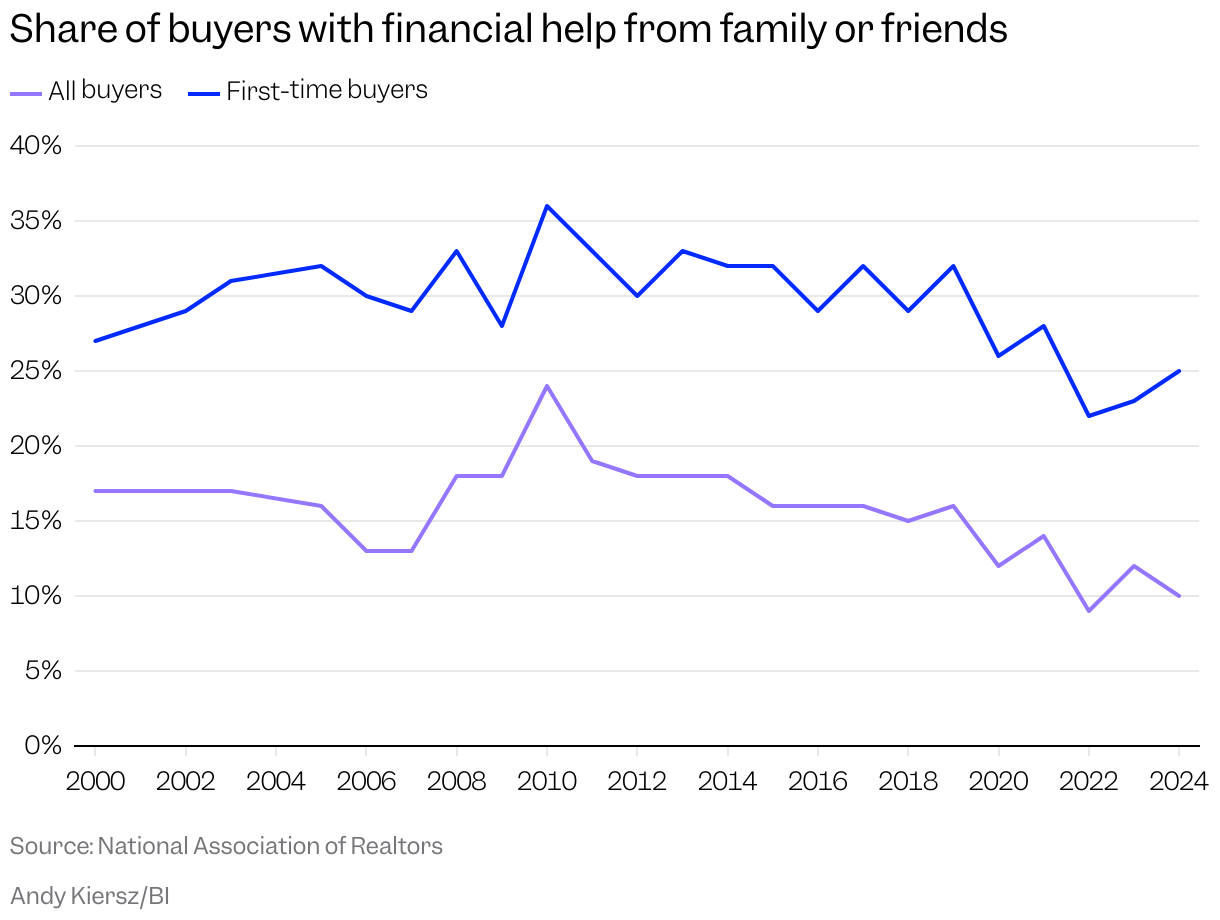
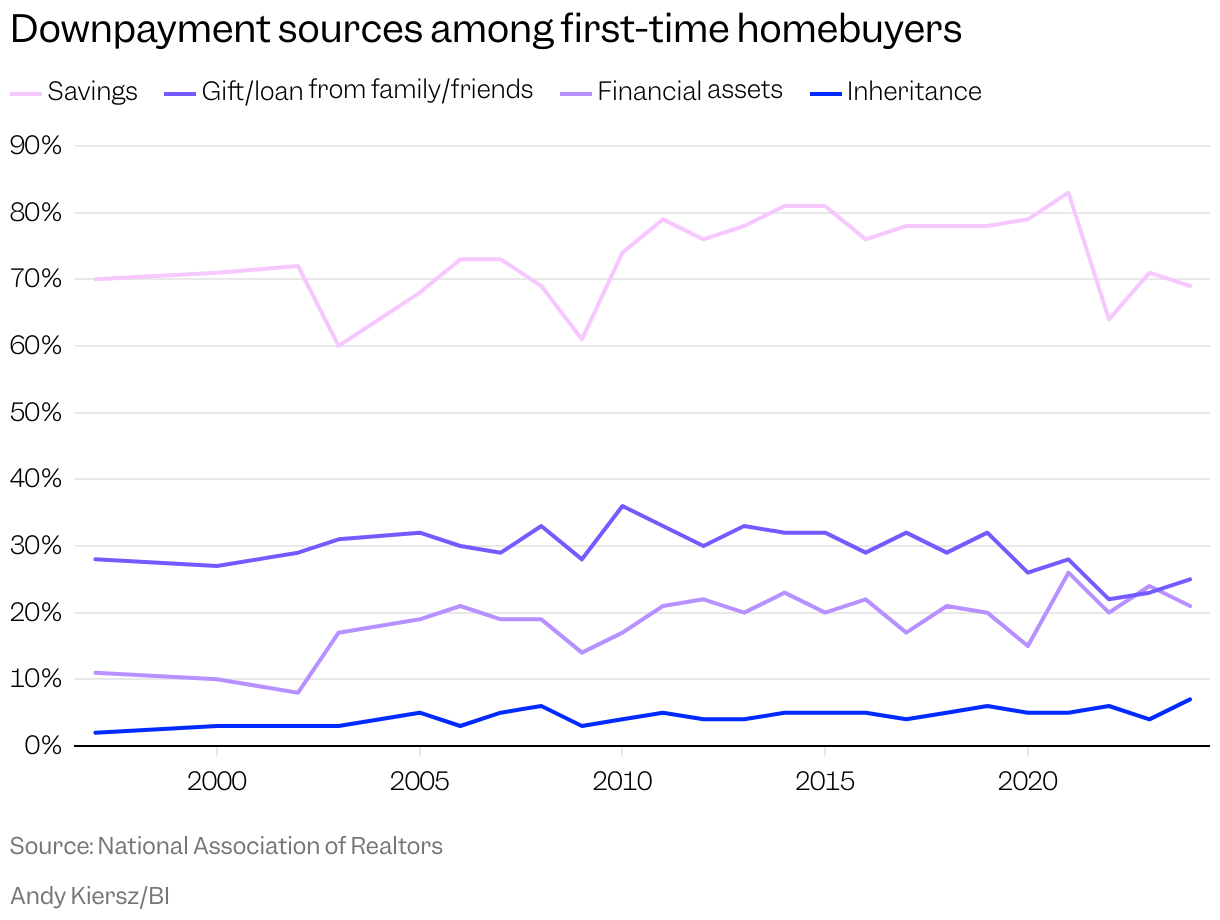
Nepotism is a hot topic these days: So-called “nepo babies” seem to be everywhere, riding the coattails of their rich and famous parents to land starring roles in movies, record Billboard hits, and wield power in Washington. The housing market isn’t Hollywood, but as long as families have had a few dollars to pass down from one generation to the next, youngsters have relied on help from parents to get their foot in the door. Over the past three decades, about 30% of first-time homebuyers each year used a gift or loan from family and friends, data from the National Association of Realtors shows. For buyers of all types, family swooped in to help about 16% of the time.
Conditions would appear ripe for nepo buyers’ numbers to spike — with prices high and borrowing rates still steep, lots of home shoppers could use a hand. Many baby boomers are sitting on piles of home equity or bulging investment portfolios that they could theoretically tap to aid their millennial and Gen Z offspring. Yet the nepo homebuyer is actually in decline. The past few years of NAR data have shown a significant dip from the historical average: In 2024, only a quarter of first-time buyers got help from friends and family. For all buyers, this share has slipped to just 10%.
This downturn defies conventional thinking. The market has been so brutal for young buyers that it can be hard to imagine someone making it onto the housing ladder without a boost. Are selfish boomers turning their backs on their kids? Has the bank of mom and dad run dry? The latest numbers suggest something else is going on: The buyers breaking into the market don’t actually need the assist.
“This is a different type of first-time homebuyer than we’ve seen historically,” Jessica Lautz, the deputy chief economist at NAR, tells me.
For those forced to rely on their humble savings accounts, all of this may sound encouraging: Fewer nepo buyers might mean better odds for everyone else. But the trend points to troubling changes in the housing market’s makeup. Ironically, the thinning ranks of nepo buyers may be yet another sign that something’s amiss.
Like it or not, the bank of mom and dad plays a crucial role in propelling Americans into homeownership. Elder family members with the means to do so may chip in money for a down payment, extend a friendly loan with below-market terms, or simply buy a house and put their kid on the title, like the Frohlings did. In 2019, according to NAR, a whopping 32% of first-time buyers — and 16% of all buyers — leveraged some help from family and friends for their home purchase. Figures like these were not uncommon. In fact, NAR recorded the highest percentage of nepo buyers in 2010, when 36% of first-time buyers and 24% of all purchasers fell into this camp.
“I do think that family has always played a role,” Lautz tells me.
This kind of assistance isn’t limited to the ultrawealthy. Chase Rogers, a mortgage loan officer in Birmingham, Alabama, where the median sale price is about $190,000 — well below the national median of more than $440,000 — says he’s recently seen middle-class buyers use family help to slightly level up their purchase. These kinds of buyers, he says, “can qualify for something without help from their families, but then to get something more to their taste, maybe a little bit higher price range, they are getting help.”
This is a different type of first-time homebuyer than we’ve seen historically.Jessica Lautz, deputy chief economist at the National Association of Realtors
Geoff Black, a mortgage loan officer in Sacramento, California, watched family money pour into the market during the COVID-era frenzy. Back then, he says, the prevailing attitude among parents was, “You need to get in right now.” The housing market was a runaway train, and you either hopped on or got left in the dust.
“I literally remember talking to a parent as she fired off $350,000 as a gift,” Black tells me. “She mumbled, ‘Get me some grandbabies.'”
Millennials and first-time buyers back then had no illusions about the chaos sweeping through the market. One guy I talked to in late 2022, a young millennial who, by a stroke of luck, managed to lock down a place after months of searching, pronounced his cohort “royally screwed.” The affordability barriers have only continued to rise. The median home price is up roughly 37% since July 2020. Mortgage rates have drifted down but are still hovering at about 6.4%, more than double the record-low rates buyers got at the height of the pandemic. A recent Bankrate study found that the household income required to afford a typical home has surged to nearly $117,000, up from about $78,000 in early 2020. And it’s not as if young buyers don’t think to use their families as a lifeline. A Redfin survey last year found that more than a third of Gen Zers and millennials who planned to buy a home soon said they expected to use a cash gift from family to fund their purchase.
As affordability has only gotten worse over the past few years, purchases with gifts have — bafflingly — faded. Black says gift-giving seemed to peak around 2021 or early 2022, right when NAR’s data began showing a decline in nepo buyers’ market share. After hovering around 27% in 2020 and 2021, just 22% of first-time buyers got help from family or friends in 2022, the lowest on record. The following year showed only a slight uptick, to 23%. Last year, just a quarter of first-timers got that kind of assistance.
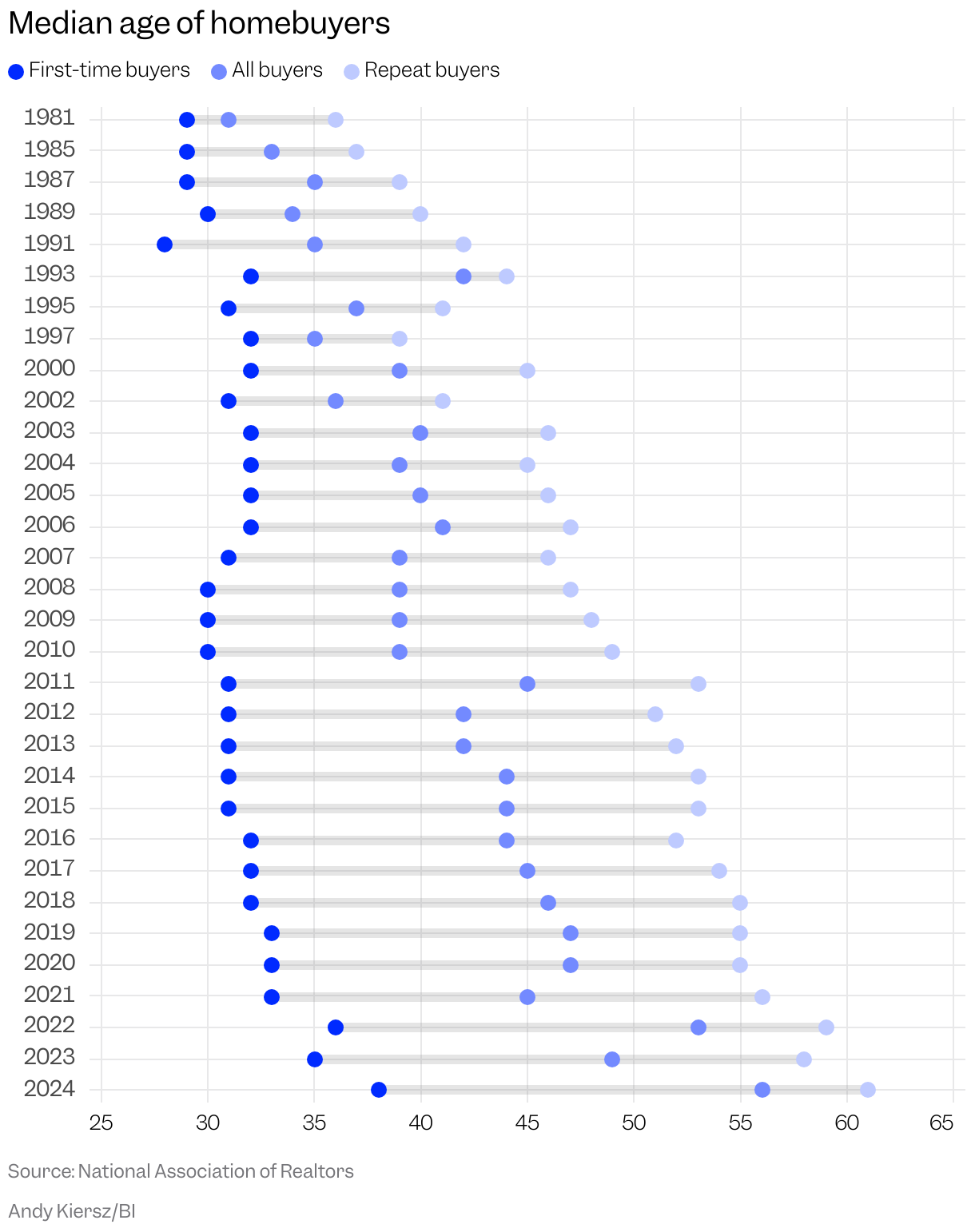
The decline of nepo buyers also coincides with another big shift in the makeup of new homeowners: First-time buyers are older and winning out with less frequency than ever before. NAR data shows that between June 2021 and June 2022, the typical first-time buyer was 36, the highest median age since NAR started tracking the figure in 1981. New homeowners accounted for a bit more than a quarter of all home purchases, a record low. Things have only gotten worse. The typical age of a first-time homebuyer last year hit another all-time high of 38, NAR data shows. First-time buyers’ market share also shrank to a new low of just 24%, down from 32% the year prior. Perhaps unsurprisingly, buyers who made it through the door were better funded than in years past — the median household income of first-timers was $97,000, a jump of $26,000 in two years.
These shifts help explain the nepo-buyer pullback. Family help is less common because the market is dominated by older, more independent buyers who can push forward despite the affordability challenges. Each year that prospective homeowners kick the can down the road, they grow less likely to ask for a family handout. NAR found last year that younger millennials, which it defined as ages 26 to 34, got gifts from family at about twice the rate of the elder cohort, ages 35 to 44.
“It becomes more uncomfortable for someone who’s 38 years old, which is the median age of today’s first-time homebuyer, to ask for mom and dad’s help to purchase a home,” Lautz says, “as opposed to someone who is in their late 20s or younger 30s.”
This shift could have ripple effects throughout this cohort’s entire lives. Older first-time homebuyers miss out on years of home-equity building, contributing to what Lautz often refers to as a “housing economy of ‘haves’ and ‘have-nots.'” Instead of people embarking on their homeownership journey with a little help from their parents, they’re staying put entirely.
“To me, it’s a sign of buyer weakness when that gifting is pulling back,” Black tells me.
As I noted in a recent story about homebuyers’ cold feet, the fear of missing out that defined the early-COVID market has given way to a different flavor of FOMO. People are wary of taking the homebuying plunge given the state of the world: The job market is wobbling as executives pull back on hiring and warn of permanently smaller headcounts. Student-loan delinquencies are spiking. In light of the staggering costs of homeownership, an analysis by the housing research firm Zelman concluded that the rent-versus-buy math favors renting to a degree that hasn’t been seen since the early 1980s. Prospective buyers may also be counting on borrowing rates to drop or sellers to slash prices even further.
With those on shakier ground hanging back, the buyers forging ahead are older and wealthier than at any point in more than four decades. They’re relying more on their own investment accounts and less on the bank of mom and dad. The nepo buyer has taken a back seat.
Of course, parents can pass along privilege in all kinds of ways that aren’t clear at the closing table. Paying for college tuition, say, can ensure their child graduates debt-free and ready to stack savings. Children whose parents are homeowners are more likely to end up buying a home themselves. A growing number of first-time buyers are moving straight out of their parents’ places, saving on rent before heading out on their own. Even homebuyers who don’t get a financial handout may benefit from the advice and know-how of parents who have already weathered the process.
To me, it’s a sign of buyer weakness when that gifting is pulling back.Geoff Black, mortgage loan officer in Sacramento, California
But cold, hard cash remains the simplest way to get a foothold in the market. That kind of help doesn’t always equate to a free ride, though. Roughly a year after Frohling and her husband purchased the Illinois home, their daughter refinanced to pull equity out of the house to pay her parents back. The maneuver leaves a new loan attached to the place, which their daughter will now begin the long process of paying off — and building a nest egg of her own.
While nepo buyers’ numbers are down, they’re far from extinct. Bill Mitchell, the loan officer who helped the Frohlings execute the refinance, says it’s hard to overstate the power of a cash offer in a competitive market like Illinois, where a relative lack of homebuilding means the number of homes available for sale is still tight. Mitchell estimates that about 20% of his clients use family money to beef up their offers.
“When I see that situation, and I see that I’ve got these clients that have made an offer on one, two, three homes and got beat out by cash offers, that’s typically when I’ll say, ‘Hey, let’s think of potential alternative strategies here,'” Mitchell tells me. “‘Do you have family that would be willing to help out in a situation like this?'”
Frohling says she initially worried she had robbed her daughter of the joy that comes with buying something all on your own after years of saving. But for Frohling’s daughter, homeownership didn’t come without sacrifice: She and her husband, for example, skipped throwing a big wedding and saved that money instead. And in the end, Frohling tells me, the ease and convenience were worth it.
“I know that we are blessed to be able to do that,” Frohling says.
James Rodriguez is a senior reporter on Business Insider’s Discourse team.
Huawei’s US research arm spent a decade on Nvidia’s headquarters campus in California. US lawmakers want to know what it was doing there.
Illustration by Pavlo Gonchar/SOPA Images/LightRocket via Getty Images
Huawei’s US research arm was embedded at Nvidia’s HQ in California for years.
US lawmakers want to know what it was doing there and asked it to turn over internal documents.
Huawei has been blacklisted since 2019, barred from US chips and suppliers on security grounds.
US lawmakers are asking for information about Huawei’s US research arm, which they say shared a campus with Nvidia’s Santa Clara, California headquarters.
In a letter sent to Huawei affiliate Futurewei on Sunday,the chairman and a member of theHouse Select Committee on the Chinese Communist Party said that the Chinese telecommunications giant’s US arm was located inside Nvidia’s campus for a decade. Futurewei held the prime lease on three buildings at 2330 Central Expressway, while Nvidia subleased space. That setup lasted until 2024, when Nvidia bought out the lease and took full control of the site.
The lawmakers said the arrangement was “deeply concerning” and asked Futurewei to turn over internal documents.
“This co-location provided Futurewei unprecedented access to America’s most advanced semiconductor and AI capabilities,” wrote Republican Chairman John Moolenaar and Democratic Ranking Member Raja Krishnamoorthi of the House Select Committee on China.
The US has blacklisted Huawei since 2019, cutting it off from advanced chips and restricting American firms from supplying the company due to national security concerns.
The committee referenced a 2018 lawsuit accusing Huawei of using Futurewei as a corporate spy tool. The case was filed in California by Jesse Hong, a former Futurewei employee who accused Huawei of “engagement in enterprise espionage.” The lawsuit said Hong was laid off in retaliation for whistleblowing.
According to the lawsuit, Futurewei directed employees to sneak into a closed-door Facebook telecommunications summit using “fake US company names” after Huawei was barred from attending. Futurewei then funneled reports back to executives in China.
The lawsuit also said Futurewei used “consulting work” with US startups to obtain confidential information. Hong’s lawsuit was settled in 2019.
“If Futurewei was used to infiltrate closed-door industry meetings and extract sensitive data through both deception and proximity, then its decade-long embedded presence within NVIDIA’s campus — at the center of US semiconductor and AI development — cannot be immediately dismissed as incidental,” the lawmakers wrote.
Futurewei has since moved to San Jose, “just a ten-minute drive down the road,” the letter said. But the company’s continued presence in the heart of Silicon Valley “underscores unresolved concerns about how it may still be operating,” it added.
Nvidia, Futurewei, Huawei, and the House panel did not respond to a request for comment from Business Insider.
An Nvidia spokesperson told Bloomberg that the company makes sure its “offices, employees, and intellectual property are safe and secure. Even where we have neighbors, we maintain a separate Nvidia-only campus.”
The chips war
Huawei has been at the center of Washington’s crackdown on Chinese tech for years.
In 2019, the Trump administration blacklisted the telecom giant, cutting it off from US suppliers and banning access to advanced chips made with American technology. Those restrictions did not abate under President Joe Biden. In June 2021, Biden signed an executive order expanding the number of Chinese companies Americans are prohibited from investing in. Huawei was on the list.
But those efforts appear to have only strengthened Huawei’s push toward self-sufficiency. The company has been using locally produced chips in its flagship smartphone line, the Huawei Mate, since 2023.
Even Nvidia’s CEO, Jensen Huang, has been impressed. In March, Huang said Huawei’s “presence in AI is growing every single year,” telling the Financial Times that the US government’s efforts to stifle the company had been “done poorly.”
It’s not just Huawei eyeing US chips. Business Insider reported last month that China’s military has been trying to source Nvidia hardware for everything from servers running DeepSeek’s AI models to 33-pound “robot dogs” with high-definition cameras.
Nearly 20 years after he shot to fame as Marc St. James on Ugly Betty, Michael Urie is celebrating a career high with his first-ever Emmy nomination as Brian in Apple TV+’s Shrinking.