
A group calling itself the New California movement is pushing for a dramatic reimagining of America’s most populous state.
Day: September 14, 2025
Tyler Robinson was arrested two days after the fatal shooting of Charlie Kirk at Utah Valley University in Orem, Utah.
A suspected gas leak explosion in a Madrid building killed 1 person and injured 25 [deltaMinutes] mins ago Now
Delayna Stover was cleaning the table her late father had built from scratch for her when she noticed something.
Getty Images; Alyssa Powell/BI
You know how great it is that airlines have unbundled every little option so that you can pay for things separately? Want to check a bag? That’ll be $50. An extra 6 inches of legroom? $96! Board first, even though everyone’s going to the same place? You’d better be part of the loyalty program. It’s so fun for flying to be split into haves and have-nots.
I’m kidding. The extractive nature of the modern-day flying experience is miserable. The airlines insist that the choose-your-own-adventure model is great because people pay only for things they really want. The issue is, no one wants to cough up more money to ensure their knees aren’t banging into the seat in front of them. The person in the cheap seats at the back is just tolerating their plight the best they can.
And yet, businesses and industries across the economy are following the airlines’ lead. They’re increasing customer stratification to boost revenues and identify exactly how much they can get out of each consumer. Sometimes, it’s a win for consumers: Uber’s “wait-and-save” option gives people who aren’t in a rush a discount. But in many instances, it feels like a loss: People now have to pay extra to forgo ads on streaming services, skip the line at Disney, and even shop special hours at Costco. In sectors such as retail, travel, and entertainment, consumers have more choices than they’ve ever had — but it all comes at a cost.
“It’s not that you always get what you pay for, but you don’t often get what you don’t pay for anymore,” says Joseph Nunes, a marketing professor at the USC Marshall School of Business.
I went to Costco for the first time recently, and it was not for me. It was too cold, everything was too big, and it was way too crowded. (The free snacks situation, however, was 10/10.) I get that I’m an outlier: Costco has more than 133 million members worldwide. And for its fancier members — the people who pay $130 a year to be in its executive tier instead of the $65 base tier — it’s rolled out fancy benefits, most recently special store hours. Executive members now have 60 minutes every morning (well, 30 on Saturdays) to shop among other higher-status customers, on top of other perks. A Costco-fan friend reassures me that the early hours are for the true “sickos.”
It’s not that you always get what you pay for, but you don’t often get what you don’t pay for anymore.
For Costco, the move is a savvy one, explains Z. John Zhang, a marketing professor at the University of Pennsylvania’s Wharton School of Business who studies pricing strategies and targeting. Once a company has locked in a business model — in Costco’s case, offering memberships to people so they can buy items in bulk at a low cost — it has to figure out ways to bring in new revenue and growth. This is especially true for publicly traded companies, which have to wow their shareholders regularly. That leaves Costco with a few options: sell a greater variety of stuff, attract more members, or, as in this recent case, split customers into tiers and then tempt more of them to opt for the pricier one.
“You have to provide some benefits that people desire so that they are willing to upgrade,” Zhang says. Marketers often think of tiering with at least a trilevel “good-better-best” approach, which allows them to cater to different customers at different price points and eschews “one size fits most” thinking, so Zhang expects Costco to add on more tiers soon.
The reason companies stratify things is simple — to maximize profits via a mechanism called perfect price discrimination.
You want each customer to buy as much as they can at the maximum price they’re willing to pay, Nunes says. The airlines’ practice of unbundling services is now “carrying over to the retail space, where they’re going to unbundle and then upcharge or provide benefits to their best customers in order to make more money,” he says.
Or as Zhang puts it: “In any service industry, pretty much, it’s hard not to find a tiered price, because the simple fact is that for any goods and services you have to sell, different people are waiting to pay different amounts.”
In some instances, this can be appealing. If having a higher tier means Costco keeps lower prices for people in the lower tier while making the store a little less nuts for power shoppers, it can be a win-win. The same goes for if someone in the back of the plane wouldn’t be able to travel at all without that ultra-cheap seat. But businesses are increasingly using their power and information advantage to take it even further.
In the era of data and AI, companies know a ton about us and are able to use that to their advantage. In some of the most egregious cases, they use surveillance pricing to identify what they can charge each individual, so conceivably, I could be steered to more expensive hotels on a travel website because the site knows I’m using a Mac and infers I’m wealthier, or an e-commerce site thinks I’m a new parent and upcharges for baby items. But even if they’re not going that far, they’re using our data to guess what people like us are likely to pay.
Sam Levine, the former director of the Federal Trade Commission’s Bureau of Consumer Protection, tells me loyalty programs, which can be paid for or earned, deliver troves of information to businesses to split customers into groups.
They know exactly what consumers are going to be willing to put up with.
“Companies can see in these programs, and I think this is relevant to Costco, how much paying consumers will tolerate, what kind of discounts they need to spend their money, what kind of inducements work with consumers, and what doesn’t work,” he says. “They know exactly what consumers are going to be willing to put up with.”
Stephanie Nguyen, the former chief technologist at the FTC, points out that the advertising tech industry has spent decades developing a hyper-effective targeting playbook. Instead of targeting males ages 18 to 34, they’re targeting males ages 20 to 22 who live in a specific ZIP code and who are into hunting. That in-depth measurement is now being used in pricing. “You see a huge shift from mass media and crude group segmentation to more of that granular, individualized ability to target a person,” she says.
If a business knows enough about you to target you with an ad for a specific pair of shoes, it may also know enough about you to guess exactly how much you’ll pay for those shoes.
The road to consumer hierarchies is a winding one. As mentioned, a lot of it is revenue development. But it also has to do with a shift in the way businesses approach pricing and have managed to turn a system of perks into a system of penalties. Consumers have gotten used to this buyer’s food chain, too. The economy has evolved from cost-plus pricing, when businesses add a markup to their total costs on supplies, labor, etc., to value pricing, which hinges on how much customers perceive an item’s worth to be, says Lindsay Owens, the executive director of Groundwork Collaborative, a progressive think tank.
“Pricing has been increasingly unmoored from the fundamentals like costs, and it’s increasingly unleashed,” she says. Companies are more willing to tap into intangible ideas of value and the laws of supply and demand to get people to spend. We don’t think of what the thing costs; we think of what it’s worth. Owens adds that many companies already “ran their course on cost-cutting” — they’ve whittled down their workforces, opted for cheaper suppliers, and streamlined their operations as much as they feel they can. They’ve also spent the past several years dealing with inflation, pushing their costs up. Many have already raised prices, including even more than inflation calls for, so they need to come up with another price-hiking play. Premiumization is an avenue for that: Production costs don’t meaningfully increase, but you can boost margins by enticing people with a better option or making the original option cost more. And, Owens says, there’s evidence that offering one premium option can sometimes put a halo around an entire brand and increase its esteem in consumers’ eyes, even if the regular options haven’t changed.
“It’s like, OK, we’ve sold one thing at one price. Can we gussy it up a little bit and offer a premium version? Or can we degrade the original version and then offer the original version in its non-degraded fashion as the premium version?” she says.
While some consumers’ wallets are tight, there’s a lot of cash sloshing around in the economy, especially as the middle class swells globally and the people nearer the top of the wealth charts increase the size of their bank accounts. A lot of money is chasing the same goods and services, and the people with that money are willing to shell out more for a better time. That’s especially the case when the non-premium version has become undesirable.
Anything that’s exclusive, you want to be part of that exclusive club.
There’s also an element of basic human nature in all of this: People like to feel special. In the case of earned status, when you get enough points to join a certain club or level, it’s motivating to have a goal. In the case of paid status, customers want to feel like they’re above the crowd.
“When you are brand loyal or loyal to whatever the thing is, the airline, the retail store, you’re hoping to try to get extra perks, and it’s also a bit of a status symbol for you, right?” says Shikha Jain, the lead partner for consumer and retail for North America at Simon-Kucher, a business consultancy. “Anything that’s exclusive, you want to be part of that exclusive club.”
People have started to complain that airport lounges are overcrowded and not as exceptional as they used to be. That may wind up benefiting a company or competitor — it allows them to offer an even higher-priced option that’s more lucrative.
“The top of the pyramid tends to make you more profit than the math at the bottom of the pyramid,” Nunes says.
Jain warns that too much stratification can backfire, though, especially if the business puts too much out of reach. “It doesn’t work when you take away something that’s core to the business,” she says.
It’s not clear there’s a way to put the genie back in the bottle on the caste system that’s emerging across the consumer economy. While companies such as Delta and Wendy’s have gotten backlash over being a little too cute with new pricing ideas in the recent past, the overall trend is toward more variation, not less. There’s dynamic pricing, when costs swing based on supply and demand, and surveillance pricing, when companies can figure out a number that’s just for you. Loyalty programs are proliferating, whether or not they actually pay off for the faithful.
For the people who can afford the better experience renting a car or reserving a movie seat or getting extra-fast delivery, this brave new world of customer rankings may be a win. And, hey, if you’re willing to accept the worse product or service to save some money, by all means, go ahead. But sometimes, it’s just nice for the thing to cost what it’s going to cost without games or strategies or paid line-cutting.
Eventually, we’ll just get used to this setup, just like we have with flying. The kids these days don’t even remember what it was like to chance it on what airplane seat you’d wind up in and get a window seat in the exit row as a pleasant surprise.
Emily Stewart is a senior correspondent at Business Insider, writing about business and the economy.
Read the original article on Business Insider
Mathieu Darche made no secret of how badly he wanted Emil Heineman after the Swede was included in the deal that sent Noah Dobson to Montreal. Heineman sounded just as happy to be on Long Island on Saturday when he spoke to reporters for the first time since the trade took place in late June….
French authorities have launched an investigation after at least nine pig heads were discovered outside mosques in Paris and its suburbs during the night of September 8, some bearing the word “Macron”. Police and prosecutors are treating the incident as a hate crime with foreign involvement. Officials noted that the perpetrators left France immediately after the act, a pattern resembling “hit-and-run” tactics often seen in hybrid operations designed to incite unrest during political crises.
Foreign links and intelligence concerns
Investigators from the French gendarmerie traced the pig heads to purchases in Normandy. They were reportedly transported in vehicles with Serbian license plates and distributed at several locations by individuals using Croatian SIM cards. After the provocation, the group crossed into Belgium. This outsourcing of operatives, minimizing risks of arrest and complicating attribution, is seen by security analysts as a method frequently employed by Russian intelligence services in Europe. Similar cases of religiously motivated vandalism in France have previously involved Balkan nationals, with probes pointing to Russian ties.
Pattern of provocations tied to Moscow
French officials compared the latest act to earlier staged provocations: coffins inscribed “for French soldiers in Ukraine” near the Eiffel Tower and Stars of David painted on buildings after Hamas’s assault on Israel. Each was designed to generate shock, attract media attention and deepen social polarization. A French military intelligence source described the mosque incident as part of a maneuver within the “pro-Russian sphere”, echoing previous provocations targeting France’s diverse communities. The use of shocking symbols, such as pig heads marked with the president’s name, was meant to strain police resources and shift public focus away from other coordinated actions, including Moscow’s recent drone strike against Poland reported by CNN.
Political timing and broader objectives
The incident coincided with the French National Assembly’s no-confidence vote against Prime Minister François Bayrou. Officials say the Kremlin intended the provocation to fuel mass protests reminiscent of the “Yellow Vests” movement, also linked in the past to Russian influence. By exploiting France’s 6–7 million-strong Muslim population, Moscow seeks to transform social discontent into sectarian confrontation. The broader strategy aims to undermine public trust in French institutions, destabilize Emmanuel Macron, and project an image of “Europe in chaos” through Russian media narratives.
Countermeasures and resilience
French authorities stress that the swift public briefing helped blunt the effect of the operation by exposing its mechanics before pro-Russian media networks could amplify the story. Analysts warn that such provocations are intended to test the speed and coordination of French security services while seeding distrust among communities. Officials argue that sustained transparency in investigations and engagement with religious leaders at municipal and prefecture levels are key to reducing the effectiveness of foreign intelligence provocations and preventing social tensions from escalating.
Maskot/Getty Images
- More parents are choosing to homeschool their kids.
- Seventeen states have so far reported increases in homeschooling in the 2024-25 school year.
- The trend comes amid a growth in school voucher programs and declining enrollment in public schools.
Eating breakfast in the kitchen at 8 am; learning math at the dining room table at 8:30 am.
That schedule is becoming increasingly prominent for America’s kids as more parents are opting to have them homeschooled.
Seventeen states have so far reported increases in homeschooling in the 2024-25 school year, according to state data compiled by Johns Hopkins’ Homeschool Research Lab, which tracks homeschooling trends in the US. One of the latest states to report is Virginia, which saw just over 56,000 students enrolled in homeschooling in the previous academic year — up from 53,680 a year prior.
North Carolina and Georgia are among the states with the largest homeschool populations to have reported data so far, with 165,243 students and 89,510 students being homeschooled, respectively.
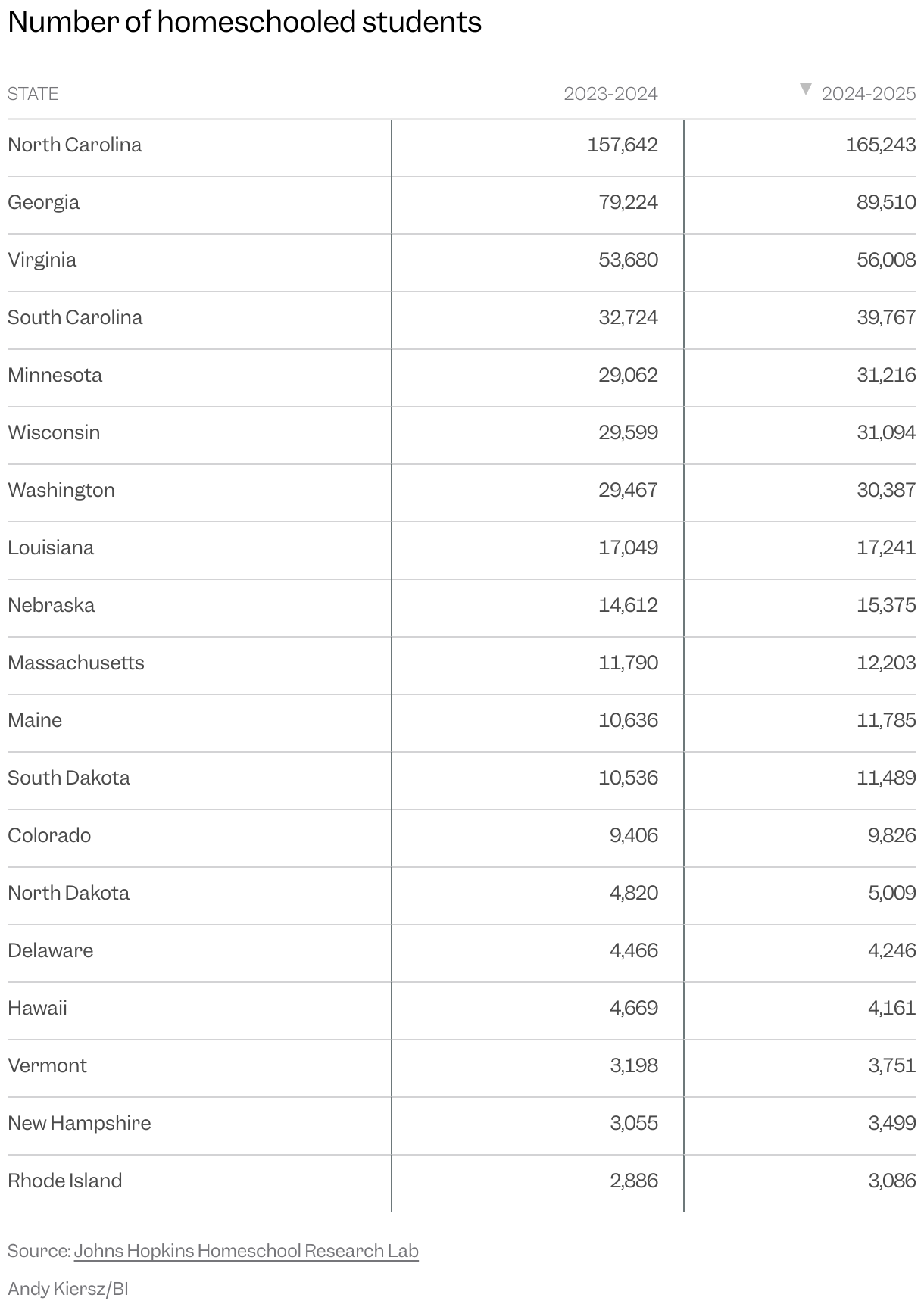
It follows 19 states reporting increases in homeschooling in the 2023-24 school year, with just two states reporting decreases. Twenty states do not collect or provide homeschooling data, per the lab, and the remaining states are expected to report their data in the coming months.
Homeschooling surged during the pandemic as many parents were dissatisfied with the remote learning options that their local public schools provided and chose to take their kids’ education into their own hands.
However, the growth in homeschooling today can’t be primarily attributed to the pandemic, Angela Watson, creator of the research lab and senior research fellow at the Johns Hopkins Institute for Education Policy, told Business Insider.
“I think now we see that people who choose to homeschool their children are slightly younger than their private school or public schooling parent peers,” Watson said. “And so it could be that this is kind of a younger generation thing where it’s not stigmatized for them in the same way.”
That’s not to say that homeschooling is dominating all forms of schooling. Virginia, for example, had 1.2 million students enrolled full-time in public school in the 2024-25 academic year.
Education in the US is shifting. President Donald Trump and his administration have pushed to expand school vouchers to allow more parents to receive federal funds to send their kids to schools of their choice, whether it be a private school or homeschooling. Meanwhile, enrollment in public schools is declining, causing some of them to consolidate or shut down, partly spurred by the growth of school vouchers, along with declining birth rates and lack of federal funds.
Watson said that as educational options grow, she expects to see more parents choosing how they want their kids to learn.
“A variety of people are exiting traditional settings for reasons that are diverse, but all fit around their needs not being met in these one-size-fits-all schooling environments,” Watson said. “And so they’re exiting, and they’re exiting into homeschooling.”
How US education is changing
Trump has signed a series of executive orders since he took office aimed at reshaping the way US public schools function. One of them called for expanding school voucher programs, primarily by determining whether agencies could redirect federal funds meant for public education toward voucher programs.
Changing how funding is allocated cannot be done without congressional approval. Still, the administration has withheld some funding for public schools meant for programs including migrant education and after-school programs before releasing it in late July with guardrails, meant to ensure that schools are using the funding in ways that align with the administration’s political views.
“I’m looking at best practices throughout all states. We want to develop a toolkit for states to say, ‘This is how it’s being done in some states that are having great success,'” Linda McMahon, Trump’s education secretary, said at a charter school visit in Michigan. “We don’t set curriculum, we don’t hire teachers, we don’t buy books, we don’t do any of that. We’re primarily a pass-through.”
While homeschool enrollment is growing, public school enrollment continues to decline, and some public schools are adapting to the increase in homeschoolers. Watson pointed to the Mesa Public Schools in Arizona, which created a program to allow homeschool students to enroll in classes part-time at local public schools, and the schools would receive voucher funds.
“As people make one choice in the future or with other children, then they’re likely to continue to make choices,” Watson said. She added that there’s a variety of choices beyond homeschooling, like microschooling or part-time public school options, and families might increasingly “cobble together an education out of all of these different options.”
Read the original article on Business Insider

As the midterm elections approach, candidates will increasingly be forced to weigh their need to connect with constituents and potential voters against the reality of practicing politics at a time of accelerating threats, attempts and slayings.
The fatal shooting of conservative activist Charlie Kirk this week on a Utah college campus marks the latest example of violence tearing through American politics across centuries and the ideological spectrum.