
Prince Harry met his father, the king, for tea in London four months after saying they were not on speaking terms.
Day: September 11, 2025
Getty Images
You may be surprised to learn that the treadmill was invented as a prison torture device in 19th-century England. Or maybe you’re not surprised, depending on your feelings about huffing and puffing as you trod along on an automatic belt to nowhere. Still, it’s a little wild to realize that upward of 50 million Americans willingly use a device each year that was conceptualized to make criminals suffer. A lot of people are gluttons for punishment, though.
Exercise fads constantly come and go. In 2025, that means spin classes are out, Pilates and strength training are in, and the Thighmaster is probably sitting somewhere in your great aunt’s basement. Americans tend to treat fitness as a consumer product to be used and, once we get bored or something better comes along, tossed aside. Yes, exercise science evolves, and doctors’ recommendations on the best ways to stay fit change over time, but not nearly as fast as whatever Hot New Thing the cool kids are into cycles through.
If there is an exception to the fadification of fitness, it is the humble treadmill. Both literally and figuratively, it doesn’t go anywhere.
Data from the Sports & Fitness Industry Association, a trade association for the sporting goods industry, shows 56.8 million Americans used a treadmill in 2024. That is a … 0% change from 2019. People use the treadmill at about the same rates as they jog or lift free weights. The only sporting activity that’s more popular is walking.
“We’ve been tracking participation trends for 38 years, and in the current iteration, we’ve been tracking it since 2008, and treadmill has always been one of the most participated sports,” says Alex Kerman, the senior director of business operations and research at SFIA.
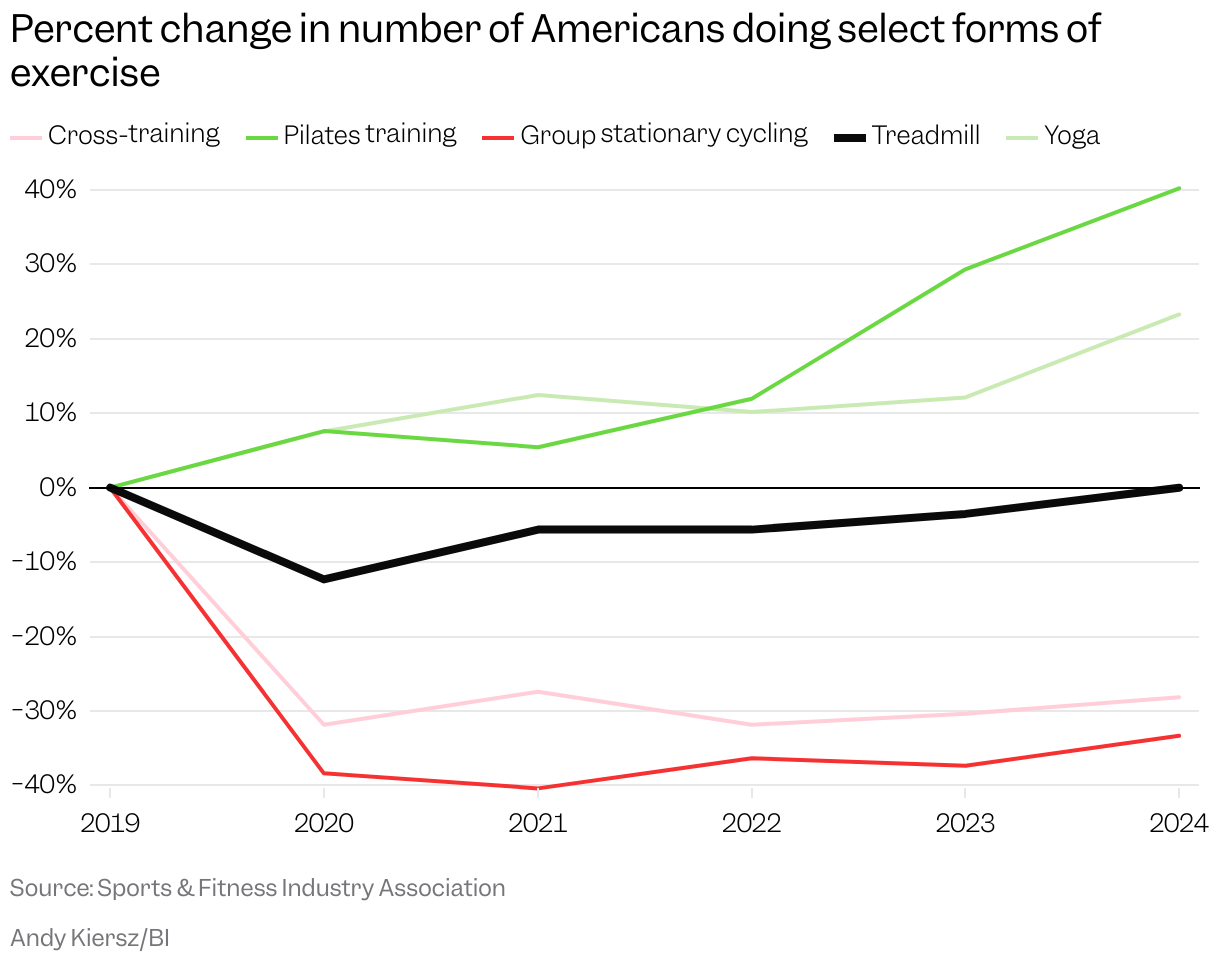
According to SFIA’s research, 18.4% of the US population ages 6 and up use a treadmill at least once a year, a small uptick from 17.2% in 2014. Treadmill use cuts across ages, demographics, geographies, and income levels, though it tends to skew female, higher-income, college-educated, and white. Given their mainstay status, it’s perhaps not a surprise that treadmills are the most lucrative piece of gym and exercise equipment in the US, generating about $1.1 billion in revenue in 2025, according to data from IBISWorld.
“The treadmill endures because it really delivers on the essential basics: accessibility, convenience, and proven effectiveness,” says Cedric Bryant, the president and CEO of the American Council on Exercise. “The most basic element to maintaining an independent lifestyle, typically, as we mature, is to be able to ambulate and move on our own. Treadmills help to maintain that quality.”
The treadmill’s hold on our society started in the late 1960s and 1970s. Aerobic fitness started to take off as people realized and publicized the cardiovascular benefits of moving and shaking. Jogging took off as an easy, cheap way to get your heart rate up. While plenty of people partake in outdoor running and walking, others prefer to do it inside.
“The treadmill sticks around because running and jogging stick around,” says Natalia Mehlman Petrzela, a history professor at The New School who’s the author of “Fit Nation: The Gains and Pains of America’s Exercise Obsession.” “Most people can put one foot in front of the other and walk or jog, and it’s that much easier to not have to deal with the elements or the time of day.”
Treadmills are versatile — they can be used by beginners starting out walking or more advanced athletes doing interval training and playing around with elevation. A treadmill can be a place to do a little (careful) multitasking. In terms of improving cardiovascular health, increasing endurance, and helping with weight management, it delivers bang for your buck, whether at the gym or in your basement.
“There’s millions of people that have health club memberships, and the treadmill is right there, free to use,” Kerman says. “They’ve made models now that are affordable for at-home purchase as well.”
Treadmills can deliver the mental health benefits of exercise, be a space for zoning out or getting in a good think, though the endeavor can, admittedly, be pretty boring. Luckily, treadmill technology has improved, so maybe that device that wasn’t for you 10 years ago would be now. Many of them have TVs, and some offer interactive classes. A lot of modern-day treadmills also have less of that “might fall off of them with any wrong move” feeling.
“We pay big bucks for fancy connected treadmills,” Mehlman Petrzela says. “As we want more out of our workouts, we want more out of less time. Running is both old school and basic, but it’s kind of hard to beat that.”
Of course, exercise trends have come for the treadmill, too. There’s the 12-3-30 “hot girl” workout that’s popular among a certain type of, well, hot girl, or the Zone 2 cardio focus. Boutique studios such as Barry’s and Orangetheory also incorporate pretty tough treadmill work.
Carmine Ciliento, a fitness manager at Crunch Fitness, tells me he’s not always in love with some of the treadmill-based workout trends that come from social media influencers. “If the person looks the part and talks in a convincing way, people will be like, ‘All right, let me try that,” he says. The 12-3-30, where you walk 3 miles per hour at a 12% incline for 30 minutes, has a “very arbitrary rationale,” he says, and while Zone 2, a moderate-intensity workout, has become popular, it’s not a “magic pill” either.
But if an influencer or some flash-in-the-pan fad gets people to move, so be it, Bryant says. “That can generate even more interest and excitement around this product that’s been around forever,” he says. There is research to support the benefits of the 12-3-30.
Ciliento himself got into running in 2019 and mainly uses the treadmill for tempo work, but he understands that running may not be for everyone. It generates a lot of impact, which can be tough on joints and could increase the risk of injury, and many Americans, especially those who didn’t play sports growing up, mainly remember dreading that timed mile in high school gym class.
Fitness crazes tend to grab the headlines and, for some of the fitness fiends out there, their hearts and wallets.
“As much as I’ve invested my time into running over the last couple of years, I don’t tell people they need to run,” Ciliento says. “That being said, the more resilient someone becomes physically, emotionally, and mentally, the more you could kind of start to reintroduce things that they might’ve strayed away from at one point or another.”
Fitness crazes tend to grab the headlines and, for some of the fitness fiends out there, their hearts and wallets. Tae Bo, Jazzercise, and hula hooping are just some of the once hot modalities that have fallen by the wayside. It’s tempting to laugh at how weird some of them were, but the fact of the matter is, the best exercise is the one you’ll keep coming back to. If it takes a Zumba class to get you moving, or if you fall back in love with that Gazelle machine, whatever. The problem is, a lot of these fads are not ones people stick with once the novelty wears off.
The treadmill is, for many people, a consistent friend. It’s simple, familiar, and incorporates movements we evolved to do. Sure, it’s not the most entertaining piece of exercise equipment in the world. But maybe that’s part of its lasting appeal: It wasn’t designed to be fun in the first place.
Emily Stewart is a senior correspondent at Business Insider, writing about business and the economy.
Read the original article on Business Insider
Courtesy of Tom Skellan
- Tom and Jeanne Skellan sold their Utah home to rent in Mesa, Arizona, and travel more.
- Older Americans increasingly rent for financial reasons, flexibility, and amenities.
- The number of renters 65 and older grew by 30% from 2013 to 2023.
Tom and Jeanne Skellan were homeowners for more than 40 years before they decided to become renters again.
As they both neared their 70s, their kids wanted them to leave St. George, Utah, where they’d moved after decades in Philadelphia, and live closer to family. So in 2021, the Skellans sold their home of 15 years and headed south to Mesa, Arizona, settling minutes away from one of their three sons and his family.
Despite having enough cash from their home sale for a down payment on a new place, the couple decided they didn’t want to sign up again for all the responsibilities that come with homeownership. Instead, they moved into a single-story three-bedroom rental house.
The Skellans’ decision to rent in retirement is increasingly common. A growing number of older Americans rent their homes for financial reasons, flexibility, and, in some cases, amenities and community.
The $2,100 monthly rent the couple pays in Mesa is a few hundred dollars more than their mortgage was in St. George, but they’re relieved they don’t have to do yard work, fix the air conditioning, or worry about rising property taxes and home insurance premiums. And they have the flexibility to move if their son leaves the area or if they want a change.
“If we bought a house, we couldn’t afford a new one, so we’d end up getting an older one, and there might be a decent amount of expenses,” said Tom, who’s turning 75 in late September.
With elevated mortgage rates and soaring home prices, renting is increasingly cheaper than buying. Plus, they might not live long enough to see their home value appreciate much or pay off their mortgage. “I’m not going to last 30 years, so I’m just thinking 12 to 15 years,” he said. “By the time the house gets appreciated, we’ll be dead.”
Instead, they’re using some of the money they would have spent on a down payment to travel. They spent three weeks in Ireland, Saratoga Springs, and the Ozarks this summer, and they’re planning a big trip to Italy for their 50th anniversary next year.
Courtesy of Tom Skellan
A surge of older renters
The number of people 65 or older who rent their homes grew by nearly 30% to around 10.4 million between 2013 and 2023, according to a recent Point2Homes study of US Census data. The only other age group with a growing number of renters was people between 55 and 64. Sunbelt destinations, like Arizona, have seen a disproportionate share of the growth with older renters, the report found.
The growth in renters speaks to the challenges of downsizing as a homeowner. With mortgage rates and housing costs high and inventory scarce, many older people are struggling to find affordable and accessible starter homes to buy. Eight in 10 baby boomer renters said renting was a better deal than buying, according to a 2024 Bank of America survey. Many older Americans are turning to rentals, including in 55-plus and retirement communities.
The rental communities are “a really hot part of the senior housing market right now that’s grown a lot in the last several years,” said Tim Mullaney, editorial director of the trade publication Senior Housing News.
Unlike many older renters, the Skellans feel financially comfortable. Jeanne is fully retired, while Tom is semi-retired and owns a small business doing reserve studies for homeowners’ associations. He also collects a pension of about $2,200 a month from his career as an accountant and IT systems manager for Delaware County, Pennsylvania, for 30 years. The couple both receive Social Security benefits, which amount to more than $3,300 monthly, combined.
While people like the Skellans were able to cash in on a booming housing market and are choosing to rent in part for convenience, many older Americans rent because they don’t have the option to buy.
About a third of 65-and-older households were cost-burdened in 2023, meaning they spent more than 30% of their income on housing, according to a recent report from Harvard’s Joint Center for Housing Studies. And older renters are notably worse off than homeowners — 58% were cost-burdened in 2023, most of them severely, the report found.
The Skellans feel fortunate to have found their home and hope to stay for the foreseeable future.
“The only concern you have when you rent is, hopefully, that you’re going to be there for a while and you’re not going to have to pick up and move again,” Tom said.
Read the original article on Business Insider
BENJAMIN HANSON/Middle East Images/AFP via Getty Images
- Reactions from business leaders are pouring in after conservative influencer Charlie Kirk’s death.
- Jared Kushner, David Sacks, and Bill Ackman have expressed dismay at Kirk’s death.
- Kirk was shot dead at a college event in Utah on September 10.
Business titans are reacting to the death of conservative influencer Charlie Kirk.
Kirk, an ally of President Donald Trump and the founder of conservative nonprofit Turning Point USA, was fatally shot in the neck while speaking at an event at Utah Valley University on Wednesday.
“Charlie was the best of America, and the monster who attacked him was attacking our whole country,” Trump said in a video statement released by the White House on Wednesday.
Trump ordered all American flags to be flown at half mast throughout the country until Sunday evening.
Reuters
Kayla Bartkowski via Getty Images
Leigh Vogel/Getty Images for Concordia Summit
Initialized Capital
Stephen McCarthy/Sportsfile for Web Summit Qatar via Getty Images
Brendan SMIALOWSKI / AFP
Read the original article on Business Insider
The 34-year-old former Apprentice star said his departure was not related to the show, claiming he had seen messages on a reporter’s phone.
Video footage shared on social media shows people taking hats after Kirk’s shooting, before security intervened.
Poland is seeking to step up its defences with plans to restrict air traffic in the eastern part of the country
Poland has requested an emergency UN security council meeting after an incursion of Russian drones into Polish airspace earlier this week.
As the fallout from the incident continues, Poland also seeks to step up its defences with plans to restrict air traffic in the eastern part of the country, in areas neighbouring with Belarus and Ukraine, which will be closed until 9 December.
A railgun uses an electric pulse to generate an electromagnetic force that accelerates a projectile to up to six times the speed of sound.
Golden Bachelor’ Mel Owens admitted his previous ageist comments were “unfair.”
The South Koreans detained in an immigration raid in Georgia are due to be released on Thursday and flown home on Friday.