
See the world in vertical: Top photos by AP’s photojournalists [deltaMinutes] mins ago Now
Day: September 3, 2025
When the Power of Siberia 2 pipeline is completed, China could account for over 60 percent of Russia’s total prewar gas exports to the EU.
Writing in an New York Times essay, nine former CDC officials said RFK Jr.’s leadership was “endangering” the health of Americans.
Treasury reveals date as speculation rises over potential tax increases to plug deficit in public finances of up to £40bn
Rachel Reeves’s autumn budget will take place on 26 November, the Treasury has announced, amid mounting speculation over tax increases.
With the government under pressure on the economy, the chancellor has previously said measures designed to reboot growth would form the basis of her highly anticipated tax and spending plans.
On 27 August 2025, the presidents and prime ministers of three major EU states – Emmanuel Macron of France, Friedrich Merz of Germany and Donald Tusk of Poland – arrived in Chișinău for Moldova’s Independence Day. Their joint visit, just one month before the 28 September parliamentary elections, was a clear demonstration of political support for the country’s European path. After talks with President Maia Sandu, the leaders pledged continued technical and financial assistance, condemned Russian attempts at interference and hybrid operations, and sent a direct signal to Moscow that the EU would not leave Moldova alone under pressure. The visit, according to Politico, underscored the bloc’s readiness to stand with Chișinău in the run-up to the vote.
Moldova and Ukraine on a joint track to the EU
Since 2022, Moldova has been a candidate for EU membership, with accession talks formally launched last year. On 4 July 2025, Chișinău and Brussels held their first-ever Moldova–EU summit, confirming the country’s “European future” and commitment to align with the Union’s legal and market standards. The path is closely linked to that of Ukraine, both facing Russian aggression and hybrid threats ranging from disinformation to energy blackmail. European capitals view this alignment as part of a single “security arc” stretching from the Carpathians to the Black Sea, reducing Moscow’s space for destabilisation.
Elections as a test of resilience
The 28 September elections are widely described as decisive for Moldova’s European orientation. Russian-backed political projects, including associates of Ilan Șor and figures such as Igor Dodon and Vladimir Voronin, are seeking to reverse reforms through external funding and disinformation campaigns. Kremlin-linked actors have amplified efforts to disrupt diaspora voting, targeting Moldovans abroad – especially in Italy, Romania, France and Germany – with false messages about closed polling stations, invalid passports or threats to residency status. Online operations include DDoS attacks against the electoral commission and falsified protocols. These tactics aim to reduce turnout and undermine legitimacy if pro-European forces prevail.
Strategic consequences of the vote
A victory for pro-European parties would consolidate Moldova’s synchronisation with EU institutions, strengthen energy and trade integration with Romania and the wider Union, and bolster joint security cooperation, including border protection and cybersecurity. Conversely, a shift to a pro-Russian course would open a “soft corridor” for Moscow via Transnistria to the Danube and the Black Sea, reviving smuggling networks and undermining EU sanctions regimes. Such an outcome would also pressure Romania’s borders, strain NATO’s eastern flank and damage the credibility of EU enlargement policy. For the Union, Moldova’s direction is thus a strategic test with implications for the region’s stability.
European leaders’ messages
In Chișinău, Chancellor Merz emphasised that “the doors of the European Union are open,” signalling the EU’s readiness to begin opening negotiation chapters this autumn. Tusk recalled Poland’s own accession path two decades ago, highlighting parallels with Moldova’s current position. Macron dismissed Russian narratives of an “aggressive EU” as lies, underlining the voluntary nature of the Union. For Sandu, her call for a “great family of peace – the European Union” framed the choice as one between stability and accountability on the one hand, and chaos and impunity on the other.
Moldova’s 2024 referendum narrowly endorsed EU integration with 50.4% support, giving the government a democratic mandate for reform. Since then, the country has shifted its energy and trade orientation to Europe, ending reliance on Russian gas after Gazprom halted supplies in late 2024. Against this backdrop, the presence of Macron, Merz and Tusk in Chișinău on 27 August was intended as a political anchor for Moldova’s pro-European trajectory in the decisive weeks before the election.
Reform UK leader to speak about Online Safety Act at House judiciary committee; government set to announce date of budget at PMQs later
Good morning. It is the first PMQs since July, and with the government set to announce the date of the budget today (Wednesday 26 November, if HuffPost UK is right), you would expect Keir Starmer and Kemi Badenoch to get stuck into a debate about the economy, and taxation.
But it might end up as a free speech day at Westminster, as a result of the conflation of two related issues.
On the question of civil liberties, Britain has, unfortunately, now lost her way.
I will do my part, as a participant in UK democracy, to help our country find its way back to the traditional freedoms which have long bound together our two countries in friendship. In the meantime, Congress should draw bright lines: British free speech rules, applicable to Britons, are made in Britain, and American speech rules, applicable to Americans, are made in America.
Social media users criticized the “entitled” neighbor in the Reddit post, with one saying: “This is his problem to solve.”
The couple, who have been dating since the summer of 2023, delighted fans around the globe on Aug. 26 with news of their engagement.
Getty Images; Alyssa Powell/BI
Flash back to the real estate market of just four years ago: homebuyers elbowing their way through crowded open houses, waiving inspections, and bidding up prices in search of the elusive “winning offer.” That sense of urgency is long gone. In fact, the formula has flipped. Instead of sprinting through the process, buyers these days are taking their time and haggling over prices. They’re also doing something that would have seemed unthinkable in 2021 — backing out of deals just before the finish line.
Call it the year of cold feet. More than 15% of home purchase agreements fell through in July, the highest percentage for that particular month since the real estate firm Redfin began tracking cancellations in 2017. The uptick — an increase from lows of 11.6% in 2020 and 2021 — reveals the market’s messy state. Buyers are skittish about the rising costs of homeownership and nervous about their jobs. Mortgage rates aren’t doing them any favors, with the typical rate more than twice the record low seen during those early days of the pandemic. With more homes available for sale and fewer buyers to compete with, shoppers who remain on the hunt can afford to be picky. Even after finally submitting that winning offer, they may wonder whether a better bargain could be found elsewhere.
“We have lots of homes available,” says Rhonda Forte, a real estate broker in Fort Worth, Texas. “If they don’t like this one, they can go to the next.”
Buyers’ uneasy leverage won’t last forever — in fact, there are early signs that the pendulum may be swinging back in favor of sellers. But until borrowing gets cheaper and people feel better about the economy, expect presale jitters to remain.
Home purchases can break down for a lot of reasons. An inspection may reveal a sagging roof, moldy attic, or flooding-prone basement. The buyer’s loan could fall through, or they may not have the cash to cover an appraisal gap. Many buyers also count on selling their existing home before closing on a new one. If they have trouble offloading their old property, they may not be able to move ahead with the new place.
And then there’s plain old buyer’s remorse. Even after an offer is accepted and the two parties sign on the dotted line, there’s a lot of work that needs to happen behind the scenes: an inspection, appraisal, mortgage underwriting, title search. Buyers can pull out at any time during this interlude, though they may forfeit their deposit, which is often a few thousand dollars. Cancellations typically spike in the fall or winter, when the real estate market slows down and buyers feel less urgency. That’s why this summer uptick stands out. In a nationwide survey of real estate agents by John Burns Research and Consulting in June, agents cited “cold feet” as the second-most common reason for purchase cancellations, right behind inspection issues. In July, 37% of agents surveyed by John Burns reported seeing more cancellations than expected at that time of year.
We have lots of homes available. If they don’t like this one, they can go to the next.Rhonda Forte, real estate broker in Fort Worth, Texas
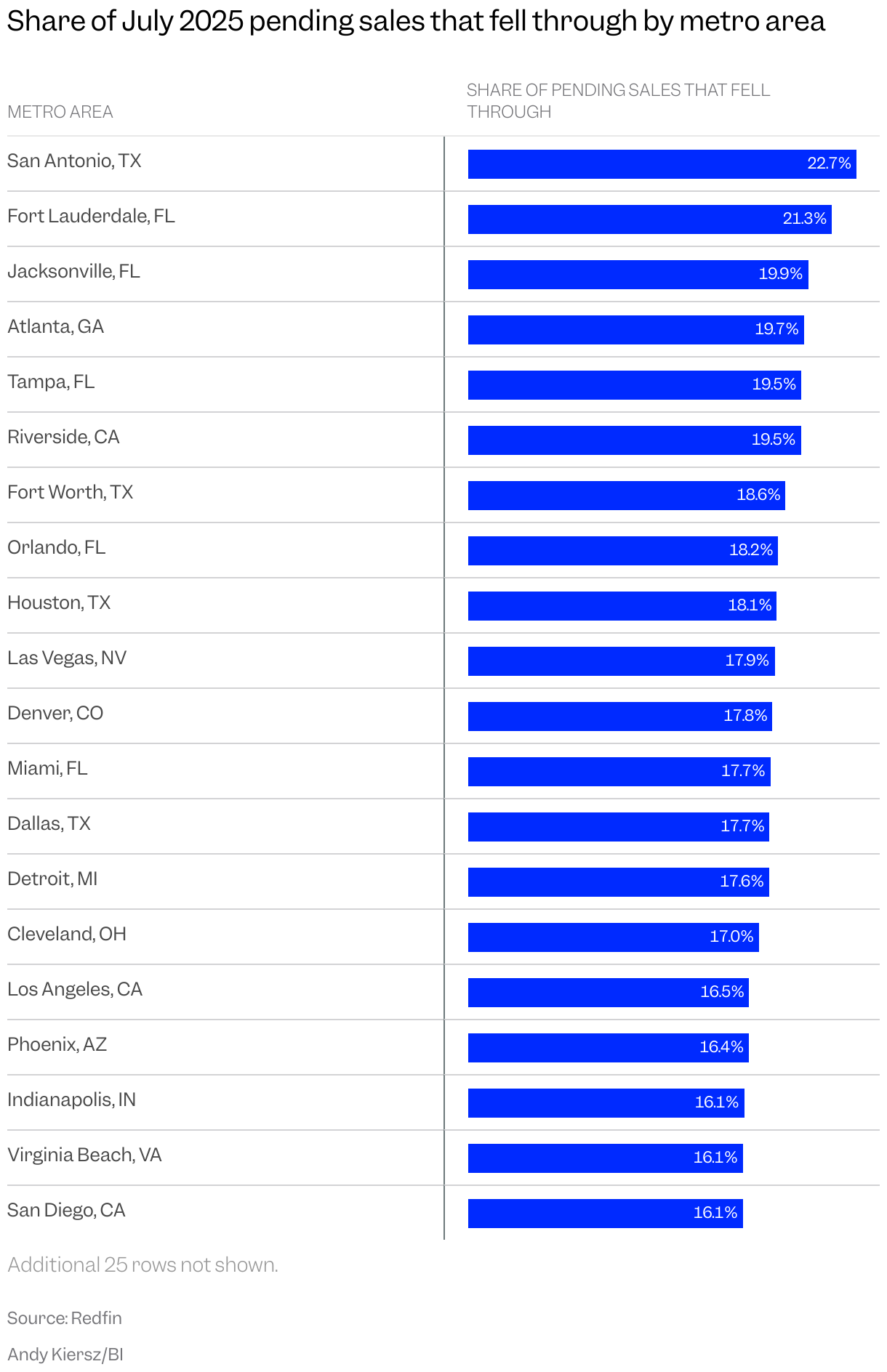
The “cold feet” phenomenon is a function of time and options. The more time that a buyer has to mull the deal, and the greater their number of choices elsewhere, the more comfortable they are in walking away. So it’s no surprise that Redfin data shows breakups were most common in places like Texas and Florida, which have seen a surge of available homes for sale thanks to busy homebuilders and a relative lack of buyers. Inventory nationwide has steadily climbed since mortgage rates jumped in 2022 — there were almost 25% more active listings in July than at the same point a year ago, data from Realtor.com shows. When more homes sit on the market, serious buyers can take their time and scrutinize properties.
“Buyers have been getting a little bit of a break in the sense that there’s more inventory,” Chen Zhao, the head of economics research at Redfin, tells me. “They can afford to be a little choosier.”
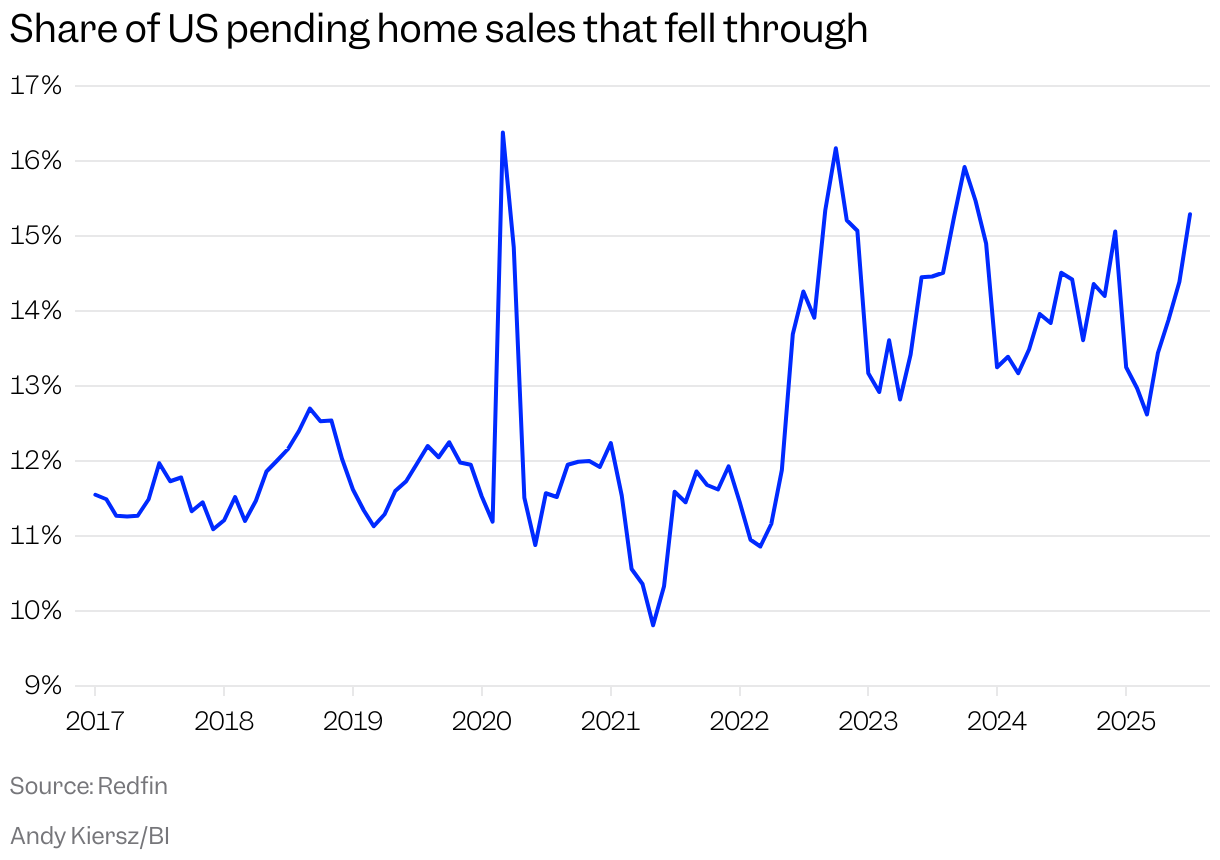
The other major factor weighing on the minds of homebuyers is affordability. They may be wary of shouldering the rising costs of ownership, like insurance, upkeep, and property taxes. If they get a mortgage with the prevailing rate of roughly 6.6%, they’ll most likely be paying hundreds of dollars more in interest every month than neighbors who snagged a sub-3% loan early in the pandemic. Home prices have fallen from their peak in some regions, but generally remain above pre-pandemic levels. To offset these costs, agents tell me, buyers are taking advantage of the slower market by starting with an offer below the asking price and requesting concessions, like payments for repairs or help on closing costs.
“They want to lowball everything,” says Danny Herndon, a real estate agent in the San Antonio area. The metro had the highest rate of cancellations in July, per Redfin’s data, with almost 23% of home-purchase agreements falling through. Fort Lauderdale (21.3%), Jacksonville (19.9%), and Atlanta (19.7%) followed close behind.
One thing those cities have in common: lots of shiny new homes. Not only does construction add more properties to the competition, but builders are more likely to offer steep incentives, like mortgage rate “buydowns,” to get homes off their books. To compete with those kinds of deals, regular sellers may have to aggressively cut their prices or toss in deal sweeteners of their own.
“Builders have had a huge upper hand,” says Cara Lavender, a senior research manager at John Burns. Regular sellers usually can’t afford to pay for all the incentives that come with a new home these days (or simply don’t want to). But even builders, who are typically loath to cut prices, now say in surveys that their prices are down 2% year over year. “We’re projecting that to continue through the year,” Lavender tells me. When the market for new homes slows down, that puts a drag on existing homes, too. “Resale prices are going to have to continue to come down,” she says. For sellers, the recent surge in cancellations adds insult to injury. Agents tell them to “get real” about the market and set their expectations accordingly. But even after ceding ground on the price or closing costs, they still risk losing a buyer to greener pastures.
The defining feature of the housing market back in 2021 was a nagging fear of missing out. Caught up in what seemed like a once-in-a-lifetime bull run, FOMO-filled buyers opted to secure a home by any means necessary — even if it meant stretching their budget or whittling down their list of must-haves. The current malaise strikes me as a different kind of FOMO. Buyers don’t want to inadvertently pass over a more favorable deal elsewhere, so they’re more likely to bail on the sure thing in front of them. Even falling prices, which probably sound like a godsend for buyers, may actually deter people from taking the leap.
“No one wants to be the one to kind of stick their hand out and say, ‘OK, I’m going to make a purchase,'” Lavender tells me. “‘What if prices keep falling? What if I wait a little bit longer and there is a better deal?'”
Real estate is local, of course. In the Midwest and Northeast, where builders have completed fewer homes, competition is generally much stiffer than it is in the lower half of the US, otherwise known as the Sun Belt. “Those two regions still do not have enough supply to meet their demand,” Lavender tells me.
No one wants to be the one to kind of stick their hand out and say, ‘OK, I’m going to make a purchase.’ What if prices keep falling?Cara Lavender, senior research manager at John Burns Research and Consulting
Analysts at John Burns expect the sluggish market to continue through the rest of this year and 2026. Even if borrowing rates do come down a little bit, what really needs to stabilize is the “consumer psyche,” Lavender tells me. As long as “uncertainty” is the word on everyone’s lips, buyers will probably keep backing out of deals. Other real estate gurus see it a little differently. Buyers may already be at their negotiating-power peak for this cycle, Redfin’s Zhao says. The pool of available homes shrank month over month in June and July — the first time inventory has gone down since July 2023. Would-be sellers are realizing the conditions aren’t so favorable for them, so they’re either yanking their homes off the market or not even listing in the first place. The latest data from Realtor.com shows that for every 100 new listings in June, 21 were pulled without a sale, a 48% increase from the previous year.
“What I’m seeing a lot of is sellers taking their house off the market because they still think it’s 2021,” Herndon tells me. “They’re not willing to drop the price, and buyers aren’t willing to pay them what they were paying during the pandemic.”
Data from Freddie Mac also shows that the typical mortgage rate has been slowly drifting lower after months of hovering near 7%. If home loans get cheaper, more buyers may enter the market, competition could heat up, and there may be more pressure to stick with a deal once it’s signed. That’s all still a big “if.” Predicting mortgage rates is tough — nobody knows for sure where things are headed. But it’s clear that the rise in cancellations is yet another symptom of what one economist last year described to me as a “savagely unhealthy” housing market. Perhaps a shift — and a thawing of buyers’ cold feet — would be welcomed by everyone.
“It seems like we’re heading toward a change, and mortgage rates are starting to reflect that,” Zhao tells me. “Maybe we’re on the cusp of something different now.”
James Rodriguez is a senior reporter on Business Insider’s Discourse team.
Read the original article on Business Insider