
Eve became a stepmom to her husband’s four children in 2014.
Day: August 29, 2025
Yes, we practically live in these pajamas — and you should too.
Katy Perry’s $15 million Montecito, CA, mansion purchase has turned into a yearslong legal standoff with the family of 84-year-old seller Carl Westcott.
The peace at the raucous J’Ouvert and the West Indian American Day Parade festivities will be enforced by a 2,500-cop deployment, NYPD Commissioner Jessica Tisch said Friday.
Western Springs, Illinois, once again ranked as the nation’s safest and richest city, with a household mean income of $294,896.
Edward Berthelot; Cheng Xin/Getty Images; Alyssa Powell/BI
From Labubu to Luckin Coffee, Chinese retail chains are betting big that American consumers can revive the growth they’re losing at home — and relying on cultural relevance and competitive pricing to make it happen.
A Business Insider analysis of top Chinese brands shows how they’re expanding their empires by opening brick-and-mortar stores beyond their borders.
Some of these brands may be looking to replicate the phenomenon of Labubu dolls, which have swept social media this year and have fans going to extraordinary lengths to snag one.
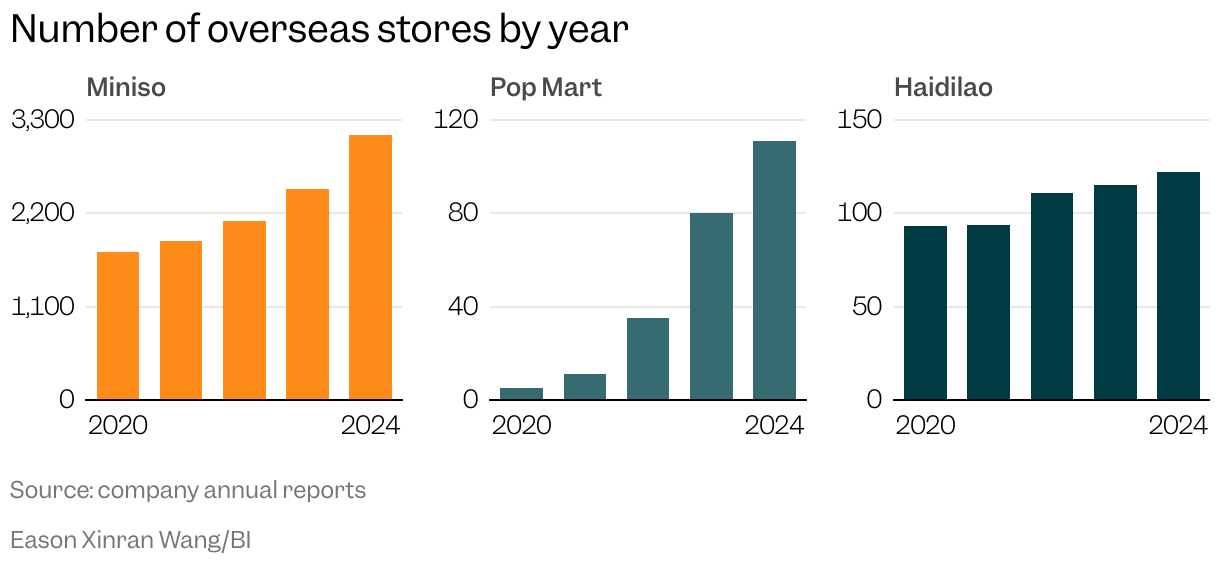
Business Insider found that in New York City alone, 20 Chinese retail chains have opened more than 40 stores across the food, beverage, and fashion sectors over the past two years, based on an analysis of company websites and announcements. Despite the US-China trade war, they aren’t showing signs of pulling back.
We zoomed in on six top brands from China that are expanding in the US for clues as to how they’re trying to win over American shoppers: Pop Mart, a toy company behind Labubu; Miniso, a home-goods retailer known for trinkets and character plush toys; Haidilao, a Sichuan-based hotpot giant; Luckin Coffee, the fast-growing coffee chain that sees Starbucks as its main competitor; Chagee, a tea chain that went public in New York in April; and Urban Revivo, a fashion label commonly thought of as Asia’s Zara. The companies did not respond to requests for comment.
Luckin Coffee, for example, opened its first two US stores in New York City in June and immediately caught the media’s attention as a challenger to the US’s leading coffee chains. Founded in 2017, Luckin had expanded to thousands of locations in China through coupon-driven marketing and surpassed Starbucks’ sales in the country by 2023.
“Luckin sees Starbucks as vulnerable to lower-priced competition,” said Russell Winer, marketing professor emeritus at New York University’s Stern business school, who recently returned from Shanghai. “They’re coming to the US and trying to position themselves between Starbucks and cheaper coffee chains, such as Dunkin’ Coffee, by offering competitive prices and good quality.”
The international expansion of Luckin and other Chinese brands comes amid sluggish consumer demand in China. China’s July consumer prices were unchanged from a year ago, while producer prices fell 3.6 %, extending their two-year slide, according to the National Bureau of Statistics — two signs of weak consumer sentiment.
As consumers in China become increasingly price-sensitive, retail brands, especially in the food and beverage industries, are caught in price wars. They rely on low prices to maintain customer traffic but see no real growth in domestic revenue.
Diversifying revenue beyond China has increasingly become necessary for these retail chains.
Many Chinese retail brands initially see Southeast Asia as a gateway for international expansion. The region offers lower labor costs, similar consumer interests, and proximity to existing supply chains in China. Tea chain Chagee opened its first overseas store in Malaysia in 2019 and expanded to 156 other international locations before entering the US market. Apparel brand Urban Revivo similarly established more than 400 stores in Southeast Asia prior to launching its first US store in New York City’s SoHo neighborhood this year.
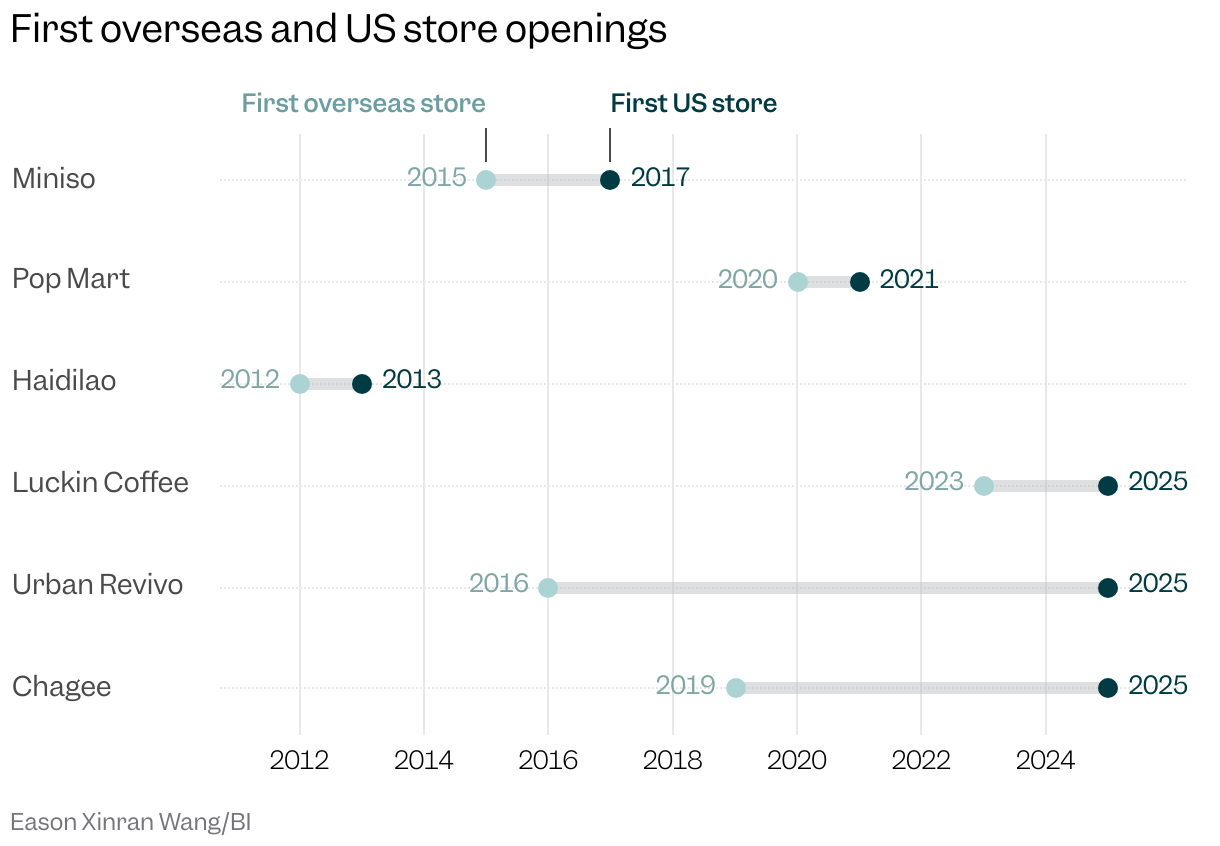
But now the pace of expansion into the US market is accelerating. Beverage brands Luckin Coffee, Cotti Coffee, and Mollytea all landed in New York within two years of first stepping overseas.
High rewards, tough hurdles
What exactly makes the US market so appealing? The Taiwanese restaurant chain Din Tai Fung offers an answer.
Famous for its Xiaolongbao dumplings, Din Tai Fung entered the US in 2000. Last year, it generated the highest revenue per restaurant in the country, reaching $27.4 million per location, according to food service research company Technomic. The US market represents huge revenue potential, in part because consumer spending in the country remains healthy.
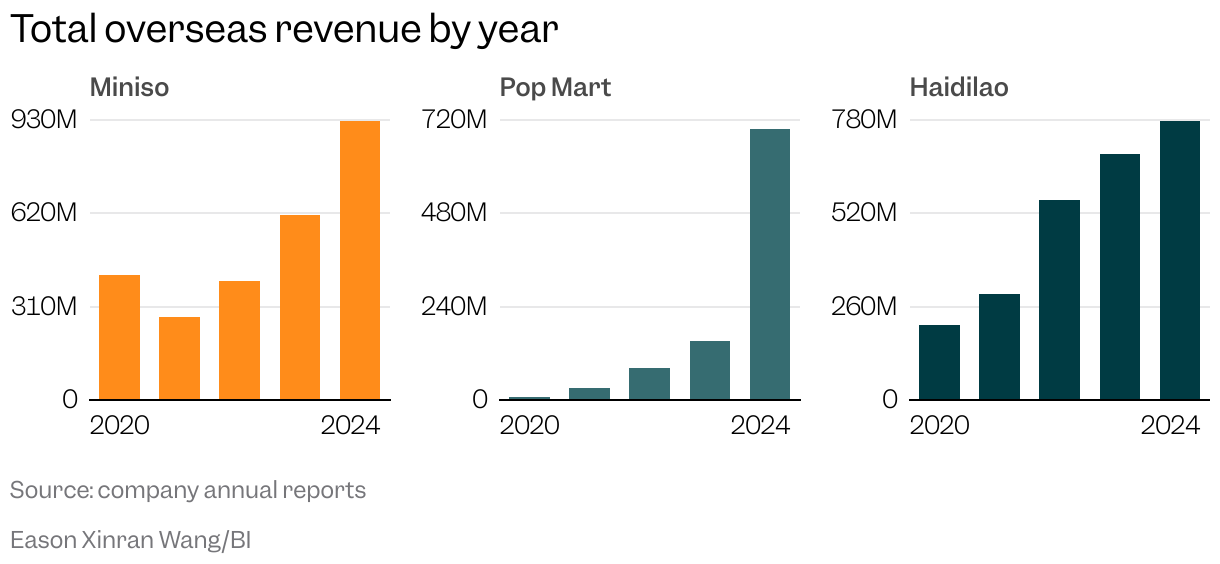
New players are also seeing surprising gains from US consumers. Pop Mart, the maker of Labubu, said it expects at least a 350% increase in profit globally for the first half of 2025. Miniso reported that its revenue in North America surpassed the combined total from all its other Asian overseas markets early this year.
Of course, companies entering a major market like the US face challenges.
“You need retail distribution, and you need to build a brand,” Winer said, adding that businesses also need to get their pricing and promotions right.
Replicating their supply chains for the US market can be an even bigger challenge. For food and beverage brands, sourcing ingredients can be difficult, and regulations on additives and safety testing often vary between states, forcing brands to rely heavily on local substitutes, which can mean sacrificing consistency in taste.
The recent US-China trade war could also complicate these retailers’ expansion plans, as they navigate a 145% tariff facing US imports of Chinese goods.
As a result, many Chinese chains have accelerated store openings in pursuit of scale, aiming to streamline their supply chains. Miniso, the home goods retailer that sees Japanese brand Muji as a key competitor, now operates more than five times as many stores worldwide as Muji. The founder said in 2024 that 24% of Miniso’s suppliers were based outside China. Meanwhile, Pop Mart, Luckin Coffee, and Urban Revivo are also racing to expand their store counts and close the revenue gap with major international rivals.
In 2022, Chinese e-commerce company Temu launched in the US, quickly becoming shorthand for low-priced, mass-produced goods from China. But a wave of newly arrived Chinese retail brands is now reshaping the market with fresh strategies, from unique product flavors and innovative payment methods to viral TikTok campaigns. Luckin, for instance, is leaning into influencer and brand collaborations to help its coffee concoctions go viral in the US as much as it’s relying on the promotions that helped it win at home. Customers lining up to buy Labubu may know it’s designed by a Hong Kong artist, but perhaps it doesn’t matter.
“American consumers are always looking for good products at a good price,” Winer said. “If it’s from a Chinese brand, that’s fine.”
Location data for Miniso, Pop Mart, and Haidilao was scraped from company websites and may be incomplete or outdated.
Eason Xinran Wang contributed reporting.
Read the original article on Business Insider
Lebanese army plans to carry out ‘sensitive missions’ amid US-backed Hezbollah disarmament plan [deltaMinutes] mins ago Now
A Broadway show asks a white actor to replace an Asian one. The backlash was swift
MICHAEL WOLFF: Melania and Epstein had sex for about a year before Trump – Google Search https://t.co/REOfGxMnat https://t.co/BQWqQnHbPA
— Michael Novakhov (@mikenov) August 29, 2025
Gov. Meyer vetoes bill to loosen marijuana zoning regulations in Delaware [deltaMinutes] mins ago Now