
Footage on social media shows protesters demonstrating their opposition to the two drag queens reading stories to children at the library.
Day: August 5, 2025
Overpayments of €55,645 were identified as having been paid to 100 individuals who had not taken up employment as expected.
Footage on social media shows protesters demonstrating their opposition to the two drag queens reading stories to children at the library.
In recent years, Central Asia has undergone a remarkable transformation — from a region historically marked by political divisions and competing national interests, to one increasingly characterised by cooperation and dialogue. Today, Central Asian countries are exploring the idea of strategic autonomy and greater regional solidarity, not as an abstract ambition, but as a practical response to the shared challenges and opportunities they have.
A key institutional vehicle for this evolving cooperation is the Consultative Meeting of Central Asian Leaders. Unlike formal international summits, this forum allows for open and informal dialogue between heads of state. It is valued precisely because it enables leaders to discuss sensitive regional matters candidly, without the constraints of protocol. The momentum for regional cooperation is clearly growing, and this forum has become a symbol of Central Asia’s desire to take its future into its own hands.
Beyond this, the countries of Central Asia cooperate through platforms such as the Shanghai Cooperation Organization (SCO) and the Organisation of Turkic States, both of which offer multilateral mechanisms for addressing regional security, economic integration, and cultural exchange. Importantly, what was once a region of competing national agendas is now evolving into a space of shared strategic vision, including coordinated positions in international forums such as the United Nations.
Additionally, in recent years, the foreign policies of Central Asian countries have demonstrated more and more coordination and regional alignment, especially in their engagement with external partners. This shift is reflected in the emergence of multilateral dialogue formats between Central Asia and key global actors. Notably, the European Union–Central Asia Summit, most recently held in Samarkand in 2025, underlined a shared commitment to regional connectivity, sustainable development, and mutual security.
Similar formats have been institutionalised with other global players, such as the C5+1 format with the United States, focusing on green transition, economic reforms, and regional security. Germany has also advanced a Central Asia–Germany high-level dialogue, including the “Berlin Initiative,” aimed at promoting green energy, vocational training, and the rule of law. Meanwhile, Italy has launched its Central Asia + Italy format as part of its strategy to diversify partnerships in Eurasia and promote economic diplomacy.
These platforms reflect a common approach, where Central Asian countries are increasingly choosing to engage as a bloc, rather than solely through bilateral channels. This enhances their negotiating capacity, visibility, and strategic coherence on the global stage. While each country maintains its sovereignty and specific foreign policy priorities, there is a growing recognition that regional solidarity amplifies voices and leverage in an increasingly complex geopolitical landscape.
This shift aligns with the broader regional identity-building efforts under the Consultative Meetings of Central Asian Leaders, and reflects a pragmatic understanding that shared challenges — such as water management, climate adaptation, and migration — are better addressed collectively and in concert with international partners.
Common regional challenges also drive this growing convergence. Climate change, water scarcity, and labor migration are issues that transcend borders. One of the most pressing concerns is the region’s vulnerability due to the presence of millions of Central Asian migrant workers in Russia, which creates economic, political, and even social fragilities. Similarly, security threats stemming from terrorism, extremism, and instability in neighboring Afghanistan demand a coordinated regional response.
In this regard, Uzbekistan has taken a leading role in advocating for constructive engagement with Afghanistan. Rather than treating Afghanistan solely as a security threat, Uzbekistan emphasises its potential as a partner in regional development. Tashkent continues to promote infrastructure and connectivity projects that include Afghanistan and actively engages with global stakeholders to avoid repeating past mistakes that led to isolation and instability. These efforts are crucial for countering radicalisation and preventing the spread of extremism across the region.
Another major regional concern is demographic pressure, particularly in Uzbekistan, where over 60% of the population is under the age of 30. This youth bulge presents both opportunities and challenges. Uzbekistan aims to provide higher education access to 50% of young people by 2030, a bold and necessary goal. However, such educational expansion must be matched by meaningful employment opportunities. To this end, Uzbekistan has established a specialised migration agency to facilitate the organised deployment of skilled labour abroad, including in cooperation with the European Union. Agreements with countries like Germany are already in place, and more are expected to follow.
All these initiatives — whether in education, migration, energy, or security — are being pursued in parallel and in partnership with regional peers. The increasing alignment of foreign policy priorities, the absence of interstate tensions, and the habit of consultation signal that Central Asia is developing a new regional identity based on strategic autonomy, mutual respect, and proactive cooperation.
While the concept of a formal “political union” remains premature, the foundations for deeper regional integration are being laid. As long as this cooperative spirit persists, the Central Asian region will continue to gain agency and resilience amid a turbulent geopolitical landscape.
Reddit users outraged after husband tells wife to leave so mother moves in

Kazakh literature is filled with towering figures who have shaped the nation’s cultural and spiritual identity. Among them, Abai Qunanbaiuly (1845–1904) remains the most iconic. A poet, philosopher, and intellectual of global stature, Abai left behind a legacy that continues to resonate within world literature. As Kazakhstan celebrates the 180th anniversary of his birth, it is a fitting moment to explore how his influence extended far beyond the steppe, reaching as far as the United States.
George Kennan: The American Who Introduced Abai to the World
In 1885, American journalist George Kennan visited Semey (then Semipalatinsk) and was deeply impressed by the city’s public library. To his surprise, local Kazakhs actively borrowed and read books, a rare sight for that time and region. In his influential work Siberia and the Exile System, Kennan specifically mentioned Abai, marking one of the earliest references to the Kazakh thinker in Western literature.
Kennan’s account stands out for its authenticity. It is based not on secondhand stories but on direct observation. His writings confirm Abai’s presence in Semey’s intellectual life and suggest that the poet had begun to attract attention well beyond the Kazakh steppe.
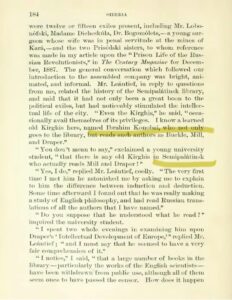
Credit «Siberia and the Exile System», by George Kennan
From Kennan’s descriptions, we gain insight into what Abai read, who his associates were, and how his worldview aligned with major thinkers of the time.
Abai’s intellectual growth was greatly influenced by E. P. Mikhaelis, a Russian political exile and lifelong friend. Under Mikhaelis’s guidance, Abai refined his reading habits and began a new phase of self-education. Through Mikhaelis, he was introduced to other exiled Russian intellectuals such as S. S. Gross, A. A. Leontiev, and N. I. Dolgopolov.
These thinkers were struck by Abai’s intellectual depth, civic engagement, and dedication to the betterment of his people. In return, Abai introduced them to Kazakh culture, history, and oral traditions, becoming a cultural bridge between East and West.
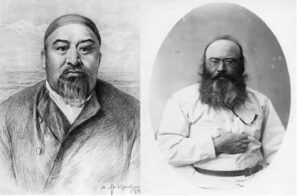
Аbai and E.P. Mikhaelis
Kennan also described the library in Semey, where Abai was a frequent visitor and reader. Since the original excerpt is in English, it is often shared as an image in historical archives rather than a transcription.

Credit «Siberia and the Exile System», by George Kennan
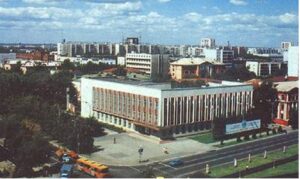
The exterior appearance of the library in Semey where Abai was a reader
Abai’s Songs and Wesleyan University
Abai’s influence extended not only through literature but also through music. In 1970, Wesleyan University Press in Connecticut published Music of Central Asia: Essays on the History of Music of the Peoples of the USSR, a groundbreaking volume by V. Belyaev and other scholars. The book includes a chapter titled Kazakh Music: From the 15th Century to the Mid-18th Century, which devotes special attention to Abai’s musical legacy.
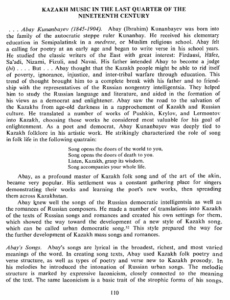
Belyaev describes Abai as a progressive thinker and a voice for enlightenment, quoting one of his famous verses:
“Song opens the doors of the world to you,
Song opens the death to you.
Listen, Kazakh, grasp its wisdom.
Song accompanies you your whole life.”
In the section Abai’s Songs, Belyaev explores the emotional range and poetic craftsmanship of Abai’s music. The poet merged Kazakh folk forms with Russian melodic influences, creating a distinctive style that aligned lyrical meaning with melodic structure.

One example is the song “Ayttim Salem, Qalamkas,” whose heartfelt lyrics convey themes of love, longing, and human connection. Another is the renowned “Kózimnіń qarasy” (“The Black of My Eye”), notable for its traditional aaba verse form and expressive melody.

Abai’s poem Segiz Ayaq (“The Eight-Liner”) is also discussed for its moral and ethical themes. Written in an innovative eight-line stanza with a unique metrical structure (558+558+88) and a rhyme pattern (aab ccb dd), it exemplifies Abai’s command of both form and content.
While his music is now receiving long-overdue recognition, much of Abai’s poetry and philosophy remains underexplored in international circles.
Abai’s commitment to education, self-awareness, and moral integrity defines him as more than a national poet. He is a universal thinker. As Professor Tursyn Zhurtbay puts it:
“We participate in global intellectual culture through Abai. He is the moral compass of our people. Every Kazakh should hold their own image of Abai in their heart.”

The only lifetime portrait of Abаi. Painter Lobanovsky P.D. 1887 y. Pencil

Abai with family members – wife Erkezhan, sons Turagul and Magauiya, grandsons – Pakizat, Abubakir and his wife Kamaliya. Semey city,1903
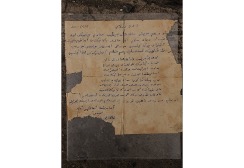
The original letter of Abai to his son Magauiya.
Arabic script. 1896 y.
From the personal fund of Musakhan Baltakaiuly.
Museum of Abai in Semey
To truly honor Abai is to engage deeply with his ideas. His vision of harmony between heart, will, and reason remains deeply relevant. As the world becomes increasingly interconnected, his wisdom continues to echo, urging us to look inward while building bridges outward.
Abai’s words are not relics of the past. They are living guides for the future. The responsibility now falls to us to read, reflect, and carry forward the message of one of Kazakhstan’s greatest minds.
Armenia and Azerbaijan to ink peace memorandum under Trump mediation | Middle East Eyehttps://t.co/VAlIhIBDvV
The South Caucasus News Review https://t.co/KYGCUA0Nwy https://t.co/68VWXDt66g#SouthCaucasus #SouthCaucasusNews#Armenia #Azerbaijan #Georgia
Armenia Azerbaijan… https://t.co/18Etxoaz1C— Michael Novakhov (@mikenov) August 5, 2025
The Lion’s Gate portal, which peaks on August 8th, is revered by astrologers and numerologists as a potent time to claim wants, voice desires and heal what has been harmed within us. A combination of the influence of Leo and the power of the number 8 conspire to make the Lion’s Gate a prime opportunity…
These digital night vision binoculars record in 1080p, zoom up to 1,000 feet, and fit in your jacket pocket.
The Ammortal Chamber can be found in a growing number of spas, clinics, sports facilities and private homes across the country.