
A California mom bravely chased down two buglers she caught exiting her home and smashed out their getaway car’s back window with her bare hand as they fled with her handgun and her son’s piggy bank.
Month: July 2025
US repatriates a child from sprawling camp in northeastern Syria [deltaMinutes] mins ago Now
UK Political Landscape Shifts Amid Gaza Crisis
Calls for official recognition of Palestine surged in the UK following distressing images revealing the extent of starvation in Gaza. Labour leader Keir Starmer advocated for advancing this position, asserting that “now was the right time to move this position forward” as hopes for a peace process evaporate, reports 24brussels.
Israeli Prime Minister Benjamin Netanyahu responded sharply, cautioning that the UK’s stance would bolster Hamas and endanger the region. In a statement on social media platform X, Netanyahu declared, “[U.K. PM Keir] Starmer rewards Hamas’s monstrous terrorism & punishes its victims.”
Expert Bruce criticized the measure, arguing it fosters unrealistic expectations among militants. He stated that the decision “gives one group hope” and offers incentives for bad actors to sidestep diplomatic efforts. He highlighted the unusual resilience of Hamas, saying, “In any other normal environment where someone was so utterly defeated, they would surrender. In this case, that just does not occur.”
Bruce elaborated that Hamas thrives on the “hope that they receive” regarding the duration of suffering and its potential to pressure the international community to support their viewpoint. This sentiment reflects a complex dynamic as the humanitarian situation worsens amid ongoing conflict.
The political tides in the UK seem increasingly pro-Palestinian, cutting across traditional party lines as public awareness of humanitarian crises deepens. This shift indicates potential changes in international policy and reflects broader global concerns regarding the Israeli-Palestinian conflict.
Getty Images; Rebecca Zisser/BI
- People have been using ChatGPT and other AI tools to “manifest” their ideal lives.
- My colleague reported on this late last year, and I keep seeing the trend on TikTok still today.
- So I thought about it: Should I give in and join the AI manifesters and visualize my dream life?
It’s a TikTok trend that’s been going on for some time now — people using ChatGPT and other AI tools to “manifest” their dream lives.
So far, I’ve avoided it, but when one of my editors noticed it trending again, I had to at least consider it: Am I the type of person who’d manifest? And then use AI to show me what my ideal life would look like?
My colleague Ana Altchek noticed the trend back in September. “Users are sharing how AI has helped them enhance their traditional manifestation practices, such as visualizations, vision boards, positive affirmations, mantras, and rewiring negative beliefs,” she reported at the time.
ChatGPT shows your dream life
I decided to investigate for myself, and I found that people essentially prompt AI to create a story about their dream life, based on their goals.
Let’s say your goals were to be rich, have flawless skin, snag a hunky husband and two kids, and live in a villa in Italy where you garden tomatoes. Enter those goals — manifest them, if you will — and it would whip up a story for you.
Then, you could use it to create an action plan to actually get there.
I tried this out myself, asking ChatGPT to tell me a story about a day in my life in that Italian villa. I can’t deny it delivered an appealing tale:
The sun slipped gently over the Tuscan hills, casting gold across the rolling vineyards and awakening Villa Rosabella, your sun-washed estate tucked among olive trees and cypress-lined roads. The sheets were linen, cool and crisp, and the smell of blooming jasmine drifted in through open French doors. You stretched, not a wrinkle on your face, your skin dewy and flawless, like you’d just walked out of a spa in Capri (because you had — last weekend).
But when I asked it to give me steps to achieve this dream life, things got a little wonky. Although it had some decent practical advice about how to achieve flawless skin (“get a consultation with a top dermatologist,”) things got slightly more complicated when it came to the “becoming rich” part of the dream. It suggested things like, “Scale income to $500K+ annual revenue,” which … OK, sure?
To be fair, had I given it slightly more specific goals, it might have come up with a better plan. But I need to admit my bias here: I’m not really into the idea of manifesting. I’m happy for anyone who finds this useful, but it’s just not for me.
A while back, I DM’ed some of the people I’d seen talking about this life hack on social media. A few of them told me they really did believe in the power of manifestation — and had clear life goals in mind. (I realized that these women were younger than I am, just starting out in their adult lives. Whereas I’m old enough that my only life goal is just to ride this thing out.)
Manifesting on video
There’s also a new twist to the AI manifestations: video. The New York Times reported last week that people are using tools like Runway, Google’s Veo 3, or a tool called Freepik to enter a real image of themselves that’s then used to illustrate a real (fake) life. For example, I could upload a picture of myself, and then have AI create a video of me sauntering around my Tuscan tomato grove.
I wanted to give it a try, so I tried to use Freepik, which one of the women interviewed by the Times used. But there was a catch: Freepik required a paid account to create video— and there’s no way I’m going to scale my income to $500,000 if I’m throwing it all away on AI tools, so I declined.
Katie Notopoulos/Business Insider
Personally, I don’t think I want to see a video of myself in a dream life, anyway.
I don’t think it would make me feel bad per se — or jealous of my dream AI self. And I’m not afraid that the AI version of me might come to life and murder and replace me. I simply do not wish to engage with such content. It just does not appeal to me at all.
Perhaps I lack a growth mindset — the desire to truly improve my life. Perhaps I should be more open to AI manifesting! But also, I am happy to just use my imagination, and tend the one scraggly cherry tomato plant in my yard.
Read the original article on Business Insider
Yokohama F. Marinos and Liverpool face off on Wednesday in a men’s club soccer friendly.
Michigan Walmart customers restrain man accused of stabbing 11 people
Japanese technology giant Panasonic announces a new chief as its profits barely hold up [deltaMinutes] mins ago Now
Kevin Dietsch/Getty Images
- Palantir attracts early-career talent with an interest in defense tech work.
- Federal filings reveal what the defense tech company pays engineers and researchers.
- Forward Deployed Engineers can make as much as $200,000 in base pay.
Palantir is having a moment. The software and defense tech company has been on a tear in 2025; its stock is up over 100% this year, as of Tuesday’s close. As shares soar, what about their employees’ paychecks?
Palantir is gaining ground with early-career talent — including some recruits who haven’t even started college — thanks to cushy software engineering salaries and a growing appetite among younger techies for defense tech work. The company is also riding a tone shift in Silicon Valley, where working with the government is no longer taboo.
Google, for instance, quietly dropped its ban on using its technology to build weapons in February. At elite universities like Stanford, a coding job at a defense tech company like Palantir or a drone startup is becoming as coveted as a traditional tech job, according to the San Francisco Standard.
Palantir builds software that helps institutions — both government agencies and commercial companies — manage and analyze their data. In addition to building defense software for the US and allied militaries, the company also makes AI tools for health systems like Mount Sinai and HCA Healthcare.
The company appears to be hiring across the board, with open roles ranging from entry-level software engineers to government-focused business development staff, according to its job listings. While compensation information isn’t publicized by most tech companies, including Palantir, public records from US work visa applications give some insight into pay for specific positions.
The data comes from filings from the first quarter of 2025 that companies submit to the US Department of Labor when hiring foreign workers on H-1B visas. Business Insider analyzed Palantir’s filings to see where it’s hiring — and what it’s paying. The figures only refer to foreign hires and only account for base pay, not the bonuses and stock awards that employees receive.
Unlike tech giants such as Microsoft, Google, and Meta, which each filed thousands of H-1B applications during the same period, Palantir submitted far fewer. That may be in part due to the nature of its government work; some of these roles at Palantir could require US security clearance, according to Palantir job postings reviewed by BI. Security clearance can only typically be granted to American citizens, according to the State Department.
Palantir didn’t immediately respond to a request for comment from BI.
Here’s what Palantir is paying across key roles, from Forward Deployed Engineers to Machine Learning Researchers.
Deployment roles: Forward Deployed Engineers can make as much as $200,000 in base pay.
Forward Deployed Engineer: $143,000 to $200,000
Deployment Strategist: $120,000 to $160,000
Software Engineers can make up to $240,000 in base pay.
Software Engineer: $155,000 to $240,000
Machine Learning Researcher: $210,000 to $250,000
Read the original article on Business Insider
Republicans view mid-decade redraws as a tool to thwart Democratic midterm gains. Experts weighed in on the plan’s viability.
Stephen Brashear/Getty Images
- Microsoft’s internal pay guidelines show how much the company generally offers new hires.
- The documents include pay ranges for engineers and researchers in the US.
- There’s a carve-out allowing recruiters to get approval for higher offers in competitive cases.
Microsoft pay guidelines obtained by Business Insider reveal how much the software giant generally will pay technical talent, shedding light on an opaque hiring process.
The documents, last updated in May, do come with a carve-out: In competitive situations, recruiters can seek approval for higher offers for exceptional candidates.
That’s a key caveat considering big tech companies are in an all-out battle for AI talent, with some offering staggering pay packages to engineers and researchers. OpenAI CEO Sam Altman said Meta is offering engineers $100 million signing bonuses. Meta also reportedly poached a former top Apple AI engineer with a pay package worth more than $200 million.
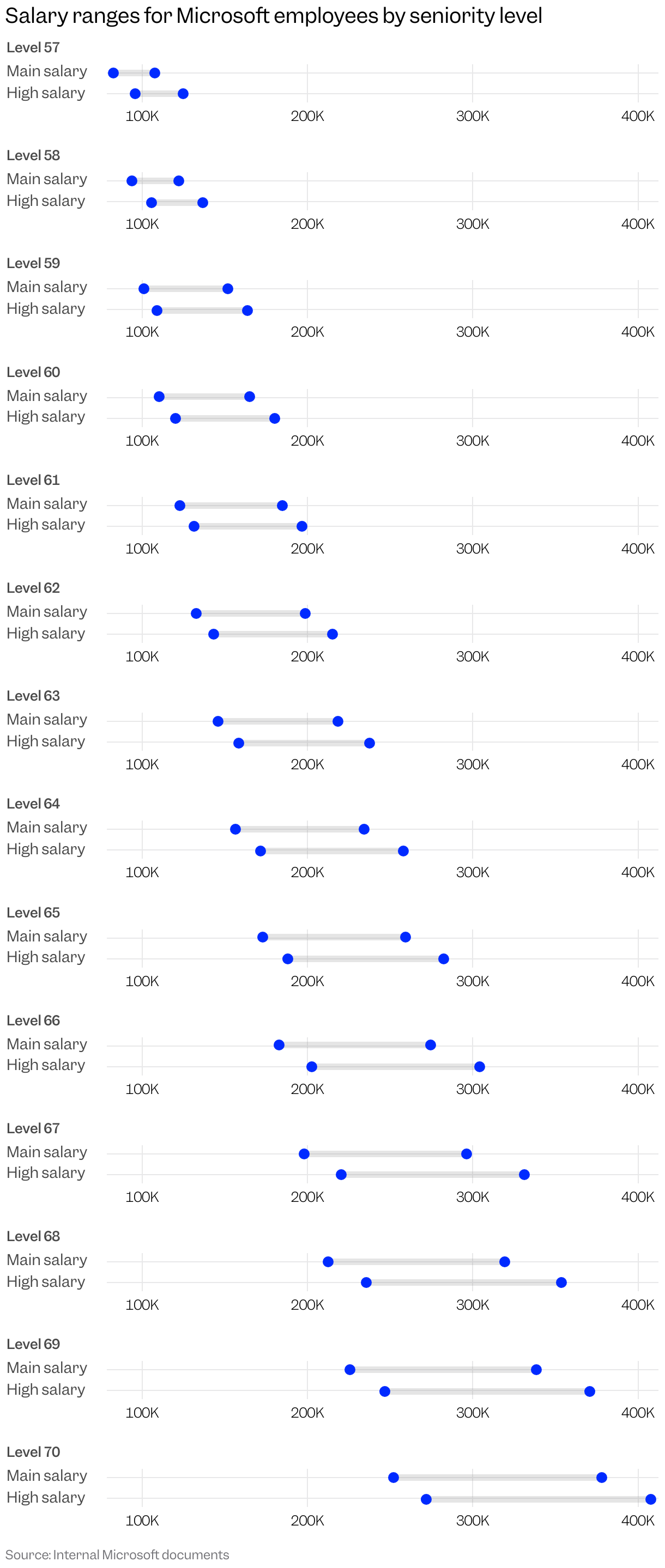
Microsoft has a level system to denote seniority. Levels 57 to 59 are generally considered entry-level engineers, while senior engineers begin at level 63, and principal-level engineers begin at level 65. The higher levels are more rare. Partners start at level 68 while distinguished engineers are at level 70.
According to the documents, Level 70 candidates can earn a yearly salary of as much as $408,000, depending on location. Their compensation would also include a one-time stock award upon hiring of as much as $1.9 million and could include an additional signing bonus, though a range isn’t specified. Their future compensation would include an annual stock award worth as much as $1,476,000, according to the documents.
Microsoft has different salary ranges for different locations. For example, there’s a “main” pay range for workers at the company’s Redmond, Washington, headquarters, along with a “high” pay range for workers in higher cost-of-living areas such as San Francisco. Most of Microsoft’s hiring happens in these locations, according to a person familiar with the hiring process.
The packages outlined in these documents include ranges for salaries, on-hire stock awards, signing bonuses, annual stock awards, and percentages for annual bonuses based on levels. Microsoft declined to comment.
Level 57
- “High” salary range: $95,800 to $124,600
- “Main” salary range: $83,000 to $108,000
- On-hire stock award: $5,000 to $13,000
- Annual stock award: “By career stage”
- Signing bonus: $0 to $9,000
- Annual bonus: “NA”
Level 58
- “Main” salary range: $94,100 to 122,300
- “High” salary range: $105,900 to $137,700
- On-hire stock award: $6,000 to $20,000
- Annual stock award: “By career stage”
- Signing bonus: $0 to $18,000
- Annual bonus: 0 to 20%
Level 59
- “Main” salary range: $101,400 to $152,000
- “High” salary range: $109,000 to $163,600
- On-hire stock award: $15,000 to $120,000
- Annual stock award: $0 to $20,000
- Signing bonus: $0 to $18,000
- Annual bonus: 0 to 20%
Level 60
- “Main” salary range: $110,200 to $165,200
- “High” salary range: $120,200 to $180,400
- On-hire stock award: $20,000 to $130,000
- Annual stock award: $0 to $24,000
- Signing bonus: $0 to $27,000
- Annual bonus: 0 to 20%
Level 61
- “Main” salary range: $123,200 to $184,800
- “High” salary range: $131,400 to $197,000
- On-hire stock award: $30,000 to $150,000
- Annual stock award: $0 to $36,000
- Signing bonus: $0 to $36,000
- Annual bonus: 0 to 20%
Level 62
- “Main” salary range: $132,600 to $199,000
- “High” salary range: $143,600 to $215,400
- On-hire stock award: $40,000 to $170,000
- Annual stock award: $0 to $44,000
- Signing bonus: $0 to $45,000
- Annual bonus: 0 to 20%
Level 63
- “Main” salary range: $145,000 to $218,400
- “High” salary range: $158,400 to $237,600
- On-hire stock award: $55,000 to $220,000
- Annual stock award: $0 to $64,000
- Signing bonus: $0 to $45,000
- Annual bonus: 0 to 30%
Level 64
- “Main” salary range: $156,500 to $234,700
- “High” salary range: $172,000 to $258,000
- On-hire stock award: $70,000 to $270,000
- Annual stock award: $0 to $80,000
- Signing bonus: $0 to $54,000
- Annual bonus: 0 to 30%
Level 65
- “Main” salary range: $172,800 to $259,200
- “High” salary range: $188,000 to $282,000
- On-hire stock award: $100,000 to $320,000
- Annual stock award: $0 to $130,000
- Signing bonus: $0 to $90,000
- Annual bonus: 0 to 40%
Level 66
- “Main” salary range: $183,200 to 274,800
- “High” salary range: $202,800 to $304,200
- On-hire stock award: $180,000 to $640,000
- Annual stock award: $0 to $200,000
- Signing bonus: $0 to $126,000
- Annual bonus: 0 to 40%
Level 67
- “Main” salary range: $197,800 to $296,400
- “High” salary range: $220,800 to $331,200
- On-hire stock award: $380,000 to $850,000
- Annual stock award: $0 to $420,000
- Signing bonus: $0 to $180,000
- Annual bonus: 0 to 60%
Level 68
- “Main” salary range: $212,800 to $319,200
- “High” salary range: $236,000 to $354,000
- On-hire stock award: $500,000 to $1,150,000
- Annual stock award: $0 to $754,000
- Signing bonus: Not listed
- Annual bonus: 0 to 90%
Level 69
- “Main” salary range: $225,600 to $338,400
- “High” salary range: $247,000 to $370,800
- On-hire stock award: $657,000 to $1.35 million
- Annual stock award: $0 to $1,150,000
- Signing bonus: Not listed
- Annual bonus: 0 to 90%
Level 70
- “Main” salary range: $252,000 to $378,000
- “High” salary range: $272,000 to $408,000
- On-hire stock award: $827,001 to $1.9 million
- Annual stock award: $0 to $1,476,000
- Signing bonus: Not listed
- Annual bonus: 0 to 90%
Have a tip? Contact this reporter via email at astewart@businessinsider.com or Signal at +1-425-344-8242. Use a personal email address and a nonwork device; here’s our guide to sharing information securely.
Read the original article on Business Insider