Categories
Selected Articles

Internal Microsoft pay guidelines reveal salary, hiring bonus, and stock award ranges by level

Satya Nadella presenting onstage with the Microsoft logo behind him.
Microsoft CEO Satya Nadella

  • Microsoft’s internal pay guidelines show how much the company generally offers new hires.
  • The documents include pay ranges for engineers and researchers in the US.
  • There’s a carve-out allowing recruiters to get approval for higher offers in competitive cases.

Microsoft pay guidelines obtained by Business Insider reveal how much the software giant generally will pay technical talent, shedding light on an opaque hiring process.

The documents, last updated in May, do come with a carve-out: In competitive situations, recruiters can seek approval for higher offers for exceptional candidates.

That’s a key caveat considering big tech companies are in an all-out battle for AI talent, with some offering staggering pay packages to engineers and researchers. OpenAI CEO Sam Altman said Meta is offering engineers $100 million signing bonuses. Meta also reportedly poached a former top Apple AI engineer with a pay package worth more than $200 million.

Microsoft has a level system to denote seniority. Levels 57 to 59 are generally considered entry-level engineers, while senior engineers begin at level 63, and principal-level engineers begin at level 65. The higher levels are more rare. Partners start at level 68 while distinguished engineers are at level 70.

According to the documents, Level 70 candidates can earn a yearly salary of as much as $408,000, depending on location. Their compensation would also include a one-time stock award upon hiring of as much as $1.9 million and could include an additional signing bonus, though a range isn’t specified. Their future compensation would include an annual stock award worth as much as $1,476,000, according to the documents.

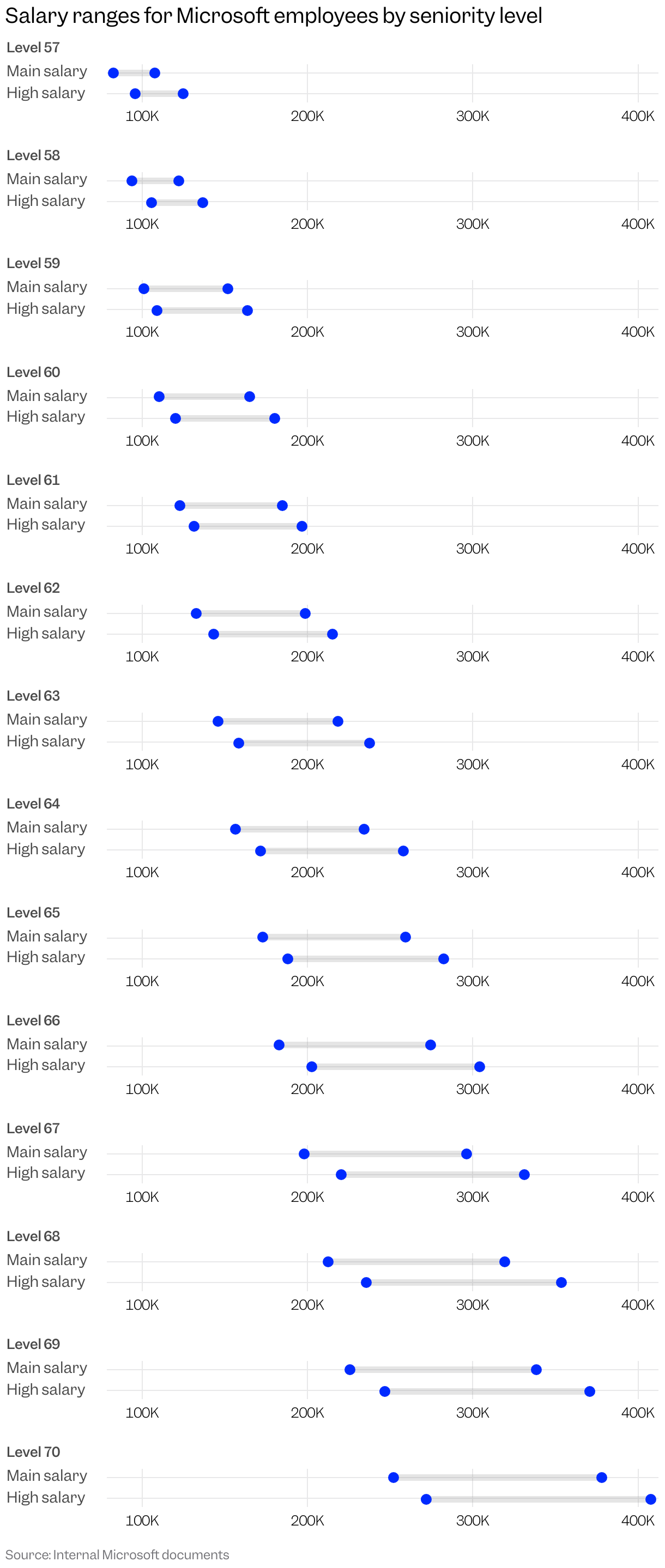
Microsoft has different salary ranges for different locations. For example, there’s a “main” pay range for workers at the company’s Redmond, Washington, headquarters, along with a “high” pay range for workers in higher cost-of-living areas such as San Francisco. Most of Microsoft’s hiring happens in these locations, according to a person familiar with the hiring process.

The packages outlined in these documents include ranges for salaries, on-hire stock awards, signing bonuses, annual stock awards, and percentages for annual bonuses based on levels. Microsoft declined to comment.

Level 57

  • “High” salary range: $95,800 to $124,600
  • “Main” salary range: $83,000 to $108,000
  • On-hire stock award: $5,000 to $13,000
  • Annual stock award: “By career stage”
  • Signing bonus: $0 to $9,000
  • Annual bonus: “NA”

Level 58

  • “Main” salary range: $94,100 to 122,300
  • “High” salary range: $105,900 to $137,700
  • On-hire stock award: $6,000 to $20,000
  • Annual stock award: “By career stage”
  • Signing bonus: $0 to $18,000
  • Annual bonus: 0 to 20%

Level 59

  • “Main” salary range: $101,400 to $152,000
  • “High” salary range: $109,000 to $163,600
  • On-hire stock award: $15,000 to $120,000
  • Annual stock award: $0 to $20,000
  • Signing bonus: $0 to $18,000
  • Annual bonus: 0 to 20%

Level 60

  • “Main” salary range: $110,200 to $165,200
  • “High” salary range: $120,200 to $180,400
  • On-hire stock award: $20,000 to $130,000
  • Annual stock award: $0 to $24,000
  • Signing bonus: $0 to $27,000
  • Annual bonus: 0 to 20%

Level 61

  • “Main” salary range: $123,200 to $184,800
  • “High” salary range: $131,400 to $197,000
  • On-hire stock award: $30,000 to $150,000
  • Annual stock award: $0 to $36,000
  • Signing bonus: $0 to $36,000
  • Annual bonus: 0 to 20%

Level 62

  • “Main” salary range: $132,600 to $199,000
  • “High” salary range: $143,600 to $215,400
  • On-hire stock award: $40,000 to $170,000
  • Annual stock award: $0 to $44,000
  • Signing bonus: $0 to $45,000
  • Annual bonus: 0 to 20%

Level 63

  • “Main” salary range: $145,000 to $218,400
  • “High” salary range: $158,400 to $237,600
  • On-hire stock award: $55,000 to $220,000
  • Annual stock award: $0 to $64,000
  • Signing bonus: $0 to $45,000
  • Annual bonus: 0 to 30%

Level 64

  • “Main” salary range: $156,500 to $234,700
  • “High” salary range: $172,000 to $258,000
  • On-hire stock award: $70,000 to $270,000
  • Annual stock award: $0 to $80,000
  • Signing bonus: $0 to $54,000
  • Annual bonus: 0 to 30%

Level 65

  • “Main” salary range: $172,800 to $259,200
  • “High” salary range: $188,000 to $282,000
  • On-hire stock award: $100,000 to $320,000
  • Annual stock award: $0 to $130,000
  • Signing bonus: $0 to $90,000
  • Annual bonus: 0 to 40%

Level 66

  • “Main” salary range: $183,200 to 274,800
  • “High” salary range: $202,800 to $304,200
  • On-hire stock award: $180,000 to $640,000
  • Annual stock award: $0 to $200,000
  • Signing bonus: $0 to $126,000
  • Annual bonus: 0 to 40%

Level 67

  • “Main” salary range: $197,800 to $296,400
  • “High” salary range: $220,800 to $331,200
  • On-hire stock award: $380,000 to $850,000
  • Annual stock award: $0 to $420,000
  • Signing bonus: $0 to $180,000
  • Annual bonus: 0 to 60%

Level 68

  • “Main” salary range: $212,800 to $319,200
  • “High” salary range: $236,000 to $354,000
  • On-hire stock award: $500,000 to $1,150,000
  • Annual stock award: $0 to $754,000
  • Signing bonus: Not listed
  • Annual bonus: 0 to 90%

Level 69

  • “Main” salary range: $225,600 to $338,400
  • “High” salary range: $247,000 to $370,800
  • On-hire stock award: $657,000 to $1.35 million
  • Annual stock award: $0 to $1,150,000
  • Signing bonus: Not listed
  • Annual bonus: 0 to 90%

Level 70

  • “Main” salary range: $252,000 to $378,000
  • “High” salary range: $272,000 to $408,000
  • On-hire stock award: $827,001 to $1.9 million
  • Annual stock award: $0 to $1,476,000
  • Signing bonus: Not listed
  • Annual bonus: 0 to 90%

Have a tip? Contact this reporter via email at astewart@businessinsider.com or Signal at +1-425-344-8242. Use a personal email address and a nonwork device; here’s our guide to sharing information securely.

Read the original article on Business Insider
Categories
Selected Articles

What’s the Cause of the Gaza Crisis—Hamas’ Tyranny or Israel’s Blockade? Newsweek Contributors Debate

Who is responsible for mass starvation in Gaza? Has Israel broken international law?
Categories
Selected Articles

Sunscreen Boss Slams FDA Recall for Putting Him ‘Out of Business’

The CEO said that the FDA’s regulation of sunscreen, particularly for organic products, was “impossible” to meet.
Categories
Selected Articles

Thailand and Cambodia reaffirm ceasefire after China-brokered meeting in Shanghai

Thailand and Cambodia reaffirm ceasefire after China-brokered meeting in Shanghai [deltaMinutes] mins ago Now
Categories
Selected Articles

Trump’s onetime friendship with Jeffrey Epstein is well-known — and also documented in records

Trump’s onetime friendship with Jeffrey Epstein is well-known — and also documented in records [deltaMinutes] mins ago Now
Categories
Selected Articles

Trump says Epstein ‘stole’ young female staff from his Mar-a-Lago resort

Trump says pair fell out because Epstein poached staffers including the late Virginia Giuffre, who accused the disgraced financer of sexual abuse.
Categories
Selected Articles

EU–Kazakhstan Relations: Strategic Cooperation Amid Geopolitical Shifts

In a recent podcast discussion, EU Ambassador to Kazakhstan Aleška Simkić and Kazakhstan’s Ambassador to the EU and NATO, Roman Vassilenko, discussed the evolving relationship between the European Union and Kazakhstan and broader Central Asia. Their exchange offered insight into the shared strategic interests driving EU–Kazakhstan cooperation across trade, energy, critical raw materials, connectivity, and mobility.

Trade and Investment: A Stable Foundation
Trade and investment continue to underpin the relationship; the European Union remains Kazakhstan’s largest trading partner and top foreign investor. Bilateral trade reached $49.7 billion in 2024, with the majority comprising energy exports from Kazakhstan, highlighting its role as a key supplier to European markets. The EU collectively accounts for a significant share of Kazakhstan’s FDI, equal to €54.8 billion in 2022, representing approximately 50–55% of Kazakhstan’s total FDI.

The Enhanced Partnership and Cooperation Agreement (EPCA), in effect since 2020, underpins the EU–Kazakhstan bilateral relationship, providing a legal framework for cooperation across 29 sectors. As noted by both ambassadors, it enables structured dialogue on trade, energy, governance, and sustainability. While political engagement has increased, both sides acknowledge that deeper implementation is needed to fully leverage the EPCA in line with the EU’s broader strategy for Central Asia.

Roman Vassilenko acknowledged the recent momentum: “I think the relationship between Kazakhstan and the EU has strengthened tremendously over the past three and a half years. With a relatively new Commission in place in Brussels, and with the President of Kazakhstan committed to strengthening ties with the European Union as part of our balanced and pragmatic foreign policy, we are at a moment where we can truly advance, deepen, and strengthen our relations in many ways.”

Energy and Raw Materials: Strategic Realignment
While energy has long anchored EU–Kazakhstan ties, both ambassadors emphasized a shift toward broader, forward-looking cooperation. Ambassador Vassilenko identified critical raw materials and green hydrogen as emerging areas of strategic importance, offering Kazakhstan opportunities to diversify its economy while supporting the EU’s green transition.

Kazakhstan, with its mineral wealth and renewable energy potential, is well-positioned to contribute to Europe’s supply chain resilience in clean technologies. Though not discussed in the interview, the EPCA framework continues to guide bilateral cooperation in these areas. At the 20th EU–Central Asia Ministerial Meeting held in Ashgabat in March 2025, the EU and Central Asian countries — including Kazakhstan — reaffirmed their shared commitment to deepening cooperation in areas such as trade, transport/connectivity, energy, climate, digitalization, and critical raw materials. A joint communiqué, based on the 2023 ‘Joint Roadmap’, called for structured long‑term engagement.

Both envoys stressed the importance of moving from basic resource exports toward long-term industrial partnerships — including local processing, infrastructure development, and regulatory alignment — as a means of ensuring mutual benefit.

Connectivity: The Middle Corridor and Infrastructure Links
Connectivity also features prominently. The Trans-Caspian International Transport Route, or “Middle Corridor,” is increasingly viewed as a viable overland route connecting China to Europe via Kazakhstan. Cargo volumes have risen, and both the EU and regional stakeholders are investing in capacity upgrades. The EU’s Global Gateway strategy includes a €12 billion commitment to infrastructure in Central Asia, covering transport, energy, and digital initiatives.

Connectivity was identified by both ambassadors as a strategic priority, with Vassilenko emphasizing the growing importance of the Middle Corridor and describing it as a key area for advancing regional integration and EU-Kazakhstan cooperation. Indeed, the EU–Kazakhstan collaboration now includes a dedicated Coordination Platform for the corridor’s development, aimed at strengthening transport links and infrastructure across the region.

As the ambassadors stressed, connectivity is not just logistical — it’s geopolitical. The Middle Corridor is becoming a central pillar of Kazakhstan’s role as a bridge between Asia and Europe.

Mobility: Negotiating Easier Access

Mobility remains a point of interest, particularly in light of Kazakhstan’s efforts toward visa facilitation with the EU. Negotiations are expected to begin in the fall of 2025, though outcomes will depend on alignment with EU visa policies and migration standards. Both ambassadors described greater people-to-people contact as a long-term investment in bilateral relations.

Strategic Context and Outlook

The EU’s broader engagement with Central Asia has gained urgency amid geopolitical tensions and supply chain disruptions. At the 20th EU‑Central Asia Ministerial Meeting, as reported by The Times of Central Asia, a joint communiqué explicitly emphasized a willingness to build a more structured and comprehensive partnership ahead of the inaugural EU–Central Asia Summit in Samarkand.

As EU Ambassador Aleška Simkić noted in the recent dialogue: “We must continue to engage with geopolitics constructively. Both the EU and Kazakhstan share a commitment to the UN Charter and a peace-oriented agenda. I also see potential in regional integration. While the EU has its internal challenges, Central Asia is moving closer together. Kazakhstan plays a key role in that. Continued progress in regional cooperation offers significant opportunities.”

However, challenges remain. EU investment, while increasing, is still competing with a substantial Chinese and Russian economic presence. Additionally, practical barriers — ranging from infrastructure bottlenecks to regulatory fragmentation — could slow progress.

Nonetheless, there is cautious optimism. As the EU seeks to diversify its supply chains and develop more resilient partnerships, Kazakhstan has positioned itself as a relevant player. Whether that translates into durable, balanced cooperation will depend on sustained policy alignment, transparency, and mutual accountability.

Categories
Selected Articles

Moment 8.8-magnitude earthquake hit Russia

Moment 8.8-magnitude earthquake hit Russia [deltaMinutes] mins ago Now
Categories
Selected Articles

Luis Diaz completes €75 million move to Bayern Munich from Liverpool

The Colombia international arrived at Anfield from Porto in 2022.
Categories
Selected Articles

Woman Captures Moment ‘Exceptionally Rare’ Phenomenon Shoots Through Sky

Social media users were blown away by the scene in the viral clip, with one saying: “the odds of catching this must be astronomical.”