Categories
Selected Articles

We bought our dream home in Colorado, but wildfires and home insurance trends had us selling 1.5 years later

A woman sanding outside in the snow with a coat and hat
Emily Moore in Colorado wildfire country.

  • We bought our dream mountain home just outside of Boulder, Colorado.
  • It had stunning views from roof-height front windows and nearby hiking trails that our dog loved.
  • We knew the risk of wildfires when we bought, but the scope of mitigation was larger than we thought.

When I first set foot inside, I knew it was special.

My partner and I had been living in a 1,150-square-foot home in Boulder, Colorado, enjoying a 2.75% interest rate, but we were feeling cramped.

We both worked from home and shared a tiny desk in our spare bedroom and a full-sized desk in our dining space. Dinner parties required creative planning, and we had no garage or basement for storage.

Then, one day, our realtor excitedly called us up. A house that checked nearly all of our boxes was just about to hit the market. She asked if we could come see it right away.

The neighborhood was comprised of sprawling land plots and spacious homes tucked into an impressive foothill, with a winding road connecting them. Our future house was at the very top.

As I stepped inside, I could see Boulder’s grasslands reach out toward the horizon through roof-height front windows. Take just a few steps into the backyard, and the craggy peaks of the Rocky Mountains poked into the sky.

shot of colorado horizon from inside house
Moore’s living room view in her dream Colorado mountain home.

It was true mountain living, but only a 10-minute drive to Boulder’s city limits. To us, it offered the best of both worlds: access to the community we loved, while gaining plenty of space to work remotely and feel connected with nature.

There was one major downside, though.

We’d have to factor wildfire risk into our day-to-day lives

Worsening drought conditions accelerated by climate change were leading to destructive, difficult-to-predict wildfires in the Western states, including Colorado’s Front Range.

Our realtor connected us with her friend, a retired fire department chief, and we walked the property together.

backyard of mountain home in colorado with trees everywhere
Moore’s dog in their backyard surrounded by trees.

He pointed out the changes we would likely need to make: updating the roof with fire-resistant shingles, adding a gravel barrier, taking down trees, and keeping wild grasses trimmed.

He said to start by contacting a local nonprofit, Wildfire Partners, that assesses wildfire risks for homeowners.

So, after closing on our dreamy mountain home in the winter of 2022, we scheduled our assessment. Since Wildfire Partners would not come until spring, and our yard was blanketed in a protective layer of snow, we shelved our concerns for the first few months.

We faced a steep learning curve

We assembled mood boards on Canva, scoured vintage rug resellers, and shopped for the perfect leather couch to complete our dream living room.

Our houseplants thrived, and our sweet dog fell in love with the trails that started outside our front door.

woman with black dog on hiking trail
Moore with their dog on a trail just outside their front door.

As the springtime rolled in, we watched the evening thunderstorms roll over the plains. Some mornings, we even woke up above the clouds.

mountains in the clouds
Sometimes Moore would wake up to clouds outside their home.

Mountain living wasn’t all rainbows, though. Upon moving in, we had a long list of tasks to complete. We needed to install a radon fan. Our well required treatment for T. coli (total coliform) contamination. Getting contractors to come out was a monumental task.

We also discovered that many of the seller’s renovations were hastily slapped together. We wondered what other corners he might have cut, and how much of our planned wildfire mitigation budget would have to go toward these unexpected fixes.

The scope of wildfire mitigation was larger than we expected

giant rainbow in colorado skies
Moore enjoyed beautiful rainbows during the spring.

When the Wildfire Partners representative came out that spring, he tagged over 30 trees that we would need to cut down. His 17-page assessment also involved trimming ladder fuels and fireproofing our house’s exterior.

If and when we completed our wildfire mitigation checklist, Wildfire Partners would come back, verify the work, and issue a certification. They would also match up to $2,000 of arborist-related costs, but the rest would be on us to fund. The proposed scope of work would cost upwards of $50,000, or several thousand less if you were able to DIY some projects.

Our assessor assured us that most people take years to complete their checklists due to the time, money, and effort required. My partner and I debated our plan of approach and decided we would sleep better at night knowing we had taken all the necessary steps to protect our home.

A grassland fire put us on edge

woman with dog in colorado wilderness
Moore with their dog in their backyard with beautiful mountain views.

That first (and only) summer in our dream home, we spent weekends working toward our certification. We felled dozens of trees, stacked logs, and gave them away. Friends pitched in, and a kind neighbor lent us chainsaws.

We trimmed the wild grasses that covered our hillside. We installed a gravel barrier around the house to reduce the likelihood of a stray ember landing and catching flame. We interviewed contractors for more complex projects, like installing roofing and ledge flashing.

It was hard work, but it was rewarding. Before we knew it, we were only a few list items away from earning our certification and feeling accomplished.

differnet colors and sizes of gravel
The rocks that Moore and her husband chose for their gravel barrier, which added defensible space around their home.

Then, one afternoon, a small wildfire broke out at the bottom of the neighborhood hill.

A neighbor told us that someone operating a weedwhacker had nicked a rock, and the resulting sparks had started a brush fire. I watched smoke curl over the ridge, and refreshed my neighborhood message board, anxiously waiting to find out if we needed to evacuate.

Fortunately, the firefighters acted swiftly, and the winds were not blowing that day, but this fire event brought back a devastating memory from just a few years prior.

On December 30, 2021, a grass fire in Boulder County transformed into a suburban firestorm, fanned by wind gusts of over 100 miles per hour. In a matter of hours, the Marshall Fire had claimed two lives and over 1,000 homes. People had minutes to evacuate. My partner and I read stories of neighbors knocking on doors to ensure no one was left behind, since there was no statewide alert system.

Wildfires are not only frightening because they are destructive. They are also infamously unpredictable. Just one ember—deposited by the wind onto a combustible ledge—could be the difference between avoiding disaster and losing your home.

sunset in colorado mountains in winter with snow all around
A stunning sunset view from Moore’s backyard.

That’s why our friends at Wildfire Partners were so stringent about handing out certifications. Details that could appear insignificant, such as decking gaps or the type of mesh covering your vents, actually make a big difference. There was also hope—but not a promise—that the mitigations would help keep homes like ours insured.

Insurance trends made us question our purchase

In 2024, the insurance landscape began to change. We heard through the neighborhood grapevine that a neighbor’s insurer had dropped them.

A friend in another part of the state also lost her coverage. Finally, we read that State Farm, our insurer, would no longer issue new home policies in California. Could Colorado be next?

It occurred to us that our safety net, which we paid thousands of dollars annually to secure, might not be there for us when we needed it.

woman in colorado wilderness in winter
Moore on a hike with their dog.

We started wondering what would happen if we lost everything. Would our insurer provide us enough to rebuild in place? Would we even want to? And in the absolute worst-case scenario possible—if a fire broke out, would a neighbor rescue our dog if we were unable to get to her?

Over beers, the same neighbors who lent us yard tools recounted tales of their most recent evacuation. The 2020 CalWood Fire had burned over 10,000 acres. On their wall hung a framed photo of the blaze, which had ripped through the foothills just across the canyon and leveled 26 structures.

I was in awe of their casual attitude, but they revealed important truths. We cannot control nature, no matter how many preventative checklists we complete. Also, we are far from experiencing the worst impacts of climate change, especially as our government takes steps to halt climate action.

Committing to life in a wildland-urban interface would require acceptance and a come-what-may point of view on the matter of wildfires, which we weren’t sure we were up for.

We sold in 2024

wild turkey in colorado
A wild turkey in Moore’s yard.

Our life on the mountain was far from perfect, but it had become our home.

We looked forward to the wild irises and larkspurs blooming. We even felt fond of the wild band of turkeys that sometimes woke us up at 6 in the morning. Could we really leave it all behind?

Despite everything, we were not resting easily. No matter how much we enjoyed it in the present, we feared our dream home could not be insured or sold in the future. This is not a dealbreaker for our neighbors, who plan to spend the rest of their lives in this special place—come what may. It doesn’t matter because they are in their forever homes.

As it turned out, we were not in ours.

Our trusty realtor listed our dream home in the spring, and by summer, it closed. Although we came out in the red, we exhaled a massive sigh of relief. A few days after closing, a wildfire broke out in South Boulder, and I told that familiar pang of fear to take a hike.

For those willing to accept the risk, our former mountain home is a magical place to live. We just weren’t those people.
Read the original article on Business Insider
Categories
Selected Articles

European economy sees growth of only 0.1% as scramble to get ahead of US tariffs goes into reverse

European economy sees growth of only 0.1% as scramble to get ahead of US tariffs goes into reverse [deltaMinutes] mins ago Now
Categories
Selected Articles

Is this TV’s endgame? A discussion with analyst Rich Greenfield.

Robert Whittaker and Reinier de Ridder compete at the UFC Fight Night event at Etihad Arena in Abu Dhabi on July 26, 2025.
UFC fighters Robert Whittaker and Reinier de Ridder square off at an event Abu Dhabi. Analyst Rich Greenfield predicts David Ellison, who is about to buy Paramount, will bid for UFC rights.

  • The TV business has been contracting for years, which is why media companies are trying to sell off their cable networks.
  • But David and Larry Ellison think there’s long-term value in Paramount and its TV business, says analyst Rich Greenfield.
  • Greenfield also weighs in on new streaming launches from ESPN and Fox.

The TV business is not slowing down this summer: Any day now, David and Larry Ellison will finally buy Paramount, with its collection of once-storied TV networks like CBS and MTV. A few weeks later, ESPN and Fox — the last two big TV players that haven’t launched their own streamers — will launch their own streamers.

But on the other hand, the TV business has been slowing down for a decade: Every quarter, more cable TV subscribers cut the cord, or never sign up for a cord in the first place. The people who own cable TV networks don’t seem to have any plan to deal with the issue, other than trying to sell their cable TV networks.

Lightshed analyst Rich Greenfield has been chronicling the industry’s massive, internet-driven change for years. I caught up with him on my Channels podcast to talk through the particular challenges — and perhaps some opportunities — facing TV right now. Here’s an edited excerpt of our chat.

Peter Kafka: When the music business collapsed back in the Napster era, it happened basically overnight. But TV has hung on for much longer, even though consumer behavior changed pretty significantly over the last decade.

Is there something specific about the TV industry that’s allowed these guys to move in slow motion?

Rich Greenfield: There’s very few businesses where you can raise the price on a product that consumers are using less and less every day.

The brilliance of the cable TV business model was the big fat bundle. It’s a pretty incredible business to put all of these channels together, even if people don’t want most of them.

It had everything you wanted and no alternatives, which is very different than where we are today.

One of my soapboxes is when I hear people saying they wish we could go back to the cable days. And I keep saying, that was terrible. You guys forget. Everyone hated that.

I think consumers are pretty adept at managing their services, and I don’t hear a lot of complaints. Sometimes it’s like, “Where is this game?” Or “How do I find this thing?” It can be a little confusing.

But think about your cellphone. You’ve had one for quite a while now. Managing the apps and deleting something if you’re not using it and adding something —these are all pretty easy functions.

We don’t give consumers enough credit. They’re pretty adept at figuring out cheaper solutions and ways to manage.

I want to ask you about a few specific companies. The Paramount deal is finally going to close. What do you think the new owners — David Ellison and his father, Larry Ellison — will do once they have control? Will it change overnight, or is this a slow-rolling thing?

It will certainly change.

The juxtaposition is sort of amazing. [Paramount, under current owner Shari Redstone, is a] financially strapped company, with challenged financial ownership.

And you’re moving to an ownership team that is one of the wealthiest families on planet Earth.

David Ellison is probably going to be running this company for 30, 40 years. He obviously has a passion for entertainment. He’s moving to a much bigger stage.

But this is still a financially struggling company. He can’t fix the trends of what consumer behavior is changing. What he can do is invest and really build.

And you saw the “South Park” deal they just cut, where they’re spending hundreds of millions of dollars to move the show [exclusively] to Paramount+. I think it’s a small sign of the post-merger strategy, which is that David Ellison is not just doing this to cut costs and squeeze more juice out of this existing company. His goal is to build something significant with a very long-term perspective, which is going to require a lot of investment.

What does that look like? Is the new Paramount just a film studio and a streaming service and CBS — and Ellison sells off everything that’s not those things?

I think initially they’ll say they need the cash flow from cable and will use that cash flow to reinvest.

I would be shocked if you didn’t see more sports on CBS. I think they will be a contender for UFC rights. You’ve seen David Ellison multiple times in the past year sitting in the front row, cage side with Ari Emanuel [CEO of TKO Group, which owns UFC], and with [UFC CEO] Dana White.

And Donald Trump.

I don’t disagree there on politics. But I also think he likes the content. I think he’s going to spend a lot of money.

He understands the tech North Star — whether we’re talking about TikTok, Meta, Netflix, or Spotify — it’s all about time spent. I think David gets that Paramount+ needs a heck of a lot more time spent. The only way you’re gonna get there is a better product and more content.

Let’s move to Disney. Sometime in the next few weeks, before college football and the NFL starts, ESPN will finally be something you can buy as a stand-alone streaming service. If they rolled this out in 2015, we would have said it’s a really big deal. Is it a big deal in 2025?

At $30 a month, I don’t think this is a huge deal. My guess is it gives them flexibility to start packaging this with other services. They can probably get some subscribers. Not a lot. It’s probably low to mid-single-digit millions. Not millions and millions.

Remember, they’re giving the new service to everybody who already subscribed to [pay TV]. So 65 million-plus ESPN subscribers are going to get this new ESPN app at no additional cost.

So who is the audience for this? You’re not subscribing to the big bundle. You’re a pretty passionate sports fan. You’re willing to spend $30 a month for sports. My guess is it’s just a small number.

It actually makes sense to do it. But I don’t think, at the end of the day, it is a huge needle-mover. What’s going to matter to Disney stock is their theme park business and their cruise ship business. Those being better than expected — because of the state of the economy and what’s happened with tariffs not being as problematic as feared a few months ago — is far more important to Disney than what happens with the ESPN streaming rollout.

We’re also close to the launch of Fox’s own streamer, Fox One. The main assets there are Fox Sports — which is really the NFL — and Fox News. Do you think Fox thinks this is primarily a product for people who want to watch football, or do you think it’s primarily for Fox News fans?

I think this is a pretty limited offering for a sports fan.

So does that lead you to believe that Fox thinks this is really a Fox News product?

I think you’ll see more uptake from Fox News viewers.

In the old days, you would have said that Fox News has a very old audience. And the idea that its audience is going to stream it doesn’t make sense. But maybe that’s not true in 2025?

Streaming’s become pretty normalized. When you look at how many subscribers Netflix now has, I don’t think streaming is some elitist thing. I think it’s pretty normalized.

I think the part you may be missing is that the Fox News audience is also widening out.

And as you make it available to people on streaming, you may pick up some younger people. Maybe it’s more interesting during election years. It creates flexibility. And I don’t think there’s a whole lot of downside.

All the basic cable networks are in freefall. Everyone who owns them is trying to sell them — either directly to another buyer or, in the case of Comcast’s Versant, trying to bundle it up as a publicly traded stock. Who is a buyer for cable networks?

I don’t think there are enough people talking about this topic. So many of the investors I deal with, or even industry executives I talk to, think you’re going to see Paramount do a deal with Warner Bros. Or maybe you’ll see Versant merge with some of the Paramount cable networks.

But let’s just step back. I think David Ellison and Larry Ellison have a much bigger plan than aggregating more linear cable networks. I would be surprised if that was the strategy. I think there’s a much bigger plan that the Ellison family is probably thinking about that goes well beyond just aggregating more legacy media assets.

WarnerMedia merged with Discovery, which hasn’t created value. CBS and Viacom became Paramount, and that hasn’t created value. Disney bought most of Fox’s cable networks, and that hasn’t created value. Putting legacy assets together that are in secular decline doesn’t work. Maybe it might’ve been worse [without those deals].

But that’s not compelling for a buyer.

It’s a reason to be a seller. As a buyer, there’s lots of things you could buy and lots of places you could go. The idea that buying more of these assets so that you have more costs to cut doesn’t seem really compelling.

Another reason you are skeptical about big media consolidation is politics. You think that either antitrust politics, or Donald Trump’s personal politics, make that unlikely. The only media mogul he wasn’t complaining about was Rupert Murdoch, and now he’s suing Murdoch.

Is there a world where anyone sells or buys a meaningful media asset while Donald Trump is president?

I think it’s going to be challenging.

Read the original article on Business Insider
Categories
Selected Articles

Nationwide McDonald’s Boycott Planned For August 1: What to Know

The People’s Union USA is leading the boycott of the fast food giant.
Categories
Selected Articles

Republicans Passed the One Big Beautiful Bill to Secure Our Borders—Here’s What We Must Do Next

There are three key areas in which we still have a long way to go—but the path is clear.
Categories
Selected Articles

Worker Wakes Up on Day Off, Looks at Phone—Can’t Believe What Boss Has Done

“I was really flustered when I woke up,” the poster told Newsweek.
Categories
Selected Articles

What Americans Really Think of Meghan Markle’s Netflix Show Revealed

American attitudes to Meghan Markle’s Netflix cooking show have been captured in polling data as her contract is due to run out.
Categories
Selected Articles

Jain Global by the numbers: A look at the hedge fund’s rollercoaster first year

bobby jain
  • Jain Global, one of the buzziest hedge fund launches, recently wrapped its first year of trading.
  • After a slow start, Jain started gathering momentum in 2025.
  • Business Insider dug into the numbers and charts that explain Jain Global’s first year.

Jain Global launched last July with great fanfare and even greater expectations. It landed with a thud — at first — before gathering momentum toward the end of its first year.

While Jain Global didn’t end up being the largest hedge fund launch ever, as founder Bobby Jain had once envisioned, it nonetheless holds a claim to being the most complex and ambitious.

Jain raised $5.3 billion in commitments from the Abu Dhabi Investment Authority, a sovereign wealth fund, and wealth management platforms from Goldman Sachs and Morgan Stanley, among others. Jain Global didn’t start trading that full amount right away. Instead, it received and put the money to work in stages, the last $700 million arriving in July.

The firm started trading with 215 employees and six overarching investment strategies, as well as a seventh Asia-specific business line that trades in each strategy — an unprecedented and expensive rollout intended to lay the foundation for future growth. In its first year, the firm traded about 50 products — everything from convertible bonds to significant risk transfers, Delta 1 options, and natural gas — across 45 countries.

Fair or not, the heft of Jain’s undertaking immediately thrust it into competition with the world’s largest multistrategy hedge funds, drawing comparisons to Millennium, Citadel, and Exoduspoint, which holds the crown as the largest ever hedge fund launch.

Business Insider dug into more of the numbers and charts that explain Jain Global’s first year. Charts are based on BI conversations with people familiar with the firm as well as public media reports.

A Jain Global spokesman declined to comment.

Jain’s headcount has kept growing

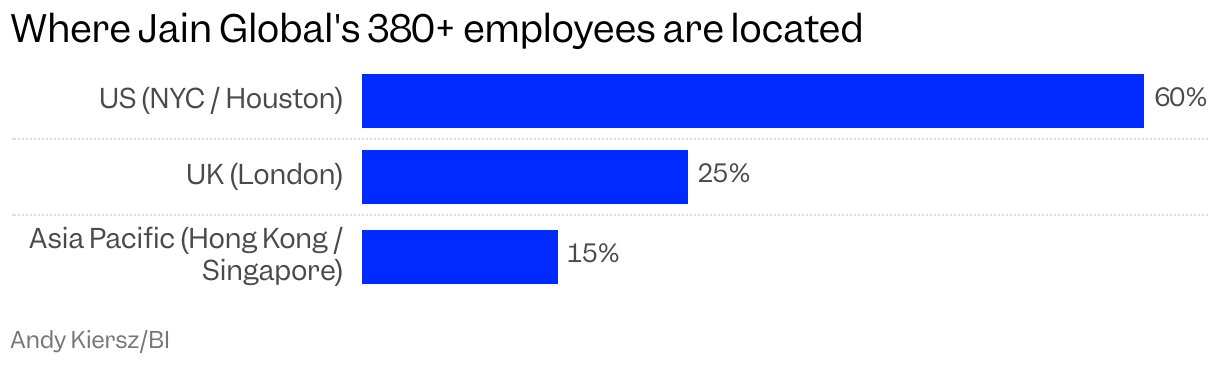
Jain Global’s roster has expanded significantly since launch, growing nearly 80% to more than 380, about half of which are investment professionals, a person close to the firm said. PMs are still joining as their noncompete provisions and garden leaves expire.

One upshot of launching seven businesses at once, according to people familiar with the firm’s strategy, is minimizing technology headaches from bolting on businesses years later.

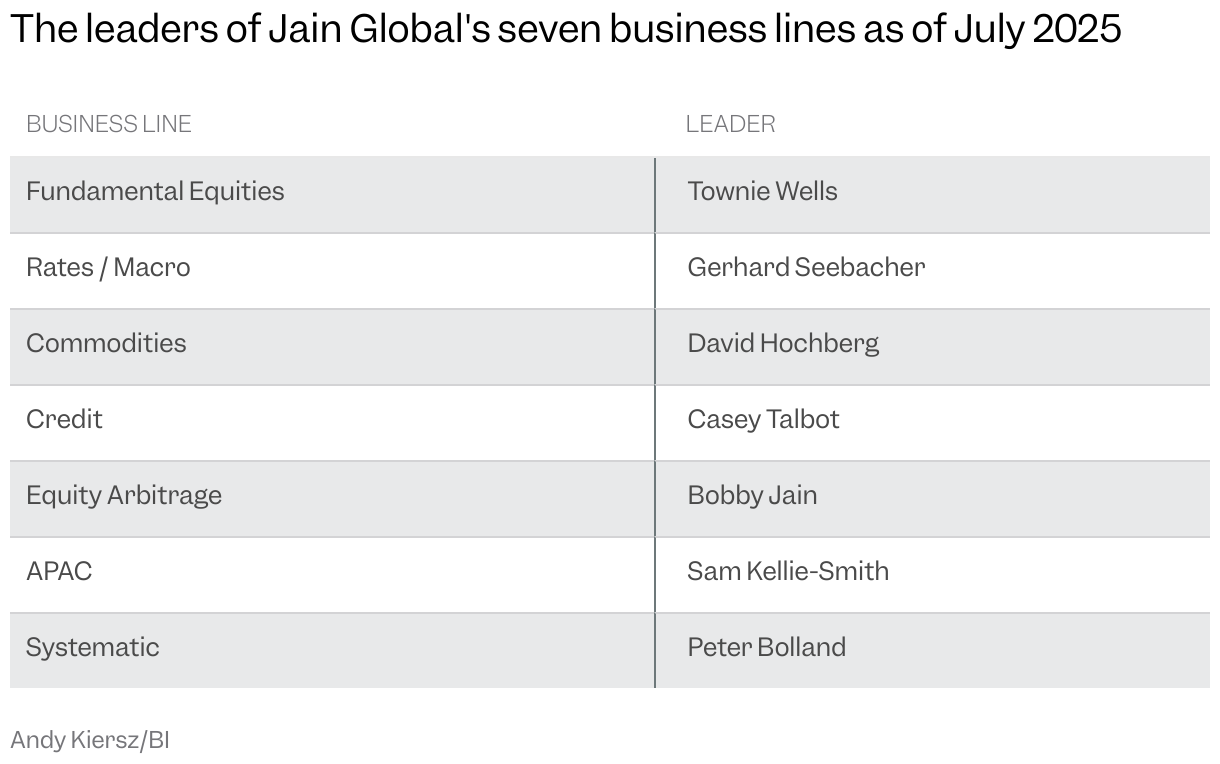
Each of the seven business lines has a dedicated CIO overseeing the operation, apart from equity arbitrage. That business, which includes strategies like index rebalance and volatility trading, is overseen by founder and firm-wide CIO Jain, who spent decades at Millennium and Credit Suisse deeply involved in such trades.

How Jain Global has put money to work

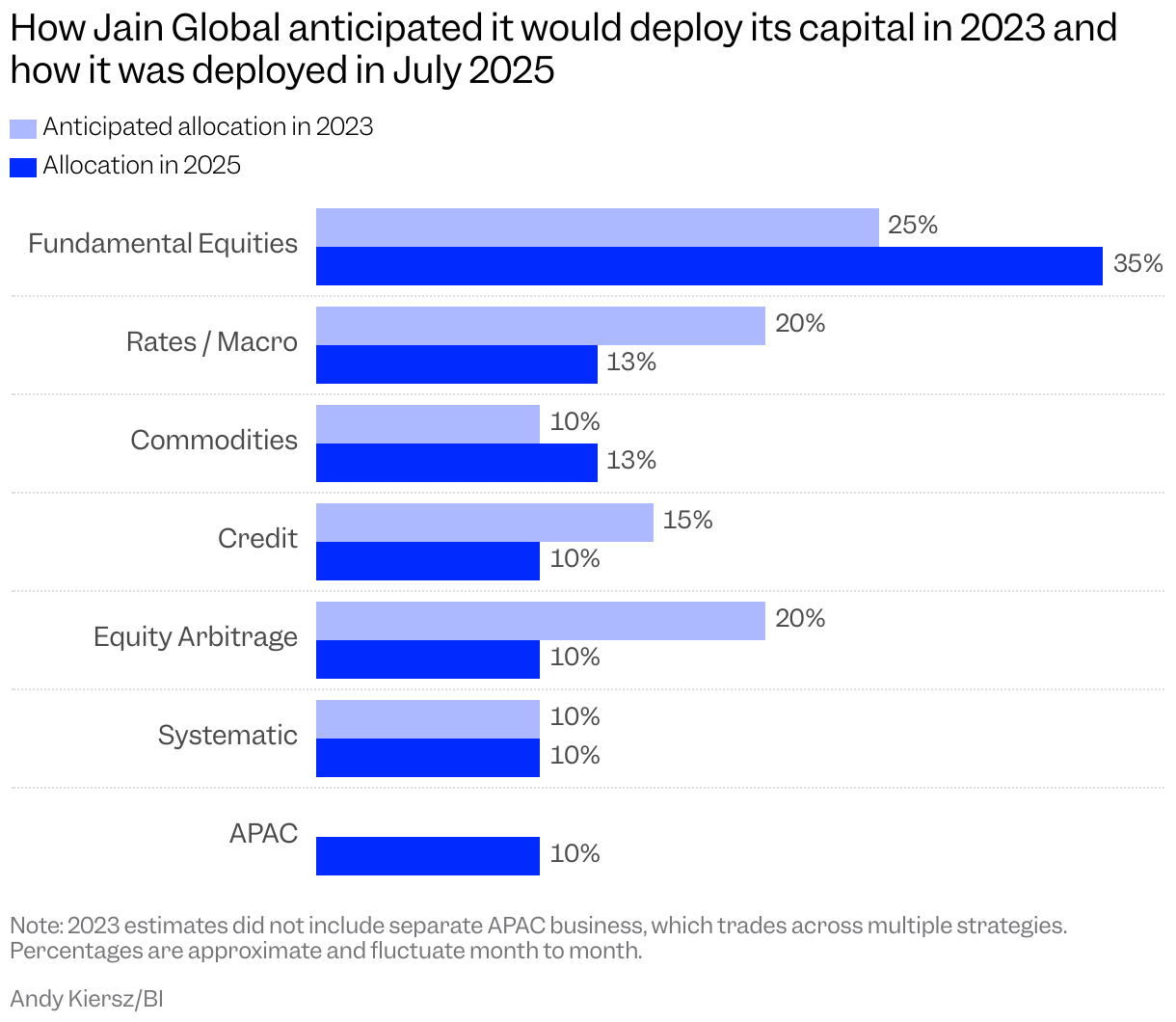
How exactly a fund deploys its capital fluctuates depending on market conditions and personnel, among other factors. When Jain was pitching investors in late 2023, he included details on how he expected to allocate investor capital once at full strength, BI reported at the time.

Here’s how those estimates compare with its capital allocation as it hit the one-year mark (The Asia business wasn’t included in the strategy breakdown early on):

Having received its last tranche of capital this month, the firm expects to have its $5.3 billion fully deployed by year-end, a person familiar with the matter said.

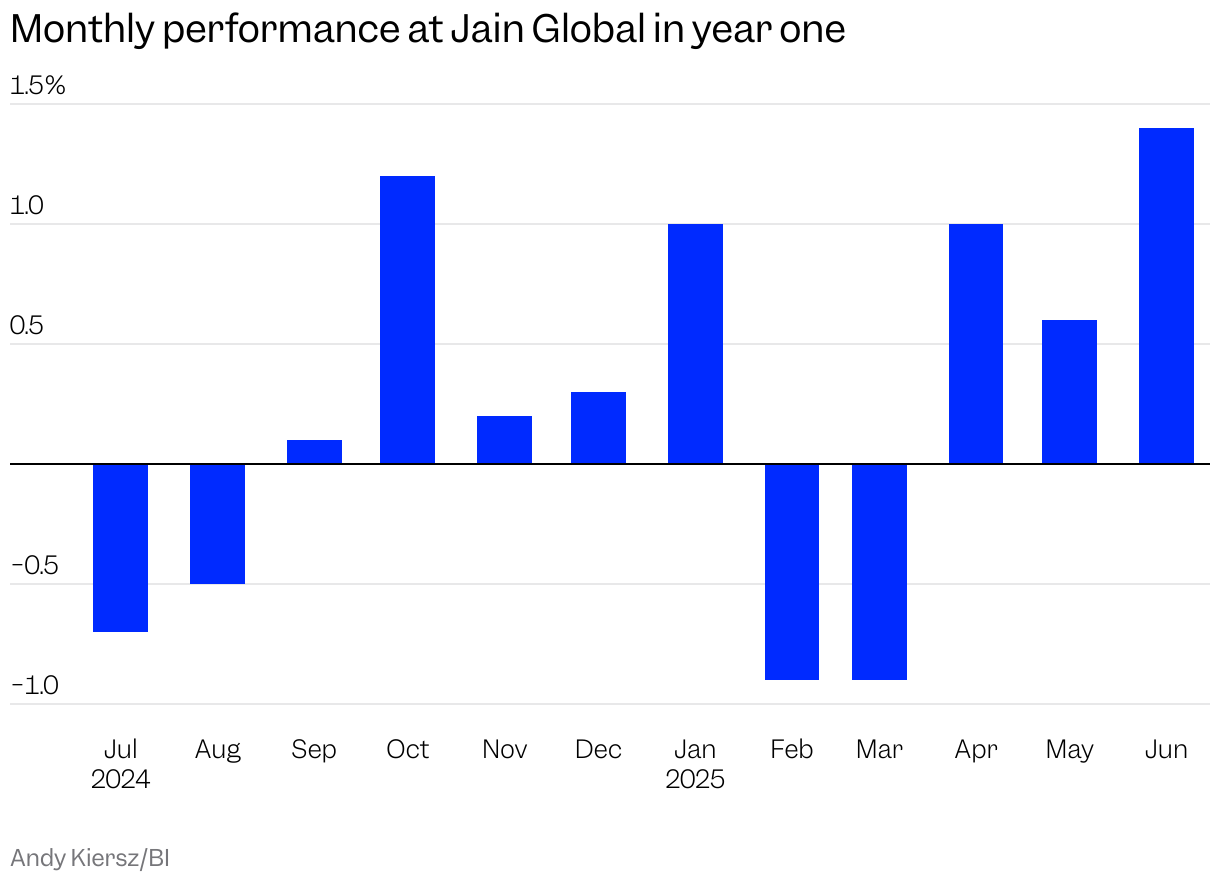
Jain Global got off to an inauspicious start, losing money in its first two months but clawing into the black by the end of 2024, finishing up 0.5%.

But it started to hit its stride in the second quarter of 2025, posting three straight months of gains and ending its first 12 months of trading up 2.7%.

Here’s a breakdown of Jain’s performance in each of the first 12 months:

Investors don’t gush over returns that lag the Treasury yield. But they also don’t sign up for a three-year commitment to a new fund — as Jain’s backers did — without some inherent patience.

“Setting up and effectively competing with the other Multi-Strats, which is already an extremely competitive backdrop, is an uphill battle,” Brian Payne, chief private markets and alternatives strategist at BCA Research, said in an email to BI. “Getting the proper talent, infrastructure, technology, etc. on top of making sure the portfolio is properly balanced and meeting objectives is not one that can be done overnight.”

It’s taken ExodusPoint, which launched with a record $8.5 billion, seven years, including plenty of fits and starts, to begin hitting its stride, BI previously reported.

Jain envisioned a fund that could one day scale to as much as $12 billion. The initial investors get first crack at future Jain Global capital raises, and one telling sign will be who signs up for more and what external investors decide to pile in.

Read the original article on Business Insider
Categories
Selected Articles

Kelley Wolf struggles to enter family home during live stream after Scott Wolf drops restraining order

In an Instagram Live video Tuesday, Kelley filmed herself trying to gain access to the Park City, Utah property with police present.
Categories
Selected Articles

I’m Gen X and job hunting for the first time in 20 years. It’s been a roller coaster, but these 3 things help.

Jennifer McMahon biking at Google's Sunnyvale office
Me at my first visit to Google’s headquarters in Sunnyvale, CA in June 2022.

  • Jennifer McMahon is job hunting for the first time in 20 years.
  • She said more competition and a lengthy interview process have changed the job-search landscape.
  • McMahon said her AI knowledge has helped, along with a job coaching service and networking.

This as-told-to essay is based on a conversation with Jennifer McMahon, a Gen X job seeker based in Connecticut. Her employment history and identification have been verified by Business Insider. This story has been edited for length and clarity.

About five months ago, I was informed that my organization at Google was getting moved to Mexico City.

I felt like the rug was ripped out from under me. I’ve been working in marketing and sales enablement continuously for over 20 years, and it’s been so long that I’ve forgotten the feeling of not working.

The job market has also changed. Gen X was always told, “No bragging, let your work speak for itself.” That’s not the case anymore. You have to put yourself out there now, and it’s uncomfortable and new for me.

The volume of applicants has also increased. I’ll look at a job that was posted 10 minutes ago, and there are already 100 people who have applied. So that’s kind of freaking me out, as I don’t know how I’m going to showcase my value when there are thousands of applicants.

There are also fake jobs being posted out there for phishing purposes. So, I’m often like, “Is this job real?”

The interview process itself has also shifted. I’ve gone through several interviews where I have to build a presentation. I’m like, “Whoa, I’m not a CEO.” I’m not going for the highest-level position here, but it’s still super competitive.

It’s been tough. It’s been a roller coaster. I’m not a job-hopper, and in this process, I’ve realized that I’m a control freak. It’s been challenging to surrender and just trust, but I have to have faith that I’m going to find the right position.

I haven’t landed anything yet, but these three things have helped improve the process.

1. AI knowledge

Having had the opportunity to work at Google has definitely been a blessing for my résumé. I think it makes a difference because of how tech- and AI-forward the company is.

I’ve been trying to look at the job hunt as an opportunity to continue to grow and learn new technologies. ChatGPT has helped me come up with an elevator pitch and I even generated a NotebookLM podcast on myself by putting in my profile and résumé. After listening to the podcast, I was like, “Wow, I am good at this.”

For one interview, I even used AI to build a one-pager prototype concept of what an AI coach would entail. It’s so incredible right now what you can build with AI. I was like, “Hey, I haven’t done this type of training before, but look what AI can help your company do, and here’s the prototype.”

I think I have a little advantage due to my experience with AI, and I think people want to hear that.

2. A job coach

One of the benefits of working with Google is that they’ll help you with the transition for six months if you don’t find a new role internally. I’ve had an incredible benefit from that experience.

The service they provide helped optimize my résumé and provided me with a one-on-one job coach. The company also offers resource hubs and webinars with recruiters so you can ask them questions about what they’re looking for in candidates.

We also have a weekly group meeting where people get together, share stories, and try to uplift each other. It’s sort of like a community of folks in the same situation, and it’s been really helpful.

3. Years of experience

Networking has to be the most important piece right now.

If someone doesn’t come in with that, “Hey, we know Jen, she’s good at what she does,” I don’t think I’m getting that call back. Since the end of June, I’ve applied for about 25 external roles, and I’ve been able to get about seven interviews out of that. I got referrals on all except for one.

After 20 years of industry experience, I’m able to rely on my network to be supportive, helpful, and put in a good word.

Read the original article on Business Insider