
The leaders will meet for wide-ranging discussions on trade and the Middle East as international alarm grows over conditions in Gaza.
Day: July 28, 2025
The cyclist, a man in his late teens, is in Beaumont Hospital in a critical condition.
Two members of the Oklahoma State Board of Education said they saw images of nude women on a TV during a meeting in his office.
“Stats and lists like these can help, but also they’re not the perfect indicator of what state is right for you,” an expert told Newsweek.
Ying Tang/NurPhoto
- The World Artificial Intelligence Conference took place in Shanghai this weekend.
- In a speech, Chinese Premier Li Qiang called for a global organization to coordinate AI safety.
- US President Donald Trump, however, may be an obstacle to that.
At this weekend’s World Artificial Intelligence Conference in Shanghai, boxing robots thrilled the crowd. But the real heavyweight bout is between the US and China over the future of AI.
The theme of the Shanghai conference, which was organized in part by the Chinese government and lasts until Monday, is “global solidarity in the AI era.” In his keynote address, Chinese Premier Li Qiang called for a new global organization to coordinate responses to AI advancements.
“Overall, global AI governance is still fragmented. Countries have great differences, particularly in terms of areas such as regulatory concepts, institutional rules,” he said, speaking in Chinese. “We should strengthen coordination to form a global AI governance framework that has broad consensus as soon as possible.”
Li’s pitch contrasted with comments made by US President Donald Trump earlier in the week. On Wednesday, the US president released his “AI Action Plan” and signed three executive orders. All of them, Trump said, were designed to free AI companies from regulatory burdens.
“From this day forward, it’ll be a policy of the United States to do whatever it takes to lead the world in artificial intelligence,” he said before signing his executive orders.
Trump’s doctrine will likely benefit American AI companies. Many of them, like OpenAI, Meta, and Google DeepMind, submitted recommendations to the president and praised the new policies.
However, it’s an open question whether forgoing stricter regulations in the United States will benefit humanity.
AI industry leaders have long warned about the threats AI could pose — everything from disinformation and economic inequality to total loss of all human control.
In 2023, a group of prominent AI scientists, including OpenAI CEO Sam Altman, Google DeepMind CEO Demis Hassabis, and Anthropic CEO Dario Amodei, signed a one-sentence statement calling for AI regulation.
“Mitigating the risk of extinction from AI should be a global priority alongside other societal-scale risks such as pandemics and nuclear war,” it said.
Altman said last year that AI could have a “negative impact way beyond the realm of one country.” He said the tech should be regulated by an “international agency looking at the most powerful systems and ensuring reasonable safety testing.”
One way to do that is through an agreed-upon global framework similar to the Nuclear Nonproliferation Treaty, which is enforced by the United Nations and which all but four countries have signed. The UN tech chief, Doreen Bogdan-Martin, told the AFP on Saturday that the world urgently needed a global deal to regulate AI.
“We have the EU approach. We have the Chinese approach. Now we’re seeing the US approach. I think what’s needed is for those approaches to dialogue,” she said.
The Trump administration, however, is likely to hinder any such international agreement. Beyond its own effort to loosen restrictions at home, it has largely dismissed other global collaborations in favor of its America First policy.
At the Shanghai conference, Geoffrey Hinton, a computer scientist known as the Godfather of AI, said international cooperation on AI would be difficult. He said few countries agree on basics like how misinformation should be policed.
He said there was one subject, however, on which the whole world seems aligned: Humans should not let AI supersede their control.
“So on that particular issue, it should be easy to get international collaboration,” he said at the conference, adding, however, that it “may be difficult with the current US administration.”
“But rational countries will collaborate on that,” he said.
Read the original article on Business Insider
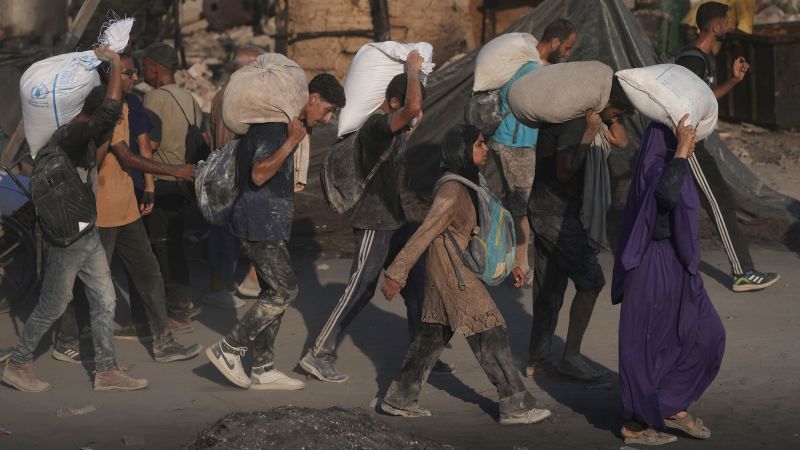
UN says ‘vast amounts of aid’ needed to prevent catastrophic health crisis after Israel allowed limited airdrops into Gaza
The World Health Organization (WHO) has warned malnutrition in Gaza has reached “alarming levels” across the territory, with rates on a “dangerous trajectory” after aid air drops resumed over the weekend.
Of 74 malnutrition-related deaths in 2025, 63 occurred in July – including 24 children under five, the WHO said, adding that nearly one in five children under five in Gaza City is now “acutely malnourished”.

On July 23, the U.S. Capitol hosted “Uzbekistan Day,” a significant event co-organized by the Congressional Uzbekistan Caucus to reaffirm growing ties between Uzbekistan and the United States. More than a hundred participants — including lawmakers, diplomats, officials from the State Department and Pentagon, business leaders, and journalists — gathered to engage with the Uzbek delegation and explore new areas for bilateral cooperation.
The forum focused on Uzbekistan’s ongoing political and socio-economic reforms and its foreign policy vision centered on regional stability and international cooperation. A central priority discussed was Uzbekistan’s accession to the World Trade Organization (WTO), with officials framing it as a vital step to ensuring long-term reform and global market integration.
U.S. Lawmakers Praise Reforms
At the event, Congressman Trent Kelly, Co-chairman of the Caucus on Uzbekistan, praised President Shavkat Mirziyoyev’s leadership, stating, “I want to express my gratitude to President Shavkat Mirziyoyev. He is a bold reformer, a reliable partner, and a sincere friend of the U.S. Under his leadership, Uzbekistan is confidently moving along the path of change. Human rights are being strengthened, democratic institutions expanded, and opportunities for international cooperation opened. These achievements inspire all of us.”
On a more personal note, Kelly added, “I have had the opportunity to visit Uzbekistan four times, and each visit left a deep impression on me. I was moved by the kindness of the Uzbek people, the richness of their cultural heritage, and the hospitality of your country. Music, cuisine, and deep traditions — all of this makes Uzbekistan truly unique… We will soon remove the Jackson-Vanik Amendment from our agenda because Uzbekistan is doing everything right and carrying out reforms,” he concluded.
Senator Steve Daines, Co-chairman of the Caucus on Central Asia, described himself as a “sincere friend of Uzbekistan.” Reflecting on his March 2024 trip to Tashkent, he said, “I felt at home and among friends. This meeting strengthened my desire to continue supporting the Central Asian countries.”
Montana Senator Steve Daines, Co-chairman of the Caucus on Central Asia
Congresswoman Carol Miller, also part of the March delegation, spoke of her personal connection to Uzbekistan’s heritage. “Uzbekistan, with its ancient history, has long aroused my professional interest, since I am a historian by education. The opportunity to see the country’s unique historical and cultural heritage in person was an invaluable experience.” Miller emphasized that, “The conversation took place in a trusting and open atmosphere. The topics raised during the meeting were not only relevant but also extremely promising from the viewpoint of the future development of Uzbek-American relations.”

West Virginia Congresswoman Carol Miller
Miller underscored her commitment to concrete legislative goals: “The removal of the Jackson-Vanik Amendment regarding our country and support for Uzbekistan’s accession to the WTO are priority tasks. I am currently working closely with members of Congress to accelerate these issues.”
Economic Cooperation and Business Confidence
The event also featured remarks from American business leaders highlighting Uzbekistan’s economic potential. Peter Flanagan, Senior Vice President of FLSmidth, spoke about a major copper mining project in Almalyk, the implementation of the which “will lead to production volumes four times greater than those of the world’s largest copper deposit [in] Kennecott (Utah, U.S.” FLSmidth is ready to “become a reliable partner in the development of Uzbekistan’s mining industry,” he stated.
Miles Hansen, President of the Stirling Foundation, echoed the importance of socio-economic development. “The innovative policy of President Shavkat Mirziyoyev gives a strong impetus to the country’s socio-economic development, increasing the world’s interest in the republic. Uzbekistan pursues an agenda in which human dignity is paramount.”
Trade Normalization and Strategic Outlook
The forum spotlighted growing momentum in Congress to normalize trade relations. The repeal of the Jackson-Vanik Amendment and granting Uzbekistan permanent normal trade relations are seen as key to deepening commercial and diplomatic ties.
Congressman Kelly and Congresswoman Miller reaffirmed their legislative efforts to remove outdated barriers. “I am currently working closely with members of Congress to accelerate these issues,” Miller emphasized.
Media outlets and analysts described “Uzbekistan Day” as a timely and effective platform for demonstrating the country’s reforms and expanding bilateral cooperation. As one observer noted, “In conditions of global turbulence, such initiatives not only contribute to strengthening mutual understanding and trust, but also serve as evidence of Uzbekistan’s significantly increased international authority.”
The event reinforced Uzbekistan’s position as a strategic and reform-oriented partner in Central Asia. With expanding business engagement and bipartisan support in Washington, the U.S.–Uzbekistan partnership appears poised for sustained growth across political, economic, and cultural domains.
Social media users praised the woman’s reaction in the viral clip, with one saying “she’s an icon,” while another said: “she’s so real for that.”
The U.S. Coast Guard said it monitored and responded to foreign government vessel activity in and near U.S. waters.