
“The emotional recovery has taken longer than the physical,” 24-year-old Abbey Alexander told Newsweek.
Day: July 27, 2025
https://t.co/kyMizBMpVX
News Review #NewsAndTimes #NT #TNT #News #Times #World #USA #POTUS #DOJ #FBI #CIA #DIA #DOD #ODNI #Trump #TrumpNews #TRUMPISTAN #Israel #Mossad #Netanyahu #Ukraine #NewAbwehr #OSINT #Putin #Russia #GRU #Путин #Россия #Bloggers #Opinions #SouthCaucasus
-… pic.twitter.com/dcW9IgGkOs— Michael Novakhov (@mikenov) July 27, 2025
The fighting has killed at least 34 people.
Getty images; Tyler Le/BI
- America is in a dating slump: It’s expensive, apps aren’t helpful, and we’re not meeting organically.
- Dating apps can lead to prolonged messaging, missed connections, and loneliness.
- One simple solution can help combat these woes: It’s time to set up our friends.
Elena Vargas is saving her friend from Hinge messaging purgatory.
When the friend said they were too busy to weed through all the profiles, Vargas took control of the app, swiping for her, and arranging meetups — with the disclaimer that they were communicating with an unpaid matchmaker, of course.
Vargas, who is 30 and on the dating scene herself in San Francisco, sees it as a modern twist on matchmaking.
“Dating is scary,” Vargas, said, adding: “But when you have someone kind of doing the heavy lifting for you, the matching, the setting up, the setting the date, the setting the reservation — I feel like when all you have to do is show up and be yourself, it just takes everything out of it and it just makes it so much more enjoyable.”
All too often, Vargas said, people never make it off the apps. They end up with pen pals, texting endlessly until the spark fizzles out. There’s also the newly added step of checking your potential dates’ reviews.
She’s onto something. With dating app burnout rampant, and the costs to meet a new mate only rising, it’s time to take matters into our own hands with good old-fashioned matchmaking and setting up our friends. Whether it’s taking over a friend’s Hinge account or swapping “elevator pitches” between mutuals, people are fed up with swiping and looking for more meaningful ways to connect.
It’s time to consider a time-honored tradition: Matchmaking.
Setting up your friends is a public service
Terence Philpotts is a single 41-year-old promoter who lives in North Carolina. He’s an avid traveler and would love to meet someone new in person.
“People simply don’t go out as much as they used to,” he said. “And I mean, I’m just as at fault as anyone else.”
Philpotts said that his best relationship came from being set up by a mutual friend, and he’s open to trying it again. After all, dating is expensive, he said. And risky; a setup is more efficient.
“The person knows both of us, they know our nuances, they know what we, what we don’t like, and most people would think that they would find their friends compatible with each other,” he said. “And that’s basically what happened there.”
Experiences like Philpotts’ used to be a lot more common, but the apps took over as the dominant matchmaker for heterosexual couples in the 2000s, per the findings of a seminal study in the Proceedings of the National Academy of Sciences.
They brought with them a new dilemma: the pen pal stage. Scott Sibley, a professor at Northern Illinois University who teaches human development and family sciences — as well as being a licensed marriage and family therapist — said that one of the big hurdles facing daters is a prolonged talking stage. Potential daters are substituting dates for digital conversation instead.
Though Sibley’s research on relationships found that singles want to move beyond the talking stage, they’re hamstrung by a fear of rejection. It’s easier to hide behind a never-ending conversation than it is to actually get out there.
“That’s the funny thing,” Sibley said. “They’d rather be going on dates and being asked on dates.”
The mismatch between expectations and reality could be fueling the loneliness epidemic. According to a Gallup survey of 6,289 Americans from August through September 2024, around a fifth of US adults said that they had experienced loneliness a lot in the previous day.

Some seem to be taking some proactive action; the latest data from the Bureau of Labor Statistics’ American Time Use Survey shows that younger Americans are spending less time alone, although they’re still spending far more time solo than they did prior to the pandemic.
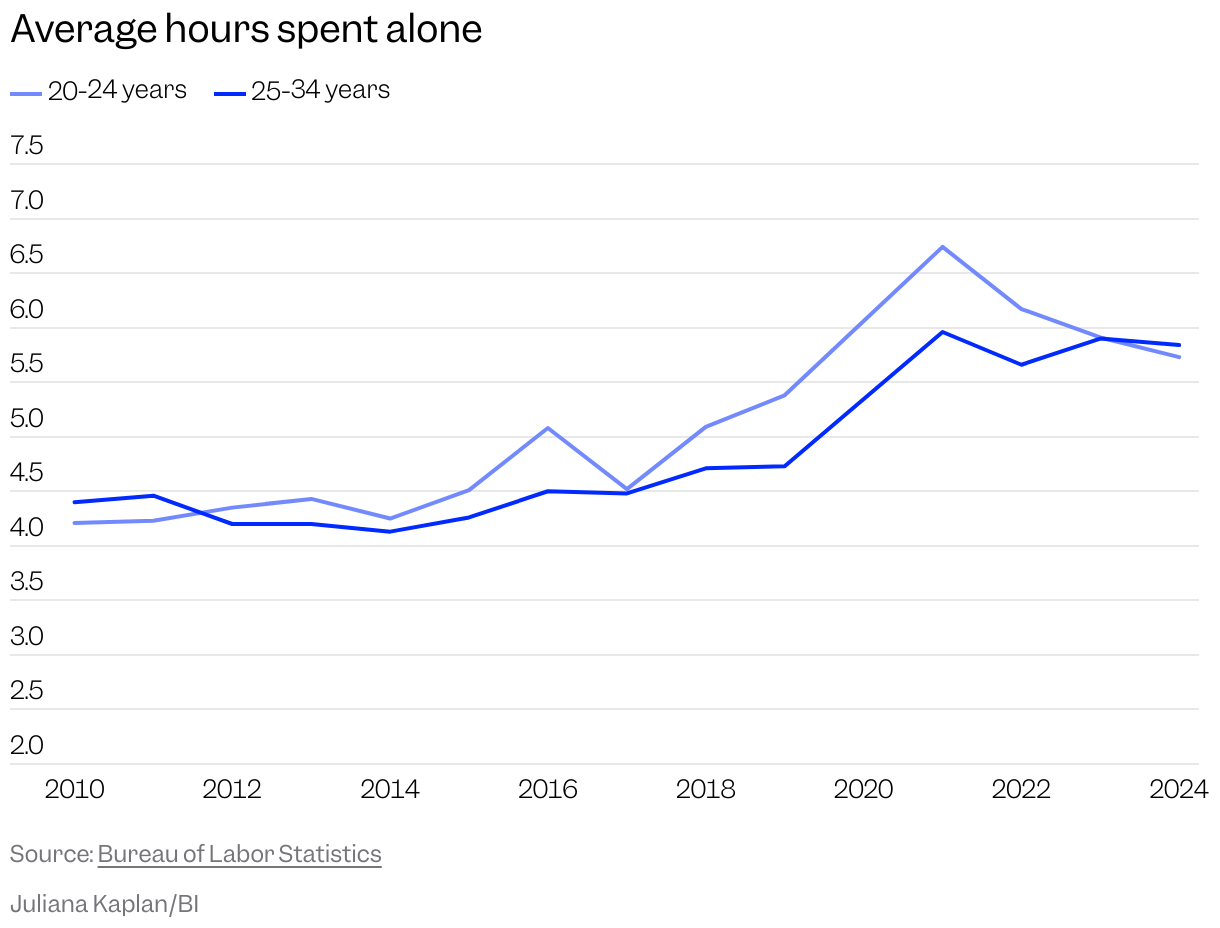
But you can help do your part to fight America’s dating drought, Damona Hoffman, a Los Angeles-based dating coach, said.
“People are so down on dating apps right now and are looking for ways to connect offline or feeling nostalgic for an old-fashioned meet-cute cute so why not try your hand at making a match?” Hoffman said. “Even if they don’t end up madly in love, they could make a meaningful connection in another way or become friends.”
Daniel Cox, the director of the Survey Center on American Life at the American Enterprise Institute, is writing a book about the growing divide between men and women, especially when it comes to dating. He said that what they’ve been hearing is that the online experience is “terrible.” Folks are more likely to treat each other as expendable in what seems like an infinite sea of choices. That’s where a return to form, or an embrace of a new form of dating, might come in. Cox’s research has found that young women are especially more likely to date through their social circles.
“There’s a recognition that we have a better chance of success or at least a better chance of success, or at least a better chance of having a good time if we’re dating people who are friends of friends,” Cox said, “people who are in our social circle, who have some sense of obligation to treat us well and respectfully.”
How to set up your friends
How people meet has evolved, but the trajectory of relationships still follows a standard formula.
Brian Ogolsky, a professor of human development and family studies at the University of Illinois Urbana-Champaign, summarized it like this: we meet, we flirt, we do the dance around defining the relationship, we end it, or become exclusive.
“As long as I’ve been studying relationships, which is now pushing 30 years, and even when we look at historical ways, that trajectory looks sort of very similar,” he said.
Hoffman said that a good setup should rest on what she deems the four pillars of long-term compatibility: “Common goals, shared values, communication styles, and mutual respect.” Look past what might be surface-level chemistry — like a shared love of sushi or hiking — and dig deeper into their beliefs, hopes, and openness to a relationship. As a friend, you may have unique insight into that.
Amy Nobile Messing, a dating coach based in New York, said that if you’re setting up a friend, you should ask for their elevator pitch — a paragraph about themselves and maybe a photo to share. The other person should do the same; there should be no surprises.
Even so, as Hoffman said, singles should also solicit setups from folks in their orbit; Hoffman calls it their “connector’s circle.”
Hoffman and Messing both agree that once you set up the friends, your job is done. If it doesn’t work out, that’s fine. You shouldn’t end up in a position where you’re fielding feedback or trying to control the situation.
Of course, setting up your friends is not necessarily a bulletproof solution. As Anna Goldfarb, the author of “Modern Friendship: How to Nurture Our Most Valued Connections,” said, there’s always the risk that your friend sets you up with someone who ends up being a dud, or your friends who get together break up and create a sticky social situation. There’s also the unpredictable nature of when sparks fly.
“That’s sort of the beauty of romance — sometimes there’s these intangibles that I couldn’t possibly predict,” Goldfarb said. “With that said, my parents were set up on a blind date by friends, so I am here in this universe because of blind dates. I think it can happen.”
For Vargas, who’s been setting up her friend via Hinge from across the country, the exercise has led to some dates. While none have translated into a romantic relationship yet, it’s led to new friendships and the ability to get to know the city better.
“I feel like she’s also gained a little bit more confidence in going on the dates and also just her ability to talk with people and see, oh, actually now I know I would rather prefer this, or I would want this instead,” Vargas said.
Read the original article on Business Insider
Philippine troops kill 7 communist rebels in latest flare-up of decades-long insurgency [deltaMinutes] mins ago Now
alacatr/Getty Images
- Some older homeowners are discouraged from selling by the capital gains tax.
- That reluctance to sell may be exacerbating a shortage of family-sized homes on the market.
- There’s bipartisan support in DC for reforming or eliminating the tax to boost housing inventory.
Joel Friedman, 71, wants nothing more than to sell the house he’s called home for more than 30 years.
The five-bedroom, 5,000-square-foot southern California home is too big for Friedman and his wife, Kathryn, who are retired empty-nesters. They’re eager to downsize to a smaller, single-story house in a 55+ community where they won’t have to worry about endless yard work and rising home maintenance costs.
But the couple has delayed the move. That’s because they don’t want to pay the significant capital gains tax they’d incur if they sold their home. Since 1997, home sellers have faced a capital gains tax — up to 20% based on income — on home sales with profits over $500,000 for married couples and $250,000 for single filers.
“There are a million reasons why we’d like to move, but we’re not because the tax is just burdensome,” Friedman said.
The couple is relying on the profits from their future home sale to help fund their retirement. Friedman is concerned that his Social Security checks and his wife’s pension won’t be enough to cover healthcare bills and long-term care as they age.
They’re among a growing number of potential home sellers facing a hefty tax that’s discouraging them from parting with their valuable properties. This has likely helped exacerbate a shortage of family-sized homes on the market. Many of those affected are older people who are looking to downsize but are relying on their homes to be their retirement nest eggs.
There may be relief on the horizon — and it’s a bipartisan effort.
President Donald Trump recently said he’s considering entirely eliminating the capital gains tax on home sales to help juice the housing market amid persistently high interest rates.
“If the Fed would lower the rates, we wouldn’t even have to do that,” Trump told reporters in the Oval Office on July 22. “But we are thinking about no tax on capital gains on houses.”
Growing desperate to move, the Friedmans finally put their house on the market in May for nearly $4.5 million. But now that Trump and members of Congress are talking about eliminating the tax, they’re letting their listing expire and hoping the law changes before they put it back up for sale.
Safe-guarding their nest egg
In part because home prices have soared in recent years, the share of home sales subject to the tax has more than doubled in the past few years.
About 34% of America’s homeowners — 29 million people — could exceed the $250,000 cap for single filers if they were to sell, and 10% could exceed the $500,000 threshold, the National Association of Realtors found in a 2025 report. In 2023, 8% of US sellers made more than $500,000 in profit on the sale of their homes, the property data firm CoreLogic found. That’s up from 1.3% in 2003 and 3% in 2019.
If the threshold had been adjusted for inflation when it was implemented, the $250,000 cutoff for individual home sellers in 1997 dollars would be about twice as high — $496,000 — in 2024 dollars.
Some housing economists believe that increasing the threshold for the tax or eliminating the levy altogether could boost crucial housing inventory by incentivizing homeowners to sell. But others are skeptical that it would make much of a difference.
“This doesn’t necessarily lead to an increase in inventory; it just leads to a turnover in the housing market, more home sale activity,” particularly in expensive markets in places like California and New York, said Selma Hepp, the chief economist at CoreLogic.
The real-estate company Redfin reported that as of 2022, empty-nest boomers owned twice as many homes with three or more bedrooms as millennials with kids.
Mary Ellen Taylor, 75, is one of those homeowners. She and her husband would like to downsize from their six-bedroom Washington, DC, home, but they’re staying put in part because of the capital gains tax. Taylor, who worked for decades in housing finance regulation, argued that the policy incentivizes boomers like herself to hold onto their large homes, when they should be selling them to families.
“With all the fuss that is made, rightly so, about the supply of housing, having tax incentives that run completely counter to what your public policy aims of increasing the supply of housing is silly,” Taylor said. “I don’t think you want a bunch of 75-year-olds occupying six-bedroom houses.”
A bipartisan issue with complicated impacts
Two weeks before the president floated eliminating the tax on home sales, Republican Rep. Marjorie Taylor Greene introduced legislation seeking to do just that. Greene celebrated Trump’s comments as an endorsement of her No Tax on Home Sales Act.
There’s also Democratic support for reforming the tax.
Rep. Jimmy Panetta, a California Democrat whose district includes several pricey coastal regions, first introduced a bill in 2022 that would double the tax exclusion to $500,000 for individuals and $1 million for joint-filing couples and index it to inflation. The More Homes on the Market Act, which has cosponsors across the aisle, aims to incentivize more homeowners to sell and boost housing inventory.
Panetta said he’s willing to work with Trump and Republicans on “a quick and rewarding way to incentivize people to sell their homes and keep intact their nest egg.”
“I just hope that the President is serious about doing something, and not just saying it, when it comes to a fix for the affordable housing issue,” he said in a statement to Business Insider.
As with any major policy change, there could be big unintended consequences down the road.
Hepp warned that sellers who walk away with extra cash in hand would then have more money to spend on their next home, which could put upward pressure on home prices. In a CNBC interview, Redfin chief economist Daryl Fairweather argued that changing the tax could perversely incentivize some homeowners who’d been planning to sell before reaching the current tax threshold to hold onto their homes for longer.
Even if the tax break stimulates home sales, it won’t address the fundamental shortage of housing across the country. Older homeowners who finally sell their homes and move still need to live somewhere.
“We’re still stuck with this problem of lack of housing in the US and I think that’s the problem that should be tackled. How do we build more, less expensively and more quickly?” Hepp said.
Reducing the capital gains burden would also disproportionately benefit higher-income Americans, even as many of these same households receive other forms of tax relief under Trump’s “one big beautiful bill.” As part of that law, many wealthy homeowners in high-tax states will benefit from an increase to the cap on the state and local tax deduction.
Eliminating the tax on home sales would also cost the federal government in lost revenue at a time when Republicans are adding at least $3.4 trillion to the national debt over the next decade.
Despite her support for reform, Taylor believes the tax code is “wildly to the benefit of more affluent people,” and worries that eliminating the capital gains tax could further skew the US tax code in favor of wealthier people.
David Levin, 71, agrees that reforming the tax would benefit lucky homeowners like himself who’ve seen their home equity soar over decades of appreciation. The couple bought their four-bedroom Manhattan Beach house for $632,000 in 1991, and it’s now worth an estimated $2.8 million, according to a local real-estate agent Levin consulted.
While they’re ready to sell and downsize, with the capital gains tax they’d face under current law, Levin says they wouldn’t make enough profit on their home sale to buy a new place. Even a much smaller home in the coastal California city would be out of budget, he said.
“The way the law stands today, we’re staying put in a home bigger than we need,” Levin said.
Read the original article on Business Insider
Humanitarian Aid Delivered to Gaza Amid Tactical Pause by Israeli Military
Humanitarian aid trucks crossed from Egypt into the Gaza Strip on Sunday, following inspections by Israeli authorities. The move coincided with a declared “tactical pause” in military operations by Israel, aimed at facilitating the distribution of essential supplies, reports 24brussels.
According to Egyptian officials and confirmed by EFE News Agency, the trucks transported substantial quantities of food, flour, and critical infrastructure materials, reflecting Egypt’s continuous efforts to mitigate the escalating humanitarian crisis in Gaza. Live coverage from Egyptian state channels, Al Qahera News and ExtraNews, showcased the trucks departing Egyptian territory.
Over the past four days, 458 aid trucks entered through the Kerem Shalom crossing, delivering various food and medical supplies, including infant formula and flour, as noted by Al Qahera News. These goods had previously been stored in a logistical area in Rafah, near the Gaza border, with strict regulations ensuring their safety for consumption.
Egypt’s Ministry of Foreign Affairs reiterated its commitment to continuous efforts to cease hostilities, facilitate aid deliveries via Rafah, and spearhead reconstruction initiatives, which receive support from Arab nations. While Rafah remains operational on the Egyptian side, access is impeded by Israeli forces controlling the Palestinian side.
As malnutrition-related fatalities in Gaza sharply increase, the Israeli military announced a provisional daily “tactical pause” spanning ten hours in three regions of the enclave, allowing humanitarian aid deliveries “every day until further notice.”
During these periods, from 6:00 a.m. to 11:00 p.m. local time, “safe routes” will be established to assist United Nations personnel and aid organizations in delivering food and medical supplies to the populace. This announcement follows Israeli air drops of humanitarian aid in acknowledgement of the growing famine crisis. According to the Gaza Health Ministry, malnutrition has resulted in the deaths of 127 individuals, including 85 children, since the onset of the military offensive on October 7, 2023.
The steps are meant to address a surge in hunger in the territory as Israel faces a wave of international criticism.
xavierarnau/Getty Images
- Middle managers are facing layoffs, and those who remain are taking on extra work.
- BI wants to talk to middle managers about their experience at work or job hunting.
- Share your experience by filling out a quick form.
Middle managers are the talk of corporate America lately — and Business Insider wants to hear about it.
Tech giants like Google and Microsoft, alongside major retailers like Walmart, are looking for ways to cut costs and streamline bureaucracy. Enter, the Great Flattening: A widespread wipeout of mid-career jobs.
Laid-off managers are pushed into a rocky job market, and those who remain employed are left with an increasing number of direct reports. Millennials and Gen X, who hold most of the US’ managerial roles, are most impacted.
Amazon CEO Andy Jassy told employees in June he plans to shrink the company’s white-collar workforce, citing “efficiency gains.” After a round of layoffs, Dell told BI in March that “Through an ongoing series of actions, we are becoming a leaner company,” which will include combining some teams. And, alongside a bout of Meta layoffs in 2023, CEO Mark Zuckerberg said that “flatter is faster.”
“I don’t think you want a management structure that’s just managers managing managers, managing managers, managing managers, managing the people who are doing the work,” he said.
If you are a middle manager — or you report to a middle manager — and are comfortable being interviewed for future reporting, please fill out this quick Google form. BI will contact you if we are interested in your story.
If you can’t see the survey, fill it out here or reach out to this reporter securely via Signal at alliekelly.10.
Read the original article on Business Insider
Passengers and crew evacuated American Airlines Flight 3023 at Denver International Airport.