
Watson, 22, was 6-foot-6, 464 pounds when the Bucs signed him after the 2025 NFL Draft.
Day: July 25, 2025
Syria’s Druze fear for their future after sectarian clashes [deltaMinutes] mins ago Now
FABIAN BIMMER/REUTERS
- More and more Western defense companies are opening up operations in Ukraine and working with local firms.
- A Ukrainian industry body called it a “win-win.”
- Ukraine gets more weapons, and Western companies learn from local experience.
Western arms makers aren’t just sending weapons to Ukraine these days; they’re moving in. As Russia’s war drags on, NATO defense companies are opening offices, setting up new production lines, and working closely with Ukrainian partners inside the country at war.
For Ukraine, the payoff is that it gets faster, more customized firepower. For the West, it’s access to something money can’t usually buy: real-time lessons in modern warfare.
Ukraine’s defense industry is offering hard-earned insights, and NATO countries are able to bring those secrets home before they need to use them themselves.
Talking with Business Insider, representatives of Ukraine’s defense industry described Western defense companies working in Ukraine as a “win-win” because it helps them learn from the war and Ukraine’s industry while also aiding Ukraine’s fight against Russia’s invasion.
And Many European leaders have acknowledged that their own domestic industries have much that they can learn from Ukraine’s booming defense sector.
Ihor Fedirko, the CEO of the Ukrainian Council of Defense Industry, an industry body that represents over 100 Ukrainian defense companies, said Western companies that open offices and produce in Ukraine gain experience “for our type of work.” The war is a fast-moving conflict where new tech and innovations are substantially changing how wars are fought, with new developments in drone technology being among the most noticeable.
Western companies in Ukraine
Among the growing number of Western defense companies that have opened up facilities in Ukraine are the German drone and aerial intelligence company Quantum Systems, which said last month that it will double its production capacity in Ukraine, and KNDS, a French-German defense group opening a subsidiary there.
Philipp Schulze/picture alliance via Getty Images
British multinational arms and aerospace company BAE Systems has also set up in Ukraine, and Norwegian defense company Nammo signed an agreement to work with a Ukrainian defense firm. German arms manufacturer Rheinmetall has plans for multiple factories in Ukraine, including an ammunition production plant to make the Lynx infantry fighting vehicle.
Even Western companies without production facilities in Ukraine are testing their products there, working with local companies and soldiers and adapting in real time.
Kuldar Väärsi, the CEO of Estonian defense company Milrem Robotics, which makes military robotic systems like the THeMIS and has some in Ukraine, told BI his company works directly with Ukrainian industry to keep its systems relevant as well as “to work collaboratively to get the lessons learned from the war in Ukraine and help to improve the European defense equipment.”
He said that Europe needs to learn from Ukraine’s industry, “what works, what doesn’t work, what needs to be shifted.”
Mykhaylo Palinchak/SOPA Images/LightRocket via Getty Images
And then domestic operations like Brave1, a Ukrainian government-run defense technology and innovation platform, are creating opportunities for foreign companies to test their combat tech on the battlefield in Ukraine.
Luke Pollard, the UK’s armed forces minister, said in May that “if you are a drone company and you do not have your kit on the front line in Ukraine, you might as well give up.”
These developments bring a lot of warfighting technology to Ukraine, which needs both innovative solutions and firepower mass to hold its own against Russia.
What the West can learn
Troels Lund Poulsen, NATO ally Denmark’s defense minister, told BI in February: “I think we have a lot to learn from Ukraine.” He explained that he wants Danish defense companies to learn from Ukrainian ones so that they can “get some of the lessons learned from the defense companies in Ukraine back to Danish defense companies.”
He said that by helping Ukraine, “some of the lessons learned will come back to Denmark, and that’s a win-win, in fact, both for Ukrainian defense companies and also for Denmark.”
Some of those lessons are coming back to Denmark through the new way it is getting weapons for Ukraine, Poulsen said. Known as the Danish model because it was pioneered by Denmark, the model sees countries buying weaponry for Ukraine directly from Ukrainian companies, which means weapons get to Ukraine faster and cheaper, without adding to the production backlog that defense companies all over Europe are seeing.
Photo by ANATOLII STEPANOV/AFP via Getty Images
Denmark’s new connection with Ukraine’s defense industry means that lessons from those companies can get back to Danish ones, Poulsen said. He said one of the key lessons Denmark needs to adopt is “the way to produce fast.”
The West is bracing for a serious conflict, such as a war between Russia and NATO or a fight between the US and China, and defense budgets are soaring. The war in Ukraine is offering insights into modern warfare, specifically what weapons, tactics, and training are needed for the future fight.
A key realization from this war is that in a major war, there is a need to produce weapons and equipment quickly. Denmark’s prime minister, Mette Frederiksen, said in February that it’s a problem “if a country at war can produce faster than the rest of us.”
“I’m not saying we are at wartime,” she said, “but we cannot say we are at peacetime anymore. So, we need to change our mindset.”
Fedirko said that speed is something other European companies can learn from Ukrainian ones: “We can say that what our defense complex is rich with is the ability to scale up manufacturing. That’s what we are very good at. So we have a very brief period between R&D.”
He said Ukrainian companies are also “very swift in terms of testing and finding out any shortcomings and then refining them, addressing them, and then getting ready a new product.”
He added that Ukraine has shown how fast it can create and scale up new types of weaponry, like drones.
Anadolu | Getty Images
Fredriko, NATO defense leaders, and warfare experts have all previously warned that Russia’s invasion shows that the West needs to get a larger number of cheaper weapons that it can make quickly, rather than just focusing on a smaller number of advanced pieces of equipment. There has to be a balance between cheap mass and exquisite firepower, they say.
Ammunition is also key. NATO’s secretary general warned this month that Russia makes as much ammunition in three months as NATO does in a year. In the war in Ukraine, ammunition has at times been a decisive factor in battles.
Working in Ukraine, Western companies get greater insight and clarity into the demands of large-scale modern wars. Russia has been getting these lessons firsthand. This is proving an opportunity for the West to catch up.
Read the original article on Business Insider
The DHS has denied the allegations, saying Victor Velazquez Gutierrez attempted to flee and actively resisted arrest, which led to him falling to the ground.
President Trump has come under fire from a section of his MAGA base over his handling of the Jeffrey Epstein case.
Experts from academia, industry and environmental groups assessed the chances for a global treaty on plastic waste at negotiations next month.
Courtesy of Ashley Archambault
- Five years ago, I decided to celebrate Christmas in July for my son.
- It brightened our spirits, and we’ve done it every year since.
- In many ways, it’s more relaxing than the real holiday.
To cheer my son up at the onset of the pandemic, I decided to celebrate Christmas in July. I had always thought of doing this, but this was the first time it seemed like something my son and I truly needed. So, that July, I chose a random day and began planning.
I told my son the plan, and that pretending it’s Christmas during the summer is just a fun thing to do when you can’t wait a whole year for the holidays. This explained why he wouldn’t be seeing Santa, and why we’d be the only ones he knew celebrating it — it was something special, just for us.
I planned for a miniature version of the real holiday
Together, we put out a quarter of our usual decorations, including a small tree and stockings. I ordered a couple of small gifts and wrapped them up when they arrived. When I told a friend of mine what we were doing, she said, “Oh, so you’re really doing Christmas.” That’s how I wanted it to feel — like a taste of the real thing.
On the day before, we acted like it was Christmas Eve. While listening to Christmas carols, we made the same holiday-shaped cutout cookies we normally make in December for Santa. But instead of leaving them by the stockings, we ate Santa’s cookies on the couch with milk before reading ‘Twas the Night Before Christmas.
After I tucked him in and stuffed his stocking, I watched a corny holiday romcom to get in the spirit. I was surprised by how much I was buying into the whole Christmas in July idea and realized just how much it was brightening my spirits as well.
Courtesy of Ashley Archambault
We formed a new tradition rooted in togetherness
The next morning, my son had to wait for me to make coffee before he could open his presents. Seeing how excited he was when he opened his gifts made the whole idea of celebrating Christmas in July worth it. Next, we made our Christmas pancakes for breakfast and spent the rest of the day watching our favorite holiday movies. We left our decorations out for about a week, to enjoy the Christmas mood for a while.
It was so successful that the next summer my son asked if we could do it again, and I thought, “Why not?” By then, I was engaged, and my fiancé was thankfully willing to be a part of the tradition. It’s stuck around, and every year, we choose a day in July to celebrate. It doesn’t have to be the 25th, just any day we can totally block off for our festivities, which include making cookies, exchanging one or two small gifts, making pancakes for breakfast, and having a Christmas movie marathon.
Courtesy of Ashley Archambault
Our July Christmas is so much more relaxing than the real thing
My son gets so excited about our mini Christmas that when it’s coming up, he tells whoever he sees about our plans. The reactions range from mild confusion to thinking it sounds sweet. In many ways, I’ve come to prefer our summer Christmas over the true holiday. Our tradition is less about the gifts and more about enjoying the time together. We also don’t have to worry about the social obligations and packed schedule that often come with the holiday season.
It’s relaxing to just be lazy and enjoy a snapshot of Christmas halfway through the year. There’s no pressure from the outside world to show up anywhere. It’s just us in our little bubble, experiencing something simple yet no less magical. Our Christmas in July tradition helps us slow down and reconnect before it’s time for back-to-school and the truly fast-paced holiday season that follows.
Read the original article on Business Insider
At least 10 killed and dozens hospitalised in north of country, while intense heat grips parts of Scandinavia
Turkey and other parts of the Balkans have been gripped by a heatwave this week, sparking wildfires that have left at least 10 people dead and dozens in hospital.
Temperatures intensified at the weekend, peaking at 43C (109F) in Volos, Greece, on Tuesday. Tourist attractions such as the Acropolis were closed by authorities between midday and 5pm.
Getty Images; Rebecca Zisser/BI
- Many millennial parents have just two kids, seeing three as a luxury.
- Experts say it’s not just financial and logistical. It’s down to changing values, too.
- Millennial parents who considered having more kids share the roadblocks they came up against.
Victoria Lamson and her husband once entertained the idea of having a third child. Then, they considered the logistics.
Even having their two children was a challenge. To alleviate financial strain, they “intentionally put five years in between” having children, Lamson, 38, told Business Insider.
The couple is raising them in San Francisco, the most expensive US city. They send their 7-year-old son to a nearby parochial school because the public school system in San Francisco is “definitely struggling,” Lamson said. When her 2-year-old daughter is old enough, she will attend the same school. Private school costs in the city average $26,000 per child annually. Moving, in order to afford a third child, would also be difficult — both her and her husband’s families live nearby.
Plus, she and her husband’s careers have undergone many changes. Lamson pivoted from sales to PR, ending her first contract PR role when she gave birth to her second child. She spent part of her maternity leave looking for a new job. Meanwhile, her husband, who works in tech recruiting, has experienced a decline in business with the recent tech layoffs.
“Putting all those factors together, it really just doesn’t make sense for us anymore,” Lamson said.
Lamson and her husband join other millennials, who are between the ages of 29 and 44, averaging two kids max. Along with the millennials who are having fewer kids or remaining child-free, the generation is often blamed for America’s shrinking birth rate.
There isn’t one economic or cultural reason as to why so many millennials are two-and-done with having kids. While childcare costs and fertility issues play substantial roles, there has also been a sea change in what an ideal family — and family size — looks like.
Barely making do with two
When it comes to family size, millennials aren’t that different from their predecessors. According to a 2020 Pew Research Center Report, millennial women average 2.02 kids. At similar ages, Gen X women had 2.05 kids and boomers 2.07.

Pamela Smock, a professor of sociology at the University of Michigan, said having two kids has been an American ideal since the 1960s. The difference between the generations is that millennials are less likely to have kids than previous generations. In that sense, a young family with two kids is no longer the norm, but, for some, a symbol of luxury.
“People see marriage and childbearing as something to do once they feel economically comfortable,” Smock said.
To many, that means not having any debt and being able to afford a mortgage. The average millennial borrower owes $42,000 in student loan debt, part of why it’s so difficult for millennials to buy their first homes. Comparatively, 45% of baby boomers bought their first homes between the ages of 25 and 34.
Stockbyte/Getty Images
Work has also changed, Smock said. Gone are the lifelong jobs that require a basic college degree. Millennials are known as the “job-hopping generation,” which also impacts their sense of security as costs keep rising.
Stephanie Fornaro, a 40-year-old mom of two in Dallas, has a 20-year-old daughter in college and a 7-year-old son. She had her daughter when she was 20, but delayed having her son until her early 30s.
“Financially, I was in a different season in my life to afford a second child,” she said, adding that she divorced a few years after giving birth to her daughter. It was only when she remarried in 2017 that she felt secure enough to have another kid.
Wendie N. Choudary, a sociologist and lecturer at Binghamton University, told BI that in addition to rent or housing costs, millennial parents also have to deal with astronomically high childcare costs, paying an annual average of $11,000 per child.
Fornaro, who founded and runs a national childcare agency, said a third child would have a huge financial impact on her family. To keep up with her job, she would need a full-time nanny — roughly $80,000 a year in Dallas.
Childcare costs are so high that some parents struggle to even have their second child. Katie Waldron, who lives in Long Island, New York, previously told Business Insider that she and her husband want a second child soon, but are considering moving to the UK to be closer to his family and find more affordable childcare services.
“The burden of childcare costs and, equally, the lack of emotional support as we go through our parenting journey make it impossible to have another,” she said.
Millennials are having kids later
Economic uncertainty also plays a role in millennials having kids later than past generations, Smock said, thus affecting how many they have. Millennials’ median age for first-time parents is 27.3, a significant increase from the 1970s when it was the norm to have kids at 21.
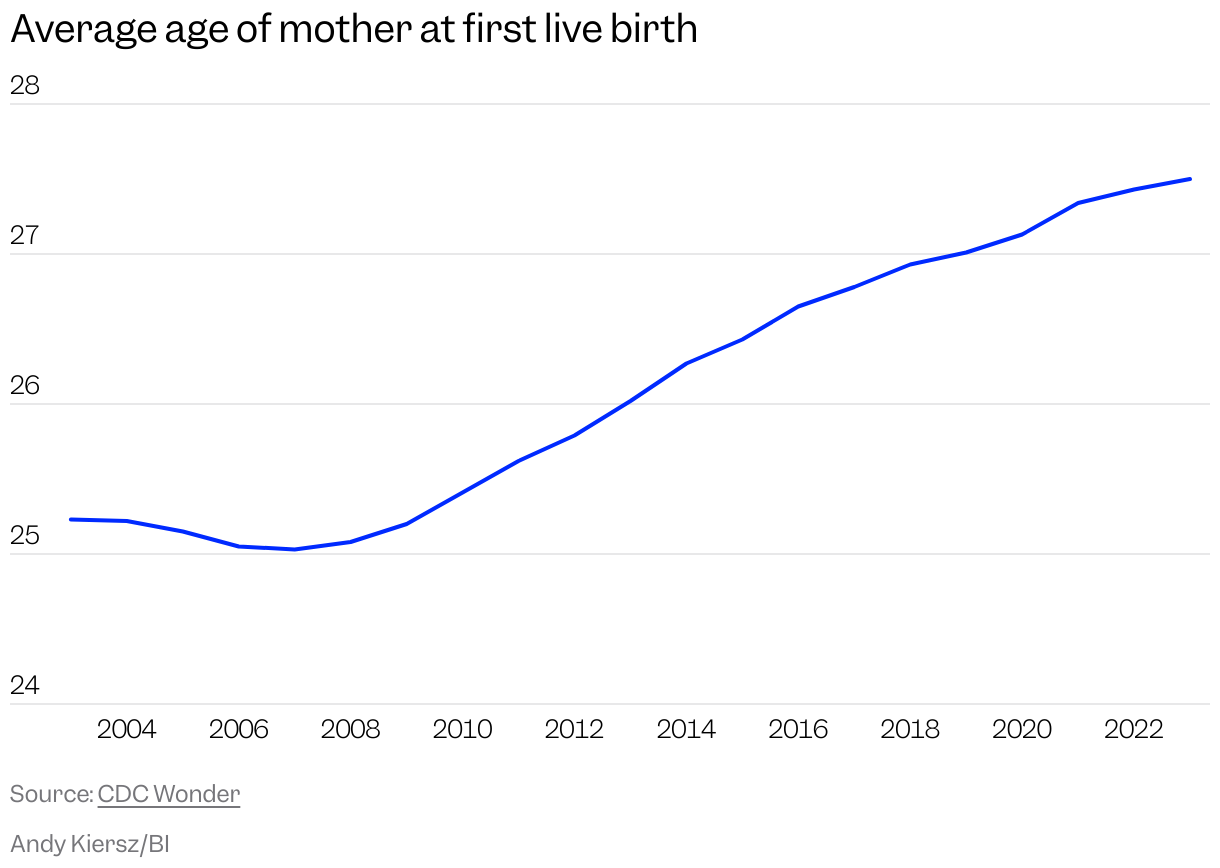
Depending on when they start having kids, timing the third can be tricky. More parents are having kids in their 40s, past the fertility peak at 37 years old. Even if the plan is to have more than two kids, it’s not necessarily in the parents’ control, Smock said. Not everyone can afford IVF, which can cost $12,000 and require six rounds to achieve success.
Having kids past 35 also increases the chances of conditions like preeclampsia, gestational diabetes, premature birth, or genetic disorders in the fetus. Parents considering a third child in their late 30s or early 40s might not feel the risk is worth it.
Sometimes, a rough pregnancy is enough to deter wanting more kids. Lamson, who had her first child at 31 and second at 36, felt a huge difference in those five years. At 31, she said it was easy to stay very active and exercise four times a week. The second time was more challenging.
“I had really low energy throughout my entire pregnancy,” she said. “I struggled with a lot of pain, so even when I would try to just get out and walk, I could only kind of do so for a period of time before I didn’t feel all that well.”
“I attribute it a lot to age,” she said, adding that she ended up going to physical therapy to alleviate some symptoms.
With more choice, parents choose fewer kids
kerkla/Getty Images
After World War II, it was normal to get married at 19 and have kids in rapid succession, Smock said. But with more choices, millennials realized “they don’t have to follow the path that their parents and grandparents took,” she said.
In recent years, there’s been an increased online interest in “trad wives” and the merits of large families. However, it hasn’t shown much of a dent in what most people want, Julia A. Behrman, an associate professor of sociology at Northwestern University who researches how values shape a person’s ideal family size, told BI.
“We are pretty consistently seeing these average ideal family sizes of about 2.5,” Behrman said. Most actually plan to have fewer: roughly 1.8 on average among people in their 20s and 30s.
In Behrman’s research, she’s found that people with more progressive views on gender norms and household labor tend to want fewer kids — often because they are aware of how childrearing disproportionately falls on mothers.
Even if parents want two or more kids, Behrman’s research found that it doesn’t mean it’s their top priority. Other aspects of family life, like financial stability, rank higher.
For the parents who can technically swing three kids, it could mean a notable decline in their quality of life. Fornaro, who grew up as one of eight children and felt neglected because her dad and stepmom struggled to raise them all, doesn’t want her kids to experience the same. She said having a third wouldn’t just impact how much she could contribute to her kids’ college tuition or inheritances. It would also change how much time she gets to spend with them.
“We are a pretty active family,” she said. Traveling and going on their boat would be harder with an infant. Taking her son to his extracurriculars — jujitsu, baseball, and football — would also be much harder with a newborn. And with Fornaro’s daughter in college, caring for a baby would make it difficult for Fornaro to visit her.
Catherine Falls Commercial/Getty Images
Lamson even felt a big difference in what she could do after having a second kid. She and her husband took their son to Europe when he was 10 months old because he had an easygoing demeanor. “My daughter doesn’t have the same personality; she’s a little bit more challenging,” Lamson said.
They’ve opted for more staycations and plan to travel more when their daughter is older. Having a third child would be financially “really limiting” for vacations, not to mention the logistics of wrangling three kids onto a flight.
It’s not that millennial parents don’t love parenting or a house full of kids. Fornaro fell in love with being a mom after her first child. Lamson wanted a third. They just wanted to give more to their existing family.
“I wanted my kids to have my undivided attention,” Fornaro said. “I felt like that was one thing that I didn’t get out of my parents.”
Read the original article on Business Insider
When Sophie Cullen went to pick up her daughter from her grandparents, she told Newsweek that she was not ready for what she saw.