
Ashley Hinson was heckled while defending President Donald Trump’s policies and agenda.
Day: May 29, 2025

U.S. President Donald Trump is expected to find a workaround after suffering a major blow to a core part of his economic agenda.
Former Hot Chili Peppers guitarist Josh Klinghoffer accepted a plea deal to avoid jail time for accidentally killing a pedestrian in California last year.
Chinese students call measure ‘Chinese Exclusion Act’ after Rubio vows to revoke visas [deltaMinutes] mins ago Now
Harrison Ruffin Tyler’s family said the last connection to the 19th century president has passed away.
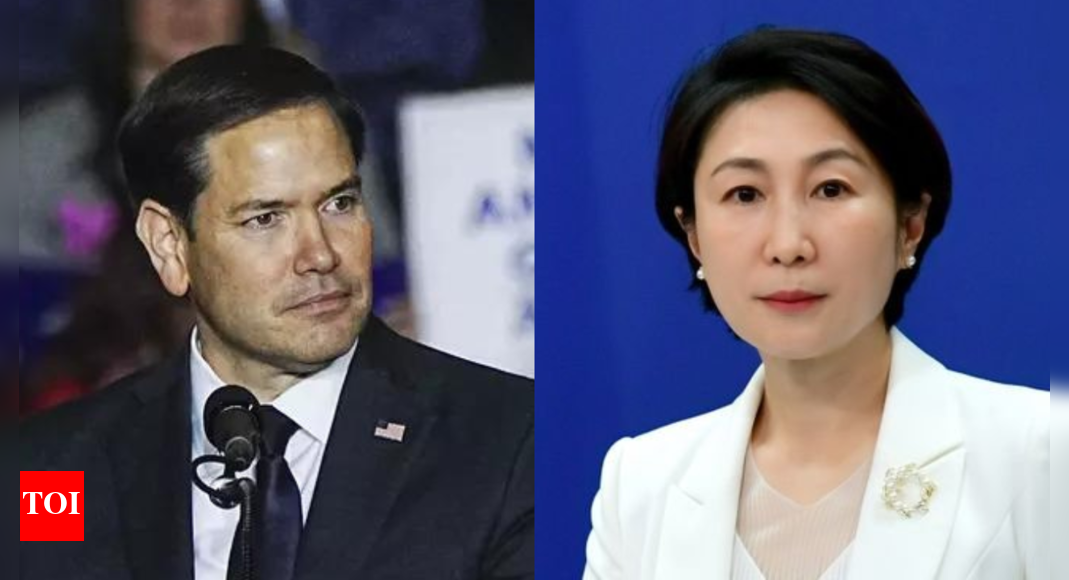
US News: China has condemned the United States’ recent decision to revoke visas of Chinese students, deeming it unreasonable and ideologically driven. This act
PM to say Reform UK leader is promoting a ‘fantasy’ that would unleash a Truss-style economic crisis
Government minister Emma Hardy has urged doctors to “vote no” in an upcoming strike ballot.
The water minister told Sky News:
We hugely value everybody who works in the NHS and we hugely value our doctors: that’s why they’ve had a 28% increase in their salary compared to three years ago, and why we’re offering above-inflation pay [rises].
But what patients are telling me, patients where I’m from in Hull and up and down the country, is they’re really pleased with the government for reducing waiting lists by 200,000 but they want to see that progress continue with the NHS, and they really don’t want to see strikes.
So my message to the doctors is: we value you, that’s why we’ve offered the above-inflation pay rise.
Farage is making the exact same bet Liz Truss did: that you can spend tens of billions on tax cuts without a proper way of paying for it. And, just like Truss, he is using your family finances, your mortgage, your bills as a gambling chip on his mad experiment. The result will be the same.
The British arm of a US contractor that profits from testing whether some people in the UK should receive disability benefits has paid out £10m in dividends to its investors. Maximus, a Virginia-based business, reported a 23% rise in pre-tax profit for its UK arm, from £23.6m to £29.1m, in its financial year to the end of September, accounts lodged at Companies House show. Its revenue rose 2%, from £294m to £300m.
The health secretary, Wes Streeting, has urged doctors to vote against industrial action as the British Medical Association (BMA) ballots resident doctors, formerly known as junior doctors, for strike action that could last for six months. Writing in the Times on Thursday, Streeting said: “We can’t afford to return to a continuous cycle of standoffs, strikes, and cancellations.”
The House of Lords watchdog has launched an investigation into a Conservative hereditary peer who admitted he “erroneously” made claims last year for travel expenses he did not incur. He is the fifth peer to face an inquiry after Guardian reporting into the upper house.
Jobcentres will no longer force people into “any job” available, the employment minister has said, promising there will be long-term, personalised career support for those losing out due to welfare cuts. Alison McGovern said she was ending the Conservative policy under which jobseekers were obliged to take any low-paid, insecure work and that the service would now be focused on helping people to build rewarding careers.
Scotland’s first minister has warned that the Hamilton byelection is now a “straight contest” between the SNP and Reform UK as he urged voters to back his party. John Swinney claimed the Labour campaign is in collapse and urged their supporters to act and “unite behind our shared principles” to defeat Farage’s party.
Multiple universities have introduced classes dedicated to teaching high schoolers essential life skills.

Donald Trump’s sweeping and volatile tariffs have left businesses in uncertainty, roiled global markets, upended U.S. relations with trading partners, and pushed up the prices of consumer goods. But on Wednesday, a federal court ruled that Trump didn’t have the authority to impose them in the first place.
A three-judge panel at the U.S. Court of International Trade (USCIT) in New York ruled that Trump overstepped his authority by implementing a tariff regime on dozens of countries in a bid to enliven domestic manufacturing and to slash budget deficits by generating revenue from import levies. The Administration has also used the tariffs as bargaining chips for trade deals more favorable to the U.S.—as well as in geopolitical negotiations.
[time-brightcove not-tgx=”true”]
The Wednesday court ruling may provide temporary relief for affected consumers and businesses—halting a 30% tariff on China, 25% tariff on certain goods from Mexico and Canada, and 10% universal tariffs on most of the rest of the world—and it throws a wrench in the centerpiece of Trump’s agenda, though the Trump Administration swiftly filed an appeal.
Here’s what to know about the ruling.
What is the U.S. Court of International Trade?
The USCIT has jurisdiction over civil cases arising from U.S. customs and international trade laws.
Its website states that “the court may grant any relief appropriate to the particular case before it, including, but not limited to, money judgments, writs of mandamus, and preliminary or permanent injunctions.”
The panel of judges that ruled on Trump’s tariffs were all appointed by different Presidents: Judge Jane Restani was appointed by Ronald Reagan; Judge Gary Katzmann was appointed by Barack Obama, and Timothy Reif was appointed by Trump during his first term.
What did the ruling say?
The USCIT issued its opinion on two consolidated cases concerning Trump’s tariffs. The first was filed by New York-based wine importer V.O.S. Selections along with four other small businesses, and the second was filed by 12 different states.
In imposing tariffs, which Congress has the constitutional power to approve, Trump invoked his authority under the International Emergency Economic Powers Act of 1977 (IEEPA), which grants the President authority to regulate commerce in light of threats that can constitute a national emergency. It was the first time a President invoked the IEEPA in a tariff situation. These include the tariffs Trump imposed earlier this year on Canada, China, and Mexico, which were aimed at curbing the entry of fentanyl into the country, as well as his April 2 “Liberation Day” so-called “reciprocal” tariffs, which were aimed at taxing dozens of nations due to their trade surpluses with the U.S.
The plaintiffs argued that Trump did not have authority under IEEPA to impose such widespread tariffs.
The court said that it “does not read IEEPA to confer such unbounded authority and sets aside the challenged tariffs imposed thereunder.” The court said that the worldwide retaliatory duties “exceed any authority granted to the President by IEEPA to regulate importation,” while the drug trafficking-related levies “fail because they do not deal with the threats set forth in those orders.”
“A tax deals with a budget deficit by raising revenue. A dam deals with flooding by holding back a river. But there is no such association between the act of imposing a tariff and the ‘unusual and extraordinary threat[s]’ that the Trafficking Orders purport to combat,” the court wrote.
In its conclusion, the court ruled in favor of a permanent injunction on the tariff orders nationwide.
How might this impact Trump’s tariffs?
Trump has 10 days to put the injunction into effect, per the order accompanying the ruling. The court ordered that four of Trump’s executive orders are invalid and must be repealed. Trump’s 25% steel, aluminum, and auto tariffs, however, were left in place, pending a Commerce Department investigation.
The ruling noted that the President has the power to impose certain tariffs when the Secretary of Commerce “finds that an ‘article is being imported into the United States in such quantities or under such circumstances as to threaten to impair the national security’” under Section 232 of the Trade Expansion Act of 1962.
The ruling threatens to upend ongoing trade-deal negotiations, though Trump could still impose new “restricted” tariffs, the ruling noted, so long as they are “in response to ‘fundamental international payment problems’” which include substantial trade deficits under Section 122 of the Trade Act of 1974. This authorizes the President to impose tariffs of as much as 15% for up to 150 days.
There’s also the chance that the Administration may simply ignore the ruling. A provision in the thousand-plus-page “One Big Beautiful Bill,” which passed in the House last week and is now before the Senate, would effectively restrict judges’ power to hold a litigant in contempt for defying court orders or injunctions. If the megabill becomes law, with the provision intact, critics say it could limit federal courts’ ability to restrain some of Trump’s moves.
Analysts warn that Trump will likely take other avenues to impose tariffs.
“This ruling represents a setback for the administration’s tariff plans and increases uncertainty but might not change the final outcome for most major U.S. trading partners,” chief U.S. political economist at Goldman Sachs Alec Phillips told Bloomberg. “For now, we expect the Trump administration will find other ways to impose tariffs.”
Timothy Moe, chief Asia Pacific equity strategist at Goldman Sachs, told Bloomberg TV, “This might be considered a body blow, but it’s not the final rendering.”
How has the Trump Administration reacted?
Minutes after the ruling, the Trump Administration filed a notice of appeal to the U.S. Court of Appeals for the Federal Circuit in Washington, D.C. The case may also later be appealed to the Supreme Court.
“The judicial coup is out of control,” White House deputy chief of staff for policy and homeland security adviser Stephen Miller posted on X.
“It is not for unelected judges to decide how to properly address a national emergency,” said White House deputy press secretary Kush Desai in a statement. Desai said that trade deficits have led to a national emergency that has “decimated American communities, left our workers behind, and weakened our defense industrial base—facts that the court did not dispute.” He added: “President Trump pledged to put America First, and the Administration is committed to using every lever of executive power to address this crisis and restore American greatness.”
How have supporters of the ruling reacted?
“This administration was already a joke in so many ways,” posted George Conway, attorney and a founder of the anti-Trump political action committee The Lincoln Project, on X. “But the USCIT’s decision striking down Trump’s tariffs could not make him look more hapless.”
The Independent Institute, a nonpartisan think tank that has previously criticized Trump’s tariffs, posted a blog with the headline: “Happy Liberation from Trump’s Tariffs Day.”
Gregory Meeks, the ranking Democrat on the House Foreign Affairs Committee who co-led an amicus brief in support of the 12 plaintiff states in the case, said in a statement: “I’m encouraged by the court’s decision today to block President Trump’s so-called ‘liberation day’ tariffs, confirming what we’ve long known: these tariffs are an illegal abuse of executive power. Trump’s declaration of a bogus national emergency to justify his global trade war was an absurd and unlawful use of IEEPA.”
“The law is clear: no president has the power to single-handedly raise taxes whenever they like,” New York Attorney General Letitia James, one of the attorneys general who filed the lawsuit, said in a statement. “These tariffs are a massive tax hike on working families and American businesses that would have led to more inflation, economic damage to businesses of all sizes, and job losses across the country if allowed to continue. This decision is a major victory for our efforts to uphold the law and protect New Yorkers from illegal policies that threaten American jobs and economy.”
Around the world, economists and leaders—and by early indications, markets—have also embraced the ruling.
Hong Kong Financial Secretary Paul Chan told reporters the ruling would “at least bring President Trump to reason.”
“For economies that have more diversified export baskets, this is a reprieve,” Nick Marro, principal economist for Asia at the Economist Intelligence Unit, told the BBC, noting that Asian economies will largely embrace the ruling. “But that’s not everyone,” he added, pointing to economies like South Korea and Taiwan that could still be “held hostage” to U.S. tariffs on auto and metals exports.
Others reacted more cautiously.
Australian Trade Minister Don Farrell told the Guardian that Australia will “continue to engage and strongly advocate for the removal of tariffs.” He noted that there may be “further legal processes through the courts,” adding that the Australian government “has been consistent in the view that these tariffs on Australian imports into the U.S. are unjustified.”
In August 2024, the US Coast Guard searched for the missing boaters but suspended it without any sightings.