
Rickie Fowler is contending so far at the Truist Championship after a scorching round of 63 on Thursday at The Philadelphia Cricket Club.
Day: May 9, 2025

When we speak of the Second World War, Kazakhstan has never wavered in honoring the bravery of those who went to the front lines eight decades ago. Historical records show that more than 1.2 million people from the Kazakh Soviet Socialist Republic took part in the war. Over 500 of them were awarded the title of Hero of the Soviet Union.
Among these valiant fighters was Kazakh lieutenant Rakhimzhan Koshkarbayev, one of the first soldiers to raise the Soviet flag over the Reichstag in Berlin. On the home front, Kazakhstan played a vital role in supplying the war effort with food, clothing, and military equipment.
But this article sheds light on a lesser-known chapter: how newspapers in far-off Australia once reported on Kazakhs fighting on the Eastern Front.
The Two Snipers
On October 19, 1943, a brief story appeared in The Mirror, a Sydney-based newspaper, highlighting Kazakh snipers serving in the Red Army. The article titled Red Snipers’ Grim Harvest reads:
“Grim-faced sniper, Siyazbekov, a Kazakh, kills four to five fascists every day. This photograph, taken during actual fighting scenes on the Russian front, shows Siyazbekov (right) well-hidden in a snow-covered Russian field, with Red Army man Djakeyev, who is also a sniper.”
Curious after reading this, we searched online for more information about these Kazakh marksmen. Unfortunately, the trail runs cold, suggesting this may be a topic worthy of deeper historical research. The newspaper’s accompanying image shows the two soldiers locked in focus behind their sniper rifles, stern, battle-hardened, and fearless.
Behind Enemy Lines

Another mention of a Kazakh soldier appeared in an Australian daily published in Adelaide, dated May 21, 1943. The story, found on page three, spotlighted a reconnaissance scout:
- “One of the Red Army’s ace scouts is Kazakh Abu Temerbaev, shown here. His job is to bring in news of enemy movements. He works on the central front, where big-scale fighting is expected again any day.”
Once again, we attempted to uncover more about this soldier. Yet, aside from this single article and one wartime photo showing him in winter camouflage, history offers no further trace.
These brief mentions in Australian newspapers, now yellowed with age, hint at a vast and mostly forgotten archive of Kazakh valor. Their stories, still waiting to be told, echo across continents and urge us not to forget.
Is this a sign of the times?
Pope Leo XIV, history’s first North American pope, celebrated his first Mass as pontiff on Friday.
The Mets pitching coach has guided the Mets to an MLB-best 2.89 ERA even though his is a career he wasn’t even looking for.
For the countries of Central Asia, Victory Day holds a deep significance. Although debates over the nature of the May 9 commemorations have intensified in recent years, the importance of the holiday remains unchallenged.
A War That Touched Every Family
Attitudes toward the celebration marking the defeat of Nazi Germany are largely shaped by each nation’s level of participation in the war effort. Kazakhstan mobilized over 1.2 million people, nearly 20% of its pre-war population of 6.5 million. Of these, more than 600,000 perished at the front, with an additional 300,000 dying in the rear due to malnutrition, forced labor, and inadequate medical care.
With a similar sized population, Uzbekistan sent approximately 1.95 million people to the front – or one in every three residents. Around 400,000 Uzbeks did not return home. Over 500 Kazakhstani and more than 300 Uzbekistani soldiers were awarded the title Hero of the Soviet Union.
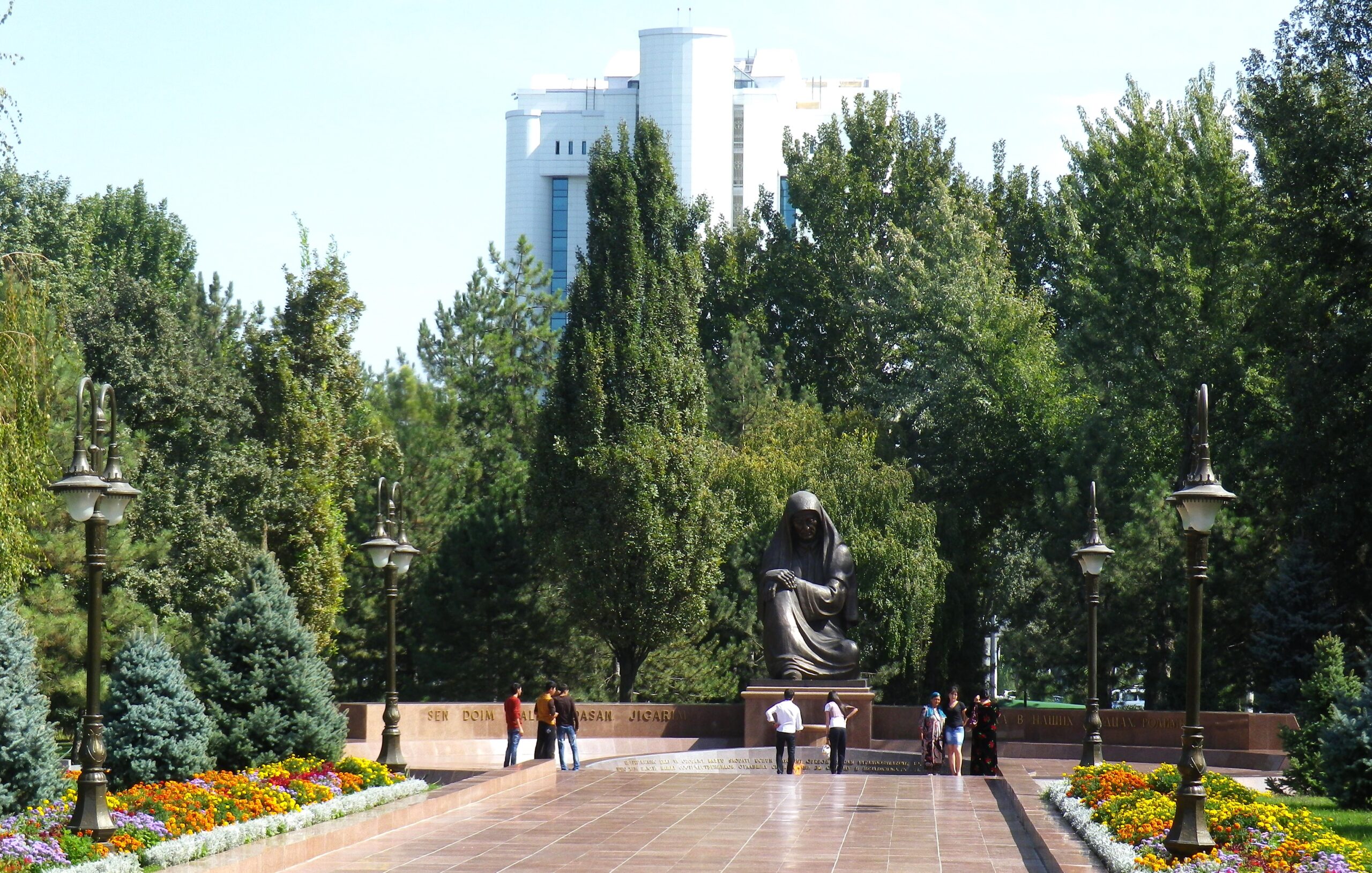
Eternal flame and Crying Mother Monument, Tashkent; image: TCA, Stephen M. Bland
Kyrgyzstan, home to just 1.5 million people at the time, sent over 363,000 to the front. Approximately 100,000 perished, and 73 received the Hero of the Soviet Union medal. Tajikistan mobilized more than 300,000 troops, with over 100,000 never returning. Fifty-five Tajiks received Hero of the Soviet Union honors. Turkmenistan, with a population of 1.3 million, sent around 200,000 soldiers and officers; 16 received Hero status.
Central Asian soldiers played vital roles in major battles, including the defense of Moscow. They helped liberate territories across the Soviet Union and Eastern Europe. The region also contributed 20-30% of its horse population, then a central component of local economies, for military use.
The war profoundly reshaped Central Asia. Thousands of Soviet enterprises were relocated to the region, fueling industrialization. Millions of refugees from Nazi-occupied zones found sanctuary in Central Asian republics. Many children were taken in by local families and raised as their own.
Today, many in Central Asia feel that outsiders fail to grasp the weight of Victory Day. While countries like the UK, U.S., Italy, and France recorded wartime deaths of 380,000, 417,000, 479,000, and 665,000 respectively, the USSR suffered over 26 million losses. German losses are estimated at 8.4 million.
Celebrating Amid Controversy
Recent years have brought a shift in how Victory Day is perceived in Central Asia. Symbols such as the Guards ribbon, criticized for echoing imperial Russian motifs, have sparked debate. Some argue that the holiday reflects colonial oppression, as the peoples of Soviet Asia were conscripted into a foreign war. These debates have grown louder since Russia annexed Crimea in 2014, with some now viewing the May 9 celebrations as a tool of Russian influence in the region. Nonetheless, Central Asian leaders have rejected efforts to “cancel” Victory Day, reaffirming its deep personal and national resonance.
Efforts to distinguish the celebration from Russian state narratives are evident. Many events now emphasize patriotism rather than Soviet nostalgia. On May 7, Kazakhstan held its first military parade in Astana in seven years, marking both Defender of the Fatherland Day and the 80th anniversary of Victory Day. In Almaty, a procession called Batyrlarğa Tağzym (“Let’s Bow to the Heroes”) will honor Kazakhstani front-line soldiers. This event mirrors Russia’s “Immortal Regiment” but is positioned within a distinct national context.
Veterans will be honored across the region through concerts, shows, community festivals, and financial support. Kazakhstan plans to name over 500 streets after World War II veterans, according to President Kassym-Jomart Tokayev.
Military parades took place on May 8 in Bishkek and Dushanbe. In Tashkent and other Uzbek cities, major festivities are planned. Uzbekistan is leading the region in veteran support, providing $10,000 to each of the 82 surviving war veterans, one of whom is 114 years old. Kazakhstan will grant $9,686.90 to its 111 veterans. Kyrgyzstan’s 32 remaining veterans will receive $1,140 each. In Tajikistan, 17 veterans will receive $4,810, with those in Dushanbe getting an additional $2,000 from the city administration.
In contrast, Russian veterans will receive less than $1,000 each.
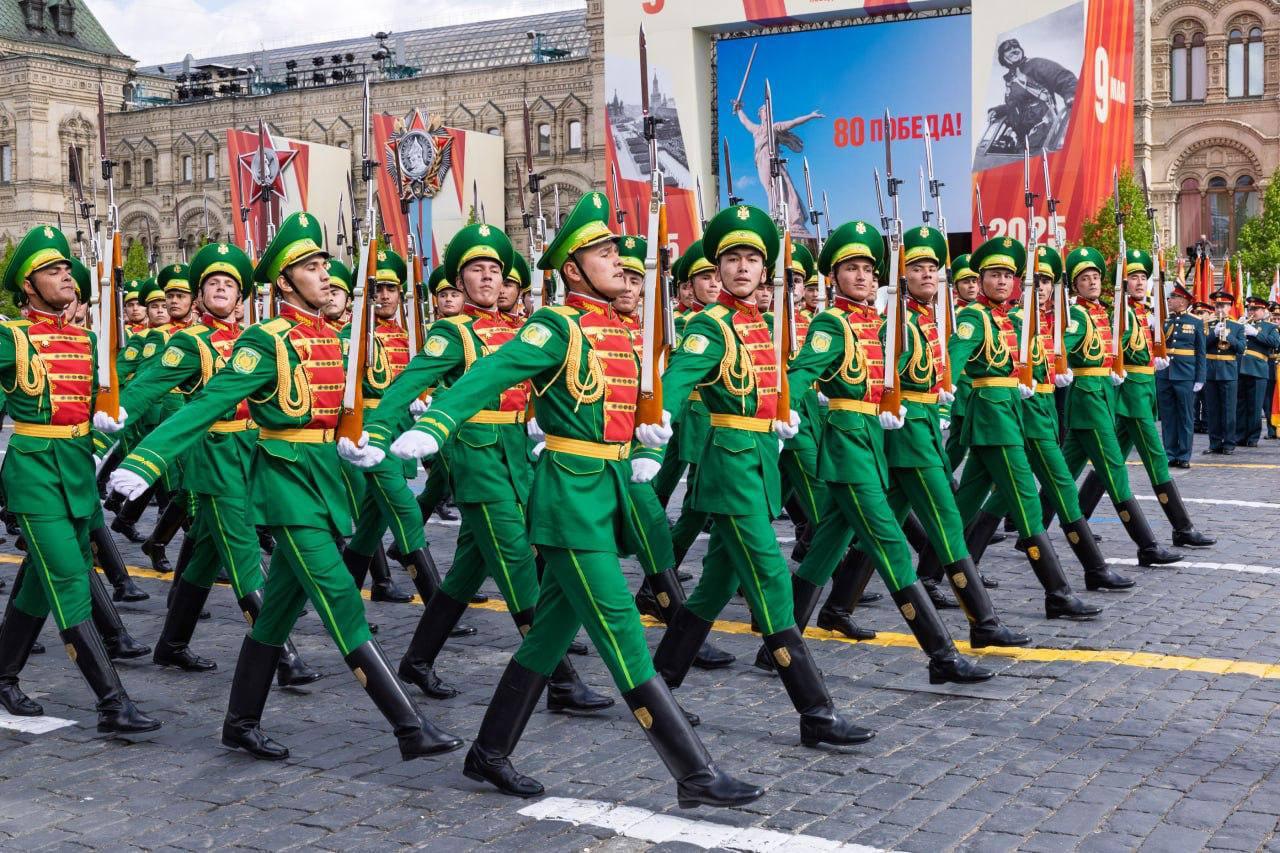
The Turkmen Rifles march in Red Square, Moscow; image: Telegram @ejpredbot
Against the backdrop of ongoing conflicts and shifting alliances, all five Central Asian leaders attended this year’s Victory Day parade on Moscow’s Red Square, which speaks volumes about the region’s delicate relationship with Russia. In Moscow, Vladimir Putin vowed that the Russian army would always stand up to “nazism,” a narrative previously used by Russia to justify its invasion of Ukraine. In one of a number of growing examples of Central Asia’s agency, however, Kazakhstan’s President Tokayev has voiced his support for Ukraine’s territorial integrity
Stockholm City Council rejects U.S. Embassy demands to end DEI programming [deltaMinutes] mins ago Now
India’s clash with Pakistan sees use of Chinese missiles, French jets, Israeli drones, and more [deltaMinutes] mins ago Now
Between 2021 and 2024, Kazakhstan planted a total of 1.15 billion tree saplings, according to the Ministry of Ecology and Natural Resources. The effort forms part of a sweeping national campaign aimed at reversing deforestation and mitigating climate impacts.
Initially, President Kassym-Jomart Tokayev had set a target of planting two billion trees by 2025. However, the government has now extended the deadline to the end of 2027 and re-approved its Comprehensive Plan for Reforestation and Afforestation.
As part of the initiative, one and two-year-old saplings of both deciduous and coniferous species are being planted across various ecosystems. Currently, 251 forest nurseries operate across the country on 3,178 hectares of land, producing more than 280 million saplings for future planting.
Urban greening is also a key focus. Under the presidential initiative to plant 15 million trees in cities and villages nationwide, 14.3 million have already been planted between 2021 and 2024. The plan calls for more than three million trees to be planted annually through 2025.
To support this effort, the government has approved detailed landscaping and green zone development plans for Kazakhstan’s regions, as well as for its three major cities, Astana, Almaty, and Shymkent.
Another priority is the afforestation of the dried bed of the Aral Sea, a critical environmental concern in Central Asia. Over the past three decades, trees and shrubs have been planted on more than 600,000 hectares of the former seabed, including 413,000 hectares over the last four years alone.
Collin Morikawa recently made a shocking change on the bag, but he is still near the top of the leaderboard after one round at the Truist Championship.