
“Signing that letter was a mistake,” the REI CEO said, adding that the administration’s actions were “at odds” with the company’s values.
Day: April 16, 2025

“When the winds of change blow, some build walls, others build windmills.” — Chinese proverb
Afghanistan remains one of the most complex and controversial spots on the map of Eurasia. After the Taliban came to power in 2021, it seemed the countries of Central Asia were faced with a choice: to distance themselves from the new regime or cautiously engage with it. However, it appears they have chosen a third path – pragmatic cooperation free from political intentions.
Today, a window of opportunity is opening for the Central Asian states to reconsider their relationship with Afghanistan, not as a buffer zone or a source of instability, but as a potential element of a new regional architecture.
At the same time, these countries are in no hurry to establish close political ties with Kabul. They avoid making declarations about “integrating” Afghanistan into Central Asia as a geopolitical region. Instead, the focus is on practical, rather than political or ideological, cooperation in areas such as transportation, trade, energy, food security, and humanitarian engagement.
This pragmatic approach is shaping a new style of regional diplomacy, which is restrained yet determined. Against this backdrop, two key questions emerge: What role can Afghanistan play in regional development scenarios, and what steps are needed to minimize risks and maximize mutual benefit?
Afghanistan After 2021: Between Stability and Dependency
Since the end of the war and the Taliban’s return to power, Afghanistan has experienced a degree of relative order. However, the country remains economically and institutionally dependent on external assistance. Historically, Afghanistan has survived through subsidies and involvement in external conflicts, from the “Great Game” to the fight against international terrorism. Today, new actors, such as China, Russia, India, Turkey, and the Arab states, are stepping onto the stage alongside Russia, the United States, and the broader West.
In the context of current geopolitical realities after the fall of its “democratic” regime, Afghanistan has found itself in a gap between the experiences of the past and a yet undetermined future. It has a unique opportunity to transcend its reputation as the “graveyard of empires” and determine its fate while simultaneously integrating into the international community. How the de facto authorities in Afghanistan handle this opportunity will not only shape the Afghan people’s and the region’s future but also influence the development of the entire global security paradigm.
In parallel, the countries of Central Asian are building bilateral relations with Kabul on strictly pragmatic terms: participation in infrastructure and energy projects, food supply, and humanitarian aid. All of these steps have been taken without political commitments and without recognizing the regime.
The border between Afghanistan and Tajikistan near Khorog, GBAO; image: TCA, Stephen M. Bland
Geo-Economics and Logistics: Afghanistan as a Strategic Hub
The regional reality in Central Asia is increasingly taking on a geo-economic dimension. The region is not only an arena for the interests of external powers but also a zone for developing transport, logistics, and energy networks in which Afghanistan is playing an increasingly prominent role.
Currently, four of the six corridors under the Central Asia Regional Economic Cooperation Program (CAREC) pass through Afghan territory, linking it with Tajikistan, Uzbekistan, and Turkmenistan.
Central Asian countries are paying special attention to infrastructure projects that, under favorable conditions, could reshape the region’s economic landscape. These include the Trans-Afghan railway, the Turkmenistan-Afghanistan-Pakistan-India (TAPI) gas pipeline, and the Central Asia-South Asia power project (CASA-1000).
What is particularly significant is that these projects are beginning to move beyond the conceptual stage.
Recently, the presidents of Kyrgyzstan and Tajikistan officially inaugurated the 500 kV Datka–Sughd transmission line, a key component of the CASA-1000 regional project. Over the next 15 years, both countries are expected to supply Afghanistan and Pakistan with 23 billion kWh of electricity through this line, marking a major step forward in regional energy cooperation.
The Trans-Afghan Corridor is also beginning to take shape. While its eastern route (via Kabul) faces engineering and financial challenges, the western path (Torgundi–Herat–Kandahar–Spin Boldak) is becoming more defined. The Afghan government recently signed five contracts with domestic companies to design a 737.5 km railway connecting Herat and Kandahar.
The “five-country corridor” initiative (China-Kyrgyzstan-Tajikistan-Afghanistan-Iran), which Tehran is trying to promote, also retains its potential. While it currently exists mostly on paper, the construction of a railway segment from Uzbekistan to Herat and its integration with the China–Kyrgyzstan–Uzbekistan (CKU) railway would give it practical value as part of a new Eurasian transport network.
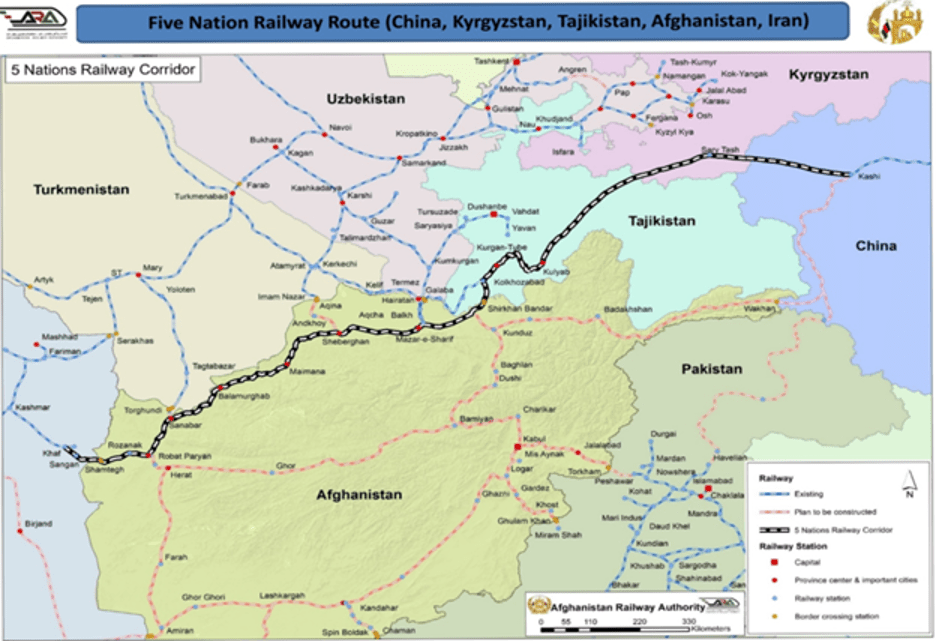
Image: Caspian Bulletin
The activity of neutral Turkmenistan in this area also deserves attention. Turkmenistan’s role in the “North-South” and “East-West” logistical intersections makes it one of the key operators in Eurasian traffic, including the Afghan direction. A connection is being formed through Iranian territory, with access to the ports of Bandar Abbas and Chabahar.
However, Ashgabat’s “flagship” project is the TAPI gas pipeline, designed to supply natural gas to countries with a total population of 1.75 billion. As President Berdimuhamedov stated, “Speaking about the TAPI gas pipeline project, I would like to emphasize its high social significance. According to experts, the construction of the pipeline and related infrastructure systems, new institutions, and enterprises will create 12,000 jobs in Afghanistan and solve several key humanitarian issues in the country.”
Alongside the implementation of the TAPI project, Turkmenistan is also building power transmission lines and an optical fiber communication system along the Turkmenistan-Afghanistan-Pakistan route. A 214-kilometer section of the pipeline has already been built in Turkmenistan. Last September, the construction of a 153-kilometer section from Serhetabad to Herat was launched. The construction is now ongoing in Afghanistan, where ten kilometers have already been built.
In addition to the countries of Central Asia, external actors are also showing interest in developing trans-Afghan routes. India, using the Iranian port of Chabahar, is seeking direct access to the markets of Afghanistan and Central Asia, bypassing Pakistan. This direction is seen by New Delhi as a strategic alternative to the China-Pakistan corridor.
Russia, in turn, links the development of Afghan logistics with the implementation of the International North-South Transport Corridor (INSTC), which connects Russia with Iran and then, via Chabahar, to South Asia. Integrating Afghan transit into this route can provide additional flexibility and a regional dimension to the INSTC.
All this opens up opportunities for transregional connections, where Afghanistan serves not as a point of fracture, but as a connecting link between South, Central, and Western Asia.
There is a political saying: “If you’re not at the Table, you’re on the Menu.” For Central Asia, participation in new corridors is not a choice but a matter of survival; either you are the route, or you are a transit territory without rights.
However, Afghanistan’s potential is not limited to transit. According to the U.S. Geological Survey (USGS), copper reserves at the Aynak deposit exceed 660 million tons of ore with a metal content of 1.67%, corresponding to about 11 million tons of copper. This makes it one of the largest undeveloped copper projects in the world. Iron ore reserves at Hajigak reach 2 billion tons with iron content up to 64%. Additionally, the USGS has recorded significant resources of lithium, beryllium, tantalum, and other rare earth elements, especially in the southwestern and northeastern provinces. According to their forecasts, Afghanistan could occupy a leading position in the world in terms of lithium potential.
However, despite the availability of these reserves, sectoral problems remain significant: lack of infrastructure, regulatory instability, absence of a transparent licensing distribution mechanism, and field commanders having control over mining operations. Due to these factors, the potential major industrial projects, Aynak and Hajigak, are essentially suspended. Despite this, an eventual wave of bidders is anticipated.
At the same time, smaller but more practically oriented projects are gaining momentum, including the construction of power grids and small hydropower plants, warehouses, and Afghan companies’ participation in agricultural programs. This is the level of cooperation where concrete solutions can be realized.
Thus, the development of Afghanistan’s infrastructure opens a window of opportunity. The country is transforming from a “buffer zone” into a geoeconomic link between Central, South, and Western Asia. At the same time, this is a space of high sensitivity: growing activity here requires coordination among the Central Asian countries to avoid duplication, enhance stability, and prevent rivalry.
Yes, Afghanistan remains a complex partner, but ignoring its geoeconomic link means losing a key element of the new Eurasian economic framework.
Of course, structural barriers remain, such as the Afghan-Pakistani conflict, lack of international recognition, and the sanctions regime. Nevertheless, the countries of Central Asia, with the support of their surrounding environment, continue to view Kabul as an important economic neighbor.
Security and Ideology: The Region’s Cautious Vigilance
Despite signs of stabilization within Afghanistan, the Central Asian states maintain a cautious stance on issues of security and ideological influence from the Taliban. Of particular concern are reports of the presence in Afghanistan of militants from transnational groups with a Central Asian orientation. Although the Taliban claims to have control over the situation, most regional experts acknowledge the long-term risks involved.
There is also some unease about the development of religious infrastructure, including a network of madrasas, including those known as “jihadist madrasas.” These institutions could potentially form an ideological base beyond Afghanistan’s borders.
Nevertheless, the Central Asian countries have avoided alarmism, focusing on dialogue and taking a realistic approach to the assessment of threats.
Afghanistan as Part of the Regional Consensus
At the first “Central Asia – European Union” summit held in Samarkand, Afghanistan did not occupy a central position on the agenda. Nevertheless, in some speeches, the importance of a stable and engaged Afghanistan was emphasized, not so much as an object of foreign policy, but as part of the broader regional space.
In the final declaration, leaders reaffirmed their commitment to seeing Afghanistan as a “safe, stable, and prosperous state with an inclusive governance system that respects the human rights and fundamental freedoms of all its citizens,” including women, girls, and ethnic and religious minorities.
It is clear that the “gender issue” was included in the declaration at the initiative of the European side since the Central Asian republics have never focused on this problem. As previously reported by TCA, the emphasis on the “gender issue” is not quite what the Central Asian countries expect in the context of the Afghan resolution. For them, it is much more important to address pressing issues such as security, economic cooperation, and migration control, which directly affect stability in the region. This is why Central Asian countries prefer to focus on practical steps and avoid unnecessary politicization of issues that might complicate dialogue with the Taliban and worsen the situation in neighboring Afghanistan.
In this regard, the position of the EU and Central Asian countries on women’s and girls’ rights, as reflected in the Samarkand declaration, should be seen as only “generally aligned.”
The declaration also established a mechanism for regular consultations on the Afghan agenda, stating: “We support the holding of regular consultations between the special representatives and envoys of Central Asian countries and the EU on issues related to Afghanistan.”
These consultations will help adapt regional policy to the new reality where this is no official recognition of the Taliban, but an understanding that, de facto, they are a key link in ensuring access to humanitarian aid and preventing cross-border threats.
Earlier at the Samarkand meetings, President Shavkat Mirziyoyev of Uzbekistan emphasized in an interview with Euronews that Afghanistan remains one of the priorities of the country’s foreign policy. According to him, the Uzbek approach has always been based on pragmatism and a focus on long-term goals, rather than ideological preferences. Mirziyoyev also noted that “many who disagreed with our policy on Afghanistan are now forced to acknowledge its correctness and inevitability,” referring, among other things, to international partners.
These statements reflect not only Uzbekistan’s position but also illustrate the overall shift in the perception of Afghanistan by the Central Asian states.
Kazakhstan has demonstrated the same approach. Since the Taliban came to power, President Kassym-Jomart Tokayev has consistently emphasized the need for a multilateral and balanced approach to the Afghan issue. His speeches focus on the integration of Afghanistan into regional and international processes. Kazakhstan supports the international community’s efforts, including under the UN’s auspices, to stabilize the situation, provide humanitarian aid, and launch infrastructure projects. Thus, Kazakhstan is developing a concept of “positive neutrality,” where Afghanistan is seen not as an isolated threat but as a potential partner and a key element of regional stability.
Against this backdrop, it becomes evident that a coordinated and pragmatic approach to the Afghan dossier has emerged in Central Asia. Even countries that previously held more rigid positions, in particular, Tajikistan, are now demonstrating increasing flexibility, both in official statements and in practical cooperation. The focus of the regional approach is gradually shifting from isolation and fears to economic ties, infrastructure, and a shared future that is in the interests of all the countries in the region.
Summary
Afghanistan has already become an integral factor in the stability and security of Central Asia. Pragmatic, cautious, and consistent interaction is the formula that the countries of the region are applying to their southern neighbor today.
A stable Afghanistan is not an end goal, but a condition for the long-term development and enhancement of Central Asia’s independent regional position in a changing world through the strengthening of ties and reduction of threats.
History has repeatedly tried to turn this region into a battleground for external interests, the so-called “Great Game.” However, at the current moment, Central Asia has the opportunity to not just react to the plans of outside powers but to implement its own. Afghanistan, no matter how complex and contradictory it may be, can become part of this shift, not as a threat but as an opportunity. It all depends on by who and how the future of the region is managed.
Thus, Central Asia is not a battleground; it is a crossroads, and crossroads have their own rules.
It seemed like a far-fetched idea for much of this NFL draft lead-up.
The court’s five judges agreed in the landmark ruling that “the terms ‘woman’ and ‘sex’” under the country’s 2010 Equality Act “refer to a biological woman and biological sex,” Justice Patrick Hodge said.
President Donald Trump is due to negotiate on trade and tariffs with Japan.
Manila uses “West Philippine Sea” for waters in its maritime zone, where China’s expanding presence challenges the U.S. ally.
Engaging in a long-term meditation practice could significantly alleviate stress and slow down aging, suggests a new study published in the journal Biomolecules.
WHO member countries agree on a draft ‘pandemic treaty’ to try to avoid COVID-19 mistakes [deltaMinutes] mins ago Now
Categories
39 Trump-Proof Universities

The president has frozen federal research funding for a host of American colleges and universities—even issuing specific demands of some top schools in exchange for federal dollars. These 39 institutions have the wherewithal to join Harvard in its resistance to Trump’s assault.

Congratulations, America! Your taxes are filed, or at least your extensions have been requested. But Americans filed taxes this week in the midst of an unprecedented upheaval of the nation’s fiscal system which was inaugurated a century ago. Headlines blare about President Donald Trump terminating or pushing out tens of thousands of IRS employees. Meanwhile the Department of Government Efficiency (DOGE) is attempting to scale back the Justice Department’s Tax Division. Plus, the White House has called for the U.S. to use tariffs to replace the income tax. Taken together, these recent actions are combining to push for dramatic reversal of the decades-long process that built the American fiscal state a century ago.
[time-brightcove not-tgx=”true”]
Tax laws and fiscal policies are the lifeblood of the modern state. They provide the federal government with the collective capacity to accomplish vital aims—from supporting retirees and subsidizing care for the disabled and the poor to protecting communities from crime and from foreign adversaries. Over a century ago, Americans advocated for an income tax to reallocate the financial burdens of funding a modern nation-state—one that would grow over time to provide badly needed public goods and services.
For much of the 19th century, the United States lacked the institutional capacity to mount ambitious federal programs. Regressive tariffs and excise taxes on alcohol and tobacco were the main sources of federal revenue. Those revenues supported limited federal spending—on average only about 3% of gross domestic product compared to 23% today—for a few grudging investments in infrastructure. So-called “internal improvements” were mostly the domain of state governments. And with the exception of the Civil War, the military was tiny by comparison to those of the European powers.
Read More: Paying Your Taxes Used to Be Patriotic
In those early years, the tariff was not intended to raise significant revenue. It was principally meant to protect the country’s “infant industries” from foreign competition. Success in that endeavor meant, by definition, that tariffs would generate little revenue. Goods kept out of the U.S. market never generated duty payments at U.S. ports.
Moreover, American protectionism soon began to diverge from its aims. Lawmakers increasingly used the protective tariff to pick winners in the marketplace, deciding which firms and which regions would benefit from duties placed on foreign rivals. The duty list became a tool for corruption and party self-dealing, a device for rewarding favorites and punishing enemies.
The protective tariff also facilitated corporate consolidations. Vast holding companies arose at the end of the 19th century, shielded from foreign competition and run by industrialists who boasted previously unknown riches. Because import duties raised the prices of everyday goods while protecting the industrialist class, ordinary Americans rightly came to associate the tariff with rising inequality and with the gross concentrations of wealth that typified the first Gilded Age—and now plague our own.
And so, a combination of agricultural interests, organized labor, and Progressive Era intellectuals demanded a new system of taxation to rein-in galloping inequality and support an expanded federal budget. Such pressure worked. Congress adopted its first peacetime income tax in 1894. When the U.S. Supreme Court struck it down a year later as unconstitutional, Americans responded by creating a social movement for what eventually, in 1913, became the 16th Amendment to the U.S. Constitution, authorizing Congress to lay and collect taxes on incomes. President Woodrow Wilson signed a new income tax into law later that same year, and the income tax has been with us ever since.
From the start, the income tax at the heart of the new modern fiscal state consisted of “progressive” or “graduated” rates. Tax rates at higher income levels were higher than tax rates at lower income levels. And thus, more affluent Americans paid not only proportionally more taxes, but progressively more than others of more modest means. By the mid-20th century, the income tax, along with a whole host of developments in law and in the economy, helped blunt the excessive 19th-century economic inequality.
But in the U.S., federal taxes were not intended to radically redistribute wealth from the rich to the poor. Rather, the aim of the new taxes was to eclipse the tariff and to establish a system of public financing adequate to meet the needs of a modern nation.
The new fiscal state sustained by the income tax created the financial foundation for twentieth-century American geopolitical power. U.S. fiscal capacity underwrote two successful world wars and a cold war nuclear arms race. It created the capacity for the host of public programs associated with the New Deal and Great Society. And it helped distribute more evenly the fruits of a post-World War II economic boom, reining-in the outsized wealth and influence of Roaring Twenties robber barons and contributing to the mid-century decades that witnessed the greatest equality of income and wealth in the past century of American capitalism.
Read More: The Tariff History Donald Trump Is Overlooking

Today, the achievements of the modern fiscal state hang in the balance. The tariff is back; the president says it is “the most wonderful word in the dictionary.” The Trump administration has levied a sweeping set of import duties against nearly all of our trading partners, including key allies in North America and Europe.
Rather than using the tariff to protect American industry, as it previously had done, Trump is now using it to launch an all-out war on the very state capacity that once made America great. Trump has called on lawmakers to extend and make permanent his 2017 tax cuts—a plan that could cost $4.5 trillion and balloon an already unsustainable level of public debt. Aides at Elon Musk’s DOGE have gutted the IRS in ways that insiders believe will cost around $500 billion dollars, or around 10% of the federal government’s annual tax revenue, and hopes to further access the sensitive personal information of American taxpayers. The rate of tax audits is expected to plummet. And Homeland Security head Kristi Noem plans to leverage IRS data to help ICE’s deportation efforts.
The modern fiscal state, with its taxation power, its legitimate coercive authority, and its sheer capacity, is arguably the only institution capable of countering the astonishing power of our billionaire robber baron oligarch class. It is no wonder, then, that the Trump White House has targeted its powers. Without it, we could return to a weaker, more unequal, and less democratic society.
Ajay K. Mehrotra is a professor of law & history at Northwestern University, a research professor at the American Bar Foundation, and author of Making the Modern American Fiscal State: Law, Politics, and the Rise of Progressive Taxation, 1877 – 1929.
John Fabian Witt is a professor of law & history at Yale. His next book, The Radical Fund: How a Band of Visionaries and a Million Dollars Upended America, will be published by Simon & Schuster in October.
Made by History takes readers beyond the headlines with articles written and edited by professional historians. Learn more about Made by History at TIME here. Opinions expressed do not necessarily reflect the views of TIME editors.